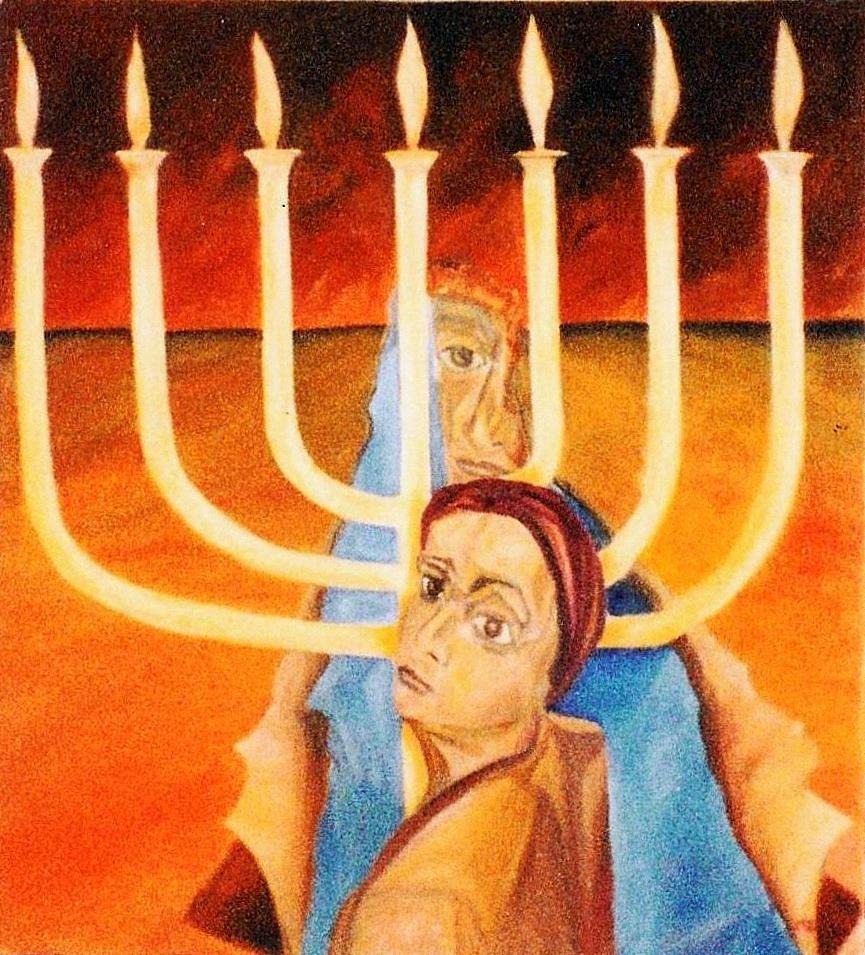
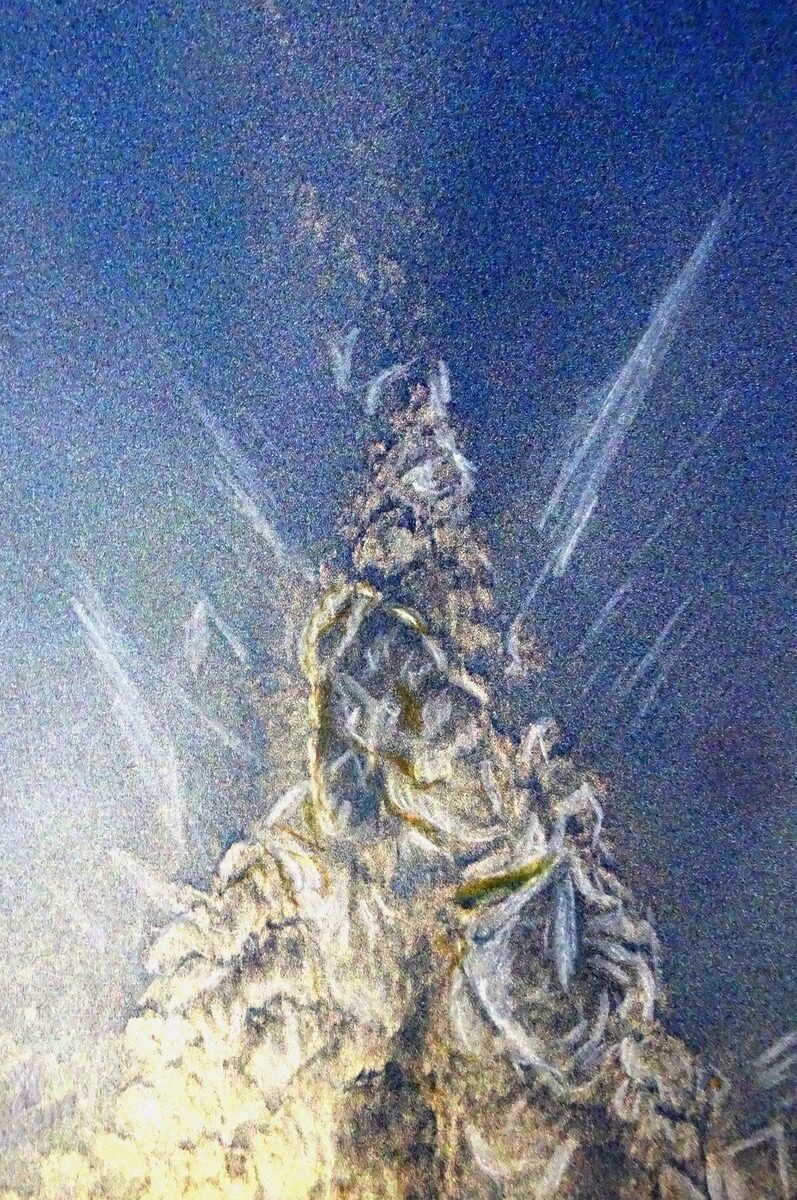
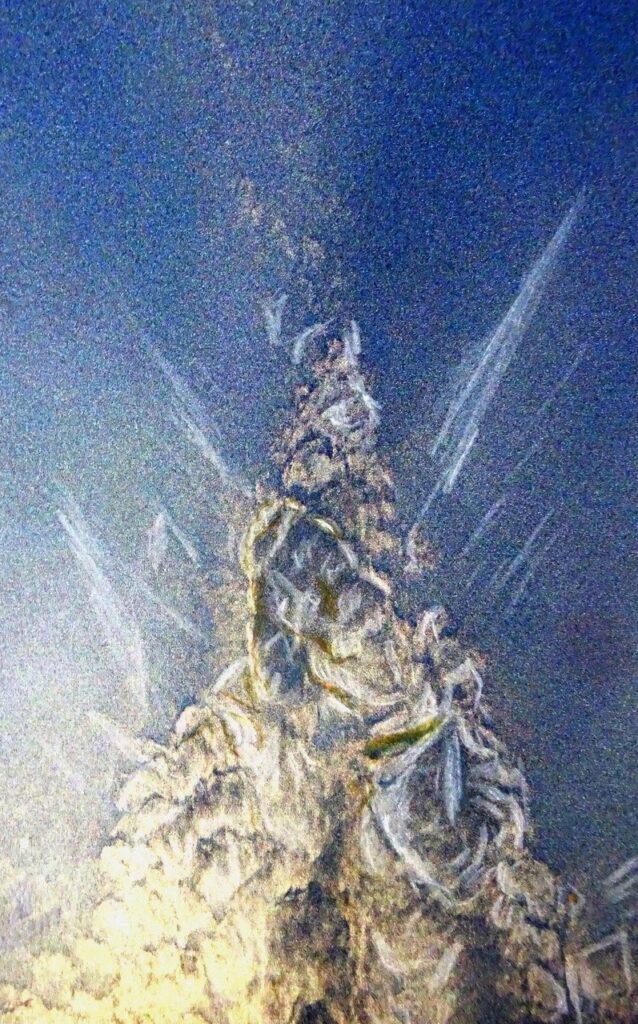
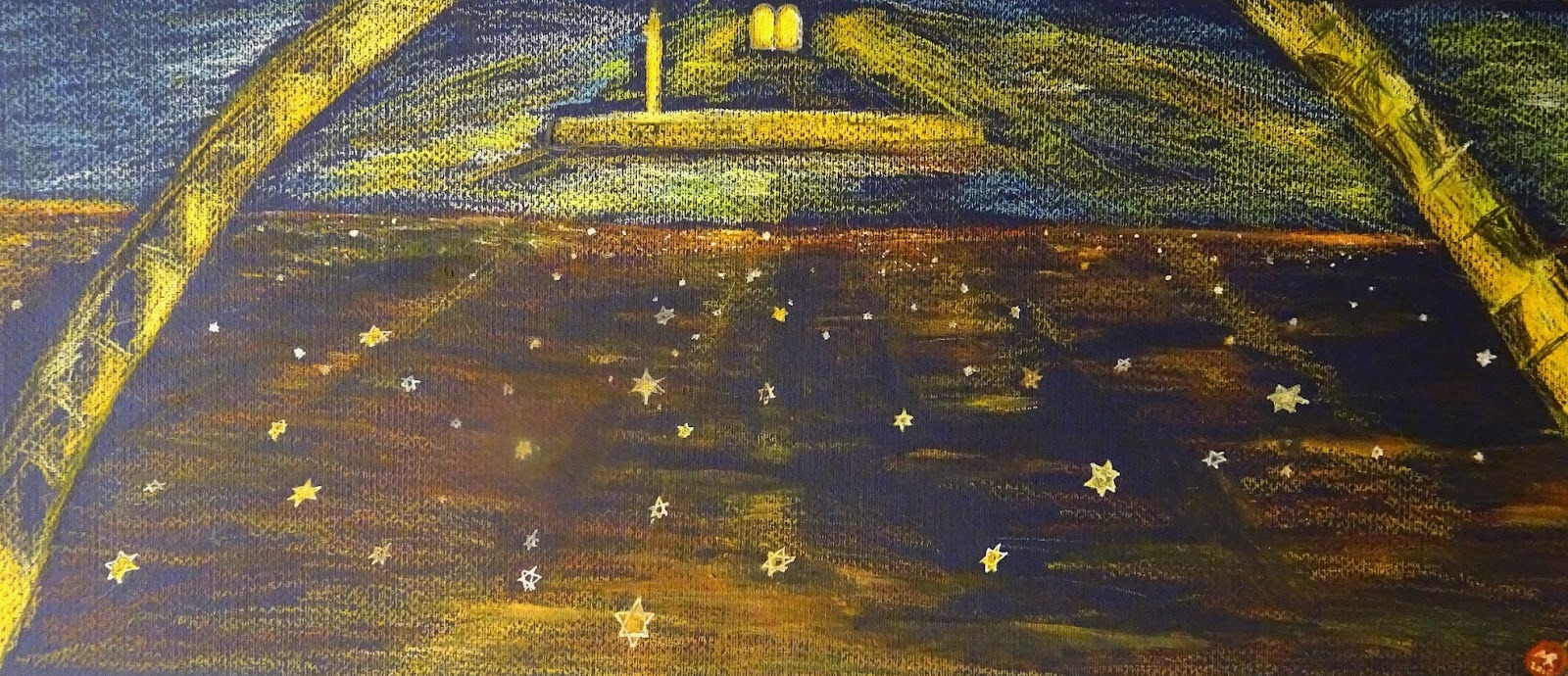
Michael Rogatchi (C). Spiral of Faith. Oil on canvas. 2005.
In those two parshot, Vayakel and Pekudei that customarily are read together, the content basically is the repetition of the previous two parshot, Terumah and Tetzavech, with their ordinances regarding the construction of Mishkan and its artifacts. As there is no occasional letter to be found in the Torah, the repetition of the ordinances means a lot. Those are the core things regarding the material parts and conditions of the G-dly Presence among the Jewish people, and those should be known and understood thoroughly, by the letter.
Importantly, the narrative of Vayakel starts immediately after Moses’ descent from the mountain. Date-wise, it was the morning of Yom Kippur. On that morning, the Creator speaks to Moses first of all about Shabbat and its absolute importance in Jewish life. Rashi made an elegant and important observation with this regard: it directly alludes to our knowledge and understanding – which are two different things, notably – about Yom Kippur as Shabbat of Shabbats.
At that moment, the Creator also powerfully reminded Moses to infuse into the consciousness of the Jewish people the concept of the Shabbat, again, to make sure that the understanding of it will be enrooted into the people’s minds deeply. Michael’s mighty and strong Menorah at his Spiral of Faith painting ( 2005), with strong and devoted Jewish couple amidst the conditions and circumstances which are harsh and dramatic, as it re-occurs in our history, is the strong, beautiful and compassionate statement of love towards the people who have lived and still are living with this kind of clear understanding and deep devotion in their lives.
Describing all the works to be done for Mishkan inside and outside, the Torah’s narrative emphases such term as ‘generosity of heart’, this is additionally to wisehood of the heart which we have analysed before. In Vayakel, generosity of heart is applied to both the masters chosen by the Creator to make the Mishkan and also to the people who were donated to the Mishkan, and they did it enthusiastically, being panicked or repentant, or both after the calamity over the golden calf.
Many Rabbinic commentators mentioned that to the repetition of the previously explained details of the Mishkan, the second round of it in Vayakel and Pekudei parshot means also the deeper message, namely, the Creator’s pardoning His people over the sin of the golden calf, after proper punishment of those who instigated it, hearing Moses’ plea on behalf of the people and seeing the repentance of many. The idea of concentrating the Children of Israel’s attention and focus on making the Mishkan, the place of dwelling of the Shekinah, namely after the episode with the golden calf, was a conscious effort to replace their concentration, thoughts and aspiration with the most positive thing possible. With constructing and completing the Mishkan, its very existence will guarantee and maintain a much higher level of morality among a much larger number of people, objectively so.
There is certainly not without a reason, an indicative phrase is to be found in Vayakel, mentioning that the construction of Mishkah was ‘more than a labour’. This is to tell that while donating to and building Mishkan, people were not just making some work mechanically, but that it was their conscious and important effort. And that effort was not built over a very special ground, over the repentance. It is quite an important moment with regard to people’s psychological motifs, mentioned in Vayakel parsha with full significance.
In both Vayakel and Pekudei, Bezala and Ohalioub re-appear, with even more text dedicated to them, their craft, and their effort. Talmud mentions that ‘Bezalel knew how to combine the ( sacred) letters, with which heaven and earth was created”. Such knowledge is given to a handful of people at any time, and this places Bezalel not only as a member of his most noble Jewish family, and not only as a superb master of artistry, but also as a man who was gifted to possess a prophetic level of knowledge.
With regard to Betzalel and his level of understanding and knowledge, Rashi highlights that while Moses did not quite see the order of works for the Mishkan and believed initially that its artifacts and furniture should be made first, before the actual construction, Betzalel had reasoned to Moses that normally, a house is built first, with furniture and everything that supposed to be inside it, after that. Betzalel was right, and Moses was grateful for his insight and understanding, writes Rashi. And it was at that moment when Moses said to Betzalel: “ You are in the shadow of G-d”. Since then, Bezalel’s name traditionally is translated like that, mentions Rashi and other sources. What an immense privilege it is, to be in such a shadow. Which also means a protection and ongoing wisdom which gets to the heart, and commands the life and deeds of such people like Betzalel and his family.
One of the most popular quotes from the Torah also has to do with Bezalel, and it is in the parsha Pekudei, which mentions that Betzalel had “infused with G-dly spirit”, and did his work for the Mishkan ‘with understanding, with knowledge, and with every craft”. Many of the commentators are united in their rendering of this important in Jewish philosophy concept, and approach in which all those qualities are seen as different things: inspiration, knowledge, understanding and mastercraft. With one of them present in a certain person, it is commendable already. With more, the person’s abilities are rising highly. With all of them presented in the same personality, we have such rare talent as Betzalel.
Another important and often overseen phenomenon regarding Mishkan is what has happened with its artifacts later on. Sforno comments on it in unusually for his style elaborated way, stating that contrary to the objects from the First and Second Temples, none of the artifacts from the Mishkan, those objects which were done under close supervision of Moses, have been ever mentioned as they were gone. Sforno explains further on, emphasising that at the construction of the Solomon’s Temple worked hundreds of thousands of foreign workers, thus people who were not genuinely infused with the special spirit and aspiration regarding the place of the resting of the Schehinah, while the construction of the Second Temple was subdued to the will of Cyrus, and not a single Levi had been present there. Due to these fundamental circumstances in the cases of both First and Second Temples, believes Sforno, the chances of the eventual loss of many artifacts of the Temples were existing from the way in which the Temples were built. Which was completely different in the case of the Mishkan, with none of its artifacts registered anywhere as being lost, or seized, or destroyed. The difference was in the principal attitude towards the building of the Jewish Temple, states Sforno.
Speaking of such a unique place as Mishhan, it is only natural to expect something super-natural there. And it was. When everything was ready for the Mishkan’s building, Moses and the rest of the Israelites were wondering: how on earth could we erect it? It was mission impossible for them, given the construction’s weight and measures. “How will I do it?” – asked a clearly nervous Moses the Creator. And gets the answer: “You should put your hands onto it. It will erect by itself”. And it was exactly what had happened. This unique event, when the presence of the High Power has instrumentalised the sincere, devoted effort by the people led by Moses, can be also seen as happening in the Shadow of G-d, borrowing Moses’s own phrase. Mishkan was everything about it.
Importantly, from the point of view of Moses’ understanding the life and absolute importance of Jewish tradition, the time of the Mishkan’s readiness and the gap between it and its final erection is also quite telling. It is known that although the Mishkan has been ready by 25th of Kislev, with its following seven erections and folding the whole construction back, Moses , under the guidance of the Creator, waited for the whole three months before Mishkan’s final erection and the start of its permanent functioning as the G-d’s Sanctionary. Why is that? The Mishkan was finally erected and became the place of the dwelling of the Schehinah on the 1st Nissan . First of all, the explanation goes for the timing of the beginning of the Jewish year at the time of Exodus and long time after that, as the Nissan is known as ‘the first month of the year’, and such timing is quite logical and positively symbolic.
But there is also another reason, as it is noted in the Midrash. Moses wanted to make the Mishkan permanently functional in the month in which our forefather Isaac was born. How gently, how lovingly, how meaningfully and humane. Moses knew that there were not many commemorative things regarding Isaac who, being shy in his character, and after the deepest but never complained about psychological trauma of the Akedah, was left somehow in the shadow of his father Abraham and his son Jacob. Moses did sympathise with Isaac a lot, did like him, understood him well, and wanted to make something seriously memorable on his behalf. What can be more serious than the place made by human hands for the dwelling of the Shehinah among the Jewish people? I absolutely understand why dear Rabbi Joseph Soloveitchik , one of the deepest humanists among our best brains and hearts, did love Moses so much and felt him so close.
We know from the parsha Pekudei that when the Mishkan was erected for the final time and became the nucleus of Jewish life, the glory of H-shem filled it. Our rabbis provide many of their thoughts to that pivotal moment in the Jewish spiritual history. Midrash Rabbah provides very interesting analyses with the Shehinah’s ascent from the level of people more and more far from them, up to the seventh Heaven corresponding to substantial moral losses, sins and wrong choices of the Israelites, and then subsequent descent from the seventh Heaven down, closer to us, in the merits of the specific deeds of the Forefathers and Moses. That process came to its rewarding balance with all the effort of so many people in building the Mishkan.
The most important note comes from Sforno who said that the Shehinah filled every part inside Mishkan, with nothing of it outside it. The firmity of the Shehinah in Mishkan was unique, said Sforno, with emphasising that nothing like that was not present either in the First or especially Second Temples, and not even in Shiloh.
Inna Rogatchi (C). Dominion of Light. Mixed technique. 2023. Rabbi Leo Dee and his family’s private collection. Israel.
The presence of the Shehina in the completed Mishkan has become the best reward, and the mightiest immense source for protection and hope for the Children of Israel for years to come.
This part of the Torah, parsha Ki Tisa, When You Take, contains so many crucial events and principal developments for Jewish nation and its destiny that it could well have be a book of its own with several expanded chapters on each of the episodes described there.
Ki Tisa starts with final instructions to Moses and Aaron rounding many detailed ordinances in the two previous parshas regarding the details of Jewish liturgy. Here, in Ki Tisa, a very indicative ordinance comes in the beginning, with the meaning which expands far beyond practicalities, the ordinance of a silver half-shekel as a means of counting adult men among the Children of Israel. There are many comments on all sides of this ordinance and its implications all over the rabbinic literature. I should emphasise two aspects: the choice and meaning of silver in Jewish tradition and understanding, and the principle of equality in human society which has been set up by this very ordinance to Jews at the time of Moses.
Rashi underlines that there is manifesting differentiation regarding the Creator’s instructions to Moses and Aaron on the people’s donations for the Mishkan. While regarding all donations in general, the principle is set for each person to donate according to their generosity and abilities, with regard to silver the principle is different. Silver shall be donated equally by everyone, the Creator instructed Moses and Aaron. Why is this?
Because silver is a special denomination in the Jewish tradition , symbolising purity and durability, decency and sustainability of all things good which are with us during all our lives, in generations, from the symbolically used spoons at the weddings of a large part of the Jewry, our kiddush cups of all sizes, our candle-sticks, and so many other subjects of our life which often are preserved and are travelling with us from generation to generation, bearing our memories in the calm, decent and comforting, assuring way, without an excessive glitz, but with that unmistaken inner beauty, calm elegance and decency of memory. I love silver, its combination of modesty and beauty, the best way of dignified, unvulgar living.
In Kabbalah, it is believed that silver brings the Divine light into this world, and our kiddush cups and menorahs are just one more evidence of this ongoing pattern. With a good reason, silver is associated with Chesed, kindness in Jewish tradition.
Analysing this special ordinance regarding donating of silver half-sheckel, Rashi also emphasised the telling line from the Torah text: “ the rich shall not give more and the poor shall not give less”. In this way of atoning the Jewish soul, which that silver half-shekel mandatory donation was about, the principle of equality of persons in the society has been introduced and laid down. And it had happened for the first time in the history of civilization there and then, at the time of the Creator instructing Moses and Aaron to organise the society of the Children of Israel in a certain way and introducing some fundamental principles to it.
In rounding the ordinances for the Mishkan and everything connected to the Jewish liturgy, the Creator in Ki Tisa emphasised to Moses and Aaron the role of Shabbat for the life of Jewish people in a strong and enduring way. The continuity of the tradition of keeping the Shabbat throughout the generations is the central point here. And the role of the Shabbat in the Jewish life is portrayed there very clearly and emphatically by the Creator, pronouncing it ‘a sign of a perpetual covenant’ between the Creator and Children of Israel for ever. Indeed, the rhythm of Jewish life has been organised with Shabbat as its starting and central point, ever since. And we are always grateful to the Creator for that incredible gift.
Mishkan itself and everything inside it was done by the talented artists and artisans who were personally chosen by the Creator for this unique mission, Betzalel, and Aholiau who was helping and assisting him.
The rabbinic authors has noticed an interesting detail: while Betzalel who was Moses and Aaron’s grand-nephew, Mirjam’s grandson, coming from the tribe of Judah, the most noble one from all the tribes, Aholiau came from the tribe of Dan, from the other end of the spectrum among the tribes. Such combination certainly not an occidental, it was done in order to bring the entire Jewish society, from one end of the Tribes to the another, to be united with the clear understanding of the purpose of their creative effort, to building the Mishkan, and further on, the Temple, as the centre of the Jewish spirit.
For his creative purposes, Betzalel was infused by the Creator with ‘wisdom, understanding, knowledge and all manners of workmanship’ as the Torah text states in Ki Tisa. Aholinai was helping and assisting Betzalel, and was personally responsible for carpenter works, weaving and embroidery which were all done at the level of an incredible beauty and clarity, with all corresponding meaning of every single detail. These are the pillars of Jewish religious art, and these pillars were established at the time of the creation of the Mishkan.
From that time on, the Jewish art – which is quite permissible, contrary to the misunderstood notions on the later stages of the life of the Jewish society and its practices – was thriving, being initiated and infused by the Creator’s spirit. Here again, the term of the wise heart, attributed in Ki Tisa to Betzalel and Aholiau, sets up the rest. When art is conceived and produced with heart, and when this heart is wise, adding the talent , the outcome is the unforgettable pearls of human life and experience.
Betzalel’s father Hur, a brave and devoted man, was very close to Moses and Aaron, his uncles. Together with Aaron, Hur was with Moses during the war with Amalek army, and it was him who, along with Aaron, supported Moses’ uplifted hands during the battle, thus ensuring the victory for the Children of Israel over the horde of bandits.
In a tragic turn of events, the brave and courageous Hur became the victim of his own ill-hearted people who revolted against the Creator in the utterly shameful episode with golden calf, which is narrated in Ki Tisa.
How could this happen? – reading the Torah annually, many of us still are puzzled by this crucial moment in the Jewish history. Trying to get to the core of it, from the point of view of psychology and human behaviour, one comes to several reasons which might let to that astonishing mass turn back in an aggressively regressive move of so many at the moment of their fascination of making an idol which, they believed in their inflamed mind, might rescue them from everything. Such a primitive way of thinking, and such a primitive objective which was – and still be – typical for a motto of an agitated crowd, not responsible individuals.
Was it recklessness? Undoubtedly, but it is rather the way of behaving. But the reason? Stupidity? Greed? Uncertainty or rather disbelief in the system of values and way of life which would be seriously or not drastically different from the life of the society in Egypt which the Jews and those who joined them, and there were many thousands, have left rather recently? Probably, all of it in a different proportion and combination of reasons that all were mixed into some essentially wrong mindset of those who started the idea of recklessly, speedily making the idol in a fervent – and very aggressive – rush, that led to the murder of brave Hur who tried to prevent the sacrilege. And one should not forget the factor of a large mixed multitude which left Egypt along with Israelites. The Ki Tisa text is very clear with regard to their leading role in the inflamed spectacle of the making of the golden calf.
Some of the rabbinic sources emphasised that during the painful episode of the making the golden calf, Aaron in his mild behaviour towards the demanding and aggressive crowd, initially was prepared to take a stand against them, but facing the brutal murder of his nephew Hur, was persuaded to try to buy time anticipating soon return of Moses. That irrational murder of one of the best of the Jewish people, one of its leaders, and his close relative did affect Aaron deeply.
The entire episode of the making golden calf in Moses’ absence is actually read as a tense thriller at its beginning and mid-part and as a deep ever-lasting drama in the end and post-finale: the plotting behind Moses and Aaron’s back and in the Moses’ absence, murdering brave Hur who was trying to prevent the sin physically, threatening Aaron with murdering him as well, Aaron’s efforts to delay unfolding sacrilege at every stage of it and by all means, heightened agitation of the crowd, their joy while celebrating the sin, which all had been punished severely not only there and then after Moses descended and broke the Tablets in the prevailing anger, but also with all consequential events, with burning the calf and making the sinners drink its bitter water, with clear polarisations of the society ( “ who is for H-shem, come to me!”), with severe on-spot punishment of the core sinners, and also with an echo of that volunteer and thus, unnecessary, sin-by-choice, throughout the Jewish history ever after.
The Talmud in its Sanhedrin 102a tractate mentions so justly: “ There is no misfortune that does not have in it something of the sin of the Golden Calf”. It is a very clear reference to the very character of that sin: it was the sin by choice, self-inflicted conscious choice prompted by the evil inclination and stupidity which prevailed at the moment. Importantly, it had its very long shadow over all our history.
Nothing is coincidental in the Torah and its narrative. The sin of making the golden calf happened on Tammuz 16th, with Moses descending with the Tablets and breaking it in a fierce, corresponding to the damage caused by the sin, anger , on Tammuz 17th – the bitter date in the Jewish calendar ever since, with many tragedies happened on the day throughout the time. And again, not coincidentally, in the case of the second tablets, this time carved by Moses, he descended with them in his hands for the second time and brought the moral code to the nation on Yom Kippur.
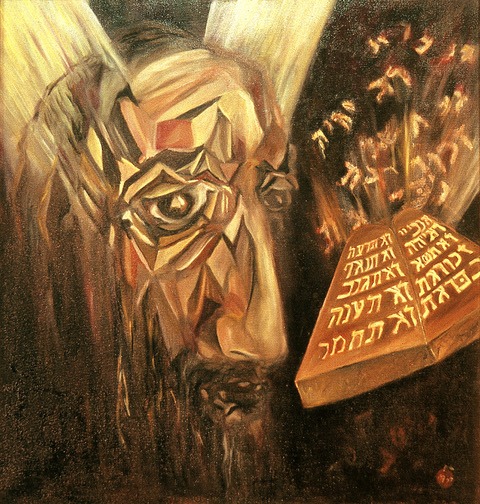
In Michael’s amazing portrait of Moses from his Forefathers series, the visual metaphor unites Moses’ first and second ascending and descending from his dialogue with the Creator, providing a philosophical observation of the leader of the Israelites at the pivotal moment in the history of the nation. Pivotal in the meaning of the morality, behaviour and choices that people make. Moses was a unique figure: humblest and most devoted Jew in our history, who was at the same time very modest and understanding person and uncompromising mighty leader. In Michael’s portrait of him, Moses is in deep thoughts with regard to the Israelites choice that led to him breaking the first Tablets. Michael here reflects the moment written in the Midrash telling that Moses was so angered when he saw the joyful dances around the Golden Calf that even before he has broken the first Tablets in a mighty anger, the letters which were engraved into the Tablets by the Creator himself, were flying off it, in fire.
This outstanding work was the beginning of Michael’s great Forefathers series featuring the main personalities of the Jewish spiritual history.
Michael Rogatchi (C). Moses. Forefathers. Oil on canvas. 64 x 60 cm. 1999.
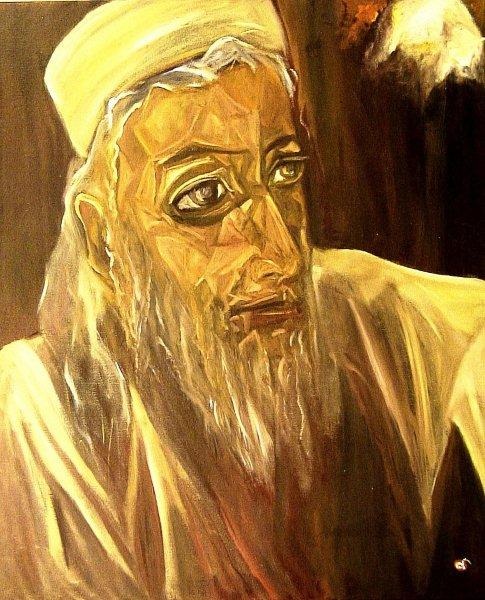
Ten years after creating the work which became the beginning of his Forefathers series, Michael painted an amazing portrait of Aaron, at the very same moment which he depicted in the Moses portrait. Here, Aaron is waiting for his brother to descend to the Israelites camp, himself being in an extraordinarily difficult and dangerous situation before, during and after making the golden calf. The composition of Aaron’s portrait and colouristic decision of the work are deliberately similar with the portrait of Moses created a decade before.
Michael said simply: “It was the moment of Aaron waiting for his brother to come back from the mountain”. Everything in this work is telling: the density of that prolonged moment of waiting for Moses to return, the sadness over the murder of Hur and the people railing off morality, the inner reflections of our first and best Cohen Gadol. But to me and to many of those who saw this rare portrait and admire it, it is the light. The light which is the decisive element of this reflective portrait of Aaron, which reflects also Aaron’s inner light as the main element of this great personality, and which sends the unmistaken message by the artist: it is about light, does not matter what.
Michael Rogatchi (C). Aaron. Forefathers. Oil on cavas. 76 x 74 cm. 2009.
In this crucial episode of making an idol, calf or anything else, one should not pass the role of Micah as it is observed by Rashi. When Aaron saw what was going on in the camp, with agitated men rushing to make an idol, whatever it might be, he did everything in his power to delay it, at every stage of the spectacle of the wrong choice. We are reading in the rabbinic literature that Aaron did hope that from the gold that was hastily collected and brought to be melted into an idol, something of an abstract form would appear, and this fact would make a newly made idol unappealing for people. He had no idea that anything of a form, not to speak of a form of a calf would emerge from the fire. How did it happen, and why was it calf?
With this second part of the question, it is clear – the expectations of those who were for the making a new idol, and among whom there was a very sizeable part of the mixed multitude from Egypt, were lining towards something familiar, which were calf-figures of the pedestals of many images of the deities all over Egypt, so it was a quick snap of lazy and average minds , for many of whom it was the natural environment and assuring choice.
But how to make it possible in the Israelite camp where the majority of people were not Egyptians? Rashi explains it in detail, remembering Micah, a complex and evil-inclined personality who was once saved, on Moses’ quite emotional sympathising request from the terrible punishment to be placed, as a child, alive into the bricked wall, as it was invented as a regular punishment by those ‘humanistic’ Egyptian overseers for the children of those Jewish slaves who would not make the prescribed portions of the impossibly demanding day-work.
When appealing to the Creator, yet while in Egypt, with an emotional request to save those children, Moses was told that while some of them would be saved, in principle, those who went through such procedure or who were destined to that, would not be left unscarred morally. Those people were inclined to be affected with evil inclination in any case, the Creator explained to Moses. As it happened, Micah was the one who was saved from this ordeal – and he always was ‘a bad apple in the tree’.
It is believed that at the time when Moses was trying to recover the Joseph’s remains from the Nile before the Exodus would start, and his attention was totally absorbed by this noble task in which he alone was interested, Mica who was nearby managed to steal a sacred piece with the name of the Creator written on it, with which help Moses managed to get the lead box with Joseph’s remains to resurface from the Nile. Moses oversaw Micah’s deceit. He was busy with far more important task.
In a while, Micah got his chance to use the stolen piece with the sacred name on it. Rashi describes, with many sources supporting it, that at the moment when the hastingly collected gold was thrown into the fire, Micah saw his chance to become a joker among the misled Israelites and the mixed multitude. It is believed that he threw the piece with the sacred name into the fire, and as a result of it, a comfortably familiar figure of a calf appeared.
There are a couple of things to be noted with regard to this ultimate moment in Jewish history: the golden calf was made a day before Moses’ expected return, and this is important as it indicates the mental preparedness, if not eagerness of too many people in the crowd to do impossible, to create an idol. Moses’ absence provided a good pretext for making these inclinations to be materialised, but it certainly was not the reason for it.
Secondly, Moses knew what was going on on his way down from the top of the mountain, with the Tablets in his hands. He knew that his people made a colossal mistake and many of them were badly misled. It happened. But when he saw and realised the joy of so many, with those dances and screams of agitation by the reason utterly wrong, then his anger flared, and in that overwhelming anger, he broke the Tablets. I was often pondering: how did Moses dare to break the Tablets with our principal and eternal moral code which had been engraved by the Creator himself? How a human being dared to break such ultimately sacred objects? But thinking deeper on this incredible act by Moses in the light of the considerations mentioned above, it does make sense, also quite a dramatic one.
It was also a pivotal moment in Jewish history because the Creator was really very close to punishing these stiff-neck people and to retracting from them for good. And here, an amazing personal quality of Moses in his ultimately persistent effort to keep the Creator as the Keeper of the Children of Israel has played a key-role as for the moment, as for the entire Jewish history to unfold.
What is incredible as it comes from the parsha Ki Tisa and many commentaries to it, is how everything is inter-connected in life, and one of the most powerful examples of this interconnection comes from the Ki Tisa directly.
With Moses after him saving the Creator’s protection for entire nation called to ascend the mountain for the second time and to chisel and engrave the second Tablets, this time by himself, in his incredible dialogue with the Highest Power that was so protective of him, he developed a very special kind of communication with the Creator, which went on as a conversation goes between friends, with ‘no riddles’ used, as noted by the great Sforno. In this dialogue, the Creator has noticed that Moses might have a limited capacity for hope, after all the calamities and recent disappointments.
In an amazing dialogue, the Creator, according to Rashi, explains to Moses that ‘while pleading with Me, your reasoning goes by referring to the merits of the Forefathers, Abraham, Isaac and Jacob. But when this ends, your belief in hope also ends with it. Which is wrong. Hope cannot be limited. I will teach you the procedure of requesting Mercy”.
This procedure is the prayer. The Prayer. At that moment and at that time of our history, the Creator has taught Moses the order of the Jewish prayer which invokes the Thirteen Attributes of Mercy. Thus, after the most dramatic moment in the Jewish history at the time, the Creator has given us the way of calling to him. He said to Moses: “You should teach the Israelites to do so. They will be answered”. And we know that they were and still are. I do not know a more precious gift in life than the way to appeal to the Creator – and to be heard.
And I do not know a more winning and comforting stance in life than to believe and know that hope cannot be limited, and to live accordingly. It did save a multitude of people under very different circumstances in their lives. And it came as a central disposition and actually as a way of life from that dialogue on the top of the mountain between the Creator and Moses after the drama of the golden calf and the broken first Tablets, described in the parsha Ki Tisa.
I was always paying attention how much the domain of mercy – and Mercy in the biblical and spiritual dimension – meant for Leonard Cohen, our dear friend and mentor, the man the connection with whom I do feel as existing and alive daily, despite the fact that at the time of me writing this essay, there is almost a decade passed since his passing.
“Do not turn on the light, you can read the address by the moon’ – just one line from his so human and so elegant poetry, this one is from the great Sisters of Mercy song. It is not without a reason that Leonard entitled his book of poetry Book of Mercy. It is always next to me at my night table.
The domain of Mercy was the orbit within which Leonard lived and created, and he had seen the world from that perspective.
His inner Mercy which was palpable in everything he created and did, was also very important for another our great contemporary, late Rabbi Lord Jonathan Sacks who absolutely loved Leonard Cohen, his songs and poetry, and very often was driving while listening to Cohen’s songs for hours long. We were discussing it with Rabbi Jonathan often, and our mutual deep attachment to the space of Mercy created by Leonard Cohen was one of the precious gifts that we were sharing, along with our families from both sides, very happily.
In this context, a special work of Michael which he has created on my authored original print, was about the return of Moses from his second ascent to the mountain, his return, with his face radiating, and with the second set of the Tablets which was wider than the Ten Commandments which were engraved on the first Tablets, as we know.
Interestingly, the Creator himself did show to Moses the stones from which he should chisel the Tablets, with a note: “And what is left, it shall be yours”. According to Rashi and other commentators, the stones were sapphires. Thus, with ‘what what was left’ that the Creator entitled Moses to, has enriched Moses very much, as those bits which were left after Moses has chiseled the second Tables, were many pure sapphires.
In his Moses Hour ( 2017) work , Michael has created it special sapphire-colour as the background of appearance of Moses after his second forty days and nights on the top of the mountain and that incredible dialogue with the Creator, as between two friends, with Moses’ face radiating and him keeping the second Tablets close to his chest.
Significantly, in contrast with the moment of giving Moses the first Tablets, which was accompanied by loud sounds and manifestation of elements, and thus has invoked a cast of an evil eye on it, as Rashi and other commentators mentioned, the second Tablets were brought by Moses to the Israelites camp quietly – and safely. “Nobody should be with you” – Creator has instructed Moses before his descense. “There is nothing better than modesty” – concludes brilliant Rashi. How absolutely correct, for that moment and any other.
When Michael and I happily gifted this fine work to Rabbi Jonatahn and Lady Elaine in London , their reaction was engaging and gracious. We both would never forget their smiles, the instant light in Rabbi Jonathan’s eyes, and his words: “This is a very gentle Moses, Michael, in one of those rare moments in his life when he was experiencing a pure joy, with shining hope risen after that unique encounter with H-shem. Thank you very much. We will be very happy to have this very fine work at our home” , – said Rabbi Jonathan, looking at the work with this unforgettable grace. We spoke about this work with Rabbi Jonathan and Lady Elaine for a long time, going together in many details of it. Since that memorable encounter, of many, the work has been the part of the Lord Rabbi and Lady Sacks family collection, and in our opinion, there cannot be a better place for this sapphire portrait of shining Moses.
Michael and Inna Rogatchi (C). Moses Hour. Indian ink, oil pastel, Luminance Caran d’Ache on original authored print on hand-made cotton paper. 40 x 30 cm. 2017. Lord Rabbi Jonathan Sacks and Lady Elaine private collection. London, the UK.
Parsha Tetzavech, translated as Command, at the first glance provides instructions on the ritual: the dresses of the Cohen Gadol, the order of the ritual objects in the Holy of Holies, and the way of sacrifice. But, as always, as it is in the Torah, there are a lot of metaphors, a lot of important symbolism which reaches far further than a ritual, however important it is. There are deeper and higher meanings which are essential for the understanding of Judaism, and this is the beauty of that High Knowledge which has been convened by the Torah to everyone who is interested to learn.
In the beginning of the parsha Tetzavech, the Creator teaches Moses on the special kind of olive oil which is prescribed to be used in the Mishan , and consequently, in the Temple, for lighting the Menorah. According to Rashi, that oil was so special, in comparison with known at the time three ways of producing olive oil, so absolutely clean it was required to be, that it was regarded as a special donation to provide it.
That the highly refined oil for lightening Menorah in the Mishkan, at the most important of our religious services, has to be an olive oil, has also an important connection with Eretz Israel, where olive is the most natural and also the most special tree. The tree symbolises a high-degree of endurance, and just incredible sustainability, the same incredible as longevity. The tree, which provides shade in the places bordering desert, which also provides fruit ( botanically) which in its turn, provides food and and oil. The oil which is used for food, as for lightening. An universe of its own, that of our olive tree.
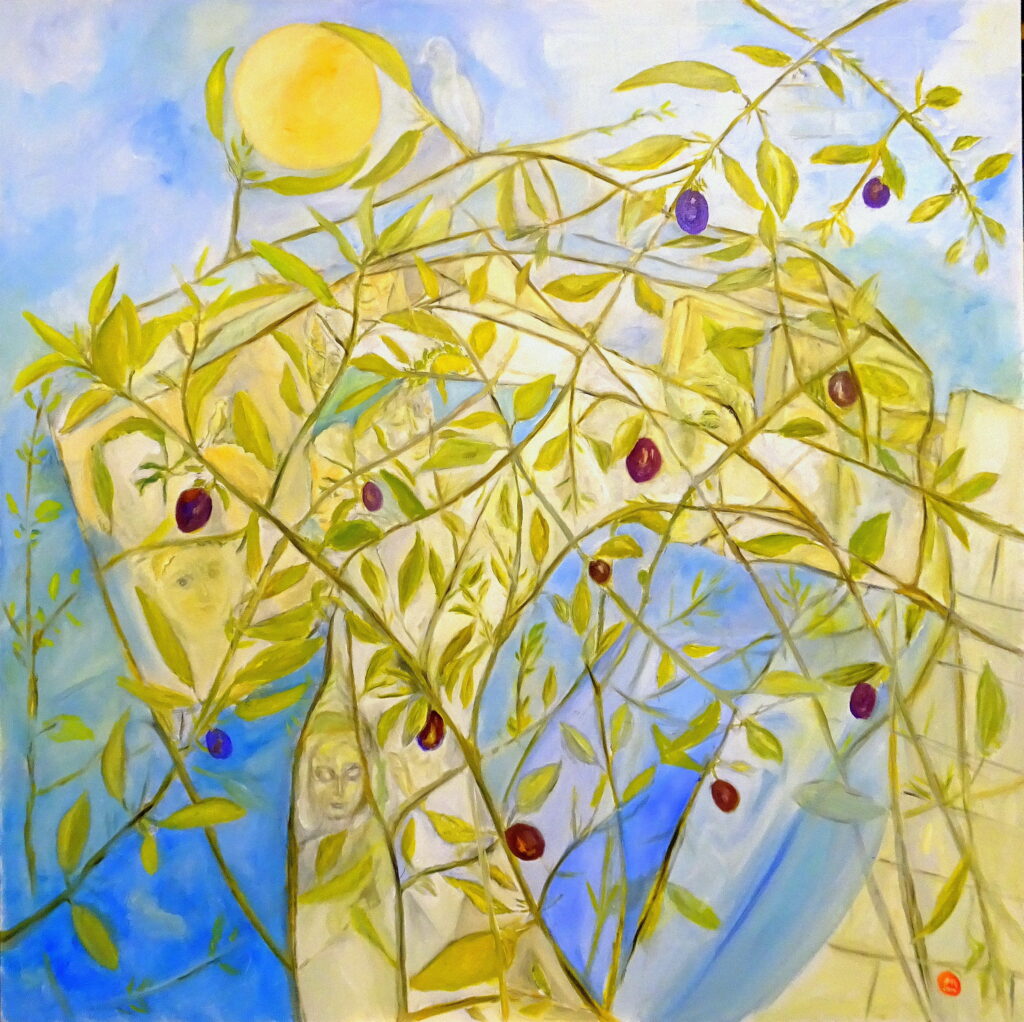
Michael Rogatchi (C). Under the Skies of Jerusalem. Oil on canvas. 2016.
In his well-known and special portrait of Israel, Under the Skies of Jerusalem (2016), Michael managed to portray that unique Jerusalem air, its skies with its special atmosphere as if you are witnessing a parallel, additional dialogue and feeling a presence , if not an entire special dimension there. He also brought there an olive tree in a symbolic way, with twelve olives referring to the twelve Tribes, with a fine bird – Elijahu? – resting on its greenery, as well as an alluded gentle lamb, figured in the way of the Chet letter of Hebrew alphabet , with all its beautiful and assuring symbolism of life and divine presence and protection. This painting is a love-song to Eretz Israel, its people and Jerusalem, in generations, calm, gentle , beautiful and protected, always and ever.
In my turn, I do love Israeli olive trees, and have created some special images with their presence there, as if transporting the remembrance of them with me back to Europe, as it is done in this special art collage The Olive Skies of a Synagogue, and the Synagogue is a symbol of an European synagogues, many of them have been destroyed or dysfunctional after WWII. In the collage, the authentic drawing of the Synagogue in Helsinki by the famed Finnish architect Johan Jacob Achrenberg done in 1905 was used.
Inna Rogatchi (C). The Olive Skies Over a Synagogue. 2020.
Giving Moses command of lighting Menorah in the Mishkan, the Creator underlines a principally important thing: the continuation of that light. He commands, via Moses, to the Children of Israel in generations to come ‘to light the lamp continually”. This is one of the most important metaphors of Jewish life and existence ever. And this command goes far beyond the actions of the religious service. It is the core principle of life. And it is up to us to understand it – and to live accordingly to it.
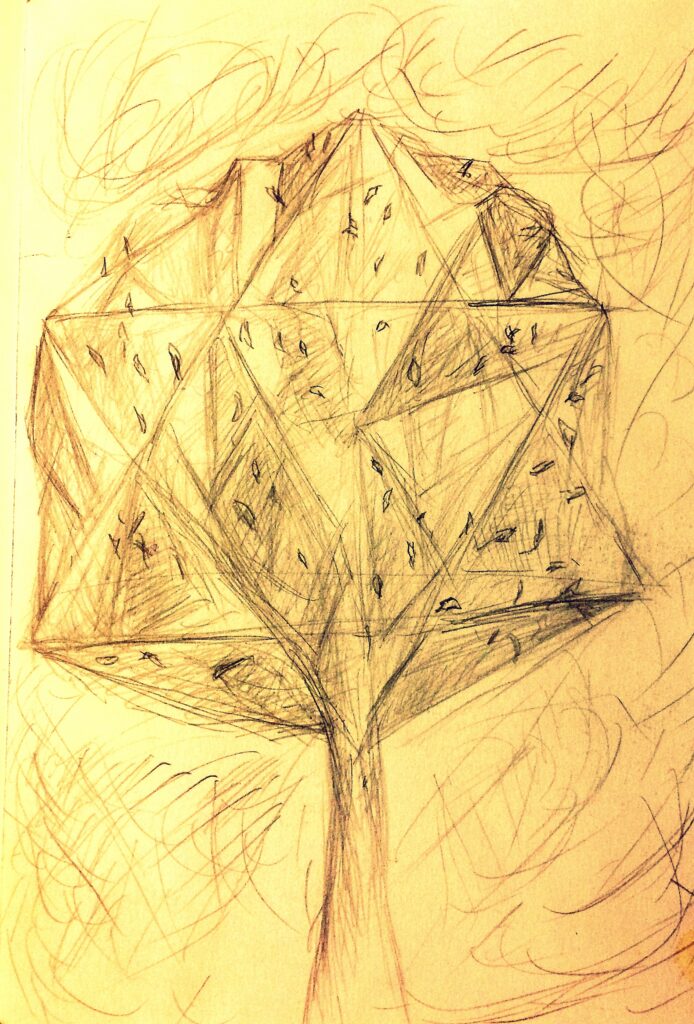
In his other work, rather poetic The Tree of Israel drawing ( 2017), Michael also depicted the symbolic tree with Mogen David inside it, as an olive tree with olives all around it, in a symbolic expression of what the Tree of Israel it is about.
Michael Rogatchi (C). The Tree of Israel. 2017.
In the parsha Tetzaveh, the Creator also instructed Moses about preparing the vestments for the cohens to conduct religious services in the Mishkan, which was the beginning of Jewish liturgy tradition, ‘to make it with a wise heart’. This term, the wise heart, is to be found throughout the Torah several times, for different functions and at the different times, but always with the same underlining, meaning good, able, responsible people who know what they are doing and who are doing it not for money or in exchange of any favours, but because the wisdom of their hearts prompts them to do it.
Wisdom of the heart is quite-essentially Jewish concept which we were lucky to receive from the Creator directly as an incredible gift, and which was spread in the civil human practice throughout the millenia as the history of civic society was unfolding.
In this concept, intellectual power is combined with morality, thus making an overwhelmingly winning combination which has allowed us to live, survive, overcome, prevail with understanding of what we are doing, why and what for.
For me personally, the concept of the wise heart is the key to the entire Torah and also to the way of Jewish life. It is my favourite concept from the Torah in its entirety, and I still remember the moment when I first read it there, decades ago, with an unmistaken ‘eureka!’ effect which has settled many questions in my head. And heart, too.
Indeed, it is also about settling the print of human behaviour in the most natural way. Both wisdom without heart and heart without wisdom do happen in life regularly, casually and probably far too often. Wisdom without heart brings to mind some big scientific names who were human failures. Heart without wisdom is probably a better option, but many purposes were not achieved because of the lack of intellectual skills in this case.
But a wise heart is winning composure of abilities and intentions, and that’s why the Torah is mentioning it to us repeatedly in many parshas, including the Tetzavech.
Another hidden lesson in the otherwise pretty plainly instructive narrative of the parsha Tetzavech has to do with the explanation regarding the order of playing precious and semi-precious stones in Ephod, the High Priest’s breastplate, about which the Creator instructed Moses as well. As it is known, the breastplate had to bear 12 precious and semi-precious stones, corresponding to the Twelve Tribes of Israel. Each of the stones was engraved with the names of the Tribes leaders. But in which order the stones had to be placed? Many of us could think of a conventional order corresponding to the order of birth of Jacob’s son – and would be mistaken.
Rashi saw something unusual in the order of the Ephod stones’ placing and explained it. As it happened, the stones with the engraved into them names of the Tribes, were placed according to their birth by Jacob’s wives and concubines, not in order of their actual time of birth: first were placed the stones corresponding to all sons of Leah, all six of them, from Reuven to Zebulun, then by both Bilhah and Zilpah, maidservants of Rachel and Leah, and then the two sons by Rachel, Joseph and Benjamin. This is an unusual and unexpected approach, but when you think about it, it teaches us about the natural and respectful order of family relations, and it is a universal value.
As Rashi has noted, the names of the Tribes were engraved inside the stones – “for the Creator to see them for ever”. And He does.
One more interesting episode to observe in the parsha Tetzavech concerns a very strict command of the Creator to Moses and Aaron regarding the precise part of the animal for sacrifice. Why should it be, namely the right shoulder?
The answer is found in Sforno’s impeccable commentary: the right shoulder of an animal for sacrifice corresponds in allusion to the right hand of a man in principle, and in this case, to the right man who performs the sacrifice in the Mishkan and future Temple, Kohen Gadol. Simple, as only the most important things can be.
Parsha Tetzavech speaks about the most sacred and secretive thing and place in the Jewish ritual, the Urim and the Thummim, and the Holy of Holies.
The Urim and the Thummim, the written unpronounceable name of the Creator, was understood to be written on the two parts consisting the one whole, which was inside the Kohen Gadol’s Chosen, the most sacred place in his vestments, located at the closest distance from his heart, tellingly. This sacred mystery was still largely intact during all millennia that went on from the moment narrated in the parsha Tetzavech, despite the fact that not only some of the inquiring rabbinic authorities , but also a notable number of historians and even archeologists were looking into that magnetic mystery.
There are at least three different opinions on the text which was possibly written on the Urim and Thummim, including the most widely accepted Tetragrammaton, but also there are suggestions about possibly written there the 42- and 72-letter Names of the Creator.
The power of this most sacred physical manifestation of the Creator in human practice is what it is and it has been never disputed or doubted, justly so. The role of the Urim and Thummim as the bearer of that power is unprecedented because that not entirely comprehensible power in this case does have its physical form. In this context and reality, Rashi’s consideration regarding the Urim and Thummim sounds as timely, as if he wrote it today.
In his commentary to the Tetzavech, Rashi mentioned in detail that according to his understanding, it has been established that the Urim and the Thummim were in place at the Kohen Gadol’s Choshen during the time of the First Temple. Then, after the Babylonian exile, partial return, and further on, during the period of the Second Temple, when the Holy of Holies was effectively empty, without the Ark and anything else from the essential ritual objects that were there both at the time of the Mishkan and during the First Temple period, the Urim and the Thummim were there, in their place inside the Chosen in the Kohen Gadol’s vestments. But – there is a crucial detail. Rashi underlines that without the physical presence of the Urim and Thummim inside the Chosen, the Temple service would not be possible. It simply would not be happening.
But: Rashi believed firmly that with the small tablets of the Urim and Thummim present inside the Kohen Gadol’s Choshen during the Second Temple period, the very text, the letters which were impersonating that supreme power, were not there any longer. Rashi came to this conclusion analysing the state of moral, behaviour of people and relationships inside the society during the highly charged, unhappy and volatile period of the Second Temple that eventually led to its tragic end.
And then, writes Rashi, it was discovered at the later stage that the two parts bearing the Urim and the Thummim had gone as well, physically too.
Parsha Tetzavech in its commands regarding the details of the religious services conducted by the Kohen Gadol also brings its reader to the central and most sacred place in everything connected to the Jewish liturgy and everything related to it, and also to the place which symbolises the physical presence of the Creator on the earth, the Holy of Holies. As it is believed, the physical place of the Holy of Holies is in the close proximity of the Foundation Stone which is on the Temple Mount. Given the fact that the Dom of the Rock has been imposed onto that sacred Jewish place, it is not easily accessible, to put it mildly.
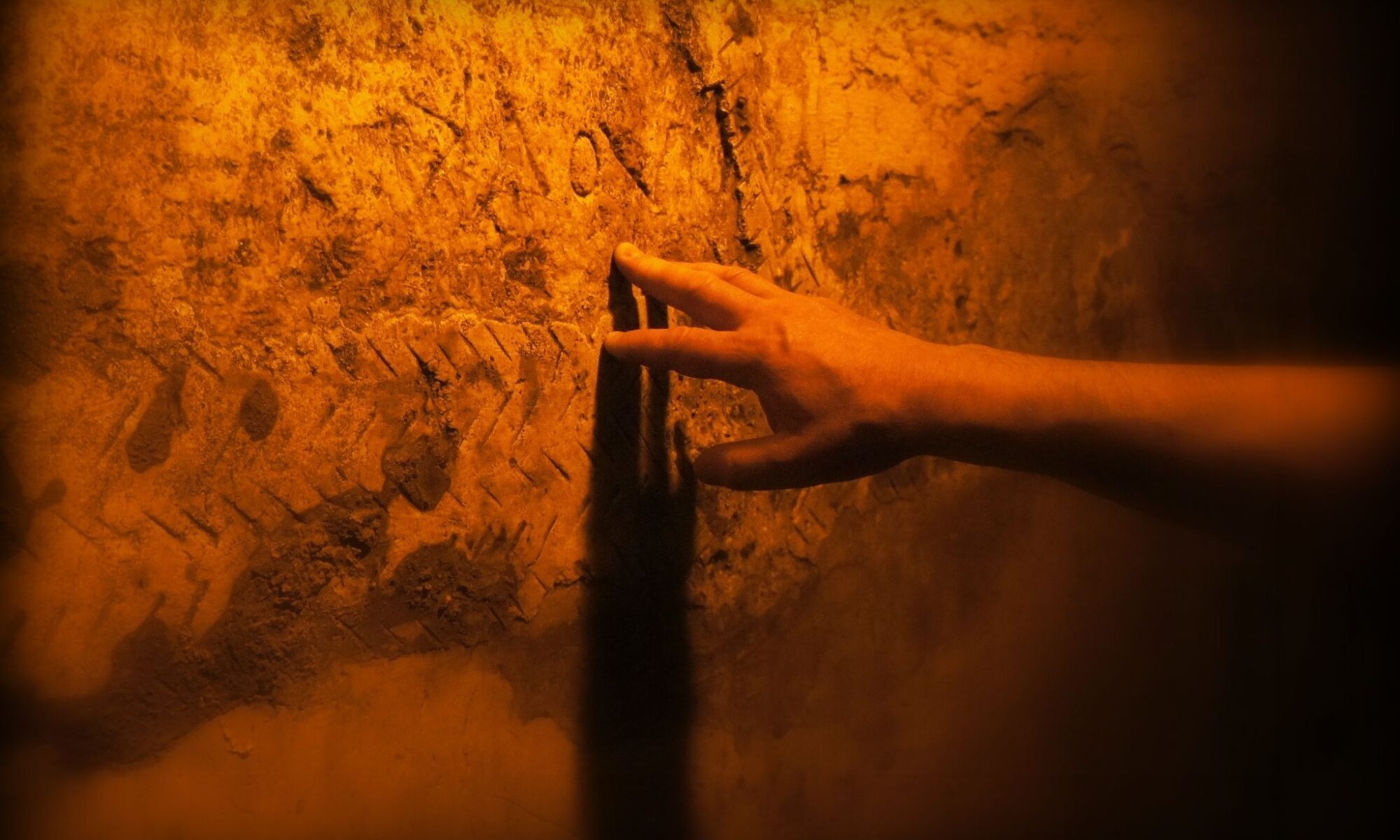
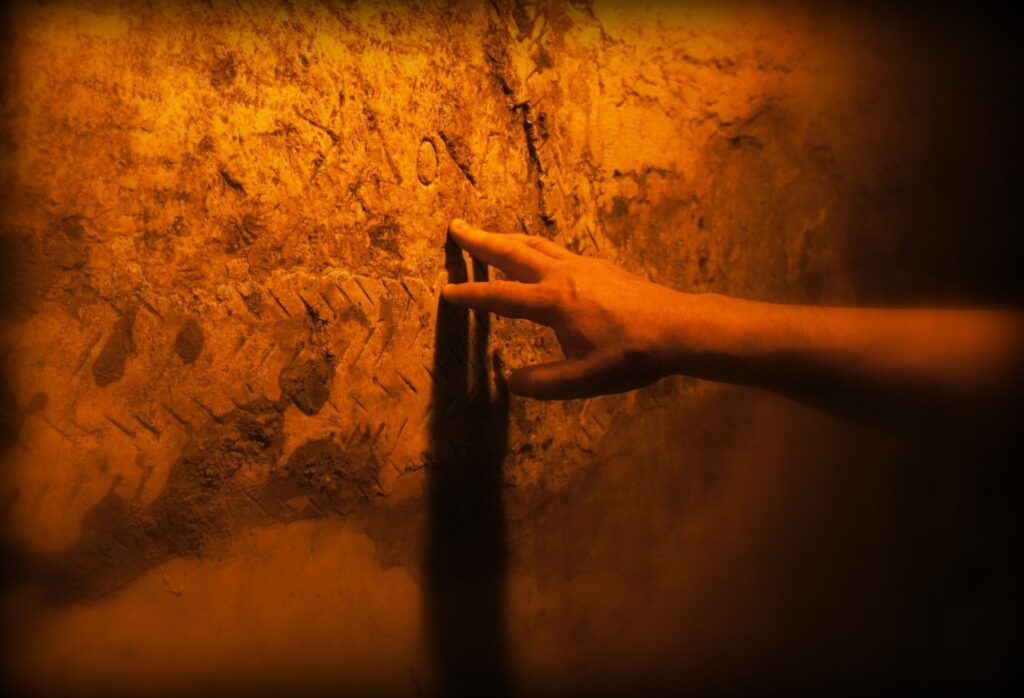
But there is a possibility to visit a certain place in the under-Kotel tunnels, from where there is the closest distance in a direct reach towards the Temple’s Holy of Holies. Next to the wall at the place, there is a small synagogue where there are some people at any time of day or night. We were extremely privileged with my husband to be able to visit the place and to spend some time there. It is one of the most remarkable experiences in my life.
I still see the wall of that particular place in the Kotel tunnel as I am there now. Its magnetism imprints into your conscience and subconsciousness in no time. You feel the weight of that special Presence and you feel the other dimension. You also feel the light there, the inner light, not of an entertaining nature, but of something ever present and every will be present, the High Power which has blessed the human world in this very place in Jerusalem. It is hardly describable and ever memorable. And there is also something highly magnetic there.
To think that you have been just less than 50 metres from the Holy of Holies of our Temple has left the feeling of ever-present huge amazement for us. And huge gratitude, too.
Those walls saw so much during the last over two and half millennia, and that energy is preserved in these incredible stones. You have a very strong impression that history speaks with you personally, in real time. The time gets volume, and you begin to reckon what it means: the sixth dimension, the one of the time.
The work Time Thread e from my special series picturing the Kotel tunnels visualises these feelings to some extent.
Inna Rogatchi (C). Time Thread. The Kotel Tunnel. 2015.
It is an incredible privilege to have physical places staying for millennia that connect your system of values with its historical background, and that infuses you with the special feeling of belonging.
In parsha Terumah ( Offering ) , the Torah narrates several important things from the aspects of philosophical rendition of life, the arts, and the symbolism of the Jewish religious practice which is still in use during this day, being un-interrupted for over three thousand years.
With regard to art, creativity and Judaica symbolism, the Creator’s dictum to Moses was of the character of direct instructions, to the degree, according to Rashi, of showing to Moses the image of menorah made of fire in the sky when he seemed to be in difficulty to comprehend how exactly it should look like.
But with regard to the Sanctuary itself, it was the introduction of a very concept of it for human society, and this is fundamentally important. The making Mishkan itself, to have it in a re-assembling mode, to make it transportable – those all were practical guidelines of the high order, which all stays fresh as it has been invented today.
But yet more importantly, the Torah in this parsha tells us about the concept of a sanctuary which is one of the central points in the human way of life, both individually and socially. In Jewish religious practice, it has all the clear ordinances which are narrated in Terumah. Additionally to that, it expands in its conceptual meaning to every individual and every society.
With regard to Jews and our religious practice, the Mishkan which has become the centre of the religious service, and was with the Children of Israel from the moment described in the prasha through all the way to the Holy Land, was an equivalent to the universe. In this way, the understanding of the symbolism of the religious practice becomes natural for people, and the intelligence of such model does tell about the intellectual qualities of our people which we were so lucky to receive as a superb gift from our Creator.
In the Midrash Rabbah, there could be found the comparison between the way of the building Mishkan with the process of the Six Days of Creation, quite convincing one. The conclusion which can be made from that comparative analysis comes to the understanding that the Mishkan, the centre-piece, the very place of Jewish religious service, is as eternal as everything that has been created during the Six Days of Creation. And it definitely emphasises the role of that place in the life of Jews, even not observing ones.
We know that Shiloh has become an absolutely important place because the Mishkan was staying there, erected and serving for about 370 years after the Children of Israel entered the Holy Land. We know that the significance of that place is still regarded as very high by many, including historians and archeologists who did a superb job during many years in very productive excavations in Shiloh, with their work and mission continuing. Some of my close friends are members of the team, and we are getting updates from the incredible historical place for our people regularly. Nothing more proves the living connection from the past to the present better that a resulting archeology, but in this case, the archeology mission in Shiloh is filled with admiration to the Jewish history from one side, and with an incredible enforcing the spirit of those people who are seeing the world through the lens of faith. It really is material proof of the existence and presence of the high spirit, and to know it in principle, and especially first-hand, is truly incredible life experience. And it is more: it is life-assurance of the highest probe. There is not without reason that one of the meanings of the word Terumah, additionally to ‘an offering’ is ‘uplifting’.
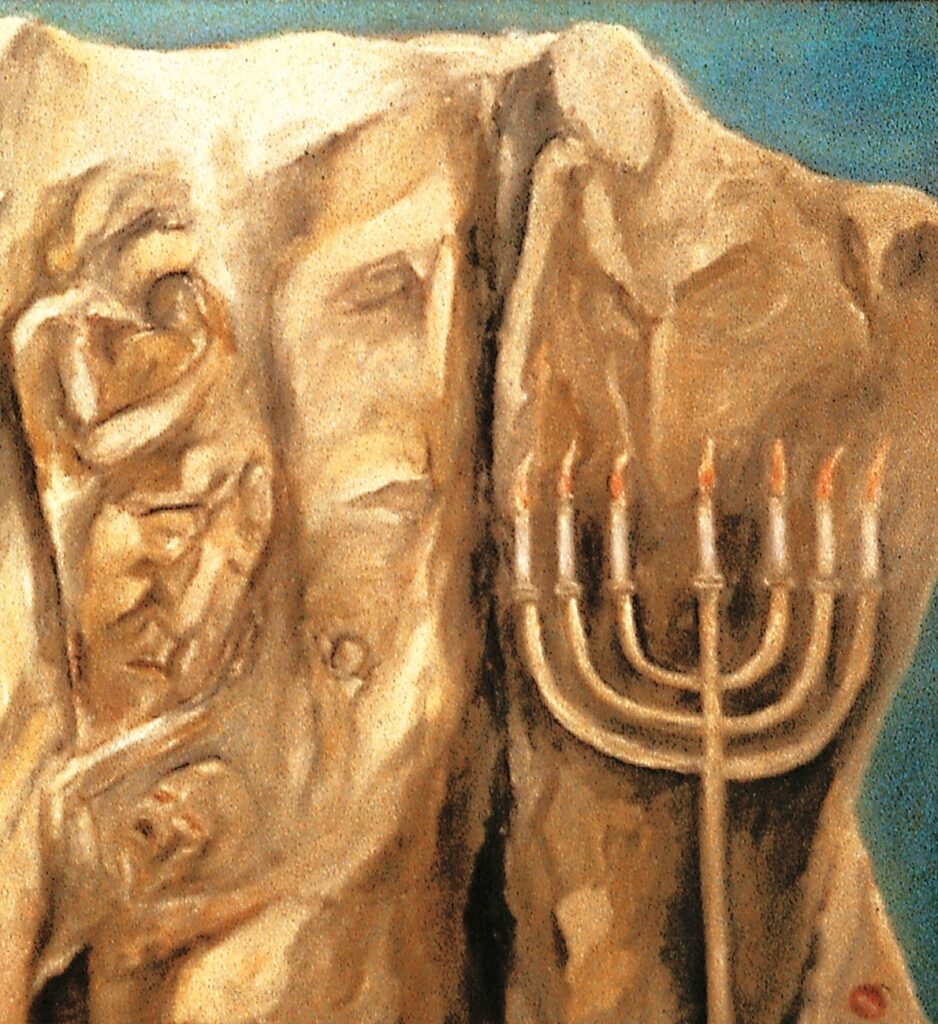
In his oeuvre, Michael created menorah in several of his works, every time within a different context. In his unique Kotel work ( 1999) depicting the Jewish history through the images he saw in his artistic imagination as if appearing in the stones of the Kotel, the menorah there with its beautiful flames is the constant , in the contrast with dynamic in their suffering figures from various periods of the Jewish history, imprinted in the Kotel’s stones. The Kotel menorah in Michael’s painting shines steadily, it is re-assuring, comforting Jewish souls, and it is beautiful. It is the sign and message from the Creator.
Michael Rogatchi (C). Kotel. Fragment. Oil on canvas. 1999.
Along with the instructions for constructing a transportable model of the Mishkan, parsha Terumah introduces and establishes such highly important aspects as art used in the religious services. It can be done without it, strictly and devotedly, but the Torah emphatically says ‘made with artistry’ with regard to the parochet , the curtain in the front of the ark, as well as with regard to the ark itself, its cherubims, the curved tablets inside the arch,, and more than ten tapestries. Thus, the foundation of the religious art has been made, and it is stated in the parsha Terumah.
In the same motion, the central subjects of religious rituals have been brought to the Jewish nation, including the ark, the tablets, the parochet, the menorah, thus establishing the foundation of the Jewish symbolism which is the beautiful part of our heritage.
With the ritual symbolic subjects, the materials and colours – such as gold, silver , copper and shittim wood, gemstones and the other precisely specified materials, of several fundamentally important colours, such as blue, red and purple – have been importantly specified, and not just like a dictum, but with a deep and important meaning. There are more than one explanations of the meaning of the materials to be used for the key religious subjects in the Mishkan, complementing each other. In the most known of such explanations, Rabbi Schmuel ( in the narrative of the Midrash HaGadol) compares gold with sun, silver with moon and copper with the western horizon at the moment of sunset, and explains that blue colour reflects sky, purple – clouds and red – rainbow. The Kabbalah states that the gold is associated with the essence of the soul, and thus is very clear why the Creator instructed Moses not only to produce the Menorah from the pure gold, but also not to make it in parts to assemble it later, but to make it from a whole large piece of gold. One should not diminish the meaning of the essence of the soul, but instead, it should absolutely be made in a wholesome way, having in mind also a metaphorical meaning of it.
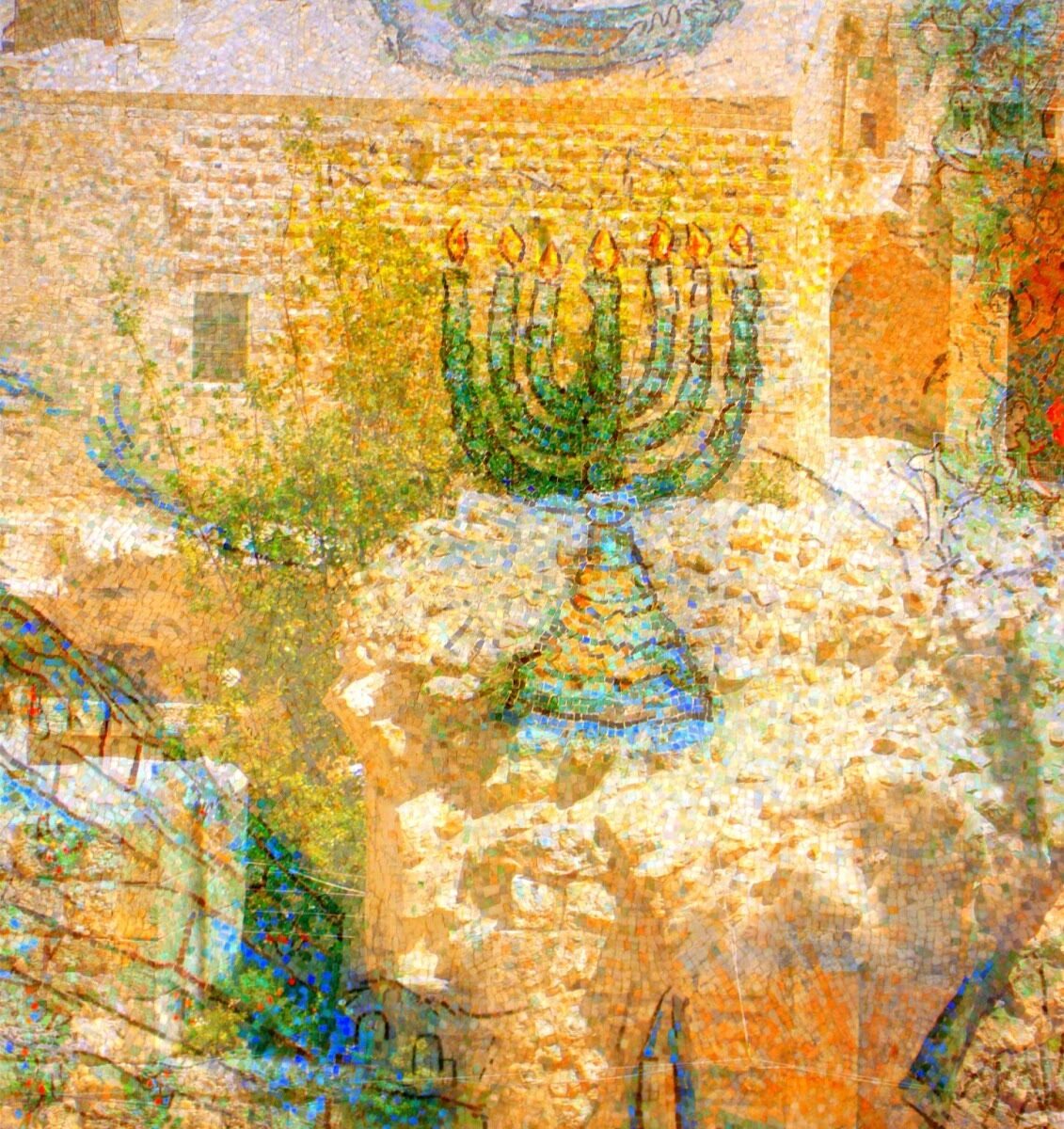
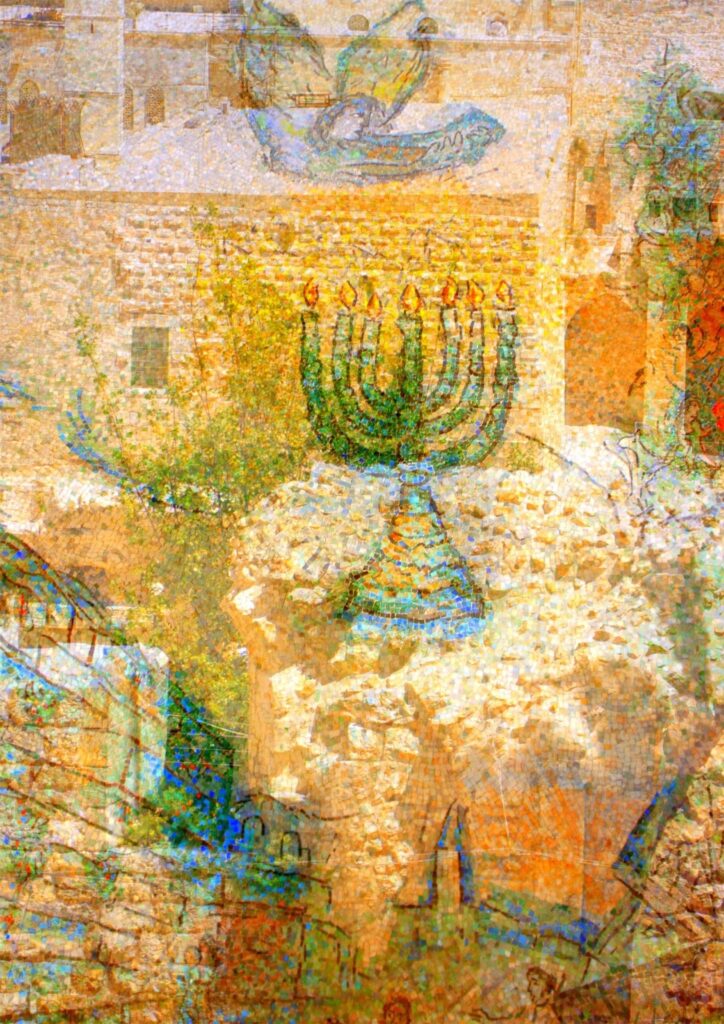
In my special homage to Jerusalem and Marc Chagall and his vision of our Jewish symbolism, I have produced the artistic collage named Flying Over Jerusalem. Homage to Marc Chagall. There, the Chagall’s menorah, which I photographed specifically also in Jerusalem, is the centre of his and our universe, consisting of Jerusalem’s streets and buildings, both random and iconic ones. The different versions of work are at the Permanent Art Collections of the Municipality of Jerusalem and of the Parliament of Austria.
Inna Rogatchi (C). Flying Over Jerusalem. Homage to Marc Chagall. 2018. Permanent Art Collection. The Municipality of Jerusalem.
In everything from what the Creator has instructed Moses to be made by the Jewish people for the Mishkan, the place of the Creator’s Sanctuary on the earth, among his chosen people, from the walls to the smallest details on the construction, and from the tablets with the Ten Commandments on them to the faces of the cherubim, and not only making the menorah but even its placing in the only right way, there was the meaning and the cause. The cause and the meaning. The necessity and symbolism. The necessity was a prerequisite to follow the Creator. The symbolism was the bridge between the Highest Knowledge and the knowledge and the way of understanding at the level of a human intelligence. And then, in that all, there was elegance and beauty. In the materials, in the shapes, in the lines, in the colours. The beauty of the Jewish art which has been established and sprang off the Mishkan artistry, is in confident visual statement and in laconic but powerful colouristic message. It is all rooted in the Creator’s dictum narrated in the parsha Terumah and it has been evolved to the heights of Jewish artistic talent and fantasy through thousands years of keeping the Jewish tradition and heritage. It does not mean that the Jewish artistic vision stood still, quite to the contrary. But it means that the beginning of this mighty and beautiful cultural phenomenon originated from the moment of Moses receiving incredibly precise instruction on everything, including the materials, shapes and colours, with emphasis on making it ‘with artistry’ from the Creator himself. There is a unique phenomenon in the cultural and civic history of the world.
Parsha Mishpatim is one of the most central ones in the Torah as it sets many rules for Jewish people, including legal, moral and behavioral ones. 53 of 613 mitzvot are narrated in this parsha alone. Such a substantial influx of moral and legal teaching is transferred to Jewish people in a certain moment, the moment of giving them the Torah and its laws, the blue-print for life for the observant Jews.
There are two ways of perception of knowledge and ordinances it contains: one’s own level and preparedness to get it, or the trust and belief at the level which will accommodate this incoming knowledge and its ordinance, allowing a person to accommodate it, to get the deeper understanding of it gradually.
Moses belonged to the first category, he was spiritually ready to perceive the Torah and its ordinances. Many other people who left Egypt under his leadership, needed more time not just to accept it, but to understand it, to rationalise it. It is only natural and does correspond both to the psychological dimension of human life and behaviour.
In this parsha, the Creator also promises to bring the Children of Israel to the Holy Land, and it is a fundamental moment in Jewish perception of the world and their place in it, in all following generations.
In his The Way of People of Israel, Michael created the metaphor of this promise. The metaphor eclipses at the moment of this entering, very much including people’s spiritual and mental preparedness and willingness. Due to its idea and the way of its relaying, the work is special, it is magnetic, and it creates a physical, optical impression of getting into the space depicted in the work. It also expresses the message which is actual at any given time. The Tablets, the top is The Book of the Covenant, the beginning of our knowledge about ourselves.
Michael Rogatchi (C). The Way of the People of Israel. Soul Talks. Indian ink, oil pastel on dark-blue hand-made cotton paper. 40 x 60 cm. 2016. Private collection. London, UK – Jerusalem, Israel.
In the same parsha, the Creator also ordains the holidays for Jewish people , with providing insights into all of them according to the seasonal schedule. It also includes the seventh year, Shmitta, set for the rest of the plants, big and small. The Children of Israel yet before entering the Holy Land, are instructed with all basic laws of cultivating the land in the best possible way of nature.
In his lovely sketch The Gifts ( 2018), Michael brings many of the gifts to the observant Jews’ lives in generations, which were ordained by the Creator at the moment described in the parsha Mishpatim. And from that time onward, it still be with us providing us joy and ever-existing connection to the Land of Israel.
With regard to 53 of 613 mitzvot that were given to the Children of Israel at the same time at the Mountain Sinai premises, what always fascinated me is the multi-dimensional meaning of the rules. In many of those as if very practical ordinances, there is a clear presence of strong moral dimension behind it. The dimension which provides a moral exponent of human attitude which is far wider than certain acts. Do help the animal of your enemy. Do cover the pit on the road. Do not take a bribe, metaphorically too, to prevent your own corruption. Distance yourself from falsehood, not even listen to false statements, be immune to it per definition.
Many ordinances listed in this parsha lay a very strong ground for the main principle of fairness as the backbone of decent living, including the principle not to follow the majority to do evil, the one of the clearest and absolutely important ordinances for human behaviour, both individual and en masse.
The ordinances from the parsha Mishpatim also are very clear warnings against pre-justice in principle, as the way of ill behaviour.
Overall, the ordinances are set to prepare the people to behave justly and be guided by the principle of fairness. It sets up a very clear moral pre-disposition to life in all, big and small. If only people would follow these clear ordinances, both then and now. How different life could have been.
The process of giving and teaching the Children of Israel in the parsha Mishpatim culminates in the ordering Moses to ascend Mount Sinai for receiving the Torah, the law of life. It was expected to be a crucial moment in the formation of the Jews as a nation.
The timing of Moses being at this summit in all senses is not occasional either. Forty days and forty nights is the time for the human embryo to be formed. This is an essential meaning in this period of time in the process of formation of ‘an embryo’ of the Jewish consciousness in the aspect of an ability to perceive the ideas of the faith and the corresponding picture of the world. Importantly, according to Rashi and some other top rabbinic sources, every time when Moses went up to the mountain to have that prescribed and absolutely necessary audience with the Creator, there was always the same period of time, forty days and forty nights.
With Moses to write the Book of Covenant as the Creator would proclaim it to him – and him only, because at the moment, Moses was the only human being in the spiritual condition sufficient to be able to perceive what he had been communicated by the Highest Force and Supreme Intelligence.
The purpose of giving the Book of the Covenant which is the text of the Torah as we know it from the Bereishit until the Mishpatim chapter was to prepare the six hundred and sixty thousand of Jews on their way from Egypt to enter the Land of Israel, both physically and psychologically, both literally and metaphorically.
Parsha Yitro, named after Moses’ father-in-law, could be also called as the parsha of gifts. In this portion of the Torah, the Children of Israel are provided with the greatest gifts the nation can dream about: the foundation of its moral code formulated in the Ten Commandments, the light of the Shabbat, the Shabbat itself as a central point of the entire Jewish life, the unique mean of our most important appealings to the Creator, the shofar, all of it essentially important for our nation.
And the appearance of Yitro was also a gift, to Moses personally, as he had brought with him Moses’ wife Zippora and their two sons, Gersom and Eliezer. When Moses came to Egypt initially, he did bring his wife and sons with him, but Aaron who met them on their way to Egypt, did advice Moses to send them back to Zipporah’s father and the family, in order to prevent them from suffering that Jews were experienced in Egypt, and certainly, Moses’ family would be used by the Pharaoh court in the most mean way.
Now, when Yitro saw the amazing events that had occurred in Egypt and also in the beginning of Exodus, he knew that it was the right moment for Moses’ family to be united. That man, Moses’ father-in-law, was a really special one. Very knowledgeable, and what’s yet more important, very understanding of facts, phenomena and people with a high adequacy.
The meeting of Yitro, Zipporah and Moses’ sons with Moses was a special and visible event in the huge camp of the Children of Israel. Aaron and his sons and elders of Israel all went to meet them along with Moses. In many of the Torah commentaries, the meaning of this emphasised event , with all the meaningful courtesy and respect from the leadership of Israel towards Moses’s father-in-law, has been noted. It certainly was an extra-ordinary and important moment.
And not only Yitro was understanding and supportive to Moses. As it happened, he was instrumental in setting up the system of legality, with special figures of judges and a structured system of juridical process that is so natural in its application that humankind still uses it today. Just to think about it, our legal system was started by the vision and suggestions of Yitro to Moses over three thousand years ago. And also, his advice to Moses on the main criterion to choose judges has no statute of limitation: judges should be the people who despise money. Simple but rare quality, as it was, as it still is.
With Yitro, there is also one question present on which the Torah authorities do not have common opinion. We know that he did come to join Moses and bring his daughter and grandsons to rejoin the leader of Jews at the most important moment prior to receiving the Torah, understanding the importance and meaning of these events. But then, in the same parsha Yitro, the Torah narrative very briefly mentioned that Yitro has left the conglomeration of the Children of Israel and returned to his home.
And the questions aroused by this fact still bother the Torah authorities. How come that Yethro, who of many people, did understand the power of the Creator and the meaning of the Torah, decided to return home without being personally present at the moment? We have many theories for that, from suggesting that in a quite natural way, Yethro wanted to be at his home before the end of his life, which is very plausible, to the supposition that he went back to convert the members of his family and household to Judaism. I tend to think that Yitro who was a very special person in the matter of the depth of his knowledge and quality of his understanding of things that many people simply had no idea about, as I mentioned in previous essays on corresponding portions of the Torah, might well see the dramatic turn of events which will befall the Children of Israel soon from the event in which he participated as mentioned in parsha Yisro. He might know or sense the forthcoming Golden Calf affair which would postpone the entering of the Children of Israel to the Promised Land. He might predict that it would be a very long and very bumpy road, and that he simply had no time to get involved into the decades of wandering in the Wilderness. So he did his best, and decided to retreat without much alarm, which would go along with his character quite naturally.
But before the giant challenges would occur, the challenges which were self-inflicted by the selfish and impatient people, as it always the case, the Creator was still gifting his chosen people at the Sinai mountain’s premises, as it described in the parsha Yisro. To proclaim the Ten Commandments, our – and many others who wanted to adopt it later on – moral code of life, the attention of people has been grabbed and held by the enormous blast of shofar, the instrument of our communication with the Creator which we still use. This fact alone of the uninterrupted continuation of the use of a single musical instrument for three thousand and three hundred years, for the same purpose, significantly, demonstrates the structural impact of symbolic subject in keeping the tradition strong and assuring.
In his Jewish-themed art, Michael turns to shofar often, not surprisingly. Not only shofar’s history is appealing, but also its lines, elegant, laconic and aesthetic. But when all of it is infused with spirituality and remembrance, the song of love is born – as it is in this dynamic and very meaningful Inside the Storm drawing ( 2023-2024).
Michael Rogatchi (C). Inside the Storm. Pencil on cotton paper. 30 x 40 cm. 2023-2024.
The Ten Commandments were proclaimed to the Children of Israel in that stormy, if not alarming, motion on a certain date, importantly. It was the 6th of Sivan, the seventh month after the Exodus started. Some rabbinic authorities stated that since the start of the Exodus, Jewish people counted days, thus that the tradition of counting days itself which eventually transformed to the Omer count, has started initially from that first Pesach. It is a notable trait to register.
In all that immense expression of the power of elements in which the Creator engaged to proclaim the Ten Commandments to the trembling Children of Israel, one detail in that overwhelming event is quite telling. In Midrash Rabbah commentary on the Torah, compiled between 5th and 12th centuries, one can find a phrase: “People perceived the voice of G-d ( during the revelation of the Ten Commandments) each according to their own strength”. This is both natural and particular. Natural because it does correspond to the abilities of a human nature, each of us has its own level, desire, skills and limits of perception, objectively so. Particular – because this factor, which is solely subjective , has become decisive in the settling of faith, in every individual person, and as a result of it , that level was never similar between the people inside the Jewish society, it was always a tapestry of the individual levels of belief . It simply is impossible otherwise, due to the psychology of human beings. And thus it produces an ever present challenge.
Among the Ten Commandments, there are rules of life, the rules which make us human, responsible and respectful. The rules that introduced the principles of decency. And among them, such gifts as Shabbat with its light. I do not know what can be more beautiful, more sustaining, and better than this our beautiful tradition, which is based on many things scientific, actually, as several other essential rules in Jewish life, such as kosher food, but it is not the point in the context. The point is the way of life which brings so much good to so many people during such a long time.
In Michael’s fine and beautiful Shabbat Light II drawing , which is part of a substantial private collection of Jewish art in New York, this beauty and this enduring light speaks about it , as we, observant Jewish women are speaking about it, quietly, to ourselves and to the Creator, every week, meeting the feast of our and families’ souls.
From many heart-warming things about the Shabbat, the belief that every Shabbat, an additional soul visits observant Jewish households, comforts me always. And I am always looking for the next Shabbat, and am very grateful for its arrival.
Michael Rogatchi (C). Shabbat Light II. Indian ink, oil pastel on red hand-made cotton paper. 35 x 25 cm. 2024. Private collection, New York.
Interestingly, there are two important episodes in the Torah regarding the Shabbat, or it is rather one episode on the same matter, but with two different readings of it. In the parsha Yitro, Moses is saying to the people echoing the command of the Creator: ” You should remember ( to keep) the Shabbat”. In the Deuteronomy, my favourite part of the Torah, because it is added with human experience, thoughts and reflections, thus making the experience deeper and understanding better, Moses is saying to the Children of Israel in his behavioural testament to them for generations ahead: “Safeguard the Shabbat” in the meaningful repetition of the Ten Commandments there. And safeguarding we are, all those thousands of years on.
But the fact that back then Moses as the chosen interlocutor of the Creator saw the necessity to warn the people about this very important line of life for all generations on, is truly telling. The light of the Shabbat is to be safeguarded by the Jewish people for ever and ever, as it brings the warmth, meaning and hope to our lives.
Parsha Beshalach ( When he sent ) relates the biggest miracle in human history, the splitting of the sea that allowed the running from Egypt Jews to get to safety. On the way from Egypt, and it was not a leisure excursion, but a run in haste and full of dangers of all sorts, hundreds of thousands of people with families and animals had been stuck in between the coast and the sea, with no other way to proceed further on. The Pharaoh with all his army and all available chariots, hundreds of those, were pursuing them in a hateful and determined path.
Was there another, easier and shorter way towards the promised Land? It was. But in a classical psychological assessment, the Creator directed Moses to take a longer route, in order to prevent mostly assured quick return of too many people back to Egypt if they would be going through a quicker and easier one route.
There should be no surprise that facing a huge sea in front of them, people with children and animals were hesitating to jump in. Self-preservation is an instinct, it is not a choice. The Talmudic sources are providing interesting observation of that crucial situation, with actually no time for decision to be made. The huge number of people on the shore has been divided into four. The first group consisted of those who would not think at all, but jump into the sea which did not split as yet, immediately. The second one was almost the constant group that was intent to return to Egypt at any next instant when the situation became problematic. The third one consisted of hot-heads who decided that it was the best moment to start a war with Egypt. And the fourth one were those who did not believe in themselves at all and proposed to start a massive cry to the Creator who supposedly would fix it somehow.
Indicatively, our sages have noticed that all those four groups were wrong. One does not jump into a strong and unsplitted sea which will lead only to death. A free man does not voluntarily return to slavery. Steady people do not start a war under whatever pretext. And a man should definitely address the Creator but should not expect anyone, even the Creator, to fix everything for him without his own input in the aroused problem.
And then the mightiest miracle of all has occurred, the splitting of the sea. It is not without serious reasoning that all those over three thousand years, the scientists of several disciplines are still engaged in the search of that incredible phenomenon, the splitting of the sea of Reeds. So engaging it is to the human mind, with no statue of limitation.
When the sea had splitted, the exhausted and frightened people were hesitating to get in. We read in the written sources that Moses had to encourage them to get into that corridor with all his might. Then, as it often, if not always happens in human conglomerations, one brave act, one set sample ignited the chain-reaction. In the case of crossing the sea on the way from Egypt, that brave and very smart man was Nahson, the brother of Elisheva, the wife of Aaron, who very justly will become the prince of Judah. Later on, it was Nahson who had an honour to make the first offering at the Tabernacle. And quite importantly, it was Nahson who was a direct predecessor of King David, becoming the figure in this lineage which was exactly in between, chronologically, in generations from Judah to David. This kind of people with these genes and qualities has defined the best from the Children of Israel.
Crossing the splitted sea after Moses and Nahson, and reaching the safety of soil on the opposite shore, leaving the mad Pharaoh and all his army with their chariots in the might of the sea, Jews not only celebrated. They were convinced in their Creator and their leader Moses. That conviction resulted from their own physical experience of surviving the mortal danger of mighty elements and of the sophisticated and armed motivated enemy. It was a victory of spirit, bravery, faith and conviction.
It is exactly reflecting that very moment that the Talmud states: “One who believes in Moses, believes in G-d”.
From the point of view of supernatural phenomena, the Talmudic sources are stating that after the Jewish people has reached the safe shore, ‘ the sea has returned to its strength’, meaning the multitude of the sea , both as an element and as a space and an essential phenomena, created on the Third Day of Creation. And we know the specifics, strength and meaning of the sea’s core element, water, as the source of life.
In my special project rendering the process of Creation both artistically and metaphorically, I presented the creation of the sea in the way of a mighty process. As it was during the entire episode of crossing it related in the Parsha Beshalah.
Inna Rogatchi (C), Creation of the Sea. Creation Stories. Mixed technique. 2022.
And then the Jewish people celebrated. Perhaps, the renditions of two songs mentioned in the Parsha Beshalah, one in its entirety, as the Song of Moses with the six hundred thousand men, and another as a description, as the song of Miriam with a multitude of women following her lead, were the first registered in the history of Jewish tradition separate festivities for men and women, as it is still the case for orthodox and ultra-orthodox Jewry yet today.
It is interesting to note that Moses who was previously known as a shy and stuttering person, not only stopped to stutter a bit earlier, on the way of the plagues’ unfold, but now , successfully leading so many thousands of people from the oppression of slavery and through the mortal danger and complete unpredictability of the mighty sea, has become self-confident enough to lead a very special song of gratitude to the Creator, known as the Song of the Sea, which is not without reason is written in the Torah, here in the parsha Beshalah, in its entirety, which is a significant detail, given the significance of every single letter and word in the Torah. The act of open mighty vocal and loud gratitude to the Creator is highly significant, as we know only three occasions and three songs which Moses authored and sang: the Song of the Sea, Haazinu before the end of his life, and the song which is known as psalm 90.
And of course, the Joseph’s bones that Moses kept close to himself all the time of Exodus, strengthen him too. I am personally positive about it. After all, Moses was the only one about a myriad of people who was not only interested in finding Joseph’s bones in order to try to fulfil Joseph’s request before he died, but who was fully committed to this both important and noble task and went to a very long length to do it, and who did it. These kinds of commitments always paid back. And this is how the core legacy has been preserved. When I am reading today that Jewish men in Israel are praying at Joseph’s tomb in Shechem, every time I am thinking of Moses with a wave of gratitude.
At the same time with a mighty Moses and hundreds of thousands Jewish men’s Song of the Sea, women were also singing, led by Miriam. How did she manage to think about taking a tambourine with her when people were leaving in such haste, anxiety and uncertainty? – the question appears practically in every generation. But Miriam was the kind of person who would not be detracted even by objective reasons for anxiety. Not only was she a prophetess, which was a rare case among Jewish women, but she was the sister of two greatest Jews, who shared the quest for her brothers in a full measure. She was also the daughter who was able to convince her divorced parents to remarry and to ignore fear of the Pharaoh and his inhuman regulations. Miriam was a true hero who did fulfil her mission by the Creator brilliantly: she saved her brother when the baby Moses was placed in the basket and sent to flow on the Nile, she made sure that the Egyptian princess who was a worthy person would find the boy and would be interested in saving him. Miriam was also made sure ‘to find a suitable nurse for the princess’ newly found adopted son, the nurse who would be nursing the boy for two years, and it was the boy’s own and Miriam’s mother Yochebed.
For missions like that, each of them and all of them, the Creator never picks up a person randomly. Miriam was destined to ensure the Creator’s will – not in general, and not in a hypothesis, but in several episodes which have defined the destiny of Jewish people and its history.
She was brave, with a lioness heart, very and deeply smart, and extremely, exemplary resourceful in many ways and at any period of her life, but especially in her childhood, young adolescence and her youth.
In Michael’s great Miriam painting from his Forefathers collection, it all is expressed boldly and with that special energy that that rare woman possessed. Additionally to her famous dance from the parsha Beshalah, one can see two core personal deeds of Miriam: her and Aaro’s ( and will be Moses’) parents re-united on her insistence after their self-forced divorce, and her, a young but extremely responsible sister of a baby boy in the floating basket, the sister who is gently and lovingly cares on the pivotal journey of the basket and the baby inside it. The baby whom she loves with all her brave and wise heart, regardless of her age, and whom she will save and assure his safety and growth in the extremely hostile environment. The boldness of the composition of the work is balanced by its warm colour solution. But not only is it warm. Michael has created the kind of warmth on canvas in his painting of Miriam which emanates a strong, unflickering light from inside. As she did. I love this painting, and many people who saw it around the globe, too. You are also as if get involved in that dance of the Jewish heroine leader with her tambourine in the famous Miriam song that was shared by thousands of Jewish women crossing the Nile with their children in their hands, with water getting up to the people noses, at the time when the mission of crossing was accomplished to its unimaginable best.
Michael Rogatchi (C). Miriam. Forefathers. Oil on canvas. 120 x 90 cm. 2010.
Meaningfully , the parsha Beshalach haftara tells about another female prophetess of Israel, Deborah. The interconnection which is a must element in between weekly portions of the Torah and post-Torah’ reading off haftarah in this case is the place. The beautiful oasis of Elim with its twelve palms, serenity, water and shadows in the heart of the desert which was a much needed break for the people who were on the move after crossing the splitted sea.
Deborah, who lived in the biblical period of Judges of Israel, was sitting under her famous palm in the hills of Israel, in the place with a parallel to the palms of Elim in parsha Beshalach. She, like Miriam, is also known for her Song, the Song of Deborah. And her role in the history of Jewish people is similarly indispensable. Not only Deborah was a judge and an exemplary thinker, but she was also a huge motivator at the time when it was needed badly. Not only was she a seer, but principally importantly, she was a doer. She was a courageous and decisive engine of the Jewish people at the daring moment of our history. And only Deborah itself knew what it all did take to make it happen.
In his FOREFATHERS, Michael has created quite a contemporary portrait of Deborah , bringing her essential qualities closer to the viewers. This work is regarded by the art critics highly, due to the originality of approach, modernity of expression, and a rare almost physical engagement moment energy that the portrait emanates.
Michael Rogatchi (C). Deborah. Forefathers. Oil on canvas. 120 x 90 cm. 2010.
As ironic as it could happen only in life, not in any creative script, on the way of Jewish historic journey from Egypt toward the promised land, a human nature started to manifest itself not from its best side soon after the Children of Israel have been saved by the mightiest miracle of all, and practically immediately as they nicely rested at the beautiful oasis of Elim. According to the Talmudic sources, those complaints started as soon as the provision that the people were able to take with them on the Exodus journey was consumed. Which might be understandable – as people are different, and their abilities to sustain the absence of food and water is both physiologically and psychologically differs – unless in this very case, uniquely in history of any nation, the multitude of human beings has been provided by the High Power with consistent feeding , in the case of the Children of Israel, manna, and water, the source of surviving and life, on every occasion it was needed.
Also, on a separate note, the Creator’s instruction to Moses regarding the way of collecting manna for people’s individual needs, and doing it in a double-portion for the sixth day without an explicit explanation of the reason for that, is the first indication for soon forthcoming the gift of Shabbat to Jewish people. And thus, it is very meaningful – also seeing it from the angle of human ability to behave being driven by belief. Even if people were not explicitly told about the reason of why they should collect the double portion of manna on the sixth day and absolutely not to do it the next day, but to eat the previously collected portion instead, many people among the Children of Israel did as they were instructed by Moses who have received the commandment from the Creator directly. And some of them were not prepared or not willing to obey, as we also learn from this parsha, and were punished severely not just for their physical disobedience which was a consequence, but for much more grave sin, for their unwillingness to believe in the High Reason that institutes goodness. This is what is called a matter of principle.
There is a telling observation in the Torah text of parsha Beschalah regarding manna. Just before the narrative gets to the appearance of that unknown blessing from the Creator to keep Jewish people fed and healthy, there is the phrase about pheasant. “ It was toward evening that the pheasant ascended and covered the camp, and in the morning there was a layer of dew around the camp” ( Exodus – Beshalach 16/13 ). This is the introduction to the fact of the first appearance of manna. And if a person who reads it is doing it for the first time, it is possible to think that the phrase is indicative of the time of the day, just before dusk, when birds are ascending in their usual routine.
And it might be so, unless the birds mentioned in the parsha, would not be pheasants. Following the structural and linguistic analyses, this mentioning of pheasant of all birds is not occasional in the parsha. Nor its context introducing the theme of manna, the food , and the process of feeding of the people in their wandering in the wilderness.
This is the hint on the episode which will follow on the way of the Children’s of Israel journey and their recurrent complaints on the way, the episode of the pheasants when the Creator in a very powerful lesson to never stopping complaining people has sent over to them that enormous amount of pheasants that they were practically obliged to eat until they were nauseating.
In this connection, the first mentioning of pheasant in the parsha Beshalah is the hint to what will follow and how those never-stopping complaints would be disciplined by the Creator. If only the people learned it, then and ever since.
Here in parsha Beshalach, two more very significant developments happened: the appearance of Joshua as the trustworthy assistant of Moses and Aaron, and future leader of Israel, and the stand-off with Amalek, the symbol of evil, who was a pretty real person in the beginning .
Parsha Beshalah tells us about Joshua who, along with Aaron, was helping Moses to ensure the prevailing of the Children of Israel in their battle against Amalek, by keeping Moses’s hands up all the time of the ongoing battle. Joshua was the person who was approved by the Creator to be both physically and metaphorically most close to Moses, except his brother Aaron. And it shows that Joshua was chosen by the Creator for his future pivotal role in Jewish history from quite early stage, just in the beginning of Exodus.
This is an important moment to remember while thinking about this admirable figure, for whom loyalty meant everything, and who did believe in the Creator with all his heart. Because we, Jewish people, believe by our hearts, and then we are able to rationalise our system and principles of belief the most brilliantly, but the heart comes first. This is the cornerstone of Judaism which comes directly from the Torah in the Creator’s phrase about the people ‘wise in their heart’. This is the foundation of our belief. And that’s why it is unshakeable – as we know from the sample of Joshua.
Parsha Beshalach not only tells about the fact of Amalek and his militants’ first war against the Jews, but, yet more importantly, it introduces the figure which will become the symbol of evil in every generation.
Amalek was a grandson of Esau, tellingly. His father Eliphaz, also known as Edomite, was Esau’s firstborn. This is also important, as the firstborn children are believed to bear in themselves their father’s vigor in the highest measure. Eliphaz’s mother Adah was the daughter of Elon the Hittite. Eliphaz has his record in the Jewish history. It was him, who was his father Esau’s trustee, and whom Esau sent after Jacob at the moment of Jacob’s flee to save his life, with a direct order to kill him. Meaning: a brother gave an order to his son to murder his uncle and as it happened, his rabbi, too.
As stated in the Rabbinic sources, when Jacob realised that Eliphaz was intent to murder him, being his uncle and his rabbi, Jacob tried to tell his nephew. With no avail, as Eliphaz tells him blatantly that his father’s order is a priority for him. Facing a mortal threat from a close relative and pupil, Jacob, by the Creator’s help and Providence, managed to think productively and proposed to Eliphaz to take everything that Jacob had with and on him, by explaining that ‘poor man is considered to be a dead one’. To which reason, plus all the Jacob’s possessions that he had with him on his run for his life, his nephew Eliphaz agreed. It does tell about the qualities of a person enough.
In his turn, Amalek was the last son of Eliphaz who had fathered him with his concubine Timna, who was a special character, as well. Throughout the Biblical narrative, there are mentionings of that woman who repeatedly wanted and tried to convert to Judaism in order to marry a notable person among Jews, but was repeatedly and consistently rejected by all patriarchs. This is the only registered case of such character, and such repeated rejections by the patriarchs who all were in position to know many things, including some crucial ones, does tell that they had had their reason for rejecting the effort of that woman. And they surely did – as she has become the mother of Amalek.
The gematria of Amalek’s name is 240 which means doubt. This is also a telling parallel noted by several Torah’s commentators who stated that Amalek decided to wage a war against the Children of Israel also because of the atmosphere which was present among them, meaning constantly re-appearing doubts, and unsureness among many of Jewish people on their way during the Exodus.
And from that moment on, Amalek appeared not just to challenge, but to be motivated, driven by the mighty force of evil, aggressive, destructive, and mortal enemy of the Jews in every generation. Such were the cases during the times of Samuel and King David, and as we know from a long record of history, it is going on with unmistaken recurrence.
What is truly impressive in the phenomenon of Amalek who is known as the agent of evil inclination, in the parsha Bechalach, it is the literate phrase of how it concludes: “ Hashem maintains a war against Amalek, from generation to generation” ( Exodus – Beshalach, 17/16).
Just to find that clear and articulated statement written in the Torah does tell us what our people have been facing and are facing in our stand against the forces of darkness. And we, each of us, and all together, just should be prepared and ready for that, to prevail.
Essay from The Glimpses of the Torah. Psychological Analysis of Human Behaviour in the Torah by Inna Rogatchi (C) 2020 – 2026 with Art by Michael Rogatchi (C).
Parsha Bo ( Come ) narrates three last from the ten plagues that the Creator has sent to Egypt at the time very close to the Exodus. That time was critical, for every party involved. And that climax impacted the hearts and will of all of them, each from their own side and each in their own direction.
The accelerated in their impact plagues although bearing the same rhythm in which it was started – 7 days of continuation of a plague, with 24-day interval in between – piled onto the Pharaoh, his household and the Egyptians in its intensified and horrific for them character.
The already hardened heart of the Pharaoh commanded his behaviour further on, with him decisively not standing any longer those two re-appearing messengers, one of whom he knew from his early childhood, and whom both he tolerated all the previous time, for something like nine months by the time. Being impacted by rising danger and serious damage caused by the plagues and their repeated character, the Pharaoh has finally recognised for himself, first of all, that he and his kingdom are facing real and present danger, intensifying one. His reaction was predictable – hardened hate.
Moses, for his part, had been strengthened psychologically. Learning in the process, by now he knew how to behave in front of that monstrous Pharaoh, and he was not afraid of him. He has become a leader who is self-confident. It was a serious and mattering psychological milestone for Moses.
As the necessity to leave Egypt was growing for its huge Jewish population, the decision of doing it was not an easy one to make for the majority of them. There were different reasons for that, applying for different groups. Many people were genuinely feared. This is understandable, and it is happening commonly, historically, as this is an integral part of human nature.
The other group was a site & time-specific, so to say. Those were many people who were not prepared to sacrifice and abandoned the constants – such as a place to live, feeding, somewhat organised habits – in their lives despite it was the life in slavery. Those people are also many in any historical period, but given the paramount fact of slavery, it was surprisingly large group, according to some stellar commentators of the Torah, such as Rashi.
There was also the third group mentioned in some classical Torah commentaries, the corrupted ones. Although it was not a large group , among huge Jewish population of Egypt, still, it was a significant one, because corruption is an infectious disease as the humankind got to know all the way during its history, without getting rid of it, although because some parts of human nature can be inclined towards things that make a quickly attained gains in life attractive for some of people. It is a choice. Those people among Jews in Egypt, according to Sforno, were influential in the Jewish society, they were connected to certain powerful Egyptians, they enjoyed comfortable life and amassed wealth, and their refusal to leave Egypt was conscious. Given their position in the Jewish society in Egypt, they did influence many people there with rejection and narrowed scepticism towards the road to freedom. The concept was completely alien to them.
What is central for the most profound commentaries for the parsha Bo is the essential importance of the timing of the Exodus. The mental conditions of the Jews in Egypt by the period of time of the last three plagues ( and the plagues in general, and the sending Moses and Aaron by the Creator to the Pharaoh to declare the intention of the Jews to leave Egypt, to get away from slavery) were such that if they would not leave at the given moment, their attitude to life, their world outlook, their self-determination will deteriorate in a qualitative change which would mean the way of no return. This is a principally important moment of the Parsha Bo.
Another essentially important circumstance responding in timing to the events described in Parsha Bo is about the young generation of Jews in Egypt. Many of the profound Torah commentators had emphasised that due to the general time of Jewish people being in Egypt, those 430 years, if at the moment described in Bo, Jews were not breaking away from Egypt, not only that generation that was young at the moment of the pre-Exodus, but the nation in total would be lost in the matter essential: its national identity. This is the consideration of a paramount importance.
This concern, the attention to the healthy maintenance of a national identity is the matter which is always important. For the nation which has been under oppression and persecution non-stop during all its history is vital. Given the fact that we did manage to keep our language, history, traditions in an integral wholesomeness for over three thousand years, it reflects an admirable effort of many in every generation. And it also tells us very tangibly that Exodus did happen just in time. Just in time, thanks G-d.
In Michael’s philosophical rendition of Exodus ( 1993) , there is everything as if he was illustrating the Parsha Bo, but he was not. It is his artistic view on Exodus in general. Here an adult, alluring to Moses , is leaving the dark land of slavery, misery and constant humiliation, keeping a child’s boy in his hand. Moses is leaving and leading at the same time. He saves the young generation and supports them, personified in the boy in the painting, on the way. There is indeed a white page in front of our people leaving Egypt, with anything possible on the way. But the sun is shining, and the sky is bright over the heads of the Jews who decided to leave. The life of Jews as a free people was just about to start. Nobody ever said that it would be an easy one. But our history as if looking back to those who were about to leave from this Michael’s painting.
The motif of time and timing is featured in parsha Bo in one more, very important aspect – the introduction of Jewish calendar, the lunar one. As it happened, it has been the very first commandment, mitzva, that Jewish people have received from the Creator via Moses. Significantly, it happened just before the Jews were about to leave Egypt. Why was it necessary to instruct Moses and the rest of the people at that very moment which has been overwhelmed with so many different things, all vital ones? Probably , because of several reasons: organising-wise, by leaving Egypt, Jewish people would come to live on their own, and to have a sense of time, they needed guidance. Spiritually-wise, a clear understanding of time-set, and following this chosen way of calculating time, meant the basics of the mode of behaviour . The observant Jews are still follow this calendar and that first mitzvah of ours till today. Socially-wise, the introduction and acceptance of a clear and known calendar meant the introduction of norm and the certain rhythm of functioning society.
Why it was the Moon is not difficult to understand: the planet’s permanent change of shape is the most visible one, and most importantly, that regular change is an objective factor that does not depend on anything else. With visible and regular phases of the moon, it was a natural and sure approach to attract the people’s attention, to discipline them, and to remind them what to do and, most importantly, when. From that organising point of view, setting the rhythm of Jewish life , precisely just before the nation will start its journey towards the life on its own, was indeed, the first necessity – thus, the introducing the lunar calendar has become the first mitzvah for Jewish people at the time immediately before Exodus.
Tellingly, as pointed out by Rashi, did not quite know which exact phase of the moon should signal to Jewish people a renewal of a month, and he requested the knowledge from the Creator, as he did every time when he was in need of precise knowledge. The Creator did respond to Moses’ request as he always did, and in this case, it was also the way in which the Creator did show the shape and images of the things and phenomena visual to Moses, by His ‘finger’, as Rashi explains. But how Moses could see the image of the correct shape of the moon’s phase in the darkness of the night, while the Creator has always communicated with Moses during the day time? – asks Rashi, and replies: “ It is understood that the Creator did show Moses the right shape of the moon to remember it for the introducing the lunar calendar and thus to know what the first mitzvah is about precisely in the late phase of the dusk when the moon is already visible, so Moses could see it”.
In one of my works featuring the moon, the idea of the moon’s special qualities, some of them mentioned above, is the point of the picture. It is not only about the shape. It is also about that very special shine that the moon can produce sometimes that has some magnetic qualities. From the point of view of symbolism in Judaism, and the role of the Moon in it, this magnetism came from us, notably, from that communication between Moses and Creator on the introducing the first mitzvah and the Creator’s visual explanation of it to Moses in the late hour of the dusk soon before Exodus.
Parsha Bo introduces two more cardinally important things in Jewish life from that moment for generations to come, Pesach and tefillin. For many observant Jewish people, Pesach is the holiday number one in our annual calendar. This is understandable: we celebrate the drive for freedom, at any given moment of both our history and present existence.
In my view, there is no coincidence the correlation of two facts to be found in the pages of the Parsha Bo: the strong insistence by the Creator in his specified on the matter addressing to Moses to make ‘this month’, the month of Nissan, in the middle of which the Jewish people led by Moses will finally leave Egypt, as ‘the first month in your calendar’ for generations to come, and the explicit, detailed description of the Pesach as the feast of freedom, with all corresponding details of it. A focused comparative research does show that no other festival mentioned in the Torah has been described there in such detail and with such fortitude to be implemented, to be remembered and to be carried on by Jews forever. There are very significant instructions in Parsha Bo regarding the Pesach as the most elevated of our holidays in the annual circle. Those instructions have been related in the way which is impossible to ignore.
In his well-known and highly critically acclaimed Family Supper painting, Michael reflected on the purity and engagement of the Pesach, of its directing the road of Jewish people towards freedom, and the freedom’s celebration of life, with its wisdom, freedom of choice, inner freedom under any circumstances, and knowledge as the fundamental basic and condition of the free choice. According to the leading art curators who did choose the work for a notable collection of an important museum in London,”there is no similar visualisation of Pesach has been created in a modern and contemporary art” ( prof. Julia Weiner, London).
Michael Rogatchi (C). Family Supper. Daily Miracles. Oil on canvas. 96 x 80 cm. 1993. Museum of Jewish Art. London, the UK.
And again, as there is no single ‘extra’ or ‘random’ letter in the text of the Torah, there is no any ‘extra’ or ‘random’ fact or subject mentioned there, with the place for all of it being absolutely precise and meaningful in the context of every Parsha. If there is ‘an absolutism’ of placing the knowledge in a written source, the Torah is a golden etalon of it.
To give the Jewish people several essential instructions at the very moment just prior to leaving Egypt in a conscious act, the effort for reaching freedom, the Creator gave Moses this: the first mitzvah, the establishing of Pesach, and the usage of the tefillin.
What is the first mitzvah, the introduction of the lunar calendar? The organising of life in big and small,, the template of it. What is Pesach? The celebration of our decision to move towards freedom and self-determination, but yet more, the eternal remembrance of it as this understanding and positioning in life is its most important basis and the starting point of every life in generations to come.
What is tefillin? The physical and tactile sign of Jewish observing man’s direct connection to the Creator, and also the most personal subject of that connection.Personal function of the tefillin also underlines both possibilities and power of a personal connection of an individual to the Creator, the opportunity of this encompassing all difficulties in life personal connection, a possibility to address and to appeal to the Creator one to one, in the most sincere addressing of one’s soul. This possibility is seen as one of the central power-points in Judaism.
In Michael’s Study for King David portrait, he featured tefillin to underline the message. King David whom Michael loves, was probably the most exponential figure among the Jewish heroes when it comes to the personal communications with the Creator. From this perspective, his tefillin is highly important in the portraying study.
Michael Rogatchi (C). Study for King David. Forefathers. Pencil on cotton paper. 50 x 40 cm. 2004.
Why did the Creator give Moses his strong instruction about the tefillin not once, but in two paces in the Parsha Bo? To underline its importance – precisely before the mass of six hundred thousand Jewish men would leave Egypt to leave on their own. And their own means the children of the Creator – thus, the physical connection of every Jewish man with the Creator, that is symbolised by the tefillin, has become a priority before Exodus, to infuse among the people the understanding of necessity to keep that individual connection. It was similar to keeping a life-rope on the eve of a journey, spiritually-wise. And observant Jewish men are keeping it still, all these over three thousand and three hundred years, in every generation.
Essay from The Glimpses of the Torah. Psychological Analysis of Human Behaviour in the Torah.
Inna Rogatchi (C), 2020 – 2026
With Art by Michael Rogatchi (C)
Throughout parsha Va’era ( I Appeared), the process of strengthening the people of Israel gets into accelerating speed, both in action and psychologically. It was happening due to Moses and Aaron’s ( or in the beginning of the process, it was rather Aaron and Moses) persistent effort to demand the right for their – and the Creator’s chosen people – to leave the slavery and to live on their own.
The process was accelerated at several levels: in Moses and Aaron’s brave and courageous confrontation with the Pharaoh, in hardening more and more the negative determination of the Pharaoh, in the Jewish people’s self-recognition on the way.
The parsha also tells about the series of wonders in the way of the plagues, which had been all set in a steady rhythm: there has been a 24-day break in between all ten plagues, with each of the plagues continuing for 7 days. A simple math from this tells us that the process of the Jewish people’s beginning of self-determination did not happen overnight, but it took in its pre-decisive stage almost a year, counting the ten months of the process of the plagues plus some time before it started, when Aaron and Moses did come to meet the Pharaoh repeatedly for several times yet before his stubborn behaviour and shifting, lying decision-making has prompted the plaques to start.
From a wealth of profound, interesting and deep commentaries on Va’era, one always intrigues me in particular. “Why did not Pharaoh send Moses and Aaron away for once and good, why did not he forbid them to re-appear any longer, still meeting them on the banks of the Nile? Why did he allow them to come for so long yet before the plaques have started ? “ – asked himself the great rabbi Yoseph Soloveitchik, who did love Moses , of all Torah personalities, explicitly, and always treated him as if he was his close and beloved relative. Indeed, why?
Rabbi Soloveitchik himself explains that there has been an inner, sub-conscious fear inside the Pharaoh of the things great and incomprehensible for him and the Egyptian culture and system of values. That he felt something powerful transpiring in Moses and Aaron’s repeating appearances, as if they indeed had some power behind them that prompted them in their bold and repeating actions. The power that the Pharaoh might feel but could not explain it to himself, nor would he ever be able to recognise it, even to himself. That inner fear of an unknown, and a sense of a mighty force as a source of it, might explain the Pharaoh agreeing to seeing Moses and Aaron repeatedly.
I also think that throughout his face-off with Moses and Aaron the Pharaoh was guided by his inner instincts which are not always necessarily translatable into some clearly formulated conclusions. He was driven in that outstanding confrontation by his sub-consciousness, possibly not quite formulated instinctive fear when a dark force is rebuked by the forces of good which are uncrackable in their determination. Such confrontation sets a sense of puzzlement and an inner upheaval, even among the most despotic personalities which often happened to be banal cowards.
Yet before the plagues, and they did contribute in the most convincing way to the feeling of self-determination of Jewish people ( the Creator is with us, the High Force is helping, supporting and protecting us, we can do it, we can get ourselves out the house of bondage), there was the important formula of four steps towards redemption, which the Creator has commuted to Moses directly. As the plagues, the fortitude of those four steps towards redemption of both the entire nation and every individual who was convinced of necessity to live in freedom, have accelerated in their strength, from Taking Out of Egypt, following by Delivering ( oneself) from enslavement, also metaphorically, to Redeeming and finally to acquiring, or self-determine themself as the chosen by the Creator people.
Our people still keep this important tradition of self-assurance and celebrate it every Pesach ( Passover). These four stages of redemption in our modern-day practices correlate with four glasses of wine which we are ceremonially drinking during the Pesach Seder.
During all the centuries that went on from the moment of Jewish people leaving Egypt, quite a serious part of anti-Semitic attitude as a phenomenon had and still has to do with this key term of the chosen people. To explain it is actually simple: envyness has always been a mighty drive force for awful things. As it is part of human nature, there is hardly anything that can be done with it. Lucky are those, of any ethnicity, who do not have it, being brought up correctly by their families in a proper humane mode. But at least, one can understand the reasons and to act accordingly.
In the parsha Va’era, those two fundamental terms, the chosen people and the Promised Land are prominent marks, with the latter appearing for the first time for the large audience. Those two terms, both are reasons for that never-dying envyness towards Jews, has also played an instrumental role in the process of self-determination about which the parsha Va’era is, essentially. And both terms, in fact, are much more than terms, they are concepts.
The concept of the chosen people , misunderstood and misinterpreted, taken only as a face value, in the phrase’s direct wording, has aggravated the ever existing anti-Semitism, especially among uneducated masses, to a serious degree .
It also has become the subject of never-ending philosophical search at any time. The Jewish response and authentic understanding of this primary concept can be found in the commitment of all our patriarchs and heroes of our people who never doubted our purpose in this world. Such understanding is very graphic when looking at the trials of Abraham, Isaac, Jacob, Joseph, Moses, Aaron, Joshua, Samson, and some others who all have had their own individual immense dramatic trials, some of which had brought them to the edge, but each time and each of those great people and true leaders has made the correct , from the point of view of the survival of Jewish people choice.
Chosen for survival via immense trials we are, indeed. And we are following the steps of our forefathers in our understanding of the world and our role in it in every generation.
The concept of the Promised Land is introduced in this clear way in this parsha Va’era , too. This concept which was a dream and the Promise for such a long time, and for so many generations, has proved to be nothing short of a miracle. To keep an idea in mind afresh for centuries and generations, to make it to be realised against absolutely all odds, to be able to defend it during so many repeated mortal attacks for so many years, has no precedent in human history. To fulfil that concept which determined for our people the main condition for life, a sovereign place, even a miracle which is a mighty asset was not enough. It was fulfilled by the mightiest instrument: a human’s belief.
* * *
Parsha Va’era also brings key members of the Moses family to us. Additionally to his parents, it is his brother Aaron and Aaron’s wife Elisheba.
Michael Rogatchi (C). Aaron, the Predecessor of the Kohanim. Zion Waltz. Oil on canvas. 120 x 100 cm. 2016-2017.
Aaron, who was Moses’s older brother, was his trusted supporter assigned to this position by the Creator himself. He, who unlike Moses, spent his life ( he was 83 when the brothers started to act demanding the release of the Jewish people from the stubborn Pharaoh ,with Moses being 80 ) with his parents and family and was deeply enrooted into the Jewish practices and belief ( with their father Amram is understood to be the head of the Sanhedrin at the time, the highest Jewish authority ), was well versed and also confident and calm, due to his knowledge and deeply enrooted understanding and practices. We know such kinds of people in every Jewish community. They are the backbone of it.
With his thoughtfulness and calm, Aaron was the beloved authority among the Jews, and being a confident although deeply modest person, he was immensely important both as the supporter of his brother Moses, and as an authority among the Jewish people in his own right. It was Aaron’s staff that absorbed all the staves of all sorcerers of the Paharoh’s household in an important demonstration of prevailing the good over evil. It was Aaron who did proclaim the first three of the ten plagues that started the show of the Creator’s might in his demonstrative defense of his people in Egypt to the apoplexity of the Pharaoh’s court. There is also a telling development concerning the plagues and its multiply effect: after the plaques, Moses’s stuttering was cured once and for ever.
It was Aaron who has become the original predecessor of all Kohanim, and it is an essentially important fact in entire Jewish history, till this day. In Michael’s large oil painting from his Zion Waltz series, Aaron is featured in his capacity as Kohanim’s predecessor. This portrait differs substantially from Michael’s early wonderful portrait of Aaron, in the diptych depicting the two brothers, Moses and Aaron. This Aaron from the Zion Waltz, which was created twenty years after the first Michael’s depiction of Aaron, is seen by the artist in an emphatically symbolic way underlining the message of devotion. Contrary to the previous portrait which was a sharp contrast between a dark palette and Aaron’s inner light exemplified by the Creator, this portrait as if brings to us a warm and all-sunny breathing of a desert, it as if breathes the Promised Land itself, and it projects all the kohanim who will descend from that extra-ordinary man, in generations.
Aaron has such a deep and assuring personality in him that it shines from the Torah and all other sources that mentioned him. He is one of the nicest and universally loved Torah main characters, without a doubt.
And importantly, his wife, Elisheba, also was a very special woman. I am thinking about her often, although she is barely mentioned in the Torah. We know from the Talmudic sources that she was the daughter of Aminadav, whose lineage comes to Peretz and thus to Judah. Hers definitely was a special family, as her brother Nachshon is known to be a very brave person who was not afraid to step into the sea on the way from Egypt, and was the first one who did it in such a bravery that the sea did part, and the people, many of whom were genuinely afraid to step in, followed Nashchon, who is also known as the Prince of Judah.
We do not know much about Elisheba, but the thighs which we do know about that wonderful woman are worthy and special. She believed to be born in Goshen, and according to some sources, she together with Moses’s mother Yochebed could be the one of the courageous midwives about whom the Torah speaks without naming them, who were saving Jewish children during their birth under the draconian Pharaoh’s laws. And amazingly, she is the only personality in the entire Torah whose Yahrzeit is mentioned there. This is a colossal and incredibly meaningful merit, indeed.
Michael Rogatchi (C). Elisheba. Oil pastel, Caran d’Ache Luminance on yellow hand-made cotton paper. 50 x 35 cm. 2013. Private collection, Finland.
In Michael’s portrait of Elisheba, the presence of a kind and thoughtful woman is created in a very gentle, suggestive way, and her concentrated look reflects both her goodness and also her look inside herself, her own personal focus on things beautiful and deeply meaningful. Roses in this unusual portrait refers to a high symbolism of a rose in Jewish tradition, projecting not only its mighty beauty, and not only many of its hidden messages in the unique construction of a rose’s petals, but also, importantly, ability and determination to defend itself.
In the Torah and all our primary Jewish sources, a principle of parallelism is one of the most essential ones. It is applicable towards personalities as well. With regard to Aaron in Moses, the Jewish major sources are referring to a possible parallel between them and another special pair of brothers, to Abraham and his brother Haran. With regard to Elisheba, the same sources are mentioning Batsheba who will become King David’s wife.
These parallels are both interesting and meaningful. They are bringing an intellectual message and laying down the foundation for interesting analysis and more profound reading of history. But yet more importantly, to me, they are sending a very re-assuring and warming up spiritual message: nothing disappears. Our souls, their parts, sometimes larger ones, sometimes smaller ones, up to the sparks, are living, migrating into the newly appeared in this world human beings, never occasionally so, caring with them the most precious continuation of a soul’s life, which simply does not stop or vanish. This is an essential message in Judaism.
Michael Rogatchi (C). Motherhood. The Next Year in Jerusalem. Forefathers. Oil on canvas. 1995.
Parsha Shemot opens the second book of the Torah with the chapter under the same title, the Names. The Torah tradition provides a special, elevated meaning for naming. When it is done ( apart from those representing evil ) it means more than a usual mentioning. It means an emphasis, double-weight and verification. It adds a special merit. In this motion, the names of all the Tribes have been provided in the Shemot, most likely, as the respectful commemoration of them at the moment of the sons of Jacob generation’s leaving the stage of life.
At the same time, very much in the mode of the Torah narrative, here also the end of something means or leads to beginning of something else, in a reflection of the Judaism philosophy and perception of life. It is in this way that after mentioning of the Tribes families names, the parsha Shemot brings to us some of the names of the Moses family, with all the family appearing in the Torah together for the first time – opening the new chapter not only in the second book of the Torah, but in the life and history of Jewish people.
Here appears Moses’ parents, Amram and Yochebed, and his siblings, sister Miriam and brother Aaron. The marriage of Moses’ parents was the marriage between a nephew and his aunt in the period when such marriages were not forbidden by the rules of Judaism yet. It also means that Moses , Aaron and Miriam all had the genetically enforced super-line, all coming from Levi, as both their mother Yochebed who was Levi’s daughter, and their father Amram who was the son of Levi’s son Kehot, were direct and closest relatives of Levi, thus making Moses and his siblings twice grandsons of Levi, so to say. This is an extremely strong and highly mattering genetic potential.
With developing the Moses’s story, his miraculous saving from the Nile river, and his high-end upbringing at the Pharaoh court, the parallel between him and Joseph appears very graphic, with only difference that Joseph appeared at his time Pharaoh court when he was 17, while Moses grew up as the adopted son of the Pharaoh daughter Bithiah since he was a baby. But the principle of their development is strikingly close: both Jewish boys were thriving as the Egyptian royalties, with no impact of anything Egyptian or royal on their both personalities of organic strong Jewish men whatsoever. This is highly unusual, if not to say unique. But this, so similar parallel in both Joseph and Moses life-lines in its beginning, their both strong and devoted withstanding of their Jewish personality amidst total and quite strong Egyptian environment around them in their formative years does explain, from yet another perspective, that deeply touching devotion that Moses had for Joseph.
After all, he was the only one amongst thousands of people whom he was preparing to lead out of Egypt , who was interested to find and to take with him Joseph’s remnants, not merely remembering Joseph’s will, plea and hope, but also being absolutely committed to fulfil it. The only one – as it is emphasised in the Talmud and other primary Jewish sources. Just to think about it.
Reading, analysing and studying this parsha, we normally concentrate on Moses’ family and the dramatic twists of their lives, with a good reason. Miriam’s character of a strong and extremely smart and decisive Jewish woman is shown here in her life-saving actions, with a rare vision, even pre-vision, understanding and knowledge of what to do, and with a phenomenal sense of timing. Moses’s mother Yochebed is set in this parsha as a model of the forthcoming in a vast number and at the different periods of history a special character of Jewish mother, with our moms’ absolute devotion, bottomless love, their unique hearts, their incredible selflessness, their warmth, gentleness, protection. Their beauty, their smartness, their stunning resourcefulness. In short, the best of what life can actually provide to a human being. All this had been set for our extremely lucky in this respect people initially by Sarah and all following matriarchs, and further on by Yochebed, that special loving and brave mother of Moses.
Michael’s Motherhood ( Next Year in Jerusalem) painting tells about it in the best possible way, with our never ending dramas, our moms’ main priority in life for their children, our strength and ability for overcoming against all odds and through any storms that are pushing non-stop our way. The work is both elegant and dynamic, which is a rare and worthy combination in visual art. It is created in a very coherent palette, thus making its strong , almost passionate message, tangible but intentionally constrained, in a noble, not over-reacting way. And finally, it brings out the ongoing drama of Jewish life and history, the drama which very often falls on the protective shoulders of Jewish mothers, from Sarah and Rebeccah to Yocheved and so many others all the way through the history. In a paradoxical way, this work , while portraying an open, ongoing drama, strengthens a viewer instead of making him depressed and weaker. When art that speaks about suffering strengthens, it is both the most unusual and most healthy outcome. It is a deed by an artist.
* * *
In my understanding, there are two unsung heroes in Parsha Shemot, additionally to its main protagonists, a man and a woman. Yethro, who will become Moses’ father-in-law, and whose role in Jewish way of life and history will be quite meaningful, due to his personal qualities and his ability to think and to see the core of matters, was known to Moses many years prior to becoming his father-in-law. It was Yethro, the one of the most notable wise men in the Pharaoh court, who saved the boy Moses from an evil-inclined powerful people in the household who with a power instilled into them by the evil forces, if not fully realised but still sensed the threat to the Egyptians en masse that will come from Moses, eventually. In both Midrash and Talmud, the story about Yetro saving the life of the adopted son of Bithiah is told in detail.
We also know, from the same primary sources, that soon after saving Moses, Yethro did become disillusioned with the pagan practices and preaching, and left the Pharaoh household making a pretty clear moral choice. Due to that fact and his principal disagreement to preach the paganism, Yethro, previously very popular and influential on the top of the Egyptian hierarchy, following , naturally for this kind of regime, with wide subduedness by the middle and lower lawyers of the Egyptian society , has become a pariah in the eyes of them all overnight, which forced him to retreat to his own place of living and to work for providing his family by himself with his seven daughters. Still , Yethro did not mind, was not depressed, and lived as he believed was right, which was and still is a privilege of strong and independent minds.
That man saw and understood many things and phenomena that most of the ordinary and non-ordinary people of his time and environment had no clue about. One of such provident samples has to do with Moses’s stuff. As we learn from the Talmudic sources, the miraculous stuff that has been created on the Sixth Day of the Creation, went from Adam to Abraham and further on the line of the patriarchs , reaching Joseph from Jacob. After Joseph’s death, his household was looted by an Egyptian mob, with the stuff ended at the Pharaoh household. The stuff had such a self-protecting power that nobody who would approach it , trying to grab it, could not do it. Except Yethro.
Leaving the Pharaoh court for good, Yethro took the stuff with him, being the only person who could physically – and metaphysically – do it. Secluded with his family at his home far from the Pharaoh court ‘s glitter and menace, Yethro was wise to place the stuff in the middle of his garden. And again, nobody was able to reach the stuff, and the stuff was a blessing and the most powerful protection for Yethro’s household and the family. Leaving the court and stating publicly his disillusionment with pagan practices and belief, Yethro had all the reasons to be in need of protection, indeed. When Moses entered the Yethro’s home after meeting him and his daughters , including his future wife Zipporah , at the well, the first thing that grabbed Moses’ attention on the spot, was the stuff that stood proudly in the centre of the Yethro’s garden. Coming closer, Moses saw the signs on the stuff and was able to read and understand that. It is then, according to the Talmudic sources, when Yethro realised fully who was the man whose life he saved in the boy’s childhood at the Pharaoh’s court, and at that moment Yethro decided to give his daughter Zipporah as the wife to Moses. And we know how Yethro was supporting and helping Moses ever since.
An unsung female hero of the Parsha Shemot is Serah. The text of the Shemot parsha does not mention Serah explicitly, but according to the Midrash and other Jewish sources, the events described in this part, has her role as a key-one. And at least in one more substantial episode from the Torah narrative, Serah has played a special and important role , as we learn from the Talmudic sources. According to the rabbinical tradition, she was daughter of Asher, possibly adopted one, and if that was the case, she is mentioned as the granddaughter of Eber. In the highly dramatic and full of possible emotional implications episode of Joseph returning home with his brothers in the parsha Vaygash , the Tribes were seriously worried of what might happen to Jacob if he would be told straightforwardly and on the spot that his beloved Joseph is alive and is about to meet him soon. Jacob’s heart might not sustain such a shocking, even if positively so, news without necessary psychological preparedness. To make it happen, the Tribes tasked Serah, an exceptionally beautiful ( as all Asher’s daughters) their niece, to sit near Jacob, with lute in her hands, and to play and sing gently, including into her solo from time to time a small phrases like “Joseph is alive”, “Joseph is about to come’, “Joseph will see his father soon”, the things like that. Serah’s solo set up Jacob’s sub-consciousness in the proper mode, so when he was informed sometime after that Joseph is alive and coming indeed, it did not come as a high emotional risk for him. It was probably the earliest psychological training in the history of humankind. At least, the earliest among the registered ones.
In the parsha Shemot, Serah plays a pivotal role twice, first time acting as a fact-checking authority, and second time as a historian or archivist with a decisive knowledge. When Moses appeared to his people, they were not convinced at all. Not to mention that some of them, like those two who reported him to the Egyptian authorities years before in the episode that had prompted his escape for his life, did not like him from the beginning. Interestingly enough , that vicious couple of low informers is believed by the Torah commentators to be the same Abiram and Dathan who would later on bring another serious mess among the Jews igniting, on purpose, the mean conflict with Moses and Aaron.
When Moses, fulfilling the Creator’s will, appeared to Jews and started to speak with them, most of them had their doubts in the beginning. Some of them ran to the wise woman who was the only one surviving of the generation of the Tribes ( as Serah was blessed with an exceptionally long life), to check what she was thinking about this newcomer. Listening to what the doubters had to say about what Moses said and how he did it , wise and knowledgeable Serah was not impressed either, saying that that man was a commoner without a mission. The people speaking with Serah then said that Moses did pronounced the phrase which they did not quite understand, ‘ I will indeed remembered”/or visited, ‘pakod pakadeti’, and Serah immediately recognised the code phrase ( known as ‘pakad-pakad’) that was known in her generation ( and previously, from Abraham onward) as a special message and the sign from the Creator indicating His chosen ones for the mission. It is hard to imagine what might happen – or might not happen – with enslaved Jewish society in Egypt without Serah and her recognition of who Moses was that she explained to the people who were doubting him.
Later on, the same woman, Serah, would be the one who only knew and remembered what had happened with the remnants of Joseph when Moses ran to her to inquire about her possible knowledge after frantically searching for Joseph’s bones prior to leaving Egypt. Among all the people who were preparing to leave ( those 20% brave and convinced ones), Moses was the only one who was occupied with the matter. After his search proved fruitless , he turned to Serah, who did remember what had happened with Joseph’s coffin, or rather the lead box with his remnants, and where the Egyptians had put it. They had placed it in the Nile, to bless the river that was in their culture much more than a river . It was the element that commanded their way of life, a cosmos of Egypt. Moses ,who went to the Nile’s bank and started to pray fervently, did succeed in finding the resurfaced lead box with Joseph’s bones in it. But he would not know where to search unless wise and special Serah would not tell him. Given the importance and not obvious underlining of all remarkable episodes ( there are many more) in which she was playing a decisive role throughout her remarkably long life, it is logical to conclude that Serah is one of the most interesting and meaningful personages of the Jewish tradition.
And there is one more exceptional woman portrayed in the parsha, Bithiah. Her, the Pharaoh’s daughter’s history in the context of the Jewish – and the world civilisation’s – history is crucial. An Egyptian royalty takes pity on a Jewish male baby, in the midst of the draconian measures against precisely these acts, imposed all over Egypt by the young woman’s father, mighty sovereign of Egypt. Something has driven her from inside, perhaps something that she was not able to comprehend fully at the time. That mighty impulse has prompted Bithiah to save that little boy who was inside that basket floating slowly through the Nile. But Pharaoh’s daughter not only saved the boy. She loved him. Only a loving person would allow the saved boy’s real mother , Yochebed, to nurse him for two years. Only a loving person would bring the boy out with utmost care and love, subduing and avoiding the rigid rules of a cold power to produce an empathy towards a lonely boy from entirely different people , and to make his life as warm and privileged as possible.
I tend to think that Bithiah was given knowledge , probably from the very beginning, even if she did not realise it in full measure at the time. I think that Bithiah might have been infused by the High Force with a subconscious sense of duty, which she might not fully comprehend in the beginning of that moral imperative . It is for that devotion, I believe, that Pharaoh daughter Bithiah , who was subsequently converted, was rewarded by marrying Caleb, according to the Talmudic sources. Caleb, of all Jewish men, the best of them at the time, the most devoted one both to Moses and to the Jewish cause, the most decisive and resilient, the eternal pride of ours. Bithiah’s life and evolution in her unique mission is a very important part of Jewish history, one of its lines that has determined our all’ future.
In this remarkable parsha, there are so many episodes which one can identify as key-ones for the entire destiny of Jewish nation, they are coming in the Shemot one after another. But the most enigmatic one, and one of the most decisive for entire Jewish history is the episode of the Burning Bush. There are some intriguing questions in the phenomenon that still has its grip not only on the Jewish observant people and scholars, but also on many of those of the Christian faith who find the episode as one of the strongest in the Old Testament. In my artwork Burning Bush II from my Songs of Our Souls collection, I have been trying to address the ongoing importance of the Burning Bush from which the Creator did speak to Moses, for every next generation of Jewish people.
Inna Rogatchi (C). The Burning Bush II. Mixed technique. 2022 – 2024.
Why was the Bush burning, without being consumed by the fire for as long as seven days? Not one, not two, not even three, but that many. As it comes from the logic of human behaviour, it happened because Moses himself could not believe in the sufficiency of his leadership abilities, most of all due to his exceptional humility. We know that Moses was the epitome of humility in the very best sense of it. But the Creator knew the main quality of that stuttering ( because of an incident in his childhood) man, a crystal honesty of his heart. This quality has become the main source of Moses’ leadership that sustained so many daring tests, and which designed the character of the man who led our people out of slavery, not only literally, but metaphorically too, which is of principal importance.
Undoubtedly, in the case of Moses, there was a fantastic genetic lineage. He was the grandson of Levi on both his mother and his father’s sides, the great-grandson of Jacob, and the direct successor of Isaac and Abraham in the third and fourth generations. But there was also the conscious choice of his heart which led him through life, and which was the decisive factor and the main criteria for the Creator’s choice, I dare to believe.
There is no coincidence in the way of the Creator’s choice among the Jewish forefathers to become our patriarchs and the key leaders. Both Abraham and Moses were chosen directly by the Creator for their personal abilities and the honesty of their hearts. It was a foundation stone of their both personalities. This honesty of the heart formed the way of their both faith. It has kept their will to believe unshaken. It has made their beliefs uncompromising, with a special strength. It also contributed largely to their both ability to lead – because due to their crystal honesty, they had nothing to be afraid of, they were both completely uncompromised people in any way, thus having a lasting moral authority under any circumstances.
These kinds of people appear in every generation, as we know. Otherwise, humankind would not sustain. My great-grandfather and my grandfather were men of this kind. I was very lucky to know what the crystal honesty of a strong, convinced in the best morality Jewish person is since I was born. The only thing is that such people are so rare. But it tells about the quality of us, and our preparedness and ability to overcome challenges and give – or not – the way for compromises. Moses did not. And that’s why Bush was in the fire, unconsumed, for seven days, to set up a strong symbol of the strength of the honest heart that gives us, everyone who is open to honest dialogue with itself and the Creator, to live decently.