Tetzavech – Command
Exodus 27:20-30:10
Parsha Tetzavech, translated as Command, at the first glance provides instructions on the ritual: the dresses of the Cohen Gadol, the order of the ritual objects in the Holy of Holies, and the way of sacrifice. But, as always, as it is in the Torah, there are a lot of metaphors, a lot of important symbolism which reaches far further than a ritual, however important it is. There are deeper and higher meanings which are essential for the understanding of Judaism, and this is the beauty of that High Knowledge which has been convened by the Torah to everyone who is interested to learn.
In the beginning of the parsha Tetzavech, the Creator teaches Moses on the special kind of olive oil which is prescribed to be used in the Mishan , and consequently, in the Temple, for lighting the Menorah. According to Rashi, that oil was so special, in comparison with known at the time three ways of producing olive oil, so absolutely clean it was required to be, that it was regarded as a special donation to provide it.
That the highly refined oil for lightening Menorah in the Mishkan, at the most important of our religious services, has to be an olive oil, has also an important connection with Eretz Israel, where olive is the most natural and also the most special tree. The tree symbolises a high-degree of endurance, and just incredible sustainability, the same incredible as longevity. The tree, which provides shade in the places bordering desert, which also provides fruit ( botanically) which in its turn, provides food and and oil. The oil which is used for food, as for lightening. An universe of its own, that of our olive tree.
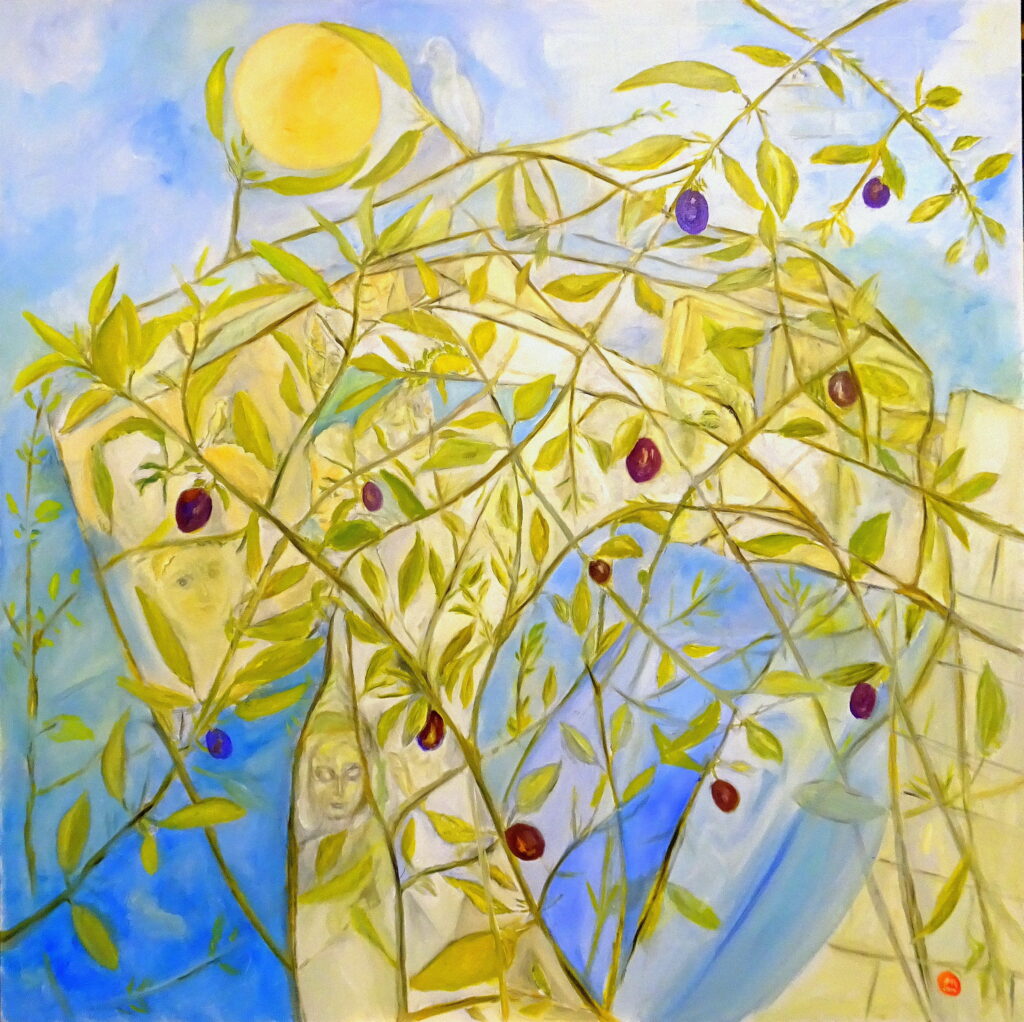
In his well-known and special portrait of Israel, Under the Skies of Jerusalem (2016), Michael managed to portray that unique Jerusalem air, its skies with its special atmosphere as if you are witnessing a parallel, additional dialogue and feeling a presence , if not an entire special dimension there. He also brought there an olive tree in a symbolic way, with twelve olives referring to the twelve Tribes, with a fine bird – Elijahu? – resting on its greenery, as well as an alluded gentle lamb, figured in the way of the Chet letter of Hebrew alphabet , with all its beautiful and assuring symbolism of life and divine presence and protection. This painting is a love-song to Eretz Israel, its people and Jerusalem, in generations, calm, gentle , beautiful and protected, always and ever.
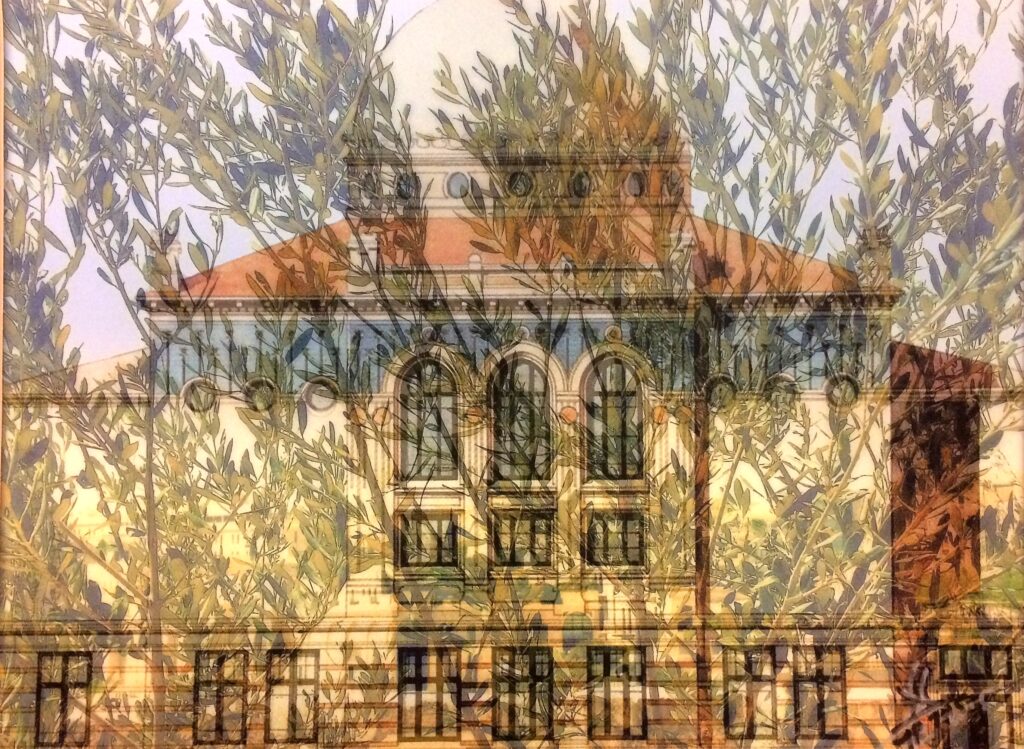
In my turn, I do love Israeli olive trees, and have created some special images with their presence there, as if transporting the remembrance of them with me back to Europe, as it is done in this special art collage The Olive Skies of a Synagogue, and the Synagogue is a symbol of an European synagogues, many of them have been destroyed or dysfunctional after WWII. In the collage, the authentic drawing of the Synagogue in Helsinki by the famed Finnish architect Johan Jacob Achrenberg done in 1905 was used.
Giving Moses command of lighting Menorah in the Mishkan, the Creator underlines a principally important thing: the continuation of that light. He commands, via Moses, to the Children of Israel in generations to come ‘to light the lamp continually”. This is one of the most important metaphors of Jewish life and existence ever. And this command goes far beyond the actions of the religious service. It is the core principle of life. And it is up to us to understand it – and to live accordingly to it.
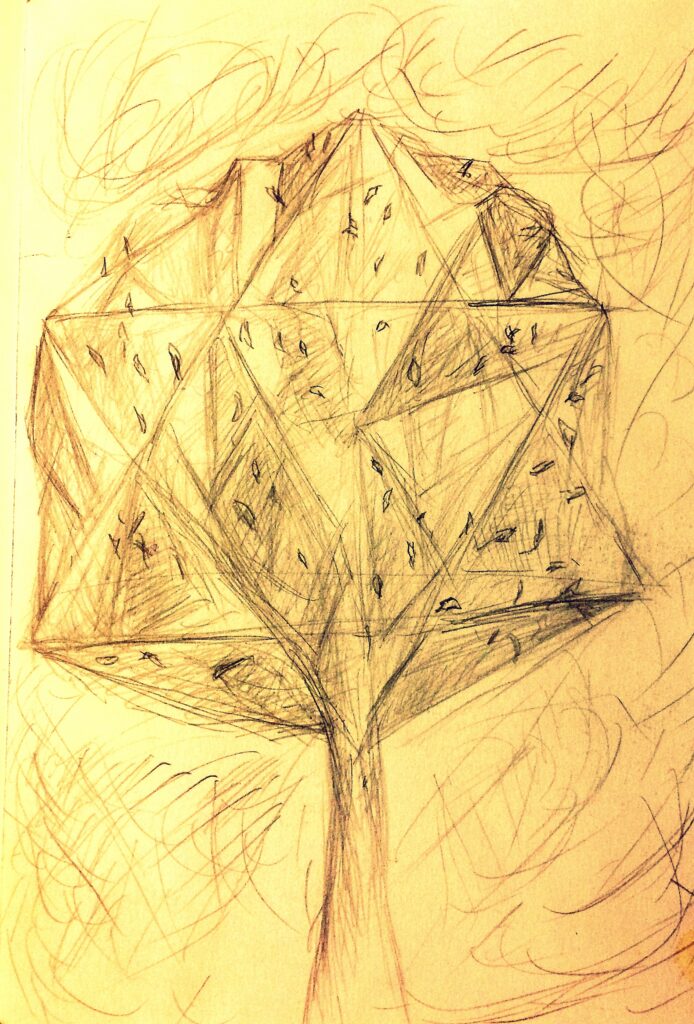
In his other work, rather poetic The Tree of Israel drawing ( 2017), Michael also depicted the symbolic tree with Mogen David inside it, as an olive tree with olives all around it, in a symbolic expression of what the Tree of Israel it is about.
In the parsha Tetzaveh, the Creator also instructed Moses about preparing the vestments for the cohens to conduct religious services in the Mishkan, which was the beginning of Jewish liturgy tradition, ‘to make it with a wise heart’. This term, the wise heart, is to be found throughout the Torah several times, for different functions and at the different times, but always with the same underlining, meaning good, able, responsible people who know what they are doing and who are doing it not for money or in exchange of any favours, but because the wisdom of their hearts prompts them to do it.
Wisdom of the heart is quite-essentially Jewish concept which we were lucky to receive from the Creator directly as an incredible gift, and which was spread in the civil human practice throughout the millenia as the history of civic society was unfolding.
In this concept, intellectual power is combined with morality, thus making an overwhelmingly winning combination which has allowed us to live, survive, overcome, prevail with understanding of what we are doing, why and what for.
For me personally, the concept of the wise heart is the key to the entire Torah and also to the way of Jewish life. It is my favourite concept from the Torah in its entirety, and I still remember the moment when I first read it there, decades ago, with an unmistaken ‘eureka!’ effect which has settled many questions in my head. And heart, too.
Indeed, it is also about settling the print of human behaviour in the most natural way. Both wisdom without heart and heart without wisdom do happen in life regularly, casually and probably far too often. Wisdom without heart brings to mind some big scientific names who were human failures. Heart without wisdom is probably a better option, but many purposes were not achieved because of the lack of intellectual skills in this case.
But a wise heart is winning composure of abilities and intentions, and that’s why the Torah is mentioning it to us repeatedly in many parshas, including the Tetzavech.
Another hidden lesson in the otherwise pretty plainly instructive narrative of the parsha Tetzavech has to do with the explanation regarding the order of playing precious and semi-precious stones in Ephod, the High Priest’s breastplate, about which the Creator instructed Moses as well. As it is known, the breastplate had to bear 12 precious and semi-precious stones, corresponding to the Twelve Tribes of Israel. Each of the stones was engraved with the names of the Tribes leaders. But in which order the stones had to be placed? Many of us could think of a conventional order corresponding to the order of birth of Jacob’s son – and would be mistaken.
Rashi saw something unusual in the order of the Ephod stones’ placing and explained it. As it happened, the stones with the engraved into them names of the Tribes, were placed according to their birth by Jacob’s wives and concubines, not in order of their actual time of birth: first were placed the stones corresponding to all sons of Leah, all six of them, from Reuven to Zebulun, then by both Bilhah and Zilpah, maidservants of Rachel and Leah, and then the two sons by Rachel, Joseph and Benjamin. This is an unusual and unexpected approach, but when you think about it, it teaches us about the natural and respectful order of family relations, and it is a universal value.
As Rashi has noted, the names of the Tribes were engraved inside the stones – “for the Creator to see them for ever”. And He does.
One more interesting episode to observe in the parsha Tetzavech concerns a very strict command of the Creator to Moses and Aaron regarding the precise part of the animal for sacrifice. Why should it be, namely the right shoulder?
The answer is found in Sforno’s impeccable commentary: the right shoulder of an animal for sacrifice corresponds in allusion to the right hand of a man in principle, and in this case, to the right man who performs the sacrifice in the Mishkan and future Temple, Kohen Gadol. Simple, as only the most important things can be.
Parsha Tetzavech speaks about the most sacred and secretive thing and place in the Jewish ritual, the Urim and the Thummim, and the Holy of Holies.
The Urim and the Thummim, the written unpronounceable name of the Creator, was understood to be written on the two parts consisting the one whole, which was inside the Kohen Gadol’s Chosen, the most sacred place in his vestments, located at the closest distance from his heart, tellingly. This sacred mystery was still largely intact during all millennia that went on from the moment narrated in the parsha Tetzavech, despite the fact that not only some of the inquiring rabbinic authorities , but also a notable number of historians and even archeologists were looking into that magnetic mystery.
There are at least three different opinions on the text which was possibly written on the Urim and Thummim, including the most widely accepted Tetragrammaton, but also there are suggestions about possibly written there the 42- and 72-letter Names of the Creator.
The power of this most sacred physical manifestation of the Creator in human practice is what it is and it has been never disputed or doubted, justly so. The role of the Urim and Thummim as the bearer of that power is unprecedented because that not entirely comprehensible power in this case does have its physical form. In this context and reality, Rashi’s consideration regarding the Urim and Thummim sounds as timely, as if he wrote it today.
In his commentary to the Tetzavech, Rashi mentioned in detail that according to his understanding, it has been established that the Urim and the Thummim were in place at the Kohen Gadol’s Choshen during the time of the First Temple. Then, after the Babylonian exile, partial return, and further on, during the period of the Second Temple, when the Holy of Holies was effectively empty, without the Ark and anything else from the essential ritual objects that were there both at the time of the Mishkan and during the First Temple period, the Urim and the Thummim were there, in their place inside the Chosen in the Kohen Gadol’s vestments. But – there is a crucial detail. Rashi underlines that without the physical presence of the Urim and Thummim inside the Chosen, the Temple service would not be possible. It simply would not be happening.
But: Rashi believed firmly that with the small tablets of the Urim and Thummim present inside the Kohen Gadol’s Choshen during the Second Temple period, the very text, the letters which were impersonating that supreme power, were not there any longer. Rashi came to this conclusion analysing the state of moral, behaviour of people and relationships inside the society during the highly charged, unhappy and volatile period of the Second Temple that eventually led to its tragic end.
And then, writes Rashi, it was discovered at the later stage that the two parts bearing the Urim and the Thummim had gone as well, physically too.
Parsha Tetzavech in its commands regarding the details of the religious services conducted by the Kohen Gadol also brings its reader to the central and most sacred place in everything connected to the Jewish liturgy and everything related to it, and also to the place which symbolises the physical presence of the Creator on the earth, the Holy of Holies. As it is believed, the physical place of the Holy of Holies is in the close proximity of the Foundation Stone which is on the Temple Mount. Given the fact that the Dom of the Rock has been imposed onto that sacred Jewish place, it is not easily accessible, to put it mildly.
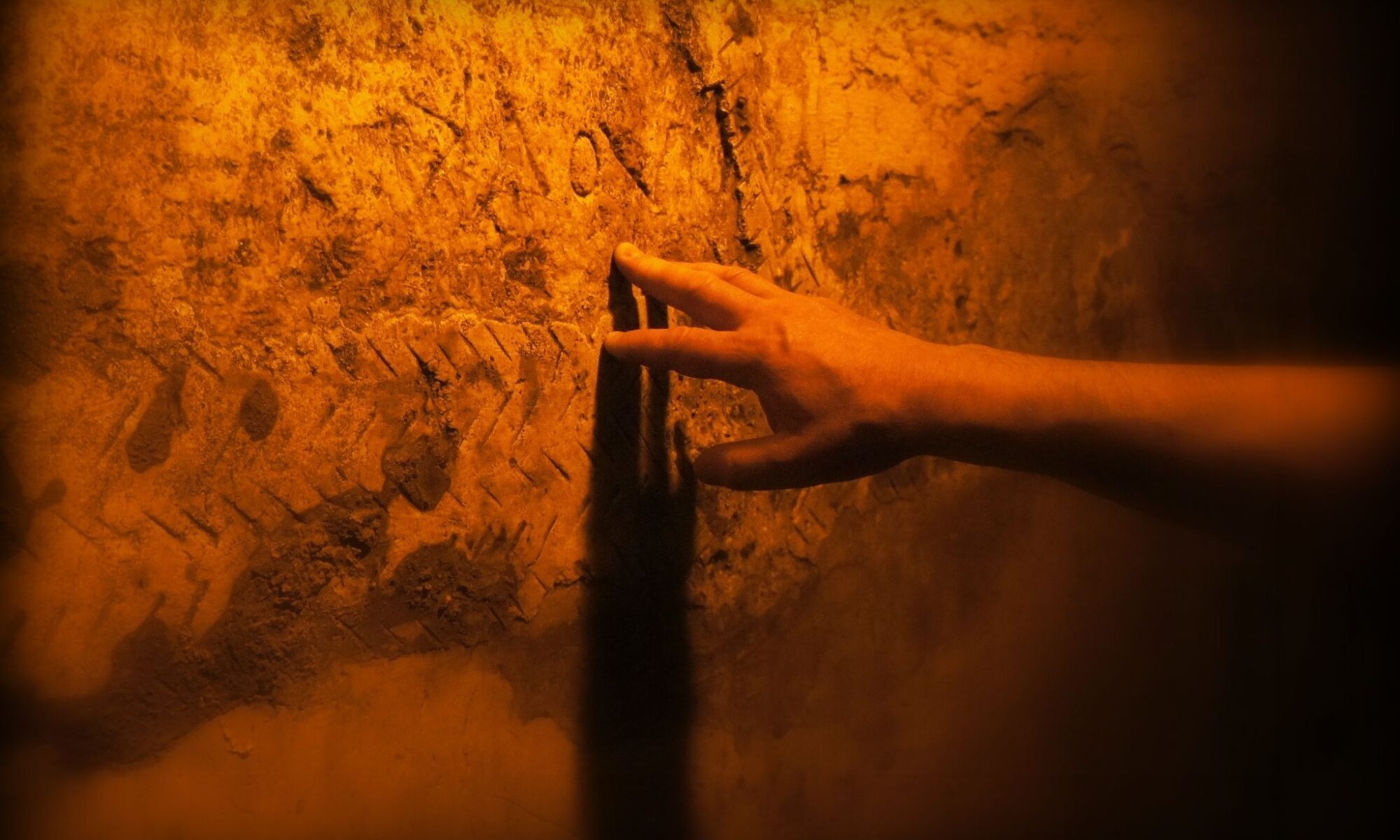
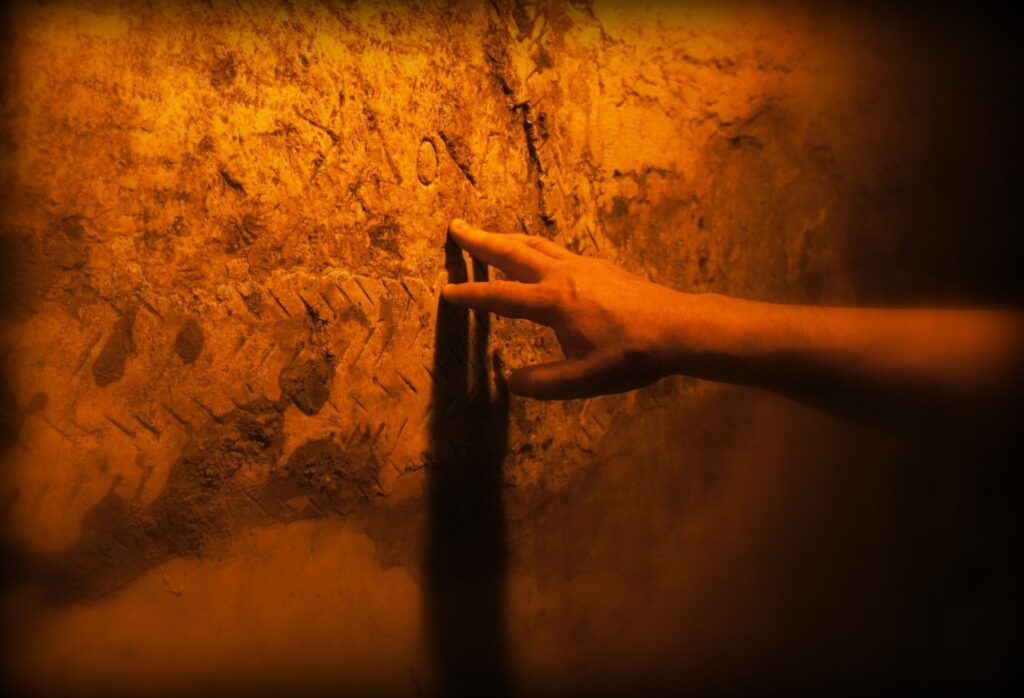
But there is a possibility to visit a certain place in the under-Kotel tunnels, from where there is the closest distance in a direct reach towards the Temple’s Holy of Holies. Next to the wall at the place, there is a small synagogue where there are some people at any time of day or night. We were extremely privileged with my husband to be able to visit the place and to spend some time there. It is one of the most remarkable experiences in my life.
I still see the wall of that particular place in the Kotel tunnel as I am there now. Its magnetism imprints into your conscience and subconsciousness in no time. You feel the weight of that special Presence and you feel the other dimension. You also feel the light there, the inner light, not of an entertaining nature, but of something ever present and every will be present, the High Power which has blessed the human world in this very place in Jerusalem. It is hardly describable and ever memorable. And there is also something highly magnetic there.
To think that you have been just less than 50 metres from the Holy of Holies of our Temple has left the feeling of ever-present huge amazement for us. And huge gratitude, too.
Those walls saw so much during the last over two and half millennia, and that energy is preserved in these incredible stones. You have a very strong impression that history speaks with you personally, in real time. The time gets volume, and you begin to reckon what it means: the sixth dimension, the one of the time.
The work Time Thread e from my special series picturing the Kotel tunnels visualises these feelings to some extent.
It is an incredible privilege to have physical places staying for millennia that connect your system of values with its historical background, and that infuses you with the special feeling of belonging.