Terumah – Offering
Exodus 25:1-27:19
In parsha Terumah ( Offering ) , the Torah narrates several important things from the aspects of philosophical rendition of life, the arts, and the symbolism of the Jewish religious practice which is still in use during this day, being un-interrupted for over three thousand years.
With regard to art, creativity and Judaica symbolism, the Creator’s dictum to Moses was of the character of direct instructions, to the degree, according to Rashi, of showing to Moses the image of menorah made of fire in the sky when he seemed to be in difficulty to comprehend how exactly it should look like.
But with regard to the Sanctuary itself, it was the introduction of a very concept of it for human society, and this is fundamentally important. The making Mishkan itself, to have it in a re-assembling mode, to make it transportable – those all were practical guidelines of the high order, which all stays fresh as it has been invented today.
But yet more importantly, the Torah in this parsha tells us about the concept of a sanctuary which is one of the central points in the human way of life, both individually and socially. In Jewish religious practice, it has all the clear ordinances which are narrated in Terumah. Additionally to that, it expands in its conceptual meaning to every individual and every society.
With regard to Jews and our religious practice, the Mishkan which has become the centre of the religious service, and was with the Children of Israel from the moment described in the prasha through all the way to the Holy Land, was an equivalent to the universe. In this way, the understanding of the symbolism of the religious practice becomes natural for people, and the intelligence of such model does tell about the intellectual qualities of our people which we were so lucky to receive as a superb gift from our Creator.
In the Midrash Rabbah, there could be found the comparison between the way of the building Mishkan with the process of the Six Days of Creation, quite convincing one. The conclusion which can be made from that comparative analysis comes to the understanding that the Mishkan, the centre-piece, the very place of Jewish religious service, is as eternal as everything that has been created during the Six Days of Creation. And it definitely emphasises the role of that place in the life of Jews, even not observing ones.
We know that Shiloh has become an absolutely important place because the Mishkan was staying there, erected and serving for about 370 years after the Children of Israel entered the Holy Land. We know that the significance of that place is still regarded as very high by many, including historians and archeologists who did a superb job during many years in very productive excavations in Shiloh, with their work and mission continuing. Some of my close friends are members of the team, and we are getting updates from the incredible historical place for our people regularly. Nothing more proves the living connection from the past to the present better that a resulting archeology, but in this case, the archeology mission in Shiloh is filled with admiration to the Jewish history from one side, and with an incredible enforcing the spirit of those people who are seeing the world through the lens of faith. It really is material proof of the existence and presence of the high spirit, and to know it in principle, and especially first-hand, is truly incredible life experience. And it is more: it is life-assurance of the highest probe. There is not without reason that one of the meanings of the word Terumah, additionally to ‘an offering’ is ‘uplifting’.
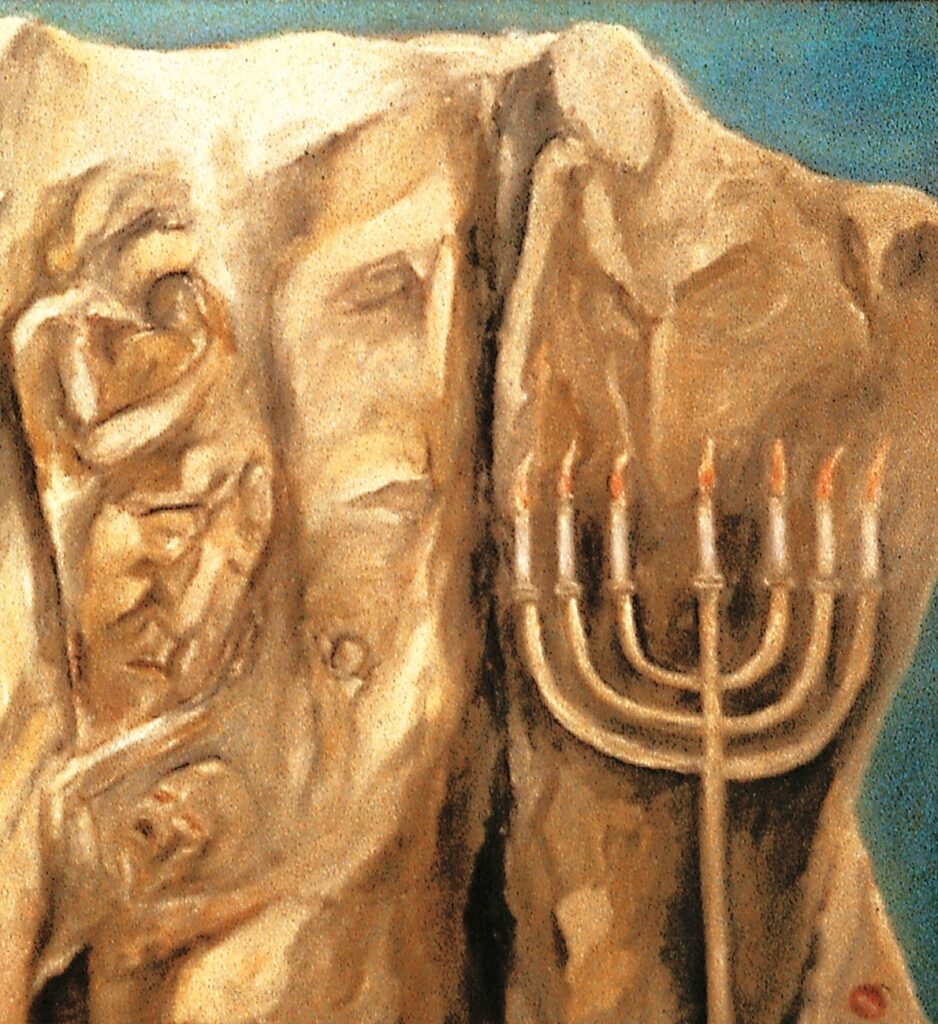
In his oeuvre, Michael created menorah in several of his works, every time within a different context. In his unique Kotel work ( 1999) depicting the Jewish history through the images he saw in his artistic imagination as if appearing in the stones of the Kotel, the menorah there with its beautiful flames is the constant , in the contrast with dynamic in their suffering figures from various periods of the Jewish history, imprinted in the Kotel’s stones. The Kotel menorah in Michael’s painting shines steadily, it is re-assuring, comforting Jewish souls, and it is beautiful. It is the sign and message from the Creator.
Along with the instructions for constructing a transportable model of the Mishkan, parsha Terumah introduces and establishes such highly important aspects as art used in the religious services. It can be done without it, strictly and devotedly, but the Torah emphatically says ‘made with artistry’ with regard to the parochet , the curtain in the front of the ark, as well as with regard to the ark itself, its cherubims, the curved tablets inside the arch,, and more than ten tapestries. Thus, the foundation of the religious art has been made, and it is stated in the parsha Terumah.
In the same motion, the central subjects of religious rituals have been brought to the Jewish nation, including the ark, the tablets, the parochet, the menorah, thus establishing the foundation of the Jewish symbolism which is the beautiful part of our heritage.
With the ritual symbolic subjects, the materials and colours – such as gold, silver , copper and shittim wood, gemstones and the other precisely specified materials, of several fundamentally important colours, such as blue, red and purple – have been importantly specified, and not just like a dictum, but with a deep and important meaning. There are more than one explanations of the meaning of the materials to be used for the key religious subjects in the Mishkan, complementing each other. In the most known of such explanations, Rabbi Schmuel ( in the narrative of the Midrash HaGadol) compares gold with sun, silver with moon and copper with the western horizon at the moment of sunset, and explains that blue colour reflects sky, purple – clouds and red – rainbow. The Kabbalah states that the gold is associated with the essence of the soul, and thus is very clear why the Creator instructed Moses not only to produce the Menorah from the pure gold, but also not to make it in parts to assemble it later, but to make it from a whole large piece of gold. One should not diminish the meaning of the essence of the soul, but instead, it should absolutely be made in a wholesome way, having in mind also a metaphorical meaning of it.
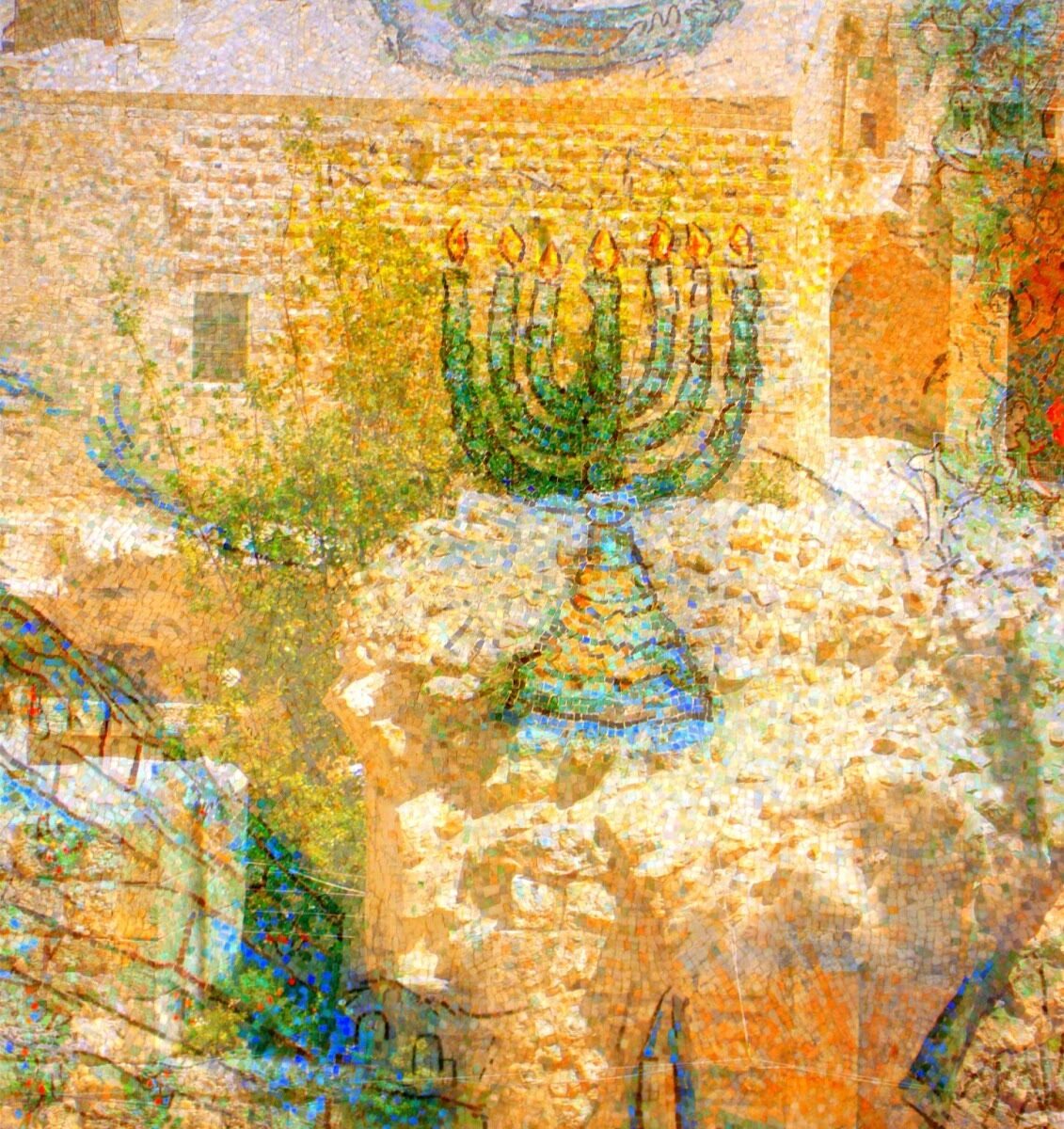
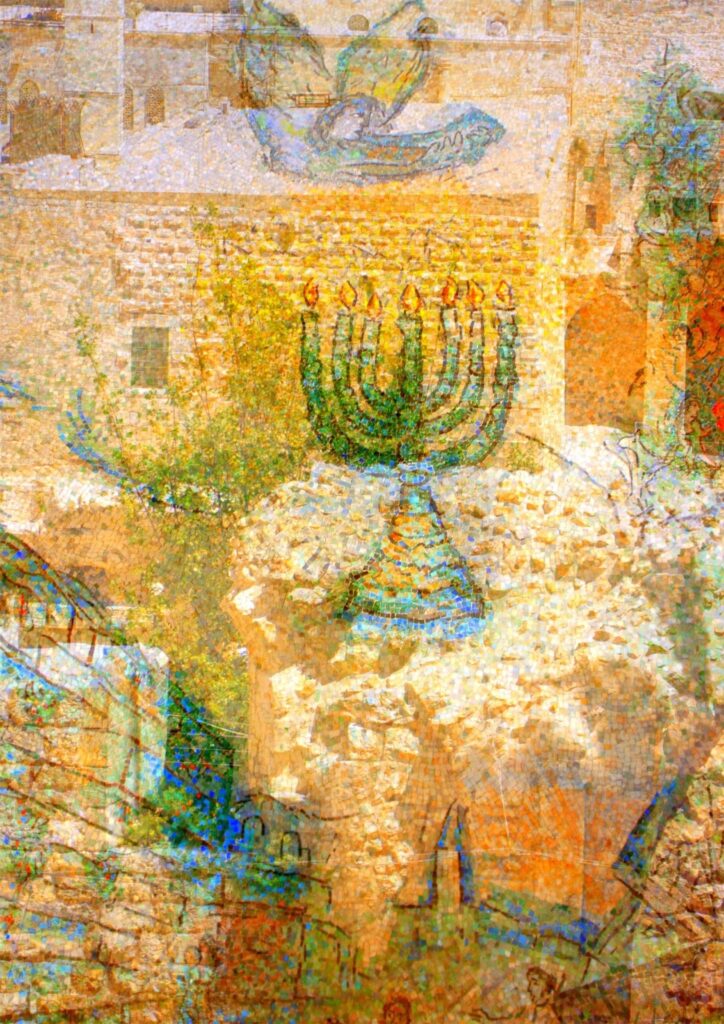
In my special homage to Jerusalem and Marc Chagall and his vision of our Jewish symbolism, I have produced the artistic collage named Flying Over Jerusalem. Homage to Marc Chagall. There, the Chagall’s menorah, which I photographed specifically also in Jerusalem, is the centre of his and our universe, consisting of Jerusalem’s streets and buildings, both random and iconic ones. The different versions of work are at the Permanent Art Collections of the Municipality of Jerusalem and of the Parliament of Austria.
In everything from what the Creator has instructed Moses to be made by the Jewish people for the Mishkan, the place of the Creator’s Sanctuary on the earth, among his chosen people, from the walls to the smallest details on the construction, and from the tablets with the Ten Commandments on them to the faces of the cherubim, and not only making the menorah but even its placing in the only right way, there was the meaning and the cause. The cause and the meaning. The necessity and symbolism. The necessity was a prerequisite to follow the Creator. The symbolism was the bridge between the Highest Knowledge and the knowledge and the way of understanding at the level of a human intelligence. And then, in that all, there was elegance and beauty. In the materials, in the shapes, in the lines, in the colours. The beauty of the Jewish art which has been established and sprang off the Mishkan artistry, is in confident visual statement and in laconic but powerful colouristic message. It is all rooted in the Creator’s dictum narrated in the parsha Terumah and it has been evolved to the heights of Jewish artistic talent and fantasy through thousands years of keeping the Jewish tradition and heritage. It does not mean that the Jewish artistic vision stood still, quite to the contrary. But it means that the beginning of this mighty and beautiful cultural phenomenon originated from the moment of Moses receiving incredibly precise instruction on everything, including the materials, shapes and colours, with emphasis on making it ‘with artistry’ from the Creator himself. There is a unique phenomenon in the cultural and civic history of the world.