Ki Tisa – When You Take
Exodus 30:11-34:35
This part of the Torah, parsha Ki Tisa, When You Take, contains so many crucial events and principal developments for Jewish nation and its destiny that it could well have be a book of its own with several expanded chapters on each of the episodes described there.
Ki Tisa starts with final instructions to Moses and Aaron rounding many detailed ordinances in the two previous parshas regarding the details of Jewish liturgy. Here, in Ki Tisa, a very indicative ordinance comes in the beginning, with the meaning which expands far beyond practicalities, the ordinance of a silver half-shekel as a means of counting adult men among the Children of Israel. There are many comments on all sides of this ordinance and its implications all over the rabbinic literature. I should emphasise two aspects: the choice and meaning of silver in Jewish tradition and understanding, and the principle of equality in human society which has been set up by this very ordinance to Jews at the time of Moses.
Rashi underlines that there is manifesting differentiation regarding the Creator’s instructions to Moses and Aaron on the people’s donations for the Mishkan. While regarding all donations in general, the principle is set for each person to donate according to their generosity and abilities, with regard to silver the principle is different. Silver shall be donated equally by everyone, the Creator instructed Moses and Aaron. Why is this?
Because silver is a special denomination in the Jewish tradition , symbolising purity and durability, decency and sustainability of all things good which are with us during all our lives, in generations, from the symbolically used spoons at the weddings of a large part of the Jewry, our kiddush cups of all sizes, our candle-sticks, and so many other subjects of our life which often are preserved and are travelling with us from generation to generation, bearing our memories in the calm, decent and comforting, assuring way, without an excessive glitz, but with that unmistaken inner beauty, calm elegance and decency of memory. I love silver, its combination of modesty and beauty, the best way of dignified, unvulgar living.
In Kabbalah, it is believed that silver brings the Divine light into this world, and our kiddush cups and menorahs are just one more evidence of this ongoing pattern. With a good reason, silver is associated with Chesed, kindness in Jewish tradition.
Analysing this special ordinance regarding donating of silver half-sheckel, Rashi also emphasised the telling line from the Torah text: “ the rich shall not give more and the poor shall not give less”. In this way of atoning the Jewish soul, which that silver half-shekel mandatory donation was about, the principle of equality of persons in the society has been introduced and laid down. And it had happened for the first time in the history of civilization there and then, at the time of the Creator instructing Moses and Aaron to organise the society of the Children of Israel in a certain way and introducing some fundamental principles to it.
In rounding the ordinances for the Mishkan and everything connected to the Jewish liturgy, the Creator in Ki Tisa emphasised to Moses and Aaron the role of Shabbat for the life of Jewish people in a strong and enduring way. The continuity of the tradition of keeping the Shabbat throughout the generations is the central point here. And the role of the Shabbat in the Jewish life is portrayed there very clearly and emphatically by the Creator, pronouncing it ‘a sign of a perpetual covenant’ between the Creator and Children of Israel for ever. Indeed, the rhythm of Jewish life has been organised with Shabbat as its starting and central point, ever since. And we are always grateful to the Creator for that incredible gift.
Mishkan itself and everything inside it was done by the talented artists and artisans who were personally chosen by the Creator for this unique mission, Betzalel, and Aholiau who was helping and assisting him.
The rabbinic authors has noticed an interesting detail: while Betzalel who was Moses and Aaron’s grand-nephew, Mirjam’s grandson, coming from the tribe of Judah, the most noble one from all the tribes, Aholiau came from the tribe of Dan, from the other end of the spectrum among the tribes. Such combination certainly not an occidental, it was done in order to bring the entire Jewish society, from one end of the Tribes to the another, to be united with the clear understanding of the purpose of their creative effort, to building the Mishkan, and further on, the Temple, as the centre of the Jewish spirit.
For his creative purposes, Betzalel was infused by the Creator with ‘wisdom, understanding, knowledge and all manners of workmanship’ as the Torah text states in Ki Tisa. Aholinai was helping and assisting Betzalel, and was personally responsible for carpenter works, weaving and embroidery which were all done at the level of an incredible beauty and clarity, with all corresponding meaning of every single detail. These are the pillars of Jewish religious art, and these pillars were established at the time of the creation of the Mishkan.
From that time on, the Jewish art – which is quite permissible, contrary to the misunderstood notions on the later stages of the life of the Jewish society and its practices – was thriving, being initiated and infused by the Creator’s spirit. Here again, the term of the wise heart, attributed in Ki Tisa to Betzalel and Aholiau, sets up the rest. When art is conceived and produced with heart, and when this heart is wise, adding the talent , the outcome is the unforgettable pearls of human life and experience.
Betzalel’s father Hur, a brave and devoted man, was very close to Moses and Aaron, his uncles. Together with Aaron, Hur was with Moses during the war with Amalek army, and it was him who, along with Aaron, supported Moses’ uplifted hands during the battle, thus ensuring the victory for the Children of Israel over the horde of bandits.
In a tragic turn of events, the brave and courageous Hur became the victim of his own ill-hearted people who revolted against the Creator in the utterly shameful episode with golden calf, which is narrated in Ki Tisa.
How could this happen? – reading the Torah annually, many of us still are puzzled by this crucial moment in the Jewish history. Trying to get to the core of it, from the point of view of psychology and human behaviour, one comes to several reasons which might let to that astonishing mass turn back in an aggressively regressive move of so many at the moment of their fascination of making an idol which, they believed in their inflamed mind, might rescue them from everything. Such a primitive way of thinking, and such a primitive objective which was – and still be – typical for a motto of an agitated crowd, not responsible individuals.
Was it recklessness? Undoubtedly, but it is rather the way of behaving. But the reason? Stupidity? Greed? Uncertainty or rather disbelief in the system of values and way of life which would be seriously or not drastically different from the life of the society in Egypt which the Jews and those who joined them, and there were many thousands, have left rather recently? Probably, all of it in a different proportion and combination of reasons that all were mixed into some essentially wrong mindset of those who started the idea of recklessly, speedily making the idol in a fervent – and very aggressive – rush, that led to the murder of brave Hur who tried to prevent the sacrilege. And one should not forget the factor of a large mixed multitude which left Egypt along with Israelites. The Ki Tisa text is very clear with regard to their leading role in the inflamed spectacle of the making of the golden calf.
Some of the rabbinic sources emphasised that during the painful episode of the making the golden calf, Aaron in his mild behaviour towards the demanding and aggressive crowd, initially was prepared to take a stand against them, but facing the brutal murder of his nephew Hur, was persuaded to try to buy time anticipating soon return of Moses. That irrational murder of one of the best of the Jewish people, one of its leaders, and his close relative did affect Aaron deeply.
The entire episode of the making golden calf in Moses’ absence is actually read as a tense thriller at its beginning and mid-part and as a deep ever-lasting drama in the end and post-finale: the plotting behind Moses and Aaron’s back and in the Moses’ absence, murdering brave Hur who was trying to prevent the sin physically, threatening Aaron with murdering him as well, Aaron’s efforts to delay unfolding sacrilege at every stage of it and by all means, heightened agitation of the crowd, their joy while celebrating the sin, which all had been punished severely not only there and then after Moses descended and broke the Tablets in the prevailing anger, but also with all consequential events, with burning the calf and making the sinners drink its bitter water, with clear polarisations of the society ( “ who is for H-shem, come to me!”), with severe on-spot punishment of the core sinners, and also with an echo of that volunteer and thus, unnecessary, sin-by-choice, throughout the Jewish history ever after.
The Talmud in its Sanhedrin 102a tractate mentions so justly: “ There is no misfortune that does not have in it something of the sin of the Golden Calf”. It is a very clear reference to the very character of that sin: it was the sin by choice, self-inflicted conscious choice prompted by the evil inclination and stupidity which prevailed at the moment. Importantly, it had its very long shadow over all our history.
Nothing is coincidental in the Torah and its narrative. The sin of making the golden calf happened on Tammuz 16th, with Moses descending with the Tablets and breaking it in a fierce, corresponding to the damage caused by the sin, anger , on Tammuz 17th – the bitter date in the Jewish calendar ever since, with many tragedies happened on the day throughout the time. And again, not coincidentally, in the case of the second tablets, this time carved by Moses, he descended with them in his hands for the second time and brought the moral code to the nation on Yom Kippur.
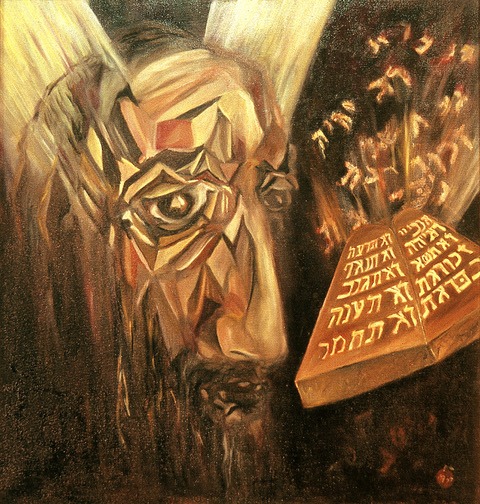
In Michael’s amazing portrait of Moses from his Forefathers series, the visual metaphor unites Moses’ first and second ascending and descending from his dialogue with the Creator, providing a philosophical observation of the leader of the Israelites at the pivotal moment in the history of the nation. Pivotal in the meaning of the morality, behaviour and choices that people make. Moses was a unique figure: humblest and most devoted Jew in our history, who was at the same time very modest and understanding person and uncompromising mighty leader. In Michael’s portrait of him, Moses is in deep thoughts with regard to the Israelites choice that led to him breaking the first Tablets. Michael here reflects the moment written in the Midrash telling that Moses was so angered when he saw the joyful dances around the Golden Calf that even before he has broken the first Tablets in a mighty anger, the letters which were engraved into the Tablets by the Creator himself, were flying off it, in fire.
This outstanding work was the beginning of Michael’s great Forefathers series featuring the main personalities of the Jewish spiritual history.
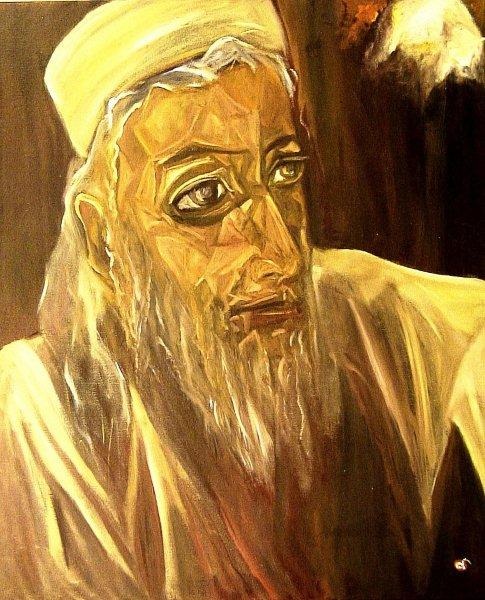
Ten years after creating the work which became the beginning of his Forefathers series, Michael painted an amazing portrait of Aaron, at the very same moment which he depicted in the Moses portrait. Here, Aaron is waiting for his brother to descend to the Israelites camp, himself being in an extraordinarily difficult and dangerous situation before, during and after making the golden calf. The composition of Aaron’s portrait and colouristic decision of the work are deliberately similar with the portrait of Moses created a decade before.
Michael said simply: “It was the moment of Aaron waiting for his brother to come back from the mountain”. Everything in this work is telling: the density of that prolonged moment of waiting for Moses to return, the sadness over the murder of Hur and the people railing off morality, the inner reflections of our first and best Cohen Gadol. But to me and to many of those who saw this rare portrait and admire it, it is the light. The light which is the decisive element of this reflective portrait of Aaron, which reflects also Aaron’s inner light as the main element of this great personality, and which sends the unmistaken message by the artist: it is about light, does not matter what.
In this crucial episode of making an idol, calf or anything else, one should not pass the role of Micah as it is observed by Rashi. When Aaron saw what was going on in the camp, with agitated men rushing to make an idol, whatever it might be, he did everything in his power to delay it, at every stage of the spectacle of the wrong choice. We are reading in the rabbinic literature that Aaron did hope that from the gold that was hastily collected and brought to be melted into an idol, something of an abstract form would appear, and this fact would make a newly made idol unappealing for people. He had no idea that anything of a form, not to speak of a form of a calf would emerge from the fire. How did it happen, and why was it calf?
With this second part of the question, it is clear – the expectations of those who were for the making a new idol, and among whom there was a very sizeable part of the mixed multitude from Egypt, were lining towards something familiar, which were calf-figures of the pedestals of many images of the deities all over Egypt, so it was a quick snap of lazy and average minds , for many of whom it was the natural environment and assuring choice.
But how to make it possible in the Israelite camp where the majority of people were not Egyptians? Rashi explains it in detail, remembering Micah, a complex and evil-inclined personality who was once saved, on Moses’ quite emotional sympathising request from the terrible punishment to be placed, as a child, alive into the bricked wall, as it was invented as a regular punishment by those ‘humanistic’ Egyptian overseers for the children of those Jewish slaves who would not make the prescribed portions of the impossibly demanding day-work.
When appealing to the Creator, yet while in Egypt, with an emotional request to save those children, Moses was told that while some of them would be saved, in principle, those who went through such procedure or who were destined to that, would not be left unscarred morally. Those people were inclined to be affected with evil inclination in any case, the Creator explained to Moses. As it happened, Micah was the one who was saved from this ordeal – and he always was ‘a bad apple in the tree’.
It is believed that at the time when Moses was trying to recover the Joseph’s remains from the Nile before the Exodus would start, and his attention was totally absorbed by this noble task in which he alone was interested, Mica who was nearby managed to steal a sacred piece with the name of the Creator written on it, with which help Moses managed to get the lead box with Joseph’s remains to resurface from the Nile. Moses oversaw Micah’s deceit. He was busy with far more important task.
In a while, Micah got his chance to use the stolen piece with the sacred name on it. Rashi describes, with many sources supporting it, that at the moment when the hastingly collected gold was thrown into the fire, Micah saw his chance to become a joker among the misled Israelites and the mixed multitude. It is believed that he threw the piece with the sacred name into the fire, and as a result of it, a comfortably familiar figure of a calf appeared.
There are a couple of things to be noted with regard to this ultimate moment in Jewish history: the golden calf was made a day before Moses’ expected return, and this is important as it indicates the mental preparedness, if not eagerness of too many people in the crowd to do impossible, to create an idol. Moses’ absence provided a good pretext for making these inclinations to be materialised, but it certainly was not the reason for it.
Secondly, Moses knew what was going on on his way down from the top of the mountain, with the Tablets in his hands. He knew that his people made a colossal mistake and many of them were badly misled. It happened. But when he saw and realised the joy of so many, with those dances and screams of agitation by the reason utterly wrong, then his anger flared, and in that overwhelming anger, he broke the Tablets. I was often pondering: how did Moses dare to break the Tablets with our principal and eternal moral code which had been engraved by the Creator himself? How a human being dared to break such ultimately sacred objects? But thinking deeper on this incredible act by Moses in the light of the considerations mentioned above, it does make sense, also quite a dramatic one.
It was also a pivotal moment in Jewish history because the Creator was really very close to punishing these stiff-neck people and to retracting from them for good. And here, an amazing personal quality of Moses in his ultimately persistent effort to keep the Creator as the Keeper of the Children of Israel has played a key-role as for the moment, as for the entire Jewish history to unfold.
What is incredible as it comes from the parsha Ki Tisa and many commentaries to it, is how everything is inter-connected in life, and one of the most powerful examples of this interconnection comes from the Ki Tisa directly.
With Moses after him saving the Creator’s protection for entire nation called to ascend the mountain for the second time and to chisel and engrave the second Tablets, this time by himself, in his incredible dialogue with the Highest Power that was so protective of him, he developed a very special kind of communication with the Creator, which went on as a conversation goes between friends, with ‘no riddles’ used, as noted by the great Sforno. In this dialogue, the Creator has noticed that Moses might have a limited capacity for hope, after all the calamities and recent disappointments.
In an amazing dialogue, the Creator, according to Rashi, explains to Moses that ‘while pleading with Me, your reasoning goes by referring to the merits of the Forefathers, Abraham, Isaac and Jacob. But when this ends, your belief in hope also ends with it. Which is wrong. Hope cannot be limited. I will teach you the procedure of requesting Mercy”.
This procedure is the prayer. The Prayer. At that moment and at that time of our history, the Creator has taught Moses the order of the Jewish prayer which invokes the Thirteen Attributes of Mercy. Thus, after the most dramatic moment in the Jewish history at the time, the Creator has given us the way of calling to him. He said to Moses: “You should teach the Israelites to do so. They will be answered”. And we know that they were and still are. I do not know a more precious gift in life than the way to appeal to the Creator – and to be heard.
And I do not know a more winning and comforting stance in life than to believe and know that hope cannot be limited, and to live accordingly. It did save a multitude of people under very different circumstances in their lives. And it came as a central disposition and actually as a way of life from that dialogue on the top of the mountain between the Creator and Moses after the drama of the golden calf and the broken first Tablets, described in the parsha Ki Tisa.
I was always paying attention how much the domain of mercy – and Mercy in the biblical and spiritual dimension – meant for Leonard Cohen, our dear friend and mentor, the man the connection with whom I do feel as existing and alive daily, despite the fact that at the time of me writing this essay, there is almost a decade passed since his passing.
“Do not turn on the light, you can read the address by the moon’ – just one line from his so human and so elegant poetry, this one is from the great Sisters of Mercy song. It is not without a reason that Leonard entitled his book of poetry Book of Mercy. It is always next to me at my night table.
The domain of Mercy was the orbit within which Leonard lived and created, and he had seen the world from that perspective.
His inner Mercy which was palpable in everything he created and did, was also very important for another our great contemporary, late Rabbi Lord Jonathan Sacks who absolutely loved Leonard Cohen, his songs and poetry, and very often was driving while listening to Cohen’s songs for hours long. We were discussing it with Rabbi Jonathan often, and our mutual deep attachment to the space of Mercy created by Leonard Cohen was one of the precious gifts that we were sharing, along with our families from both sides, very happily.
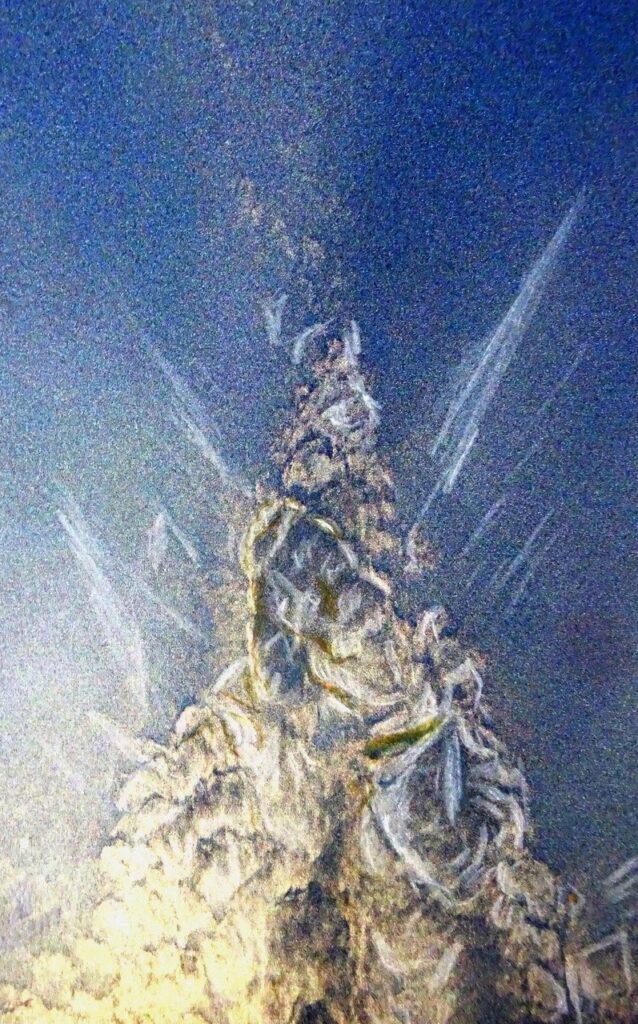
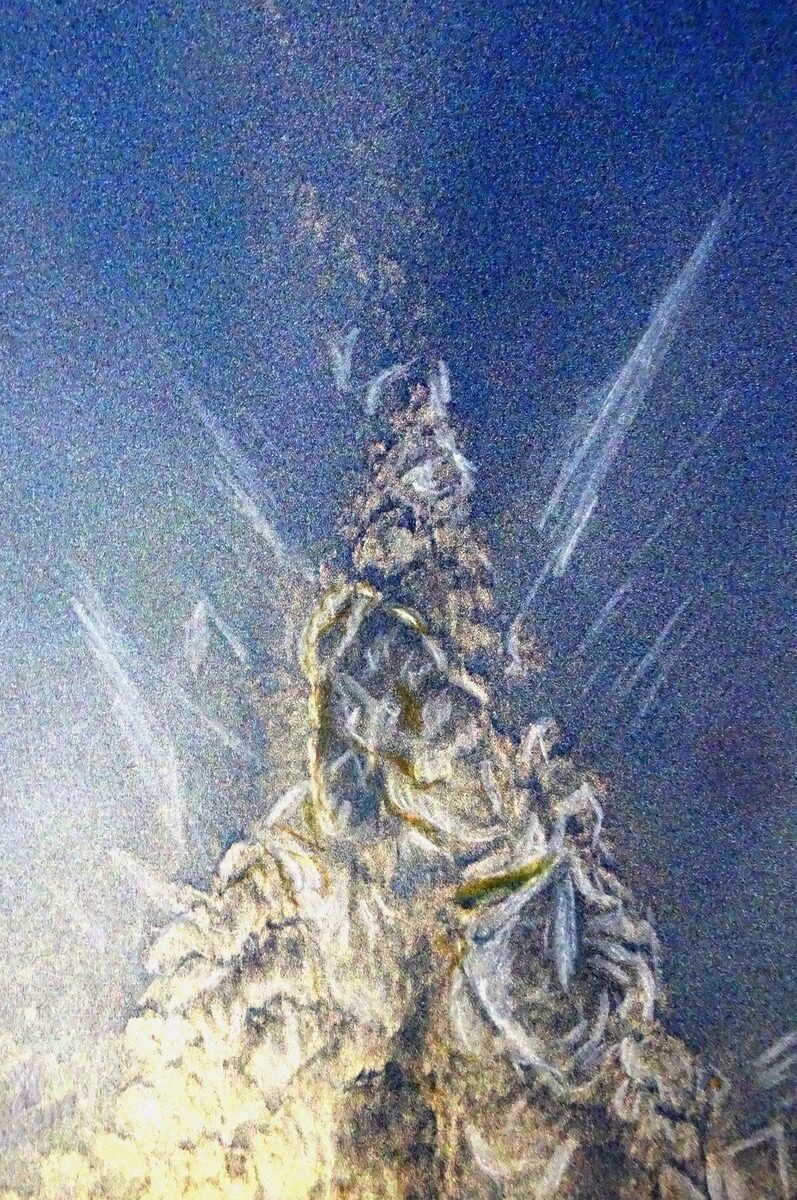
In this context, a special work of Michael which he has created on my authored original print, was about the return of Moses from his second ascent to the mountain, his return, with his face radiating, and with the second set of the Tablets which was wider than the Ten Commandments which were engraved on the first Tablets, as we know.
Interestingly, the Creator himself did show to Moses the stones from which he should chisel the Tablets, with a note: “And what is left, it shall be yours”. According to Rashi and other commentators, the stones were sapphires. Thus, with ‘what what was left’ that the Creator entitled Moses to, has enriched Moses very much, as those bits which were left after Moses has chiseled the second Tables, were many pure sapphires.
In his Moses Hour ( 2017) work , Michael has created it special sapphire-colour as the background of appearance of Moses after his second forty days and nights on the top of the mountain and that incredible dialogue with the Creator, as between two friends, with Moses’ face radiating and him keeping the second Tablets close to his chest.
Significantly, in contrast with the moment of giving Moses the first Tablets, which was accompanied by loud sounds and manifestation of elements, and thus has invoked a cast of an evil eye on it, as Rashi and other commentators mentioned, the second Tablets were brought by Moses to the Israelites camp quietly – and safely. “Nobody should be with you” – Creator has instructed Moses before his descense. “There is nothing better than modesty” – concludes brilliant Rashi. How absolutely correct, for that moment and any other.
When Michael and I happily gifted this fine work to Rabbi Jonatahn and Lady Elaine in London , their reaction was engaging and gracious. We both would never forget their smiles, the instant light in Rabbi Jonathan’s eyes, and his words: “This is a very gentle Moses, Michael, in one of those rare moments in his life when he was experiencing a pure joy, with shining hope risen after that unique encounter with H-shem. Thank you very much. We will be very happy to have this very fine work at our home” , – said Rabbi Jonathan, looking at the work with this unforgettable grace. We spoke about this work with Rabbi Jonathan and Lady Elaine for a long time, going together in many details of it. Since that memorable encounter, of many, the work has been the part of the Lord Rabbi and Lady Sacks family collection, and in our opinion, there cannot be a better place for this sapphire portrait of shining Moses.