
Vayakhel – And He Gathered
Exodus 35:1-38:20
and
Pekudei – Amount Of
Exodus 38:21 – 40:38
In those two parshot, Vayakel and Pekudei that customarily are read together, the content basically is the repetition of the previous two parshot, Terumah and Tetzavech, with their ordinances regarding the construction of Mishkan and its artifacts. As there is no occasional letter to be found in the Torah, the repetition of the ordinances means a lot. Those are the core things regarding the material parts and conditions of the G-dly Presence among the Jewish people, and those should be known and understood thoroughly, by the letter.
Importantly, the narrative of Vayakel starts immediately after Moses’ descent from the mountain. Date-wise, it was the morning of Yom Kippur. On that morning, the Creator speaks to Moses first of all about Shabbat and its absolute importance in Jewish life. Rashi made an elegant and important observation with this regard: it directly alludes to our knowledge and understanding – which are two different things, notably – about Yom Kippur as Shabbat of Shabbats.
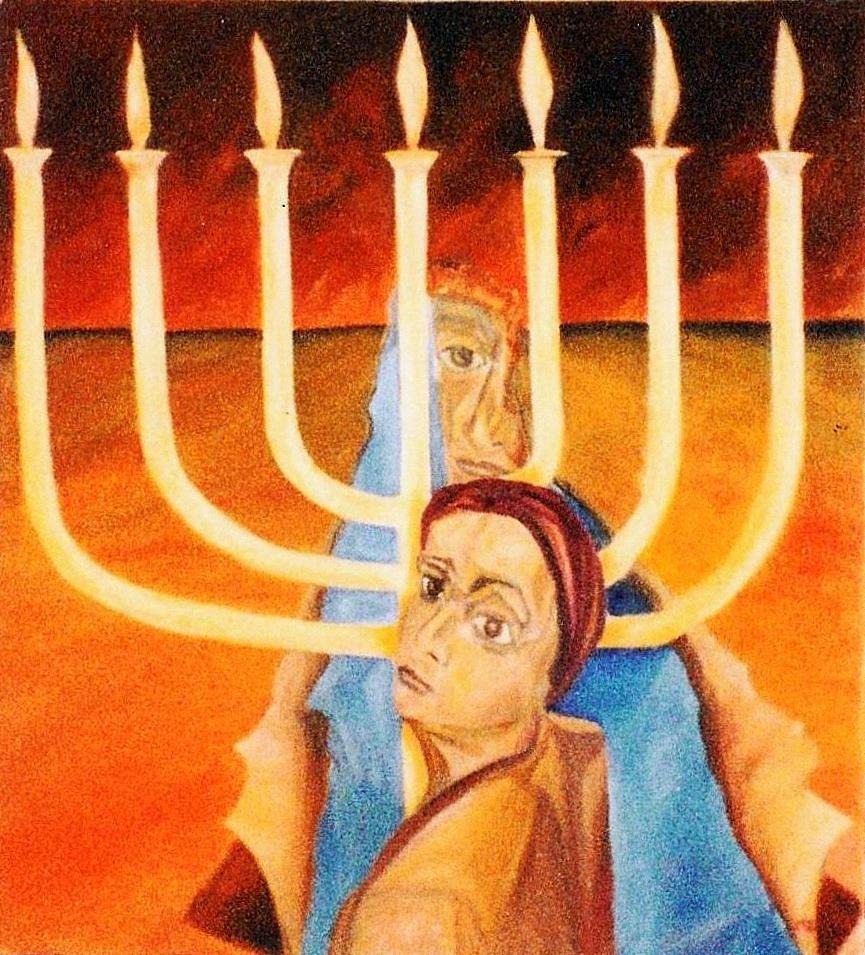
At that moment, the Creator also powerfully reminded Moses to infuse into the consciousness of the Jewish people the concept of the Shabbat, again, to make sure that the understanding of it will be enrooted into the people’s minds deeply. Michael’s mighty and strong Menorah at his Spiral of Faith painting ( 2005), with strong and devoted Jewish couple amidst the conditions and circumstances which are harsh and dramatic, as it re-occurs in our history, is the strong, beautiful and compassionate statement of love towards the people who have lived and still are living with this kind of clear understanding and deep devotion in their lives.
Describing all the works to be done for Mishkan inside and outside, the Torah’s narrative emphases such term as ‘generosity of heart’, this is additionally to wisehood of the heart which we have analysed before. In Vayakel, generosity of heart is applied to both the masters chosen by the Creator to make the Mishkan and also to the people who were donated to the Mishkan, and they did it enthusiastically, being panicked or repentant, or both after the calamity over the golden calf.
Many Rabbinic commentators mentioned that to the repetition of the previously explained details of the Mishkan, the second round of it in Vayakel and Pekudei parshot means also the deeper message, namely, the Creator’s pardoning His people over the sin of the golden calf, after proper punishment of those who instigated it, hearing Moses’ plea on behalf of the people and seeing the repentance of many. The idea of concentrating the Children of Israel’s attention and focus on making the Mishkan, the place of dwelling of the Shekinah, namely after the episode with the golden calf, was a conscious effort to replace their concentration, thoughts and aspiration with the most positive thing possible. With constructing and completing the Mishkan, its very existence will guarantee and maintain a much higher level of morality among a much larger number of people, objectively so.
There is certainly not without a reason, an indicative phrase is to be found in Vayakel, mentioning that the construction of Mishkah was ‘more than a labour’. This is to tell that while donating to and building Mishkan, people were not just making some work mechanically, but that it was their conscious and important effort. And that effort was not built over a very special ground, over the repentance. It is quite an important moment with regard to people’s psychological motifs, mentioned in Vayakel parsha with full significance.
In both Vayakel and Pekudei, Bezala and Ohalioub re-appear, with even more text dedicated to them, their craft, and their effort. Talmud mentions that ‘Bezalel knew how to combine the ( sacred) letters, with which heaven and earth was created”. Such knowledge is given to a handful of people at any time, and this places Bezalel not only as a member of his most noble Jewish family, and not only as a superb master of artistry, but also as a man who was gifted to possess a prophetic level of knowledge.
With regard to Betzalel and his level of understanding and knowledge, Rashi highlights that while Moses did not quite see the order of works for the Mishkan and believed initially that its artifacts and furniture should be made first, before the actual construction, Betzalel had reasoned to Moses that normally, a house is built first, with furniture and everything that supposed to be inside it, after that. Betzalel was right, and Moses was grateful for his insight and understanding, writes Rashi. And it was at that moment when Moses said to Betzalel: “ You are in the shadow of G-d”. Since then, Bezalel’s name traditionally is translated like that, mentions Rashi and other sources. What an immense privilege it is, to be in such a shadow. Which also means a protection and ongoing wisdom which gets to the heart, and commands the life and deeds of such people like Betzalel and his family.
One of the most popular quotes from the Torah also has to do with Bezalel, and it is in the parsha Pekudei, which mentions that Betzalel had “infused with G-dly spirit”, and did his work for the Mishkan ‘with understanding, with knowledge, and with every craft”. Many of the commentators are united in their rendering of this important in Jewish philosophy concept, and approach in which all those qualities are seen as different things: inspiration, knowledge, understanding and mastercraft. With one of them present in a certain person, it is commendable already. With more, the person’s abilities are rising highly. With all of them presented in the same personality, we have such rare talent as Betzalel.
Another important and often overseen phenomenon regarding Mishkan is what has happened with its artifacts later on. Sforno comments on it in unusually for his style elaborated way, stating that contrary to the objects from the First and Second Temples, none of the artifacts from the Mishkan, those objects which were done under close supervision of Moses, have been ever mentioned as they were gone. Sforno explains further on, emphasising that at the construction of the Solomon’s Temple worked hundreds of thousands of foreign workers, thus people who were not genuinely infused with the special spirit and aspiration regarding the place of the resting of the Schehinah, while the construction of the Second Temple was subdued to the will of Cyrus, and not a single Levi had been present there. Due to these fundamental circumstances in the cases of both First and Second Temples, believes Sforno, the chances of the eventual loss of many artifacts of the Temples were existing from the way in which the Temples were built. Which was completely different in the case of the Mishkan, with none of its artifacts registered anywhere as being lost, or seized, or destroyed. The difference was in the principal attitude towards the building of the Jewish Temple, states Sforno.
Speaking of such a unique place as Mishhan, it is only natural to expect something super-natural there. And it was. When everything was ready for the Mishkan’s building, Moses and the rest of the Israelites were wondering: how on earth could we erect it? It was mission impossible for them, given the construction’s weight and measures. “How will I do it?” – asked a clearly nervous Moses the Creator. And gets the answer: “You should put your hands onto it. It will erect by itself”. And it was exactly what had happened. This unique event, when the presence of the High Power has instrumentalised the sincere, devoted effort by the people led by Moses, can be also seen as happening in the Shadow of G-d, borrowing Moses’s own phrase. Mishkan was everything about it.
Importantly, from the point of view of Moses’ understanding the life and absolute importance of Jewish tradition, the time of the Mishkan’s readiness and the gap between it and its final erection is also quite telling. It is known that although the Mishkan has been ready by 25th of Kislev, with its following seven erections and folding the whole construction back, Moses , under the guidance of the Creator, waited for the whole three months before Mishkan’s final erection and the start of its permanent functioning as the G-d’s Sanctionary. Why is that? The Mishkan was finally erected and became the place of the dwelling of the Schehinah on the 1st Nissan . First of all, the explanation goes for the timing of the beginning of the Jewish year at the time of Exodus and long time after that, as the Nissan is known as ‘the first month of the year’, and such timing is quite logical and positively symbolic.
But there is also another reason, as it is noted in the Midrash. Moses wanted to make the Mishkan permanently functional in the month in which our forefather Isaac was born. How gently, how lovingly, how meaningfully and humane. Moses knew that there were not many commemorative things regarding Isaac who, being shy in his character, and after the deepest but never complained about psychological trauma of the Akedah, was left somehow in the shadow of his father Abraham and his son Jacob. Moses did sympathise with Isaac a lot, did like him, understood him well, and wanted to make something seriously memorable on his behalf. What can be more serious than the place made by human hands for the dwelling of the Shehinah among the Jewish people? I absolutely understand why dear Rabbi Joseph Soloveitchik , one of the deepest humanists among our best brains and hearts, did love Moses so much and felt him so close.
We know from the parsha Pekudei that when the Mishkan was erected for the final time and became the nucleus of Jewish life, the glory of H-shem filled it. Our rabbis provide many of their thoughts to that pivotal moment in the Jewish spiritual history. Midrash Rabbah provides very interesting analyses with the Shehinah’s ascent from the level of people more and more far from them, up to the seventh Heaven corresponding to substantial moral losses, sins and wrong choices of the Israelites, and then subsequent descent from the seventh Heaven down, closer to us, in the merits of the specific deeds of the Forefathers and Moses. That process came to its rewarding balance with all the effort of so many people in building the Mishkan.
The most important note comes from Sforno who said that the Shehinah filled every part inside Mishkan, with nothing of it outside it. The firmity of the Shehinah in Mishkan was unique, said Sforno, with emphasising that nothing like that was not present either in the First or especially Second Temples, and not even in Shiloh.

The presence of the Shehina in the completed Mishkan has become the best reward, and the mightiest immense source for protection and hope for the Children of Israel for years to come.