The SIMCHAT TORAH WAR AGAINST ISRAEL – 7.10.2023

Daily entry of the WAR & HUMANITY Special Project.

Michael Rogatchi (C). Strength of Love. Zion Waltz. Oil on canvas. 2016.

Well, quite a holiday Israel had experienced in the worst assault since the Yom Kippur War, and – exactly on the day in a secular calendar marking its 50th anniversary. In the atrocity which would be known as Simchat Torah War. Which we win, undoubtedly. The toll is already devastating. Appalling cruelty by Hamas savages attacking Israel. Terrible losses. Terrible way of losses. All the horrifying pictures which we saw today would stay with us for good. Arrested, beaten and pushed in the jeep with a dozen of savages, a young Israeli woman. I heard her screams from inside the jeep, and am still hearing it all the time. Two young boys in the arms of their grandmother, completely terrified, pushed as hostages to Gaza. I will remember their all faces for a long time. Our soldiers, those who were murdered and those who were captured, looking at their murdered friend. All of them. Elderly women terrified by the savages in their own homes, and taken from their homes to Gaza as hostages. My goodness. It is a long list of revenge, but they all will be avenged. And more.

We are with our people, with the state of Israel, every inch and every second of these challenging and sobering days. We are with all our friends in Israel and their families, each and every of them. They are with the IDF and wishing them smashing, as quick as possible victory over the beasts. We all are collected and ready to fight. And we will prevail. Israel always does. Am Israel Chai.

ЯВЛЕНИЕ ПАМЯТИ

Фильм Любови Аркус “Кто Тебя Победит Никто” ( 2021)

Инна Рогачий (С)

Просмотр фильма Любови Аркус “Кто Тебя Победил Никто” на Первом канале Российского Телевидения. Октябрь 2021. Фото (С) Первый Канал.

Любовь Аркус и ее замечательная команда работали над этим фильмом шесть лет. Слава Богу, что создателям, и прежде всего Любови Аркус, хватило силы воли и присутствия духа, чтобы завершить этот очень трудный, подчас почти невозможный проект, который сразу же стал явлением. Явлением памяти. Чутким, нежным, проникновенным, умным, взыскательным, не карамельным. Живым.

Память, чтобы она была и осталась живой, воссоздать необыкновенно трудно. Для этого нужны не только знания и понимание, чувство меры и вкус, деликатность и посвященность . Такие свершения требуют прежде всего проживания, отдачи автора. Это всегда кусок собственной жизни и часть собственной души, отношение к людям и явлениям, которые делают воссоздаваемую память живой. Любови Аркус удалось именно это, и это главный результат ее тяжелого шестилетнего труда.

Премьера фильма “Кто Тебя Победил Никто” в Москве. Любовь Аркус со съемочной труппой. Фото (С) Светлана Колосова.

В профессиональном смысле, кинопроизведение Аркус достигает подлинных высот в своем начале и конце, когда камера и монтаж начальных и финальных эпизодов документальной драмы об Алле Демидовой, но на самом деле, о ткани времени, в котором она и мы жили, являются художественным откровением. Начало и конец элегии Аркус нашему времени, второй половине 20-го века – это прекрасно сделанное кино, художественное, тонкое, изобретательное и мастерское.

Кинорежиссер, кинокритик Любовь Аркус.

Но документалистика, мой любимый жанр, потому что оставляет людей, не может состояться без конкретных персонажей – хотя кадры хроники толпы на похоронах Сталина, включенные в этот фильм, стали одним из самых сильных его впечатлений. 

В своем фильме Любовь Аркус подарила нам прекрасные эпизоды с прекрасными, редкими людьми, выдающими театроведами, ее Учителем Майей Туровской и знаменитым Вадимом Гаевским, прекрасным кинорежиссером Кирой Муратовой, и гигантом сцены, театральным режиссером Анатолием Васильевым. Дело даже не в том, что в трех случаях, кроме Васильева, эти съемки стали последними снятыми интервью колоссов истории театра и выдающейся женщины-режиссера, что само по себе является очень ценным материалом документального фильма. 

Майя Туровская.

Но то, как сняты и смонтированы все эпизоды с Туровской, Гаевским и Муратовой ( оператор этих эпизодов Ирина Штрих, ведущий оператор Алишер Хамидходжаев, монтаж Дмитрия Новосельцева), вызывает радость, тепло и любовь. Потому что это сделано не только совершенно профессионально – а именно, что  с потрясающим, редким приближением, проникновением и любовью. Господи, как нам не хватает этой теплой, внимательной человечности, да еще так хорошо сделанной, сегодня, в наше нервное, неровное, какое-то синкопическое время. Спасибо, ребята, спасибо, Люба, за то, что привнесли это в нашу жизнь. Очень хороший монтаж фильма стал дебютом Дмитрия Новосельцева – это очень обращающий на себя внимание дебют. 

Вадим Гаевский.

Для меня лично присутствие этих выдающихся людей в фильме стало самым большим подарком. Умные, светлые лица Гаевского и Туровской, такие знакомые многим театральным людям ( и мы с мужем в их числе), их неординарное видение, которым они с нами поделились на экране, как оказалось, в последний раз, просто стоят перед глазами долгое время после окончания просмотра, и никуда не уходят, а даже наоборот. Смотрела бы и слушала бы еще, и еще. Света, ума и доброты в мире стало бы еще больше, даже после их ухода из земной жизни.

Кира Муратова

Кира Муратова – умница, с ее тонким видением в большом и малом – из той же группы самых замечательных людей российской культуры, жемчужина, такая самодостаточная, такая скромная, такая интересная, и такая милая. И ее хочется и видеть, и слышать, и ощущать как можно дольше и больше после фильма Аркус. Такие люди обогащают наше существование во все времена и на все времена. И эти жемчужины посылают свои нежные блики, какие и есть у настоящего, не искусственного, жемчуга, в элегантном и точно выверенном визуальном измерении фильма.

Анатолий Васильев – он всегда интересен, потому что он всегда глубок и всегда является самим собой, человек-океан, вся красота и притягательность которого – на глубине. Но добраться до этой глубины, разглядеть ее и показать другим могут немногие. Любови Аркус это удалось. Я никогда не видела Васильева, этого гиганта российского и мирового театра, таким незащищенным, таким откровенным, таким щемящим. Если бы Люба Аркус сделала фильм о Васильеве, это было бы прекрасно. В ее фильме о Демидовой мы увидели проблески прекрасного, волнующего, интереснейшего явления Васильева.

Анатолий Васильев

Отдельное спасибо Любе за линию об Анатолии Эфросе. Историю и драму этого большого режиссера и замечательного, доброго человека, знают многие театральные люди. Но рассказать ее так точно и честно с большого экрана, в фильме, который останется навсегда, потому что стал документом эпохи ( именно ввиду честности замысла и смелости его исполнения) – это поступок. И этот поступок стал важной частью создания Аркус и ее командой именно живой, живущей памяти, самого благородного и самого трудного вида документалистики.

В этом фильме – много удивительных моментов. Я не стану их пересказывать, их нужно видеть. В этом своем впечатлении я рассказала о том, что тронуло больше всего лично меня.

Требовательность автора к самой себе в этом фильме на очень высоком уровне, и профессионально, и морально, и эстетически. Такой уровень требовательности вызывает большое коллегиальное уважение к Любе. Она создала мастерское произведение. На этом уровне требовательности, избрание камертоном длинного двухчасового фильма Бродского – как явления – не стало удивительным. Это стало очень точным, в десятку, решением автора. Бродский и был нашим камертоном в те годы, о которых рассказывает Аркус через судьбу Демидовой. Бродский  – и никто иной. 

Иосиф Бродский

Финал фильма, с наложением голоса Бродского с замечательным чтением своего “Осеннего Крика Ястреба” 1975 года, вскоре после его выдворения, а по сути, жестокой, неоправданной вышвырнутости из жизни как он ее понимал и ощущал, вообще,  стихотворения,  полного отчаяния, тоски и некоей толики уникальной ироничной бравурности Бродского, на разбирание этого стихотворения вслух Аллой Демидовой почти полвека спустя, слияние их голосов, разделение их голосов, преобладание голоса то Демидовой, то Бродского, и наоборот, на фоне крупного плана из вечного немого кино, стало лучшим из того, что я видела не только в богатой тематически и высокопрофессиональной российской кинодокументалистике, но и в жанре документального биографического кино вообще. Финал фильма “Кто тебя победил никто” стал опытом погружения, внесения зрителя во время Демидовой, Бродского, Валуцкого, Любимого, Высоцкого, Эфроса, Васильева, Таганки, которая была нашим всем на театре  и в жизни в течение многих лет асфиксии и мечтаний – у тех, кто был способен – о полете ястреба без отчаяния, просто о возможности долететь до Коннектикута, посмотреть на него, побывать, сделать, помечтать, совершить, воплотить – то, что хочется, а не то, что разрешат. 

Поймут ли зрители новых поколений, о чем это мы? О чем это Люба Аркус в двухчасовом портрете нашего времени на фоне 80-летней Аллы Демидовой? Я думаю, что да. Ведь делали этот фильм под руководством Любы Аркус молодые люди, что ей и им особое спасибо. 

Когда наши друзья, которые посмотрели фильм чуть раньше нас, грустили, и печалились, что этот прекрасный фильм есть прощание – со многим и многими, я немного переживала. Грустно, все-таки. Вокзалы  – места нервические. Но когда я увидела фильм и ту молодую команду, которая так точно профессионально и с такой человеческой любовью и пониманием помогла Любе воплотить ее большой, важный, неординарный и смелый замысел, то обрадовалась и успокоилась. 

Этот фильм стал объемным, глубоким отпечатком нашей жизни второй половины 20го века в грядущем времени. Фильм будет жить и сохранит наше время, и людей нашего времени,  в честной, проникновенной, изящной и теплой элегии Любы Аркус, честь ей и хвала. 

Инна Рогачий (С). Посвящение Бродскому. 2014. Частное собрание, Москва, Россия.

Иосиф Бродский рассказывал в минуту редкой откровенности, похожей на задумчивую откровенность Анатолия Васильева в фильме Аркус, что первой для себя задачей, творческой и человеческой, он сокровенно хотел “сохранить родных. Чтобы они не исчезли. Чтобы ( их) помнили. Чтобы они были”. Бродский был очень хорошим – и очень несчастным – сыном.

Любовь Аркус совсем недаром избрала Бродского камертоном своего документального повествования. Она тоже сохранила. Мы и те, кто пришли и придут после нас, будем и будут помнить. Явления памяти состоялось. Спасибо, Люба. Большое спасибо.

Фильм можно посмотреть здесь.

Октябрь 2021

Финляндия

Inna Rogatchi’s The Lessons of Survival film to be shown at The Long Night of Museum 2021 in Vienna

The Lessons of Survival, Inna Rogatchi’s well-known documentary about her friendly, intimate conversations with legendary Simon Wiesenthal will be shown at the Vienna Wiesenthal Institute ( VWI) program of the Institute’s participation at the Vienna and Austria annual mega cultural event, The Long Night of Museums, on October 2nd, 2021. 

The documentary which was successfully shown global-wise, was filmed in Vienna, at Simon Wiesenthal’s residence and his office of the Jewish Documentation Centre, as well as in Mauthausen concentration camp, in Linz, and the other related places in Austria. 

The film is different from many documentaries about the legendary Nazi-hunter in the way that Inna and Simon were close friends for many years, and the film reflects the intimacy and openness of their conversations on the most dramatic moments and tragic events prior, during and after the Second World War and the Holocaust. It is a special human document, rare in its openness and sincerity of its main protagonist Simon Wiesenthal, the one of the most crucial international figures in the post-Holocaust. 

Additionally to the special qualities of ‘an open heart’ testimony of a monumental personality, the film is important due to its artistic features: special music by the Israeli composer Israel Sharon performed by Karizma Ensemble, and powerful unique art created by Michael Rogatchi whose works were deeply appreciated and loved by Simon Wiesenthal. 

The combination of those unique human and artistic monologues has created the film which speaks from a very close distance and straight to the feelings of the viewers. The film’s concept and way of communication with its viewers is to leave each person alone with the unique monologues of Simon Wisenthal, added by the musical and artistic ‘solos’ of Israel Sharon and Michael Rogatchi accompanying the Simon Wiesenthal’s narrative in their own powerful and unique way. 

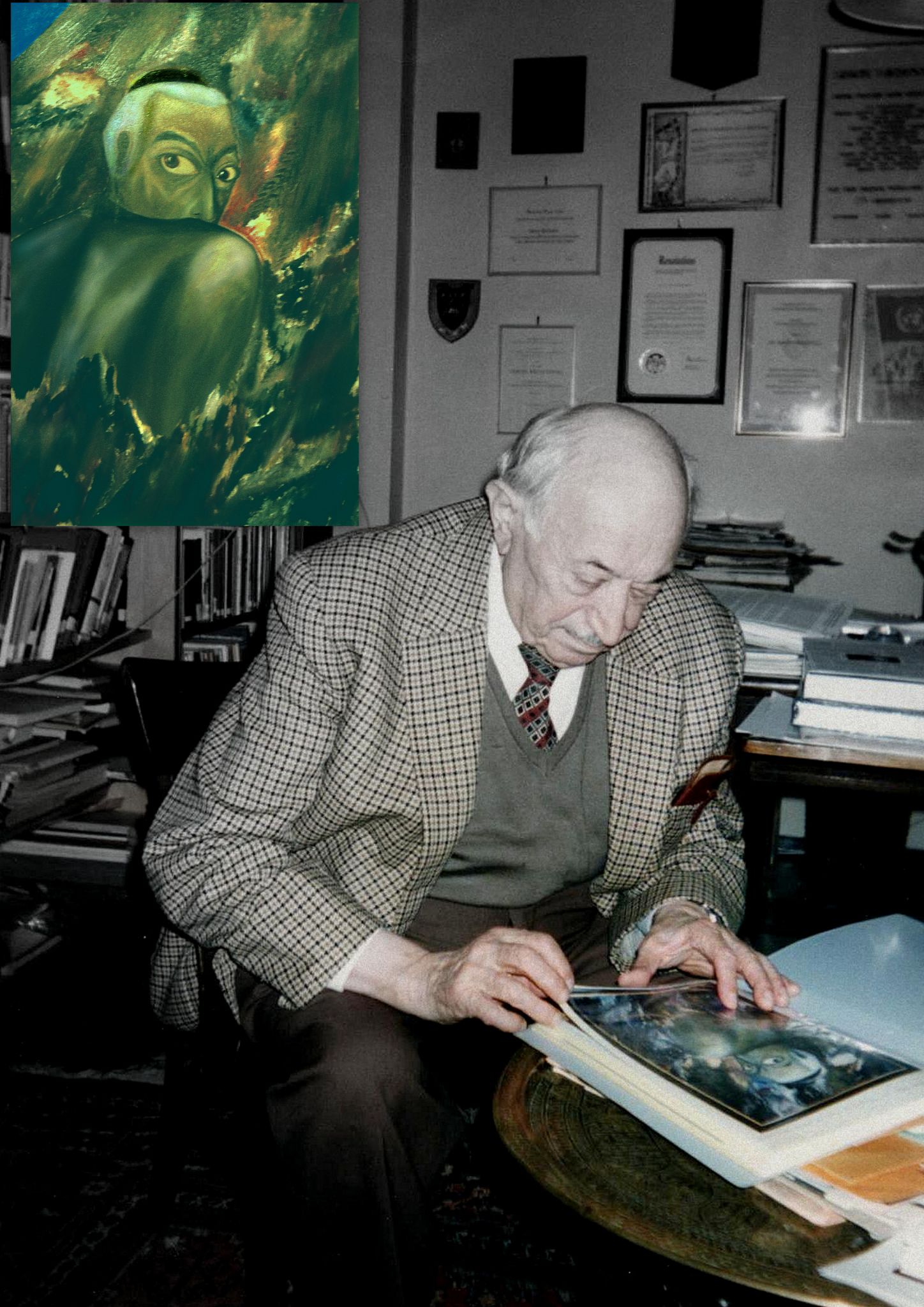
Simon Wiesenthal in his study in Vienna with Michael Rogatchi’s portfolio of his works dedicated to the Shoah. The painting in question, Unforgiveness ( 1996) belongs today to the Permanent Art Collection of the Ministry for Foreign Affairs of Israel. Photo © Inna Rogatchi. Courtesy: The Rogatchi Archive.  

More about the film can be read here – https://rogatchifilms.org/?page_id=259

Vienna Wiesenthal Institute for Holocaust Studies ( VWI) is very natural place for screening the film in the capital of Austria where Simon Wiesenthal lived and worked for many decades after the end of the Second World War. 

Simon Wiesenthal in his study in Vienna during one of many conversations with Inna Rogatchi. 1990s. Photo © Michael Rogatchi. Courtesy © The Rogatchi Archive. 

The screening of The Lessons of Survival film by Inna Rogatchi at the Vienna Wiesenthal Institute can be seen in the VWI program here : https://langenacht.orf.at/museum/bl/wien/li/die-zukunft-des-erinnerns—–museum-simon-wiesenthal

Inna Rogatchi next to the Simon Wiesenthal working desk from Vienna which Inna knows very well. Simon Wiesenthal’s family has bestowed this special artifact to the Illinois Holocaust Museum & Memorial Centre Chicago. 2015. Photo © Lilian Gerster. Courtesy © The Rogatchi Archive. 

Lang Nacht der Museen, the Long Night of Museums is an annual mega cultural event in Vienna and Austria. It is characterised not only by the fact that many great museums of the Austrian capital and all over the country would stay open at unusual late hours, but the fact that the museums comes with special programs, specially created events, showing rare artifact or organising special experience for the audience which is huge for the annual celebration of culture. In Vienna alone, the event traditionally gathers 200 000 people. The previous year 2020 the beloved by the Viennese public Lang Nacht der Museen event was not organised due to the covid pandemic. This year it is expected with enthusiasm although the traditional number of people attending can be smaller because of the restrictions. But still, the cultural festivities of the Long Night of Museums are back to Vienna and Austria this year, and the public is invited to wonderful museums of Vienna and the country on Saturday night of  October 2nd, 2021. 

The timing of the screening of Inna Rogatchi’s film about Simon Wiesenthal The Lessons of Survival ( in English) would be at 9.30 pm Viennese time at the Vienna Wiesenthal Institute for Holocaust Studies, at Rabesteig, 3, 1010, Vienna.

Chazak, Jim!..

A TRIBUTE TO GENERAL JAMES M. HUTCHENS

First published in The Times of Israel – https://blogs.timesofisrael.com/chazak-jim-a-tribute-to-general-james-m-hutchens/

There are some people whose life is a novel, a movie, and it comes effortlessly and naturally because it is just the way they are. 

Late General James M.Hutches, a beacon of light and assuredness, was just like that. If somebody would mention a semblance of my first phrase to Jim, he would laugh it off instantly, and he meant it. But in fact, so many episodes of his long life are worth a book of its own, with several of them written, that it is really hard to believe that all these episodes belong to the life of just one person. 

Late Brig. General, the US Army James M. Hutchens. Courtesy ©: The Jerusalem Connection and The Rogatchi Foundation. 

His incredible service in Vietnam where he fought so bravely, being rewarded two Bronze Stars and one Purple Heart for his exemplary service to his country and his countrymen. His tireless work in support of Israel which he did for decades, devoted, efficient, noble. His fight against terrorism both in Israel and in the USA. 

Opening ceremony of Michael Rogatchi’s Year 1953 painting at the Laogai Museum, with General Jim Hutchens and Pat Hutchens in the centre. Washington D.C., February 2013. Courtesy ©: The Rogatchi Archive. 

They all were deeds of the man with a great vision. Jim did know exactly what he is doing  – or not doing , and where he gets involved – or not so, and why. The clarity of his vision was remarkable in the times of so many compromises of all sorts, and prevailing political correctness all around. And that clarity was reassuring in an honest, pure, curing way. The way many of us miss nowadays, increasingly so. The assuredness of  Good Forces that emanated from Jim during his lifetime was magnetic. And healing.  

It is what is expected largely from the servant of God which Jim was. But in his case, it was 101% true. No false, no pretension, no supposition, no suggestion. Reverend Hutchens was the man of organic goodness. 

It took me some while to start to comprehend how to write about Jim in the past tense. He was always there – for us, for his friends, for his family, for Israel. He was limitlessly generous in providing his presence and availability to us all. He became the factor of stability of hope, light, supportive action, and assuredness. 

I am writing a tribute to this remarkable man on his birthday, imagine. Jim would be 87 today. He passed away just five days before his 87th birthday, being weakened to the defining degree by the last 18 months of probably the most difficult period in his life.   Due to the covid restrictions, he was confined within the four walls of the place where he lived this last period of his life. That confinement was heart-breaking for all who knew and loved the brave General. 

* * * 

Jim and his wife, artist Pat Hutchens who passed away in April 2014, were dear and close friends of my husband Michael’s and myself. Very dear and very close friends. A family, in many senses of the word. We were blessed with this family-like friendship for over twenty years. 

Inna and Michael Rogatchis with Pat and Jim Hutchens at the concert of Felix Menhelshon’s Elijah at the Kennedy Centre. February 2021. Courtesy ©: The Rogatchi Archive. 

It was during one of my frequent visits to Washington D.C. while advising some senior MEPs and participating in the work of the key foreign policy bodies of the European Parliament that I was speaking at an important US forum on the Middle East policies as an invited guest speaker when I have noticed a special figure and special face in the audience. In that fully packed audience that face and the reactions of that man on what I was saying were distinct in the most positive way. 

He came to talk with me after my speech, and we have become instant friends. Next morning, Jim and I continued to talk over breakfast at my hotel , and during that talk I had to reschedule the rest of the day of my tightly planned program full of meetings, because both Jim and I just absolutely  needed to talk more, and more, and more. It was a gift of friendship from the first sight. 

Immediately after that rewarding encounter, Jim’s wife Pat, well-known artist and theologist ( as Jim himself) and my husband artist Michael joined our family-like unit, and from that moment over twenty years ago, it was a celebration of trust, compassion, solidarity, understanding, sharing, and support. 

It was the family of the real American hero who was passionate about Israel where they did live for several years in the 1970s, and who did everything in their power to make this passion constructive. This was a truly rare attitude against so many challenges on their way, always. But not for once, their belief was not flinching for an inch. Israel and Jewish people have had staunch, selfless and very noble supporters as long as Pat and Jim Hutchens were living in this world. 

Both Jim and Pat have decided to convert to Judaism at a certain stage of their lives, and till her end, Pat always signed her messages to us as Yael, her Jewish name, and Jim as Yaakov. He had a good command of Hebrew, as well. That essential change in their both’ lives turned to be dramatic and complicated, by the serious fault and ungraceful misunderstanding of the others, without a slightest sign of their both’ fault. What was amazing for Michael and myself always, was a total absence of bitterness in Jim and Pat after that incredibly traumatic experience. And their unwavering, encompassing love of Israel and Jewish people. 

The one of the most stunning human deeds in support of Israel was Jim’s personal undertake of buying the remnants of the bus exploded by the terrorists in Tel-Aviv – and organising the shipping of the remnants of that bus all the way to Washington DC, installing this screaming evidence of the anti-Israel terror in the front of the Capitol, conducting many extraordinary rallies and events next to the bus there, thus really influencing and essentially helping the acceptance of  several resolutions of the US Congress and Senate essential for the Israel’s struggle against terror on its soil.  

Being an undisputed hero of the United States, being justly respected widely and highly, the former Deputy Chaplain of the US Army Brig. General James M. Hutchens spent a colossal amount of his time in his tireless practical everyday hard work supporting Israel. Myriads of the Israeli officials who were tasked with various important and often quite uneasy tasks knew that they could rely fully on General Hutchens who acted in quite unusual way. 

When help was needed, Jim was not relying on a casual and sporadic telephone call. He was personally coming with the persons who needed support to all and every office at the Capitol Hill to make sure that the people from Israel would be heard, understood, and assisted. There was no better and more reliable man in the huge DC pool of senior influencers for Israelis than General Hutchens – who never failed to support Israel in anything he was addressed on, from the required political support to the serious, high-up and discreet resolving of truly tricky problems, as the one with the anti-Israeli flotillas. 

He never, ever did it for a penny. I know about it in detail. He did it out of love, and his principles. That love was rooted deeply in both Jim and his wife, artist Pat who was the person who undertook a very demanding personal journey back to the Holocaust realities creating her famous by now Auschwizt Album Re-Visited series

I was privileged to witness the process as it was evolving, worked on this project of her life with Pat, and wrote about it, with huge gratitude. 

We were seeing each other regularly and often, not only in the States. When Jim and Pat were coming to Poland, with the Auschwitz Album Re-Visited exhibition which was the first show of those so very special images outside the US, and more, at the close proximity to the place of the actual actions depicted in the original monstrous Auschwitz Album put into the human and moral questioning context by brave Pat Hutchens, I flew over to Krakow specifically to be there with both of them during that uneasy and challenging experience. 

Inna Rogatchi with Pat and Jim Hutchens at the Auschwitz Album Re-Visited first European exhibition, Krakow, Poland, 2012. Courtesy: © The Rogatchi Archive.  

Later on, I curated and organised several of the exhibitions of those incredibly important artworks in various European countries. 

The generosity of both Jim and Pat Hutchens was legendary. Seeing them in so many various circumstances, at their home and while travelling, at the special events and during a casual walks, in the morning and in the evening, with telephone ringing often in their truly hospitable and open, inviting home, I was often thinking that those are the people who were born to help to others. But I knew that what has become such a natural way of life for both Jim and Pat, was rooted in their deepest conviction, crystal-clear understanding of right and wrong, and stern principles. Plus – two golden hearts which were as one, due to their fantastic love, respect and admiration for each other. They both have become true guardians of many. So many people love them, and always will. 

* * * 

There is no wonder that when The Rogatchi Foundation decided to introduce a Life Achievement Family Award to the range of our annual Humanist of the Year Awards, our Board and the International Advisory Board unanimously voted for Jim and Pat ( posthumously) Hutchens as the recipients of it. The wonder was the timing. 

As it happened, a warm and enlightening ceremony of the Award in Virginia in early March 2020 was the very last public event attended by General James M. Hutchens in his long, heroic, fantastic, exemplary, rare life. All three of Jim and Pat’s children were there, along with many friends and colleagues. It was also the very last time when Jim was among the people, not by himself.

I flew to the US specifically for that occasion, without knowing that it would be the last time that I will be seeing Jim in person, but with absolute clear inner understanding that the ceremony must be done now. At the moment, I had no clue of the reasoning behind that strong push inside myself to accomplish the ceremony of awarding Jim as soon as possible. Now I know. When I was leaving the Ronald Reigan airport, flying back from Washington DC, I was flying from an already completely empty space. When I landed home, the era of covid pandemic had started. 

Our mutual friend who was very kindly and devotedly visiting Jim all the time during his covid-caused confinement whenever it was possible, was seeing our brave general a week before his passing in his sleep. The general was weak, life was leaving him slowly but steadily. He was in and out of conscience, dreaming and waking in turns. Amy, our friend, was sitting next to Jim at the moment when he was in between that all the time prolonging dream and consciousness. Jim was saying something, Amy understood. That something was ‘Yahweh’. 

I was both surprised and not. Because, for many years now, I remember the episode in which Jim played a very special role. The one of the towering figures of American Jewry, the person who contributed enormously much into the active support of Israel during all his life, was battling the vicious cancer for a few years. At a certain point, he was close to losing the battle. Jim, who was a good friend and colleague of that man, was visiting him in hospital regularly and often. 

Once, the man had asked Jim, the Reverend, to promise him something. “Please, stay with me during that moment, Jim. Nobody else, but you. Promise me that it will be you”. For three last hours in that great Jewish man’s life Jim Hutchens was the person who held the hand of the dying Jewish fighter reciting all proper Jewish prayers with and for him. ‘Chazak, my friend, chazak”, – Jim was saying to his passing friend. “Chazak” – was the last word, with the smile, of the man whose purpose in life was the safety of Israel and legacy of Ze’ev Zhabotinsky. 

* * * *

When one’s parents are leaving this world, it is part of us leaving. When one’s siblings are leaving, it is the same. When one’s relatives are leaving, our world cracks and crumbles. When one’s friends are leaving, our own personal world gets holes in it, the holes which are unrepairable. And then, there are the people, the giants of men, who were protecting you, supporting you, helping you, listening to you, understanding you, comforting you, all this without any pomposity, humbly, modestly, organically, cordially, with needed pitches of humour, always, and that good laughs together. People who understood you without words, and whose unassuming but steady love and unquestionable loyalty was your blessing and protection, your shield. When such people who are extremely rare in one’s life are leaving this world, after a paralysis of an instinctive non-belief in what has happened, you start to understand what it means to be orphaned. 

It is not only Michael and I who lost a dear friend. It is Israel which has lost a great and loving supporter, Yaakov ben Abraham, with the passing of real American hero General James M. Hutchens. We hope that his memory will be long and fruitfully lasting. 

July 18, 2021

© Inna Rogatchi

The Story of Little Lulek, and Us All

First published in The Times of Israel – https://blogs.timesofisrael.com/the-story-of-little-lulek-and-us-all/, as well as in Tribune Juive ( Paris, France) and The Jerusalem Connection Report ( Washington, D.C.).

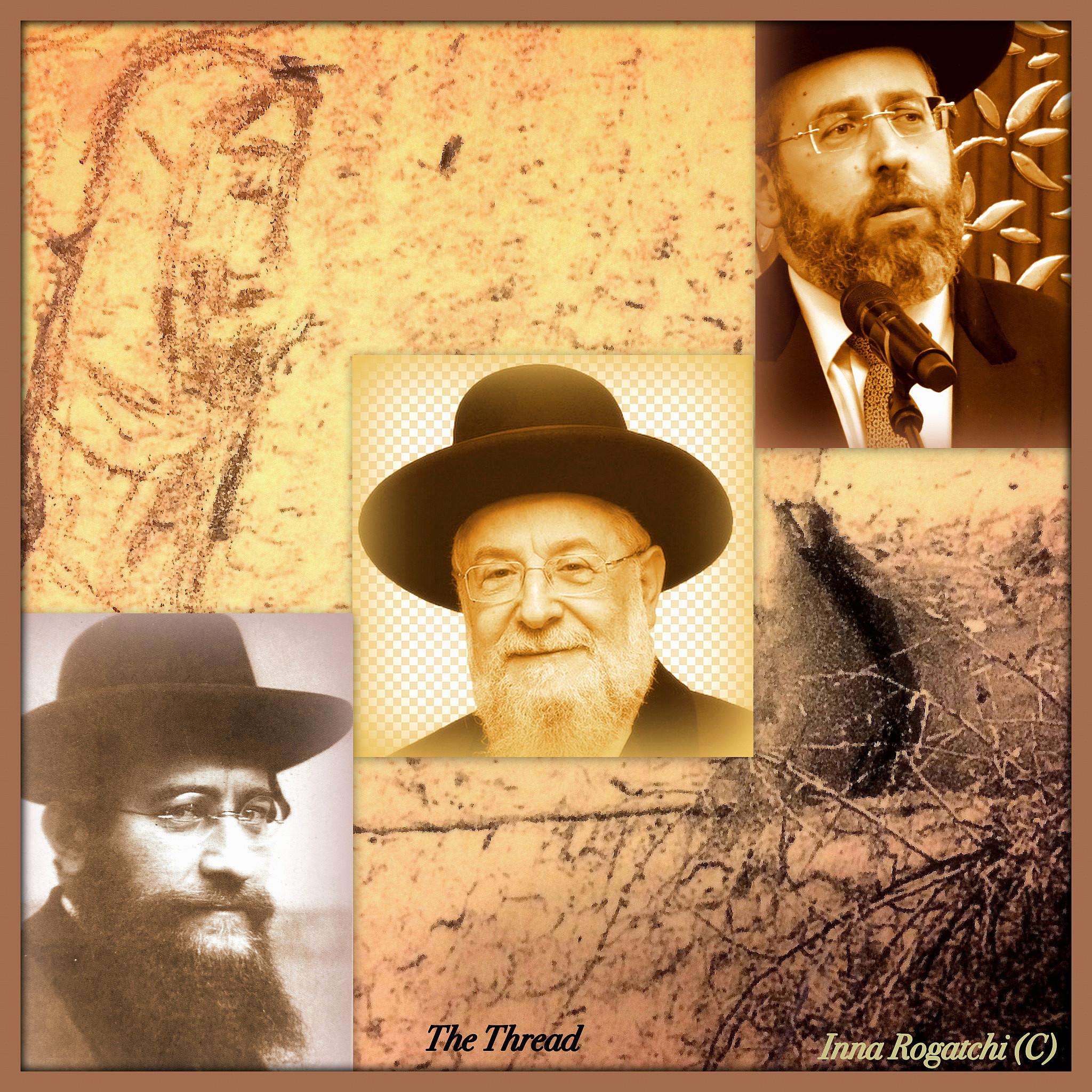
Some half of a year after the Shining Souls was presented at the European Parliament in January 2017, we met and talked with Rabbi David Lau, the current Chief Rabbi of Israel, now the 39th generation of the Lau rabbinic dynasty. We were discussing the event in Brussels, and I did show to Rabbi David the brochure with the text about his father. He was deeply moved. And I was also deeply moved by his love for his father and their family. Deep, warm, human, very quiet, not manifesting, noble love. I still remember that moment with a huge gratitude to the Creator for being able to witness such pure and sincere human emotions. 

The person next to Rabbi David who was reading the text while Rabbi David was full into emotions, was not aware of those details. He was asking Rabbi David if that had had the place, and Rabbi David who could not quite talk, was only nodding to him. The man felt silent and was sitting for a long time deep in his thoughts amidst lots of activities around us. 

I’ve met Rabbi David on several various occasions in Israel before, and I knew that he is a very thoughtful and deep person, and very compassionate and humane, as well. Inna Rogatchi (C). Portrait of Ashkenasi Chief Rabbi of Israel David Lau. Fine art photography. Limited Edition. 2017.

Recently, I was deeply impressed by his reaction, his stand, and everything he did and stated in the wake of the tragedy in Meron. As we all know, there were different reactions. But Chief Rabbi David Lau who happened to be in Meron at the time of the disaster, was gentle, compassionate, understanding, fair, intelligent, wise and honest – just like his father. 

I will never forget one photograph of so many that we all saw from the place of the tragedy. The Chief Rabbi of Israel was crying stepping a bit aside in Meron, so unpretentiously, so humanly that it went straight to the heart. “This is what the real Rabbi is about” – said my husband. I cannot agree more. 

These days, we are thinking on the Second World War again, on Holocaust, on all its victims. We have been doing it for 76 years already, and it still feels as if it had happened yesterday. Because of the magnanimity of the crime? Because of the unspeakably cruel violation of so many innocent souls? Or because the eyes of little Lulek witnessing his mother taken in that horrifying track are still there, at the scene, the whole  life after, day and night?Inna Rogatchi (C). Kotel II. Fragment. Crayons Luminance on authored original archival print on cotton paper. 45 x 60 cm. 2020. Private collection, London, the UK.

There were so many little Luleks, so many fathers murdered, so many mothers taken, so many little sisters, like the one of Elie Wiesel’s, were thrown in the fire, alive, so many of young Minas, like my great-aunt, were murdered in a cold blood, along with all those women, and men, and children, and elderly, and those who were not born as yet, as their pregnant mothers were exterminated. 

Of course, we all are Holocaust survivors.  Rabbi Yisrael Lau is absolutely right on that. For us to remember that, to comprehend that, and to live accordingly, on so many levels, it is needed that we would be reminded by people like him, in all his characteristic intellectual honesty  and that special humane shining of the Lau family. 

We need to see little Lulek’s eyes, in the 38th, and the 39th, and the following generations of this extraordinary rabbinic dynasty that has not been interrupted, against all odds, for it has the purpose which they are carrying on in this unmanifested, highly intelligent, deeply understanding, very moving, noble and quiet way. As real Rabbis should. Inna Rogatchi (C). The Thread. Rabbis Lau in 37th, 38th and 39th generations. Fine art collage mounted on Inna Rogatchi’s Kotel original drawing. 60 x 60 cm. 2021.

I think I know why little Lulek was saved in the Churban. I have no slightest doubt about it. Only unlimited gratitude. 

May 2021

‘All the Jews are Holocaust Survivors’

‘To tell you the truth, all the Jews of the world are Holocaust survivors’ – said legendary Rabbi Yisrael Meir Lau, 83-year old, in his speech on the 76-th anniversary of the end of the Second World War. I always thought this way, ever since I learned about Holocaust in my early age. Holocaust lived in our family, as it lived in the families of everyone we knew, and those we did not. 

It was personal, and it was not personal at the same time. It was and is cosmic. Both, that crime and that survival. 

When I was younger, I could not understand how on earth some people who survived in the Shoah did not tell their children what they had come through. I had that marginalised, insensitive attitude until I have read the devastating books of Aharon Appelfeld when I finally realised that there had been  such horror that many people simply could not start to recall it. By the time I’ve come to this conclusion, I learned about the Shoah a lot, methodically, professionally, from the first-hand witnesses. Still, each story is a revelation. Because of a simple fact: it was a living soul to be subjected to the worst of nightmares. Inna Rogatchi (C). Landscape of Jewish Memory. Watercolour, wax pastel, oil pastel, lapice pastel, encre l’alcool, perle le blanc on authored original archival print on cotton paper. 50 x 70 cm. 2017.

While my grandmother was always speaking on her murdered young sister Mina, my grandfather always clinched his jaws in a lead-like silence regarding his mother and father and the other relatives annihilated in the Shoah. While my mother spoke often about her murdered aunt and uncle, my father kept silent and was getting white while thinking of his aunt and her murdered family. 

But they all were present in our lives, always, day and night. Their souls were living under the same roof with us. 

Although it took too long for me to fully understand the reasons of silence of those of the Jews who could not open up on the Shoah, I always thought in awe of those who did. Because such an opening means a repetition, and everything evoked by it.  Elie Wiesel, who we had an honour to know, for many decades was unable to say a word about his little sister whose terrible death he had to witness, himself being just a 16-year old youth. Such a giant trauma the Shoah was for so many Jewish people that the horror that they lived through was still actively blocking their ability to narrate for decades. Just to think about it.Michael Rogatchi (C). Faces of Holocaust. Triptych. Part II. Child. Oil, Indian ink, black and white cotton paper, burn paper on cardboard. 70 x 50 cm. 1991-1992. Permanent Art Collection, Jewish community of Dnepr, Ukraine.

My husband Michael who drew and painted only handful, but quite powerful Holocaust-evoked images during his long artistic career, always are thinking on the little boy whose mother was taken from him in the truck. He was just seven. That boy was waiting for sixty eight years for being able to describe that heart-wrenching scene that he bore with him all his life. As Elie Wiesel bore the similar scene of murder of his mother and little sister in the front of his 16-year old eyes. 

Very rarely in our life, including tragic personal circumstances, I saw my husband crying. But it was the case while he was reading that book of that boy written almost seven decades after the events that the boy was made to witness at the age of seven. The name of this book is Out of the Depths, and its author is Rabbi Yisrael Meir Lau. 8-year old Lulek, future Rabbi Yisrael Meir Lau, with fellow Buchenwald survivor Eleazar Schiff on arrival to the port of Haifa, aboard the RMS Mataroa, July 15, 1945. Courtesy: Rabbi Yisrael Meir Lau.

Because of the several extremely powerful photographs with that small boy survivor that has become the part of the documented legacy of Holocaust, because of that extremely powerful book, but mainly because of symbolic role of that child, Rabbi Yisrael by Providence has become as if existing in two images, two characters in our perception. The one is of the distinguished Rabbi who is widely respected and whose authority is overpassing many factions and groups inside the Jewish world and outside it. And the other one is of that boy, small Lulek, who has become the one of the most tangible, most powerful symbols of humanity, yes, deeply wounded, but ultimate humanity which prevailed evil.  

The presence of little Lulek

I am positive that distinguished Rabbi Lau who was also the Chief Rabbi of Israel, and who is the Chairman of Yad Vashem, is able to maintain his superb and towering spiritual, intellectual and human qualities all his great life  due to the fact that in parallel with him, Lulek in and just after the camps, always there. Even I can feel Lulek’s presence, what to say about Rabbi Yisrael himself. 

That Lulek boy, what a destiny he has. He was the one whom American Rabbi Shacter had noticed being in the deepest shock possible, behind the pile of corpses in Buchenwald on the day of the American liberation of the camp in April 1945. Rabbi Schacter was the first American Rabbi entering the liberated Buchenwald, in the hour after the American troops had entered it. If not that boy, with that special expression in his eyes, Rabbi Shacter might lose his mind, he said himself, out of what he saw entering the camp. But in Lulek, he embraced life, and kept sane. 

Yet before that, the soldier of the Soviet Army who was a prisoner in Buchenwald, did care for Lulek, was feeding him, protecting him, saving him. That soldier warmed and sheltered a small Jewish boy and wanted to adopt him. But it was also Lulek who was keeping the soldier willing to live, because the soldier in captivity had a purpose to survive to protect the child he wanted to adopt. Years and decades after the war, Lulek always remembered the soldier. The soldier always remembered Lulek. Chief Rabbi Lau was able to identify the soldier’s name, Fedor Michailichenko, and his whereabouts, Rostov-Don in southern Russia, years after Fedor’s passing. Still, Rabbi Lau has visited the place and met with Fedor’s daughters who told him how their father has lovingly remembered Lulek all the years of his life. Inna Rogatchi (C). Ghetto Waltz I. Crayons Luminance on authored original archival print on cotton paper. 45 x 60 cm. 2019.

Lulek could not be adapted by the Soviet Army soldier, because he with his brother Naftaly, a real hero who did save his small brother in the camps, and who was the only surviving member of a large Lau family along with Lulek, were about to be sent to their relatives to Palestine, their uncle and his family. 

I saw Rabbi Yisrael and heard him speaking many times in my life, fortunately, in Jerusalem and New York, in Warsaw and Tel-Aviv, on different occasions and at different venues. I remember all of those meetings, because we all were lucky to be in the presence of a great man. Ten years ago, I was honoured to be present at the launching of the English version of Out of the Depth book at the Jewish Book Fair in London where Lord Rabbi Sacks was presenting Rabbi Lau’s extraordinary memoir. 

Arguably the best public speaker in the modern Jewish world, Rabbi Jonathan who never had any kind of difficulties at his brilliant public speeches, simply had to do it that time very slowly, with many pauses in between his deeply emotional words, and we all standing around, grasped for extra air every time during each of those many pauses. I always was deeply impressed by dear Rabbi Jonathan’s attitude to the Shoah. He had taken it to the very bottom of his kind heart, and it was always extremely personal for him. Michael Rogatchi (C). Final Solution. Oil on canvas. 88 x 68 cm. 1994.

Of all these encounters, I will never forget the meeting with Rabbi Yisrael in his office when from the first second my eyes were completely magnetised by one picture of Rabbi’s wall, and there are many of them there. But this one which is situated closest to the Rabbi’s chair was special. It was his father, the last Rabbi of Piotrkow Tribynalski, the city in Poland which has its special role in the history of Holocaust. It was in that very place that the first Jewish ghetto of the Second World War had been established as early, as in October 1939. As many, as 25 000 people were cramped in there, with 22 000 of them, the entire Jewish community, from the city itself. Rabbi Moshe Chaim Lau was their last Rabbi. With all of them, in its entirety, he was exterminated in Treblinka. Rabbi Moshe Chaim Lau, the last Rabbi of Piotrkow Tribunlaski in Poland, father of Rabbi Yisrael meir Lau. Courtesy: Rabbi Yisrael Meir Lau.

Rabbi Moshe Lau was the Rabbi in the Lau family in the 37th generation. Just to think about it. The line was not interrupted throughout all the tremendous turmoil of the history of Jews in Poland during about one thousand years. With Rabbi Moshe being murdered by the Nazis, and his two sons both in young age, being in the Nazi concentration camps, the danger of breaking the silver thread was imminent. When I read about the history of the Lau family, and compared it with what I knew of the family’s tragedy in the Shoah, I thought so very often: “How absolutely awful it could be if such a special, strong  line of Rabbis which never exists on its own, but is predestined to be for important purposes and missions, could be interrupted, ended , G-d forbid. It was so close to that because of the Shoah”. 

I always feel proud for the entire Jewish people due to the fact that Rabbinic dynasty of Lau has sustained. I feel that it is an important fact not only in the history of one family, but for us all. It is the statement of our prevailing and our humanity. And this statement had been possible because of little Lulek and his heroic brother Naftali.

So, when I saw the old photograph of Rabbi Moshe Lau next to his son’s chair over the Chief Rabbi of Israel desk, I could not think about anything else, frankly. Rabbi Yisrael did notice it, as he always does, and told me, gently but proudly: “It is my father”. – “I know, dear Rabbi Yisrael” – I responded – “ I know this photograph, and I think that your father’s soul feels very happy that the dynasty is preserved”. We smiled, quietly. Both Rabbi Shlomo, murdered in Treblinka, and little Lelek were in the room with us at that moment, we all knew it. 

Rabbi Yisrael, as I know first-hand, is always honest about the lessons of the Holocaust – which is none, frankly. “I am afraid people did not learn about Holocaust”, he said to us once. I cannot agree more with Rabbi Yisrael, but to hear it from the person of his destiny was hardly bearable. 

Shining Souls

Naturally, Rabbi Yisrael has become the one of the central characters in my Shining Souls project which is paying tribute to Holocaust heroes, Jews and non-Jews. Inna Rogatchi (C). HATIKVAH. Homage to Rabbi Yisrael Meir Lau. Shining Souls project. Original art panel. 70 x 50 cm. 2017.

My highlight next to the artwork dedicated to Rabbi Yisrael Lau was this: 

On April 11th, 1945, an hour after the liberation of Buchenwald, the American officer had bumped into a small shy inmate boy who was hiding behind a giant pile of corpses. “What’s your name?”, – the officer who happened to be the US Army Chaplain Rabbi Herschel Schacter, asked the boy, with his own heart pumping as mighty, as it never did before. “Lulek”, – the boy said quietly. “Come with me, Lulek, my boy”, – said the officer taking the surviving 7-year old by hand tightly. The officer did not ask Lelek about his parents. He did correctly. They and the entire family of Lelek, except his elder brother Naphtali who heroically saved him in the hell of the camps, were murdered. Additionally to the brother, it was the Providence that saved that boy, prompting him to continue uninterruptedly the noble dynasty of thirty seven generations of Rabbis of the Lau family, and to eventually become the Chief Rabbi of the State of Israel known as the outstanding public figure to the whole world. The sons of Rabbi Yisrael Meir Lau are continuing the Rabbinic Lau dynasty today in its 39th generation. Am Israel Chai!’  

Shavuot Under Fire

Michael Rogatchi (C). Strength of Love. Oil on canvas. 120 x 100 cm. 2016. Zion Waltz series.

Art as an Instrument of Conscience

It was supposed to be an extraordinary Shavuot, from the matter of its incredible numerology and its meaning. This year the Shavuot marks the 3333d anniversary of the pivotal moment in the history of mankind, the giving of the Torah to the Jewish people. 

Any educated person, believer or not, knows what the inside knowledge and moral code of the Torah means in the history of human civilisation. Many different from Judaism faiths are based on their adoption of a serious part of the Torah postulates. In civil life, many cardinal principles of functioning of society and state in its universal application comes from the Torah. The basic of security as a concept, the basic of the army as organised defence comes from the Torah. The principles of police and policing as an organised system of establishing and maintaining order comes from the Torah. The legal and juridical system in its entirety comes from the Torah. 

The moral code of a human being  comes from the Torah and applies to anyone on this planet. This is without going into the depth and incredible richness of knowledge laying literally in every letter, not even a word or a phrase of the Torah. Michael Rogatchi (C). Under the Jerusalem Skies. Oil on canvas. 110 x 90 cm. 2016. Zion Waltz series.

So we were supposed to celebrate this unique Shavuot with this extremely special 3333 figure of its date these days. As it is known widely, number three, 3, is a corn-stone of Judaic thinking. It is not without a reason that we have three Patriarchs, that Noah had three sons, that we have three written in the Torah main religious holidays. It is also not without a reason that Moses had been ascending to the Sinai three times, and that the Jewish people after liberating themselves from slavery, had been instructed to prepare for receiving the Torah for three days. 

Number three has a fundamental meaning. It is the foot-print of logic and completion. We live in the past, present and future, having three dimensions of time. Our life process unfolds in three stages: birth, life and passing. Any process in nature, and any process as such has three stages: beginning, middle, and the end. In geometry, the science loved by our sages because of its indisputable logic, it is namely a triangle that provides the most stable form, construction and shape. It is not without a reason that the symbol of the State of Israel has two triangles intertwined. Our Magen David is about many things, but it is also about in-deconstructability. Just saying. Michael Rogatchi (C). Strength of Love. Oil on canvas. 120 x 100 cm. 2016. Zion Waltz series.

In these days, all this we will celebrate multiplied in four times, in four -fold strength, being privileged to live at the time of the three thousand three hundred and thirty third time and year of celebrating the most distinct moment in the history of our people, the giving the Torah. 

This year the celebration is marred with worries and anxiousness. We are strong, largely thanks to our Torah, even for those who would not like to think this way, it is in the Jewish genes, luckily. But we are under fire. We are attacked by vicious Hamas terrorists, but we are not weak, neither are we shaken. Inna Rogatchi (C). Gog & Magog I. Hidden Windows series. Watercolour, oil pastel, wax pastel, lapice pastel, crayons Luminance on authored original archival print on cotton paper. 50 x 70 cm. 2020.

This year, we are witnessing unheard of pogroms inside the state of Israel. We hope that this would be dealt with as it should, to eradicate the slightest possibility of this outrage on Israeli soil ever. We are misread and mistreated by utterly hypocritical international media in their ever shameful and untreatable anti-Semitism, open and hidden alike. Nothing changed with this respect whatsoever from the 1930s, global-wise. We are mentored by those mumbling international leaders who really do not believe a word of what they are pronouncing as rather pathetic mannequins, with a very small exception of a few openly sympathising and supporting Israel countries.  We are mistreated by all those international bodies and organisations. All of them have become a parody of itself and common sense, utterly useless conglomerates of self-imposed self-importance. 

We are attacked outside Israel as well, massively so, at those outrageous permitted, allowed, non-confronted massive rallies of racist hate in London, Paris, Los-Angeles, The Hague, you name it. As unprovoked Hamas terrorist attacks would not be allowed against any other country in the world, the same insult of the State of Israel in all those places washed with raving hatred, would not be permitted against any other country in the world. Utter shame to all and every government at all those places, visible places in the world, who did permit it and did not stop it. These things do count. If people who chose not to act, facing all those anti-Israel rallies and vandal acts world-wide, would be able to think, they would realise that their non-action is and will be accountable. But we are living at the time of spineless hypocrites primarily, with rare fortunate exceptions, who will be coming down to history as pathetic nobodies. 

It is not an easy, smooth, peaceful Shavuot filled with honey, blintzes and serenity. The Shavuot 5781, in our 3333d celebration of receiving our moral code and trove of knowledge is marked with density and sadness. 

Still, we will celebrate, not brainlessly, but very much counter to that. We will celebrate our gratitude for being so uniquely privileged to get the Torah, our code of survival. To be a part of our great people. To have an amazing country which was, is and will amaze the world in all possible directions. 

The Rabbinic tradition tells that on the Shavuot, and only then, the skies open up, and the unique communication can have a place if we are attentive enough. It is a special moment for interconnection, for actual, real-time self-inspection. The one of my artworks reflects on this distinctive moment of the Shavuot. Inna Rogatchi (C). Shavuot Window I. Watercolour, oil pastel, wax pastel, lapice pastel, crayons Luminance on authored original archival print on cotton paper. 40 x 50 cm. 2020.

The other artwork in this examination of art as an instrument of consciousness is by my husband. This Michael’s well-known artwork from his series on the Jewish heritage points very clearly on the principal, un-muddled distinction between right and wrong – as it stays in civilised life, as it comes from our Torah.Michael Rogatchi (C). Shema, Israel!… Oil on canvas. 76 x 66 cm. 2003. Daily Miracles series.

Chag Shavuot Sameach. 

The Feeling of Jerusalem

Previously published in The Times of Israel – https://blogs.timesofisrael.com/the-feeling-of-jerusalem-artistic-perspective/, as well as in Tribune Juive ( Paris, France), and The Jerusalem Connection Report ( Washington D.C., the USA).

Jerusalem in artworks of Inna and Michael Rogatchi.

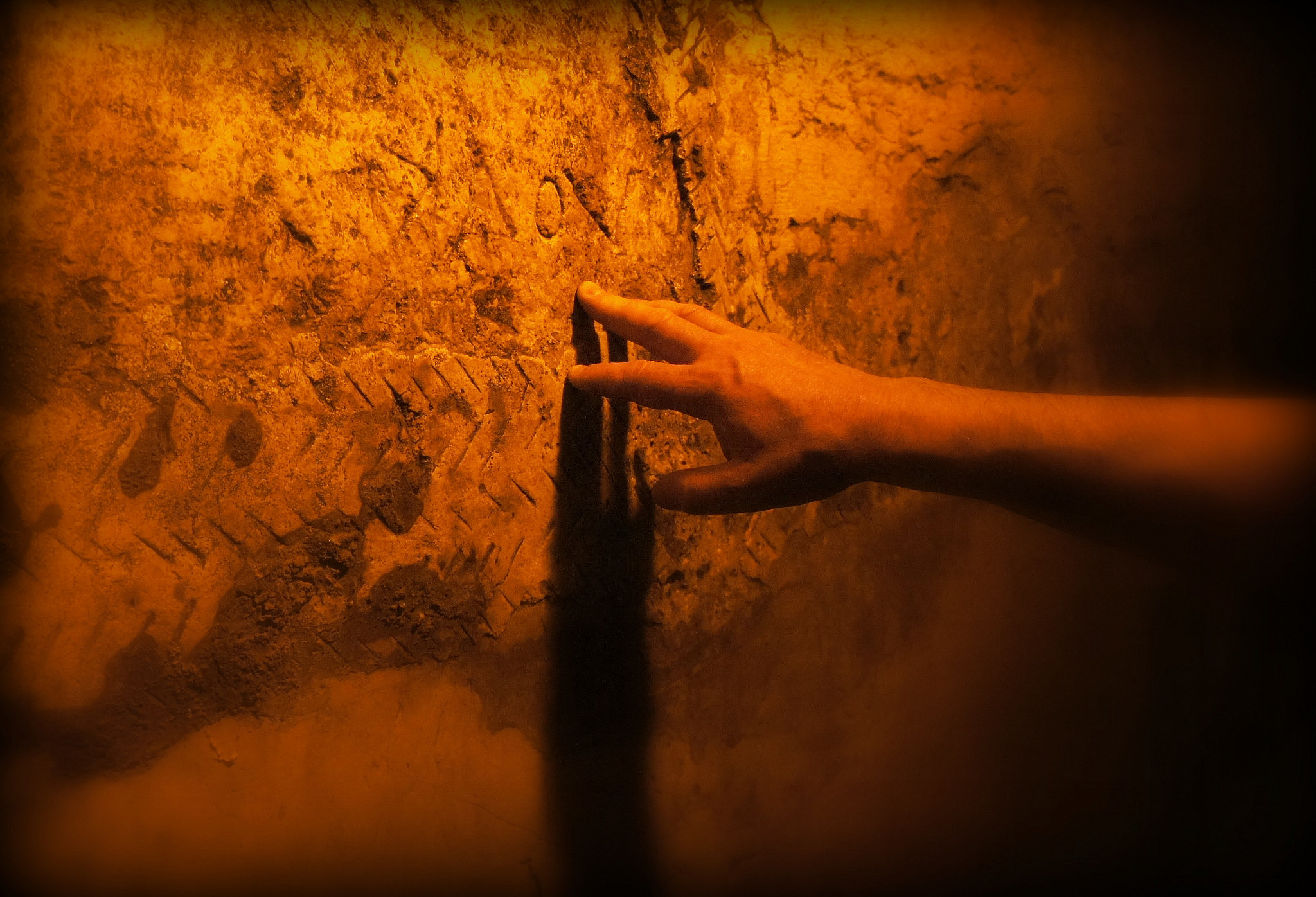
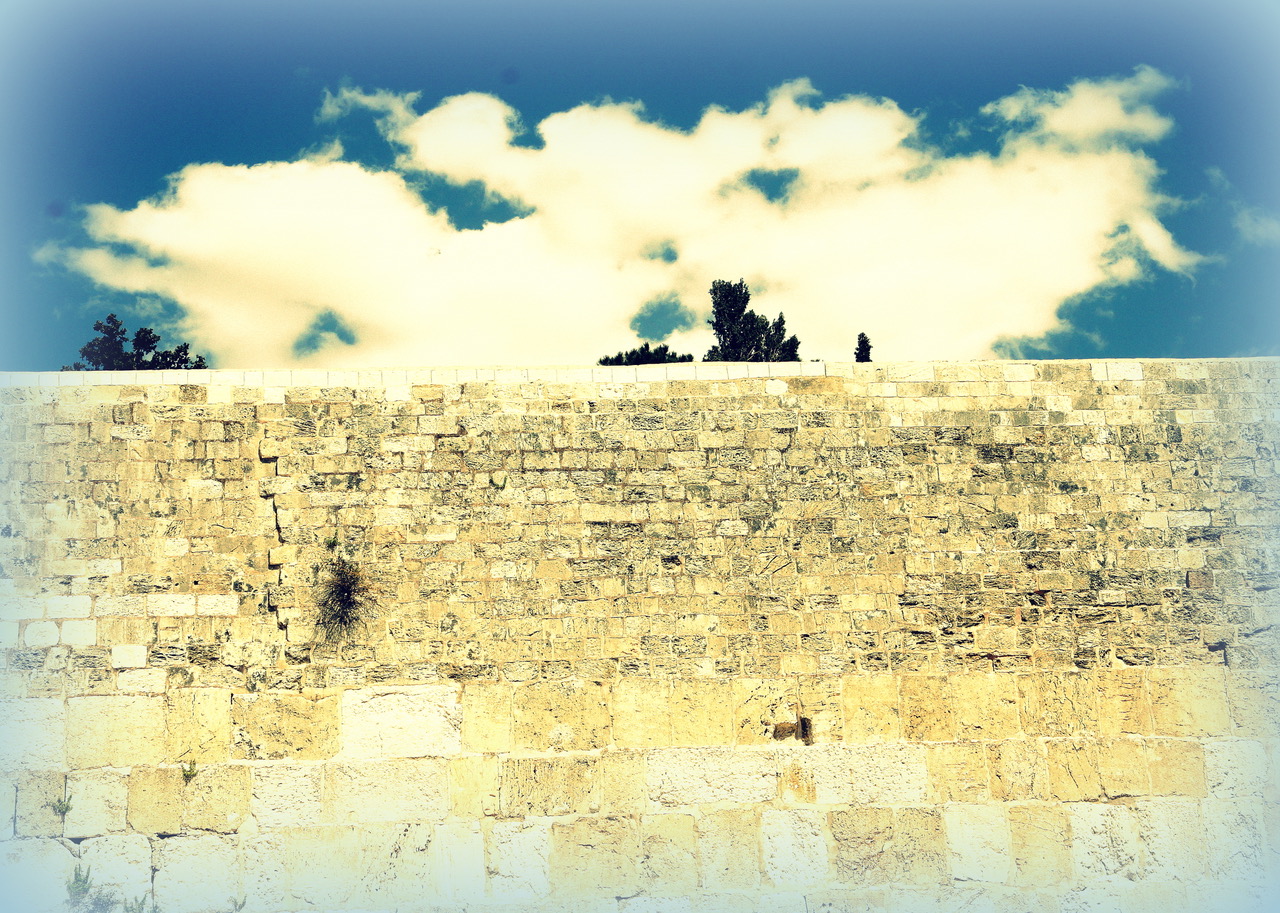
The energy of these stones has provided the nourishment for many generations of the Jewish people, for all those who keep Jerusalem in their hearts as the nucleus of their universe.

There is no other sensation in the world like the one felt when one’s hand is touching those warm, wise stones, the stones which are speaking to you, one to one. Inna Rogatchi (C). The Thread of Jerusalem. Fine art photography. Limited Edition. 2015.

When we had visited Jerusalem for the first time in the  beginning of the 1990s, we were trembling in excitement and disbelief at being on Israeli soil.

The most powerful sensation that I’ve had at the time was losing the sense of time. I felt as if the city had been kept above the earth and held upward by a superior power. It was a very distinct magnetism, gentle, but extremely firm. Most importantly, time has no power over it. I also was stricken by the the gentleness of the air around us, that unique Jerusalem gaze, those tones of gentle blue and rose and shimmering beige being melted into that one and only aired, flying colour of Jerusalem. If colours can fly, it happens at this very place. 

The Feeling of Jerusalem is the sort of a sensation which transforms into conviction.

As a matter of fact, Jerusalem, to me, has never been a city – it is the Place. The unique, blessed Place of unparalleled, re-assuring power and magnetism. The source of strength and hope. The place which is upheld by the ultimate power. The Talmud provides a straightforward explanation for this: “Eternity – this refers to Jerusalem” ( Berachot 58a). Inna Rogatchi (C). The cloud of Glory. Watercolour, wax pastel, oil pastel, lapice pastel, perle le blanc on authored original archival print on cotton paper. 50 x 70 cm. 2013-2020.

The Wonders of the Tunnels

Later on, exploring the Temple Tunnel, we were extremely privileged to be at the place which is just ninety metres from the Holy of Holies. The place which is the holiest one for the Jewish observant people, is quite simple but appropriately adorned. It is a place for praying, with many praying books around, a few chairs, and a couple of rows of seats. Everything there is unpretentiously gracious and just incredibly calm.

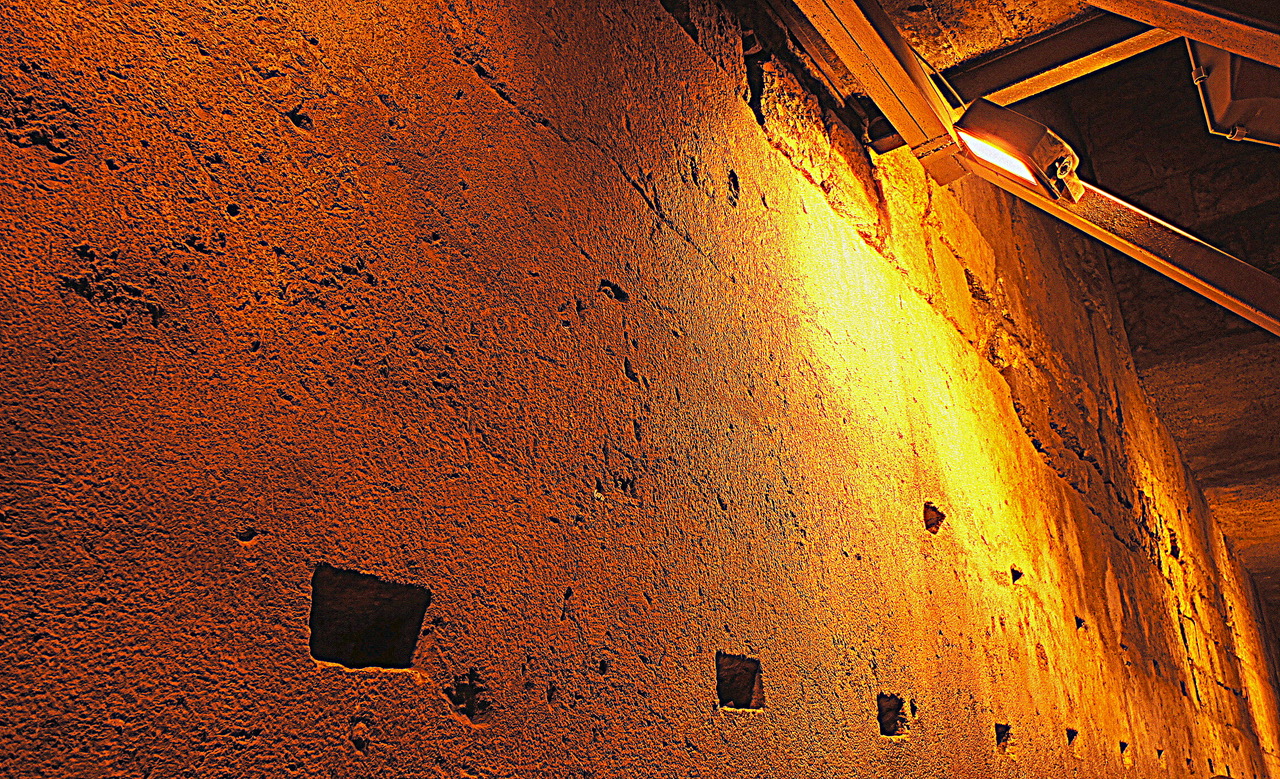
I always think that we, people, are so small staying next to the solid parts of the Wall which are 55 and 45 thousand tons of weight each, correspondingly. But as small as we are next to these stones, we do feel their warmth – which is wondrous given the fact that they are staying erect from the Second Temple period, and are under the level of earth for thousands of years by now.

In the Tunnel, one can also see the place where the Kotel really ends, and one realises, happily, that the Kotel – and our strength emanated and sustained by it –  is substantially longer than the visible part, those precious 87,5 metres of the Wall at the Temple Plaza today.Inna Rogatchi (C). Giant of the Wall. The Temple Tunnel. Watercolour, wax pastel, oil pastel, lapice pastel, perle d’or on authored original archival print on cotton paper. 50 x 70 cm. 2014-2020.

Among the wonders of the Tunnel, we can also see the part of the authentic, original street from the Second Temple period, – and one just close of losing one’s mind trying to comprehend that we are able to touch and to be present among the stones which were witnessing and were the part of life in Jerusalem at the time of the Second Temple.

When examining the stones of Jerusalem, one can get as close as it gets, to the real understanding of what the Lurianic teaching means when it says that stones have their own soul, too. Stones accumulate the energy of people and their emotions throughout the time. This energy does not disappear. It stays in stones. And never deeper than in the stones of Jerusalem.

In the Temple Tunnel, there is one particular, very special place, archeological sensation. I never saw anything like it in the world. In the same hall called as Hall of Epochs by the Temple Heritage Foundation, there are physical stones, architectural details, and artefacts from five epochs: the floor and from the period of the First Temple, the stones from the Second Temple period; a column and pillars from the Hellenistic time; the arches from the Hasmonean period; and corridors from the Roman  rule time, – all of it in the same physical space of not that large hall.

Jerusalem, My Stones art video essay which includes my art photography and collages and some of my husband Michael Rogatchi’s paintings, is dedicated to all Jerusalemites, those who are physically in the Holy City and those who hold it in their hearts.

When the Silver Thread becomes the Golden Bowl

Bar-Mitzvah ceremonies for Jewish boys are organised regularly in the Tunnel today by the Temple Heritage Foundation. Significantly, many of those boys are orphans and from underprivileged families. This is what I call the Silver Thread – or the Silver Cord as it often translated from Ecclesiastes  – “Remember Him before the silver cord is broken  (and the golden bowl is crushed, the pitcher by the well is shattered and the wheel at the cistern is crushed), (Ecclesiastes 12:6).

I find it very symbolic that there has been only one documented episode in the entire Jewish-Arab history where there was Arab and Jewish unification on a certain issue. What was the issue? Back in the early 20th century, between 1907 and 1914, there were scandalous and farcical escapades of British aristocrats led by Monty Parker, to excavate in the heart of Jerusalem to recover nothing less than the Ark of the Covenant. They efficiently bribed the Turkish officials who were administering Jerusalem, and they went for unauthorised excavations hiding what they were doing in the most hilarious way. When word went out that the Brits were after the Ark, Jews and Arabs of Jerusalem united in fierce riots against the illegal doings of Monty Parker’s ‘brigade’ and made him flee for his life.    

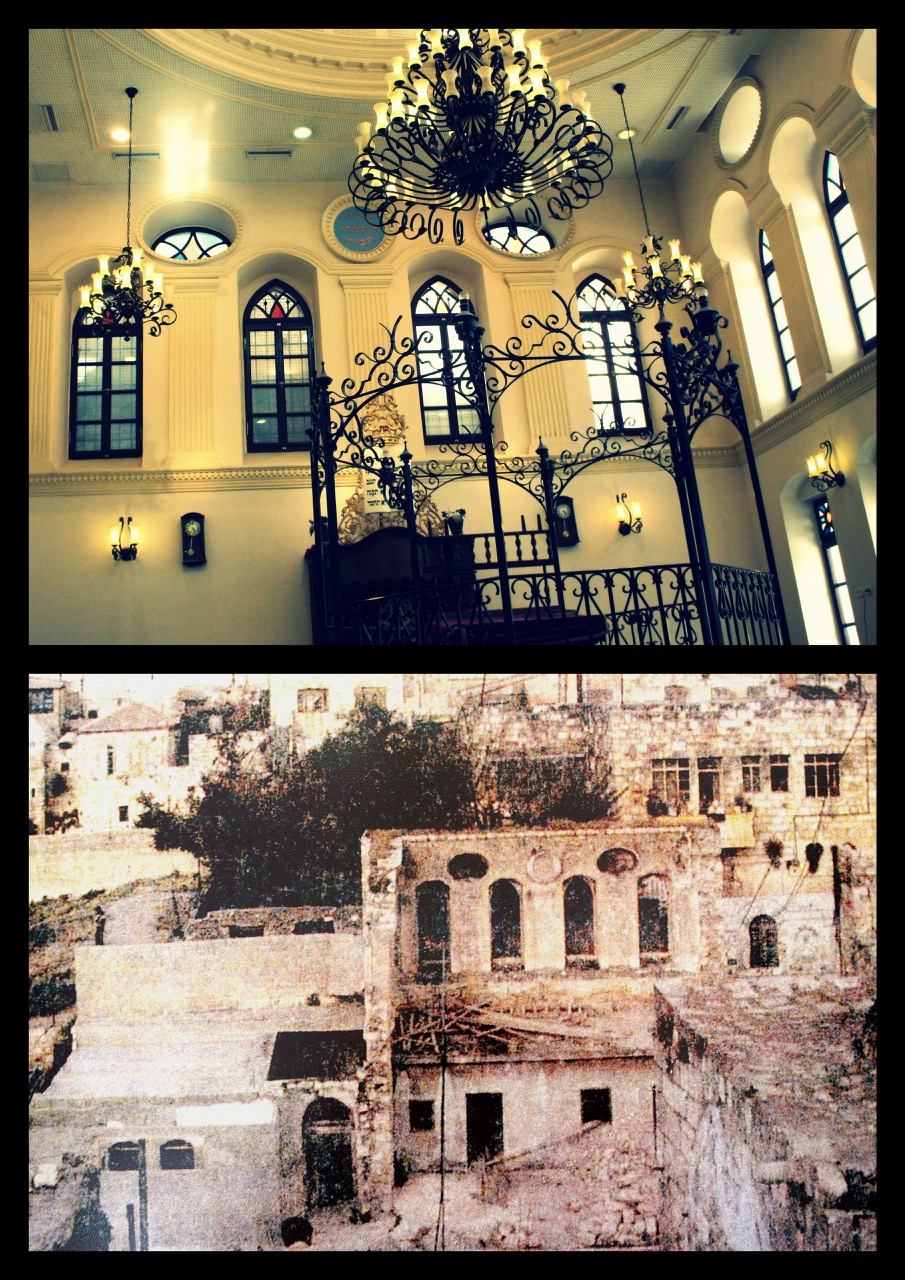
At the junction where Muslim Quarter comes to Temple Plaza, there is another remarkable place, the Ohel Yitzhak Synagogue, which was destroyed by Jordan to its foundation – the same as the Hurva synagogue was  – in 1948, and which had been restored in mid-2010s. The synagogue which formerly was the Synagogue of Hungarian Jewry and was built in 1870s and now it is back to life, is very light, gracious and beautiful . Just before it was re-opened in mid- 2010s, we saw the IDF soldiers with their officers there with some of them able to pray at the quiet and inviting place. This is how the Ecclesiastic Silver Thread is becoming the Golden Bowl – without cracks.Inna Rogatchi (C). Ohel Yakov reborn. Fine art collage. 70 x 50 cm. 2014.

Hopes implemented

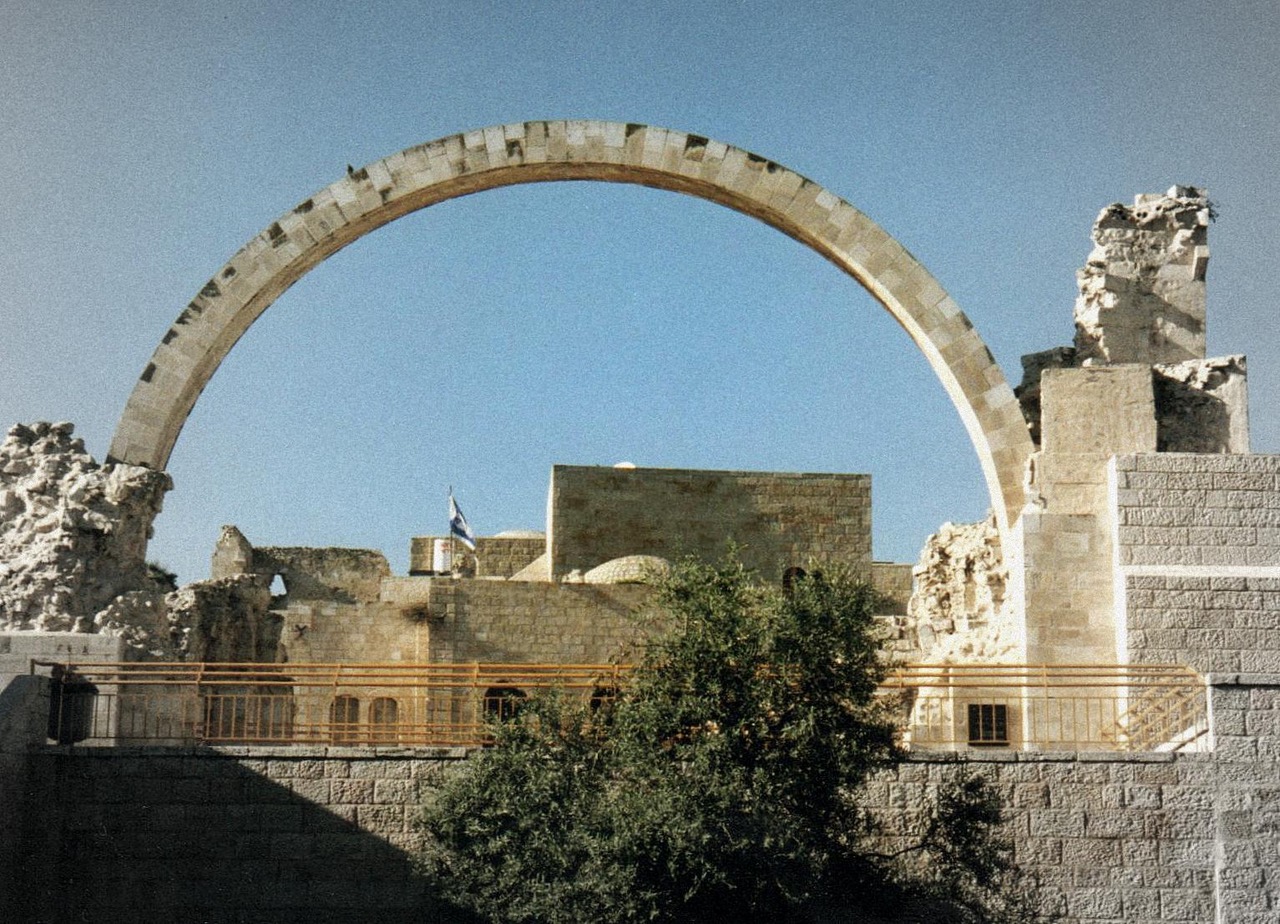
The Oleh Yitzhak Synagogue re-birth story was preceded by the well known Hurva Synagogue, a crown of the Hurva Square today.  After the date of its completed restoration in 2010, it is almost impossible to imagine that  this central place of the Old City once looked very different. Additionally, the Hurva story was particularly painful as it was the largest Ashkenazi synagogue in Jerusalem. Inna Rogatchi (C). Hurva Reminisce. Fine art photography. Limited edition. 1993-2013.

But when it comes to Jerusalem, there is something particular even in despair. In the early 1990s, the Hurva’s only surviving arch jumped into my husband’s and my hearts and stayed there. There are symbols like that in one’s life. Despite all the sorrow, that very arch meant our bridge to Jerusalem, for both of us. Reflecting this tangible bridge, Michael painted his so very special My Stones.Jerusalem painting which belongs to the Permanent Art Collection of the Municipality of Jerusalem, alongside famous works of Chagall and other great Jewish masters who did love Israel and Jerusalem with all their heart.Michael Rogatchi (C). My Stones. Jerusalem. Oil on canvas. 110 x 90 cm. 1993. Permanent Art Collection, the Municipality of Jerusalem.

Seventeen years after the completion of Michael’s work, Hurva Synagogue was restored. And then we united our artistic efforts and our love for Jerusalem and its spiritual treasures, and have created a special art collage, existing in the only copy. In that work, the ruins and the Arch of Hurva painted by Michael are merged with my artistic photograph of the Hurva restored. The piece is entitled Hurva Return, and we have presented the work to the outstanding Rabbi Shmuel Kaminetzki who was an instrumental figure in making the restoration of Hurva possible. Inna & Michael Rogatchi (C). Hurva Return. Fine art collage on canvas. Unique. 2013. Permanent Art Collection, the Chief Rabbi of Dnepr, Ukraine.

With Jerusalem in heart in the desert of Gulag

Our generation is lucky to remember the Day in 1967 when it had happened, when historic justice prevailed due to human courage and commitment.

My husband will never forget when Jews exiled to the Soviet Gulag who were listening to the Voice of America secretly, risking their lives, were coming out to the streets in Kazakhstan crying out of joy “We’ve made the victory! We won! Jerusalem is ours, back again!”  ‘We’ – were crying with joy Jews exiled in nobody’s land. Many of us have been sharing their joy every year since Iyar 28, 1967 all over the world.

When many years and decades later, Michael was approached by the Jerusalem culture authorities with an idea to create a special collection of his works dedicated to the city, he worked with love and joy. Some of these works are the part of his special Zion Waltz series of exuberant paintings created in 2015-2017.Michael Rogatchi (C). My Yerushalaim. Exclusive art poster. 100 x 80 cm. 2021.

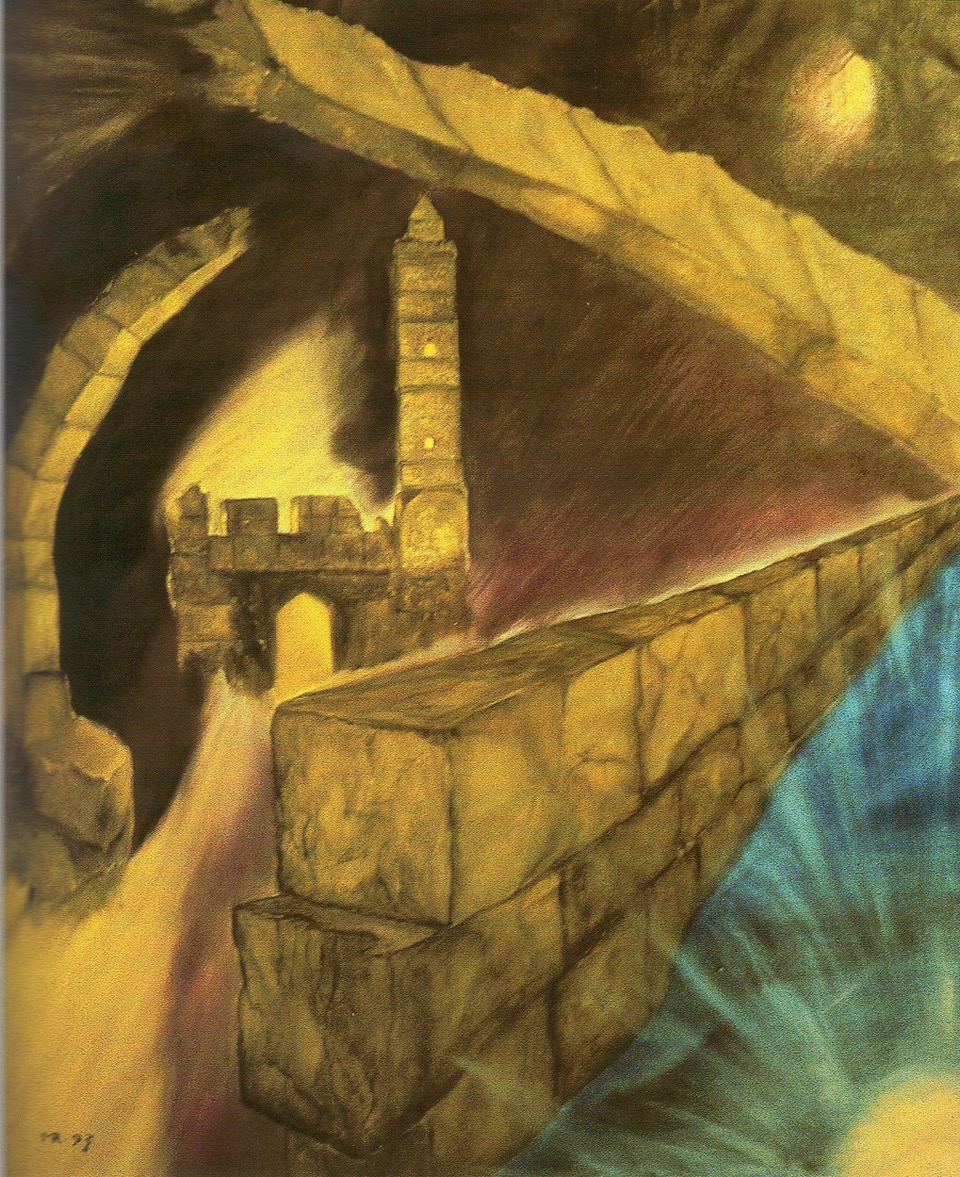
It is interesting to observe the transformation of feeling of Jerusalem in the artist’s heart: from painful, dramatic unsettling in Michael’s visioning of the Kotel as the essence of the Jewish history of suffering in his Portrait of the Kotel ( 1999) to the airy, flying, gentle Under the Skies of Jerusalem in 2016. In between those drama versus flight point, there are two depictions of the Lion of Judah, created by Michael with an 8 years gap, his shining  Lion created in 2008, and his soothing one created eight years later, in the work called Strength of Love ( 2016). The interesting and telling detail in the both works is the thoughtfulness of the Lion. The determination of love defending the essence of Judaism and the heart of Jewish nation in the second work is  pretty clear manifestation of the artist’s thoughts.

 Embracing ‘the whole Jerusalem’

My heart aches every time I pass the house where Israel patriots were hiding while fighting in the underground in 1948. My heart jumps every time when I am privileged to hear our Psalms at the Great Synagogue with its magnificent choir led by Ellie Jaffe. My heart stops when I feel the gentle but powerful push of the wind at every Shabbat we start at the Wall. That push of that wind signals us that the people of the nation are heard.

And I am thinking of Bella Chagall who was willing ‘to embrace the whole Jerusalem’ when she was a five years old child sitting with her family in Vitebsk, thousands of miles from it, – but knowing by her heart, the heart of a Jewish child, what Jerusalem is about.

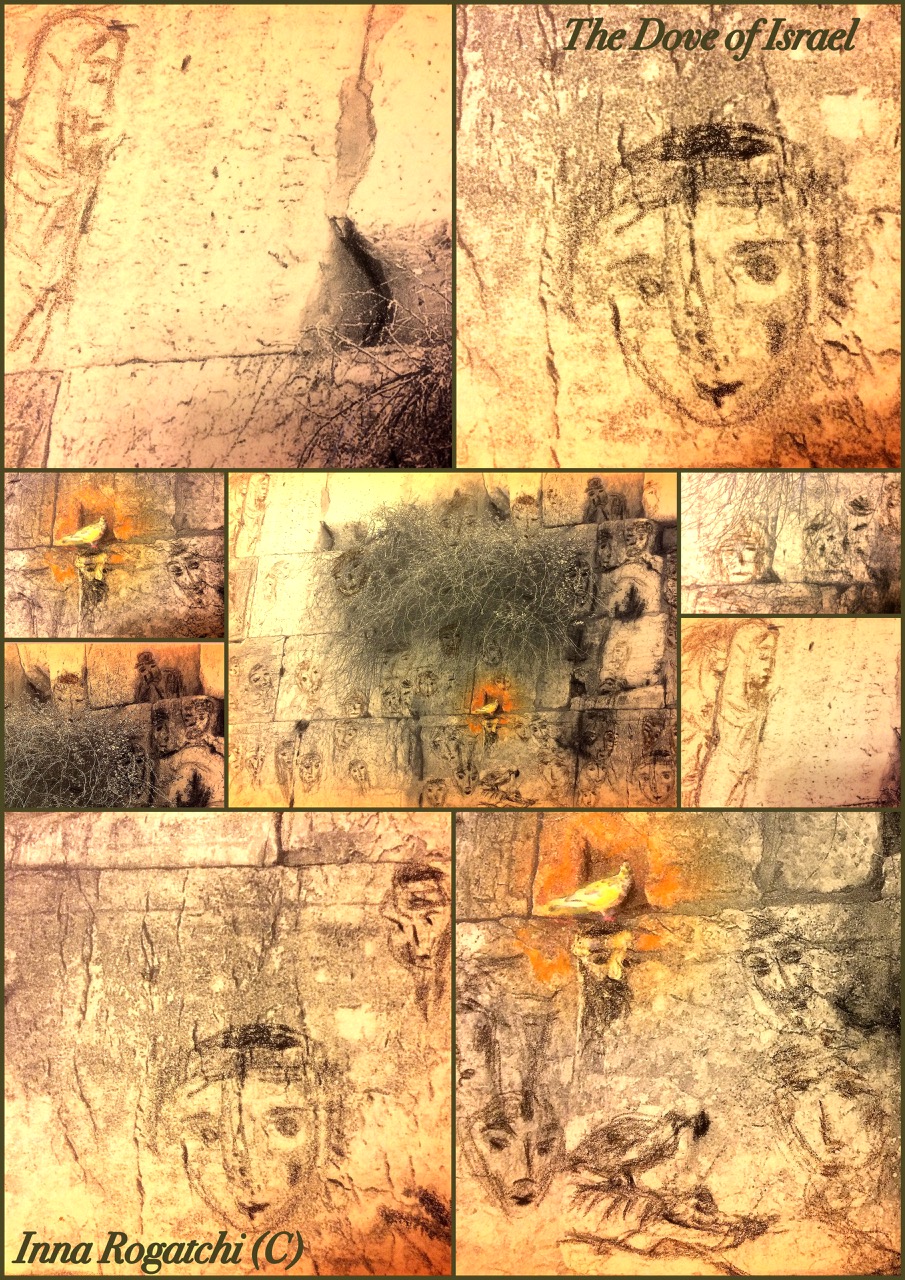
Thirty years passed since my first acquaintance with Jerusalem, and our life has been stuffed with events. But I still remember and do feel the sensation of my personal discovering of Jerusalem  three decades ago as if it was happening today.  Probably, it was the main discovery in my entire life.Inna Rogatchi (C). The Dove of Israel. Exclusive art poster. 70 x 50 cm. 2021.

The Talmud provides the insight into the secret of the Kotel: according to it, there is a mirrored image of the Temple in the Heaven, and that entity keeps the Wall standing, no matter what occurs. Yet more importantly, it transcends the Presence. This presence is felt by anyone who ever visited the Kotel, even the most self-convinced atheists.   

For those who are not, in the beginning and in the end of the day, Jerusalem is the only place in this world where a person can talk with the Creator directly. 

WALKING FOR SARAH

FIRST PUBLISHED in The Times of Israel – https://blogs.timesofisrael.com/walking-for-sarah/, as well as in Tribune Juive ( Paris, France) and The Jerusalem Connection Report ( Washington, D.C., the USA)

Soon after the publication of my essay in Israel, France and the USA, I’ve got the message from a good man in Paris who wrote that he will be coming to the demonstration that he knew will be organized — on April 25th — with his son, and that they, the Jews in Paris and France, are ‘feeling so underpowered in this system’. I felt acute pain for the talented, intelligent, hard-working Jewish people of France at that bitter moment, doubly so thinking of all the history of their inherited pain. 

Today, I feel much better, and I know that my French Jewish friends do as well. We all will be marching together in those massive rallies on Sunday, April 25th. There are so many of us for Sarah and her family. 

For the first time during the last four years since the horrific murder of the innocent, nice, kind Jewish teacher in Paris in April 2017, we all would feel a bit of some consolation while fighting in real-time and many real places for her honor and in her memory. 

There were many protests for Sarah Halimi before: after her terrible murder in 2017, after that extremely shameful verdict of the examination litigation body in Paris in January 2020, after that unheard mockery of justice in upholding the verdict after April 14th this year, 2021. 

But never before, in the period of just one week, these protests have been transformed into the global massive movement for decency, real concern for human life, and outright opposing the evil, white on black.  Or as it is on the Marching for Sarah protests, white on blue, with a bit of read. 

This is the main outcome of the committed in cold-blood, arrogance and never-dying anti-Semitic hate capital injustice in France: our all global conscious, active and articulated resistance to that. 

This is what solidarity is about. 

The protests are organized under the united slogan “ Sans justice pas se Républic”, “There is no Republic without justice’. 

All French Jewish organizations, many of the leading synagogues and congregations are united in this unprecedented expression of indignation and solidarity. 

To my serious satisfaction, I saw many messages from Arab people in France who were sending their solidarity with Sarah Halimi’s family. It is a decency that speaks at the moments like that, not race. 

We all will be coming to those rallies on Sunday, April 25th, in Paris, London, Tel-Aviv and elsewhere. Our people and those who have solidarity with us, just did demonstrate our guts, our heart, and our determination to fight the evil and those scoundrels who cover for it. 

In another surreal development, the judge called Anne Ihuellou who has committed that outrageous mockery of justice in the decision not to prosecute Sarah Halimi’s murderer on the ground that he used drugs before committing the crime, has demanded police protection for herself on the ground ‘of hostile attitude towards her from the Jewish community of France’. I am convinced that it is the Jewish community of France who is absolutely entitled of the police and any other possible protection from ‘the judges’ like that.

We now know about so many massive protests to be organized for Sarah Halimi – but for some reason, we have not heard about anything in the place which is geographically much close to Paris than Miami. I mean Brussels, the heart of the European democracy, and the seat of its governing bodies. We also have not heard anything, so far, from the EU, EC, and the European Parliament officials. I have heard that there is even a special high-ranking official whose cosmic salary is paid for her alleged fight against anti-Semitism. Just recently, we’ve heard that a huge budget of 2 billion euros has been allocated to fight anti-Semitism in the European Union. Probably, it all is misinformation – as there is virtually zero in everything which has to be done in real actions and deeds by all those hyper-inflated with officials and their salary bodies — and nothing, ever, done.  It feels that in the case of anti-Semitism, EU authorities responsible for that are placed in somewhere like Amazon jungle without internet and being not informed on anything. Pathetic inadequate mannequins. Poor European tax-payers, too.

When I was writing my previous essay a week ago on April 16th describing the utter shame cause by an unparalleled case of injustice in France, my heart was bleeding. My only consolation during those hours were the photographs from the first protests in Paris which were held just immediately after the scandalous decision of the Court of Cassation, on April 14th and 15th. When I saw how many people came there, and what good faces they had, I was a bit consoled that Sarah is remembered and loved, and that the pain of her family is shared. 

There can not be two more different erevs Shabbat, as it has been in between the previous Shabbat, on April 16th, and the current one, on April 23d. Sarah Halimi rally poster. Credit: B’nai Brit France. With kind permission.

A week ago, we felt deep pain and utter indignation, after hearing on the simply unbelievable insult of justice and common sense, after the French Court of Cassation upheld the previous scandalous decision in the case of the vicious murder of Sarah Halimi, the Jewish French teacher and physician in Paris back in April 2017. According to that surreal decision, the monster who murdered Sarah, now a 31-year-old Islamist from Mali, has been freed of prosecution on the ground that before the premeditated murder he smoked cannabis. This upheld verdict will go to the annals of history staining the reputation of France for good.

Inevitably, such scandal and insult have caused a storming reaction. I was one of those who protested publicly.

Immediately, I started to receive letters, notes, reactions, feedback, questions from all over the world, from Jerusalem and London to New York and San-Paolo. People were not only justly outraged. They wanted to act. Many of them have asked me: “what can be done, additionally to writing the letters of protests to the French judiciary and to the office of the President of France? Would it be the demonstrations in New York? What kind of protest will there be in London? Whom from the officials should we protest? We would like to act”.  

I felt very grateful. And encouraged. I am in constant touch with my French Jewish friends and colleagues who are working like lions and lionesses and who are fighting for Sarah Halimi’s honor and dignity of her poor family as attacked Jews always did, being focused, brave and unstoppable. Because, once and again, if we would not defend ourselves, nobody else will. Nothing has changed with that regard, does not matter what horrors might occur towards the Jews.

I have interconnected my French friends with those many other people worldwide who wanted to act in protesting that screaming injustice that had happened in France towards Sarah Halimi. 

During this past week, French President Macron has reacted in time and better than he did previously, in a more articulated way. Not only he personally expressed his clear concern over the fresh shame of France, but his chancellery has issued a special statement about it, an official document. And I think, president Macron meant what he stated. 

The Israeli authorities were not silent either: the Foreign Ministry of Israel has made a strong statement, the leading media in Israel and in the Jewish world has been quite clear in our all united and severe condemnation. Sarah’s family started to realize that they are supported not only by the united Jewish community of France, but now by the international brethren as well. This is important. 

In an absolutely just move, the family of Sarah Halimi is about to submit the case of the murder of a Jew to Israel’s jurisdiction, as it is prescribed by two articles in the Israeli criminal code. With all my heart, I do hope that the case will be accepted and that the state of Israel will officially request the extradition of the beast who has murdered Sarah Halimi, in accordance with the existing French-Israeli treaty on the matter. I do hope that Sarah Halimi and her family will get justice. It is just impossible that the forces of darkness will celebrate their evil cause on the account of Sarah’s life and her unpunished murderer. 

But today, most of all,  I am thinking about so many people in France and abroad who are preparing to march in protest of that colossal injustice the coming Sunday. One week ago sharp, we were discussing with my brave French friends two demonstrations on the coming Sunday, April 25th, in Paris and in Israel. 

Today, just in the matter of a week, we know about ten massive protests all over France, in all of the country’s big cities, as well as three major rallies in the USA, and also in London and Tel-Aviv. Sara Halimi international rallies. Credit (C) Alan Skorsky. With kind permission.

My heart is pumping when I am reading the information and seeing the posters for the forthcoming protest marches: Paris, Bordeaux, Lille, Lyon, Marseille, Nice, Strasbourg, Toulouse, Deauville, Montpellier in France, most of them at the same day and the same time, April 25th, Sunday, at 14.00, at the main squares of all those cities, and next to the courts, as well. In New York and Los Angeles, the rallies went on Thursday, April 22nd. In Miami, London and Tel-Aviv, they will be organized on the same day and time as Paris.


This is what solidarity is about. 

The protests are organized under the united slogan “ Sans justice pas se Républic”, “There is no Republic without justice’. 

All French Jewish organizations, many of the leading synagogues and congregations are united in this unprecedented expression of indignation and solidarity. 

To my serious satisfaction, I saw many messages from Arab people in France who were sending their solidarity with Sarah Halimi’s family. It is a decency that speaks at the moments like that, not race. 

We all will be coming to those rallies on Sunday, April 25th, in Paris, London, Tel-Aviv and elsewhere. Our people and those who have solidarity with us, just did demonstrate our guts, our heart, and our determination to fight the evil and those scoundrels who cover for it. 

In another surreal development, the judge called Anne Ihuellou who has committed that outrageous mockery of justice in the decision not to prosecute Sarah Halimi’s murderer on the ground that he used drugs before committing the crime, has demanded police protection for herself on the ground ‘of hostile attitude towards her from the Jewish community of France’. I am convinced that it is the Jewish community of France who is absolutely entitled of the police and any other possible protection from ‘the judges’ like that.

We now know about so many massive protests to be organized for Sarah Halimi – but for some reason, we have not heard about anything in the place which is geographically much close to Paris than Miami. I mean Brussels, the heart of the European democracy, and the seat of its governing bodies. We also have not heard anything, so far, from the EU, EC, and the European Parliament officials. I have heard that there is even a special high-ranking official whose cosmic salary is paid for her alleged fight against anti-Semitism. Just recently, we’ve heard that a huge budget of 2 billion euros has been allocated to fight anti-Semitism in the European Union. Probably, it all is misinformation – as there is virtually zero in everything which has to be done in real actions and deeds by all those hyper-inflated with officials and their salary bodies — and nothing, ever, done.  It feels that in the case of anti-Semitism, EU authorities responsible for that are placed in somewhere like Amazon jungle without internet and being not informed on anything. Pathetic inadequate mannequins. Poor European tax-payers, too.

When I was writing my previous essay a week ago on April 16th describing the utter shame cause by an unparalleled case of injustice in France, my heart was bleeding. My only consolation during those hours were the photographs from the first protests in Paris which were held just immediately after the scandalous decision of the Court of Cassation, on April 14th and 15th. When I saw how many people came there, and what good faces they had, I was a bit consoled that Sarah is remembered and loved, and that the pain of her family is shared. 

The Dreyfus Legacy of France

First published in The Times of Israel – https://blogs.timesofisrael.com/the-dreyfus-legacy-of-france/, as well as in Tribune Juive ( Paris, France), and the Jerusalem Connection Report ( Washington, D.C., the USA)

The mockery of justice in the case of neglected murder of Sarah Halimi   Sarah Halimi murdered by Islamist fanatic in Paris in April 2017. Commons Images Library.

First, the disclaimer to make: I do like France very much. Its culture, its landscapes, its distinct style and charm.  I grew up with admiration of France’s intellectual and cultural might, and it is an integral part of who I am. 

I also have a family connection to France, and it places me on the inner level of appreciation. 

Additionally, we have many wonderful family-like friends in France who are an organic part of my husband’s and mine lives. 

And then comes the part of history. As sorry as I am to say it, the fact is that the history of France is nasty all the way, from the early settlements on the banks of Seine to the shocking news of the mockery of justice that we are stunned to see today. 

The more one studies the history of France, the more chilled one is. I will not provide the full catalog of it because the list would be too long, and because the subject of this essay is not the observation of France’s shortcomings from a historical perspective. 

The subject of this essay is boiling indignation. 

In April 2017, a wild 27-year old monster from Mali intruded via balcony into the apartment of 65-year old teacher Sarah Halimi, the mother of three children, widow of a well-known psychologist, renowned for her kind and widely appreciated work in her school. Nice, kind, quiet, very likable woman. 

The intruding monster attacks the woman who is three times older than him. He beats her severely leaving twenty-two — twenty-two — fractures in her small body. He screams ‘Allahu Akbar!’ attacking his defenseless victim. Then he throws her from the high Paris third floor balcony, to her death. He screams “ I killed the Shaitan!’. 

As it has been chronicled in multiple, including official sources, the police did not appear in time despite many repeated emergency calls from many alarmed people. When the police appeared, they did not storm the apartment. They were waiting for the enforcement, they have explained later. 

What happened next is too well-known to the Jewish people in France — and it is stunning to the outside world. Many of the French media were reluctant to report the crime as it was. Three months passed before a word ‘anti-Semitic’ was added, extremely reluctantly, to the qualification of the crime, after enormous pressure by the Sarah Halimi’s family, the Jewish community of France and many intellectuals, all Jewish, who just could not allow themselves to be silent. 

The killer, who had a long criminal record, was put in a mental clinic, and was posed as ‘unfitted to be tried’. Did he have a history of mental disorders? He did not. 

Two years passed before the next juridical move had had a place, after a very pale one-phrase comment by President Macron saying that ‘even if him ( the killer) would be seen by the judge as unfitting for a trial, the trial, a judicial proceeding has to have a place’. Not the tone we used to hear from the Presidents of the French Republics. Not the tone which we used to hear from this very President, as a rule. 

In 2019, the examining magistrate made its

verdict: the killer was not criminally responsible. The reason? Because “ before the killing, he smoked cannabis”. Black on white, in the decision made in July 2019. 

Half a year later, in December 2019, this utterly scandalous decision was upheld by the Paris Court Appeal.  

Naturally, Sarah Halimi’s family appealed after that insult of common sense.  Their appeal took two years to have proceeded. 

Now, in April 2021, two years after the appeal, and four years after the horrific killing, the Court of the Cassation, the highest instance of the French legal system, has upheld the initial verdict. The animal who killed an innocent woman has been verified as having no criminal responsibility for wild murder just because he smoked cannabis before attacking his victim. 

Certainly, with this action, France has contributed to the world practices of litigation in the most shocking way possible. 

When back in 2019, responding, very reluctantly, to the mounting pressure of justified outrage over the intent negligence of the French police and then legal authorities to this unspeakable crime,  President Macron extremely cautiously uttered that just one carefully constructed phrase on the necessity of some legal proceeding of the case of murder,  some of those in charge, namely the case prosecutor Francois Molins and judge Chantal Arens from the Court of Cassation, supported by the top French judge, the head of the Union of the main judges of France Katia Dubreuil, unleashed a fountaining reprimand against him. How dared the President to interfere into the sacred independence of the French court system? Oh yeah. 

I have had a personal experience with this decision-making at the French courts and that omerta of silence all over it when I was publicly defending my distinguished colleague, internationally renowned French historian George Bensoussan. Today George along with his colleagues, including many of our personal friends, is fighting for the dignity of Sarah Halimi and against the cruel absurdity of this unique French legal system which has proven, once and again, on its high selectiveness, from the Dreyfus Affair and to this day. 

APR 16, 2021, 7:22 PM

Please note that the posts on The Blogs are contributed by third parties. The opinions, facts and any media content in them are presented solely by the authors, and neither The Times of Israel nor its partners assume any responsibility for them. Please contact us in case of abuse. In case of abuse,
Report this post.

The mockery of justice in the case of neglected murder of Sarah Halimi   Sarah Halimi murdered by Islamist fanatic in Paris in April 2017. Commons Images Library.

First, the disclaimer to make: I do like France very much. Its culture, its landscapes, its distinct style and charm.  I grew up with admiration of France’s intellectual and cultural might, and it is an integral part of who I am. 

I also have a family connection to France, and it places me on the inner level of appreciation. 

Additionally, we have many wonderful family-like friends in France who are an organic part of my husband’s and mine lives. 

And then comes the part of history. As sorry as I am to say it, the fact is that the history of France is nasty all the way, from the early settlements on the banks of Seine to the shocking news of the mockery of justice that we are stunned to see today. 

The more one studies the history of France, the more chilled one is. I will not provide the full catalog of it because the list would be too long, and because the subject of this essay is not the observation of France’s shortcomings from a historical perspective. 

The subject of this essay is boiling indignation. 

In April 2017, a wild 27-year old monster from Mali intruded via balcony into the apartment of 65-year old teacher Sarah Halimi, the mother of three children, widow of a well-known psychologist, renowned for her kind and widely appreciated work in her school. Nice, kind, quiet, very likable woman. 

The intruding monster attacks the woman who is three times older than him. He beats her severely leaving twenty-two — twenty-two — fractures in her small body. He screams ‘Allahu Akbar!’ attacking his defenseless victim. Then he throws her from the high Paris third floor balcony, to her death. He screams “ I killed the Shaitan!’. 

As it has been chronicled in multiple, including official sources, the police did not appear in time despite many repeated emergency calls from many alarmed people. When the police appeared, they did not storm the apartment. They were waiting for the enforcement, they have explained later. 

What happened next is too well-known to the Jewish people in France — and it is stunning to the outside world. Many of the French media were reluctant to report the crime as it was. Three months passed before a word ‘anti-Semitic’ was added, extremely reluctantly, to the qualification of the crime, after enormous pressure by the Sarah Halimi’s family, the Jewish community of France and many intellectuals, all Jewish, who just could not allow themselves to be silent. 

The killer, who had a long criminal record, was put in a mental clinic, and was posed as ‘unfitted to be tried’. Did he have a history of mental disorders? He did not. 

Two years passed before the next juridical move had had a place, after a very pale one-phrase comment by President Macron saying that ‘even if him ( the killer) would be seen by the judge as unfitting for a trial, the trial, a judicial proceeding has to have a place’. Not the tone we used to hear from the Presidents of the French Republics. Not the tone which we used to hear from this very President, as a rule. 

In 2019, the examining magistrate made its verdict: the killer was not criminally responsible. The reason? Because “ before the killing, he smoked cannabis”. Black on white, in the decision made in July 2019. 

Half a year later, in December 2019, this utterly scandalous decision was upheld by the Paris Court Appeal.  

Naturally, Sarah Halimi’s family appealed after that insult of common sense.  Their appeal took two years to have proceeded. 

Now, in April 2021, two years after the appeal, and four years after the horrific killing, the Court of the Cassation, the highest instance of the French legal system, has upheld the initial verdict. The animal who killed an innocent woman has been verified as having no criminal responsibility for wild murder just because he smoked cannabis before attacking his victim. 

Certainly, with this action, France has contributed to the world practices of litigation in the most shocking way possible. 

When back in 2019, responding, very reluctantly, to the mounting pressure of justified outrage over the intent negligence of the French police and then legal authorities to this unspeakable crime,  President Macron extremely cautiously uttered that just one carefully constructed phrase on the necessity of some legal proceeding of the case of murder,  some of those in charge, namely the case prosecutor Francois Molins and judge Chantal Arens from the Court of Cassation, supported by the top French judge, the head of the Union of the main judges of France Katia Dubreuil, unleashed a fountaining reprimand against him. How dared the President to interfere into the sacred independence of the French court system? Oh yeah. 

I have had a personal experience with this decision-making at the French courts and that omerta of silence all over it when I was publicly defending my distinguished colleague, internationally renowned French historian George Bensoussan. Today George along with his colleagues, including many of our personal friends, is fighting for the dignity of Sarah Halimi and against the cruel absurdity of this unique French legal system which has proven, once and again, on its high selectiveness, from the Dreyfus Affair and to this day. Inna Rogatchi in discussion with George Bensoussan. Memorial de la Shoah. Paris. April 2015. Courtesy (C) The Rogatchi Foundation.

In the way, as only real life can teach us, the mockery trial of George Bensoussan which I have called ‘a modern-day Dreyfus Affair’ had happened just three weeks before the horrific murder of Sarah Halimi. 

In the light of Sarah Halimi’s murder that has no criminal responsibility in modern-day France, Bensoussan absurd trial has to be called ‘modern Dreyfus Affair One’, and denial of justice to the victim Sarah Halimi and her family has to be called ‘modern Dreyfus Affair Two’. Congratulations to France with this growing list of shame. 

Exactly as in the case of a distinguished historian who was tried for several years for a quote, I believe that the people who were responsible for all premeditated mockery of policing and law in the attack, torture, and murder of Sarah Halimi, and for the consequent lenience of the investigation and the travesty of courts, should be named, with personal responsibility — moral, yes, at very least — to be bored by every one of them in that outrage that has tarnished the reputation of France for good. 

Those who were late in arriving at the location of the ongoing crime. Those who decided not to storm the apartment. Those who never interrogated the animal who murdered an innocent woman. Those who have authorized his move to the mental clinic. Those who kept him in the mental clinic obediently. Those who did not investigate. Those who were late to investigate. Those who obstructed justice. Those who came out with the verdict of ‘not bearing criminal responsibility’. Those who did upheld this verdict twice. Those who were and are silent in violating their professional duties in the media. Those who were and are ignorant at the National Assembly and the Senate of France. Those who were and are indifferent at the multiplied human rights organizations. 

All above applied to the murder committed independently of a racial element in this tragic story. Double tragic because of how the crime has been treated in France. 

Under the French law, so utterly independent, usage of drugs is an aggravating circumstance of a crime. This way, not the perverted one applied out of blue and against the existing law by the French judges who were ruling on the murder of Sarah Halimi. So what on earth has made them to pervert the law of the country in which they are enjoying their supreme independence? 

Probably, ‘Allahu Akbar!’ screams of the 27-year old Islamist fanatic on drugs torturing and murdering 65-year old teacher? Probably, ‘I killed Shaitan!’ screams of him after throwing her body off the third-floor balcony? Probably, his criminal history as a serial offender? 

To qualify the attack as ‘an anti-Semitic’ took three months and a battle, and it was never established as a racial motivation in the investigation of the case – which is another aggravating circumstance under the existing French law. 

The family of Sarah Halimi is not alone in their nightmare-like four-years battle against the wall of stunning negligence. In France, the Jewish community is fighting consistently against this screaming racial anti-Semitic crime. The French intellectuals are on the right side of this surreal barricade, as well. The Simon Wiesenthal Centre in France is fighting along. Some people from Israel are joining the protests. But there are many more public organizations and institutions in France and outside it which can intervene. 

I have also a revelation to make: one does not need to be Jewish to defend a Jew. Just like Emile Zola did. And many like him. I call those people Shining Souls. Demonstration in Paris after the verdict of the Court of Cassations. Paris. April 2021. Credit: SIPA.

After the original Dreyfus Affair, after the copycat Dreyfus Affair of the trial of George Bensoussan, in face of the third Dreyfus Affair of denying justice to brutally murdered Sarah Halimi, one cannot help but be appalled by the reality of legally verifying a sheer absurdity and institutionalizing it through the legal system upholding it on the top of it. This is the essence of what had happened in the perverted justice applied by the French police and legal system to the case of the murder of Sarah Halimi. When one of the protesters has said that with that verdict Sarah Halimi has been murdered twice, he was dead right. And as outrageous as it is, there are more cases like that in the modern history of France.

The people, with the names and official positions, who all, in a large quantity, neglected two aggravating circumstances of premeditated murder, did not oversee it by chance. They all did it consciously. They all did it on purpose. They all knew exactly what they were doing. 

That’s why I believe that we all who are protesting this yet another Dreyfus Affair, now in the XXI century, ought to know their names. All of them. 

And I also would like to hear, on record, in the public domain, their all, each of them personally, explanation, in their all official capacities, in replying on this one question: “Why did you decide to ignore two aggravation circumstances of premeditated murder of Sarah Halimi on April 4th, 2017?”. I would like to have all those people to give a detailed reply to this one question. I would like to publish their all’ replies next to their photographs, and the official positions they hold. This publication would be France’s other ‘J’Accuse…!’. Obviously, the original one was not enough.

Does somebody still remember, by the way, that the Paris police had never – this is never — investigated the arson at the house of Emile Zola which killed the writer and a great man in September 1902, almost four years after publishing “J’Accuse…!” in the act which preserved which was left of the reputation of France in the Dreyfus Affair? That the coroner has refused to make the existing expert report and has, just one man, declared Zola’s death of natural causes? That nobody ever challenged that verdict of one man at a minor police position in that mighty, huge, and oh-so-frighteningly independent legal system of France in the case of the death of the famous writer known as the conscience of the nation? And this is given the well-known fact that after the publication of  ‘J’Accuse…!” Zola had received numerous death threats due to his honest position and incredible bravery all four years preceding his weird death? Oh well. 

And even when half of a century later, some glimpses of truth had appeared in one modest investigative report in Liberation in 1953, it was orchestrated in the way of a possible personal vendetta of just one too eager anti-Dreyfus zealot. Well, it might be sobering – and timing – to remember that at the time of that fatal arson, Emile Zola has completed his novel Vérité summarising the Colonel Dreyfus case, the shame of the century for France as it was known, completely justified. The second volume of the novel called Justice Emile Zola was unable to complete. He was dead laying on the floor of his Paris apartment desperately trying to reach the window to open it. He suffocated. It is a natural cause as it was seen by the French police and legal system in 1902. 

The same as torturing, causing 22 fractions, terrible beating to death, and throwing a woman from the balcony bears no criminal responsibility as it is seen by the French police and legal system in 2021. 

This phenomenon is called ‘Dreyfus Legacy of France’, and it is absolutely impossible to accept it. 

Two Alexes, a Family Reminscence

First published in The Times of Israel – https://blogs.timesofisrael.com/two-alexes-a-family-reminiscence/, as well as in Tribune Juive ( Paris, France) and The Jerusalem Connection Report ( Washington, D.C., the USA)

The story of two Alexes appeared to me from old photographs, new documents, all kinds of papers, maps, clips, and fact leads of my ongoing art historical research with regard to the art looted by the Nazis during World War II, and on my family history as well. This time, the scene of the events is Paris in the early 1940s, and thereafter, when the war was just over. 

My research has brought me to the heart of the Paris 8th arrondissement, to the street which runs in parallel with Boulevard Hausmann starting from the Place Saint Augustin and ending at the Champs Elysees. It is rue la Boetie, the very heart of central Paris. The street was also very much the heart of the French art life in the last century. Businesses, storages, houses of the leading art dealers were situated there. Wildenstein, Bernheim, Rosenberg, the creme a la creme of the French, Parisian and actually the world art dealers had been living and working on this street which I came to research in close detail. 21, rue la Boetie, former house and business of art dealer Paul Rosenberg. Photo: Inna Rogatchi.

There is more in such kind of research than a topography in its literal meaning. The stones of the buildings on rue la Boetie, as the stones of the buildings at any place, does keep the energy of the people who were living there, and some of it could be felt even decades on. 

Coming out of the dramatic events from 80 years back, the destinies of two Jewish Parisian boys have resurfaced in front of me, in both striking and thoughtful parallel. Two Alexes of the same age and with a similar background, they both were thrown into the fire of the Kurban, as the Holocaust survivors were calling the Catastrophe for many years after it had happened.  Both boys took their stand with a great bravery and determination.

One boy was Alex Rosenberg, the son of the world-famous art dealer who was the principal dealer of Picasso, and a major collector of post-Impressionists. The other was Alex Bujanover, the son of well-known doctor Simcha Bujanover and the second niece of Gustav Mahler, Eleanor Rose. Alex Bujanover was my uncle. Both boys were born in 1921, Alex Rosenberg on March 5th, and Alex Bujanover on September 27th. Both boys started to study in Sorbonne, Alex Rosenberg studied classics, Alex Bujanover medicine. Both Alexs’ university years were cut very short. 

They were both nineteen in 1940. 

Three months before the Nazis marched into Paris, almost all of the Paul Rosenberg family had left the capital. The dealer’s brother was staying ( he died in 1947 after all that he, his family and his brethren went through) , and Paul’s son Alex went to England to fight against the Nazis. He did it bravely, fighting with the French 2nd Armoured Division of the Free French Forces during the all years of the war in  the world’s different locations. 

Doctor Bujanover’s family did not leave Paris. They were in Resistance. Alex’s mother, my great-aunt Eleanor was helping the Resistance in a big way despite mortal danger for herself and the family. The couple’s just 15-year old daughter Eleanor ( the name went down in that family for its women in one generation after the other) was very active in Resistance youth, the same as her a bit older brother. At a certain stage, towards the end of 1942, Alex has become too close to real danger, and he had to escape via the Resistance route to Switzerland. I found the documents about it at the US Holocaust Museum Archive in Washington D.C. 

Shortly after Alex’s run, in December 1942, his aunt, the first cousin of his mother with whom they were very close, the daughter of the legendary concertmaster of the Vienna Opera and Philharmonic Orchestras Arnold RoseAlma was betrayed to the Nazis on her way to freedom. Alma was kept at Drancy for about a year while the family tried desperately to free her from there, in vain. Alma was sent to Auschwitz in 1943.  I wrote about the saga of my family here. 

I have learned that Alex’s run from the Nazis was very daring. It was very uneasy, as he clearly had a Semitic outlook. He managed, and later would prove his bravery under very daring circumstances after the end of the war, with so many tragedies still unfolding years after the pact of the Third Reich’s capitulation.Alexandre Alex Bujanover in Paris. the second part of the 1930s. Courtesy: The Rogatchi Archive.

In his turn, Alex Rosenberg knew that the family’s house on 21, rue la Boetie, was confiscated by the Nazis almost immediately after the fall of Paris, in three days, actually, with everything that Paul Rosenberg did not manage to hide or relocate. He also knew that in their house, where his father used to work for the pride of France and its culture for decades, the Nazis and their local collabos ( the name for the Nazi collaborators in France) has set one of the most outrageous organizations, L’Institut d’Etude des Questions Juives  ( IEQJ) , the nest of the vile anti-Semitism in occupied France. There was a special — and intent — insult added to a standard proceeding of the Nazi robbery, with regard to the Rosenberg family.

Meanwhile, Alex Bujanover was extremely worried for his family who spent the first two years of the occupation in Paris before they managed to relocate to the Bordeaux area.  

During the rest of the war, both Alexs were each fighting against the Nazis and for their families and brethren, Alex Rosenberg as a soldier in the British forces, Alex Bujanover as a doctor. 

More than four years later after running for their lives, Paul Rosenberg’s son Alex was just 23 when he was re-entering Paris with the Allied Forces in August 1944 as a victor and as a lieutenant. Alexandre Alex Rosenberg, with his comrade in arms, at the camp de Delville, 1944. Credit: Free France History. With kind permission.

In one of the most colorful episodes of WWII in France, lieutenant Rosenberg was informed about the Nazi-organised train leaving Paris and heading towards Germany. It was the last train leaving for Germany, and it was full of looted art. The train number was 40 044. 

The train was loaded with about 150 large crates with the art looted by the Nazis in France. In an unbelievable sprint, Alex Rosenberg, who was given a car and soldiers to accompany him, was chasing that train and stopped it north from Paris.

The episode was described accurately in the astonishing book by Rose Valland Le front de l’art published in 1961. Valland, who died in 1980, is a very special person in the history of World War II and the looted art, and her amazing story is a subject of its own. Referring to just one episode,  it was that woman who was personally confronting Göering with her first-hand testimony on him as a banal low-life looter at the Nuremberg Trial. 

After the publication of Rose Valland’s book, Hollywood took interest in lieutenant Rosenberg’s chase of the German train number 40 044 in August 1944. The outcome of it is The Train film released in 1964 with Burt Lancaster in the leading role. Initially, the film should be directed by Arthur Penn. Interestingly, Lancaster who was calling shots at that production succeeded in firing the great director just a few days before the shooting would start. The reason? Penn was really interested in the art-line of the script and the Rosenberg family’s drama. Lancaster wanted action. The result is a rather clumsy film, and a very Hollywoodish tale that is really difficult to watch to the end out of its shallow boringness. 

In real circumstances, not a Hollywood version of life, when Alex started to open the crates loaded in the train, in two of them he saw the artworks which were looking upon him in their family’s apartment and in his father’s gallery as long as he knew himself.Inna Rogatchi (C). Cry of Heaven. In Memory of Six Million. Original drawing. Watercolour, wax pastel, oil pastel, lapice pastel, crayons Luminance on white cotton paper. 60 x 40 cm. 2019.

At the same time, Alex Bujanover has become a doctor at the DPC ( Displaced Persons Camp) after the war. As it comes from my research, it was Biberach camp that was under the French jurisdiction after the end of the war.  The place is in the middle between Munich and Stuttgart. When I was trying to locate the former DP Camp, I learned that the place was demolished in the 1960s. I guess, they were only too eager to erase the place of the former sanatorium in which the camp had been located, instead of preserving it as a memorial and, importantly, educational center. 

 It is well known that medical conditions at the Displaced Persons Camps were extremely challenging, with a widespread of highly contagious diseases. During the first two years after the war, as many as 850 000 people, mostly after the Nazi camps, were living there. In Biberach, there were more than 400 of them on average, with people coming and going for over two years. Biberach DP Camp, in between 1946 and 1947. Credit: Commons Images Open Archive.

Once I have met a nice person in the United States, educated, thoughtful, versed in all kinds of knowledge man. Somehow, his behavior was a bit distinct. Thoughtful a bit too much, shy a bit too much, static a bit too much. I never asked a question, but his wife thought that it would be useful to let me know, at a quiet moment, that her husband was the person who  ‘ was reportedly the first child ever born at the DPC, you know’. I did know. I loved this man. And I remember his rounded face, with his childish eyes, and that shy inner expression, all the years since we met for the first time in Boston, now it is some of them years after his passing, sadly. 

After the end of war, and that famous chase of the train 40 044 from Paris to Germany, Alex Rosenberg joined his family in New York in 1946. Joining and later continuing the business with his father, Alex has become a very senior art dealer himself, the founder of the Art Dealers Association in America. 

In a dramatic turn, Alex Rosenberg died prematurely, being just 66, in 1987. It happened in London, suddenly, during his visit to reunite with his fighting unit during WWII. Seemingly, that meeting, and the circumstances it evoked in his memory, turned out far too emotional and difficult to sustain.

Unlike Alex Rosenberg, Alex Buyanover did not live long enough to see his friends in Resistance for commemorations. As a matter of fact, he did not live long at all. Alex died in 1948, being just 27, of typhus which he had contracted at the DP camp on his doctor position there. His mother never recovered from that tragedy, yet another devastating blow of the Holocaust in our family. The line of very good doctors Bujanovers has come to its abrupt and forced end with the death of my just 27-year old uncle at the Displaced Persons Camp in 1948. Inna Rogatchi (C). Memories. Stop-Cadre II. Watercolour, wax pastel, oil pastel, lapice pastel, encre a l’alcool, perle le blanc on authored original archival print on cotton paper. 50 x 40 cm. 2017-2021.

As we all know, there are things in life which are hardly explicable. In one such phenomenon, I always have those two same-aged, same-named Parisian Jewish boys from families of a similar background to Alexes, together in my head. They were so very much alike. And the destinies of their families, too. 

Despite the French state returning that confiscated house on 21, rue la Boetie to Alex Rosenberg’s father Paul, he could never live there. He just cannot, and I understand him completely. I was always, and still am, terrified to think about the fact that German Nazi officers during the occupation of Ukraine, one of them major, as we know, were living in my paternal grandparents’ apartment in Ukraine. It was the apartment of Alex Bujanover’s uncle, my grandfather Elijah.

Not only the three Nazis were living there for three years, in the Bujanover apartment where my father and his brother grew up, but they also seized all those very special, unique large-size mechanized toys, models of car, ship, and the other things which my talented engineer grandfather created and produced by his able hands for his sons, my father Isaac and uncle Leonid. 

It might sound a bit loony, but I am often thinking about who in Germany, which children in which cities were playing with my father’s car, and ship, and all those marvelous things, some of which I have on the family’s photos after the three Nazis did return to their homes if they did return. Hopefully not.

I cannot get it out of my mind, and I know that it will always be there, in the back of it: which German kids were sitting inside that great car, and ship which were made by the Jewish engineer for his Jewish sons? I really want to know it. 

One more thing. This family reminiscence of two Alexes, two Parisian Jewish boys, had reminded me on how, being so young and inexperienced, they were so brave and so determined. I am looking into their both’ crucial years between 1940 and 1947 with grateful pride. In my head, I am reconstructing the process of sudden, emergency-like development of the character of those two boys. I can almost feel how steeled has become their inner will, which one would not recognize immediately in two well-bred boys from affluent families who had a  serene trouble-free upbringing before the war. 

I am thinking, and thinking again, on how courageous those two Alexes were, despite all the horrors that they were facing so suddenly and so shockingly. How helpful both of them has become to the others, at the time of an ultimate calling. How devoted they proved to be to their families, to our people, to everyone under the attack.

No Hollywood ever would be able to show the subtlety and the power of that dramatic transformation of the inner capacity of goodness inside our Jewish boys into the uncrushable fighting power and determined resistance to evil. This is why we prevailed. 

As sad as I am for not being able to know my uncle Alex who would be as great a doctor, like his father, and over the premature death of Alex Rosenberg who might live well more than 20-plus years unless his heart had been too worn up by the Nazi war, I am very proud of both of them, and of many other Jewish boys with similar destinies.

But most of all, I am limitlessly grateful to that heritage of goodness that defines the best of our people and that makes them victors, even in their premature death. Inna Rogatchi (C). Two Alexes art collage. Watercolour, wax pastel, oil pastel, lapice pastel on authored original archival print on cotton paper. 50 x 50 cm. 2021.

April 2021