Exclusive conversation with professor Rainer Mahlamäki
Publication is in Russian. First published at The Art Newspaper Russia – http://www.theartnewspaper.ru/posts/8908/
С возведением небоскребов в Дании, Норвегии, Швеции ландшафт изменится радикально. Новые высотки Trigoni в Хельсинки будут видны через Финский залив даже из Таллина
Самая высокая в мире башня из дерева Mjosa Tower. Норвегия, 2019.Фото: Metsä Wood/Voll Architect
Северная Европа не привыкла к небоскребам. В то время как в Центральной Европе и Британии со второй половины 1990-х нашествие высоток начало диктовать новые стандарты городского ландшафта, скандинавские страны не пытались устремиться в небеса. Близость к природе играет огромную роль в мироощущении человека по всей Скандинавии. Поэтому так подчеркнуто здесь ухаживают за здоровьем деревьев и чистотой воды. При таком отношении к природе небоскребы, которые радикально меняют рельеф местности, не были востребованы на севере. Из всех скандинавских стран только в Швеции построили несколько сверхвысоких зданий, но это были буквально единичные случаи. Теперь же небоскребы пришли в Скандинавию практически одновременно.
В 2019 году в Норвегии, в городке Брумунндаль на берегу крупнейшего в стране озера был построен небоскреб-плайскапер (plyscaper, от англ. «фанера» — plywood), самое высокое в мире здание почти полностью из дерева, высотой 85 м. Сейчас в стране намечается строительство еще как минимум трех гигантских объектов: 200-метрового комплекса в Беруме, где должна разместиться штаб-квартира некоммерческой организации REV Ocean, многофункционального комплекса Urban Mountain в Осло и офисной башни Breiavatnet Lanterna в Ставангере.
В Дании, в маленьком городке Бранде, где живет 7 тыс. человек, возводится крупнейший в Европе небоскреб высотой 325 м как центральная часть проекта Tower & Village, который совершенно преобразит низменные виды Ютландии. Одновременно в Орхусе, втором по величине городе Дании, идет строительство 146-метровой жилой башни под названием Lighthouse («Маяк»), которая будет самой высокой постройкой в стране.
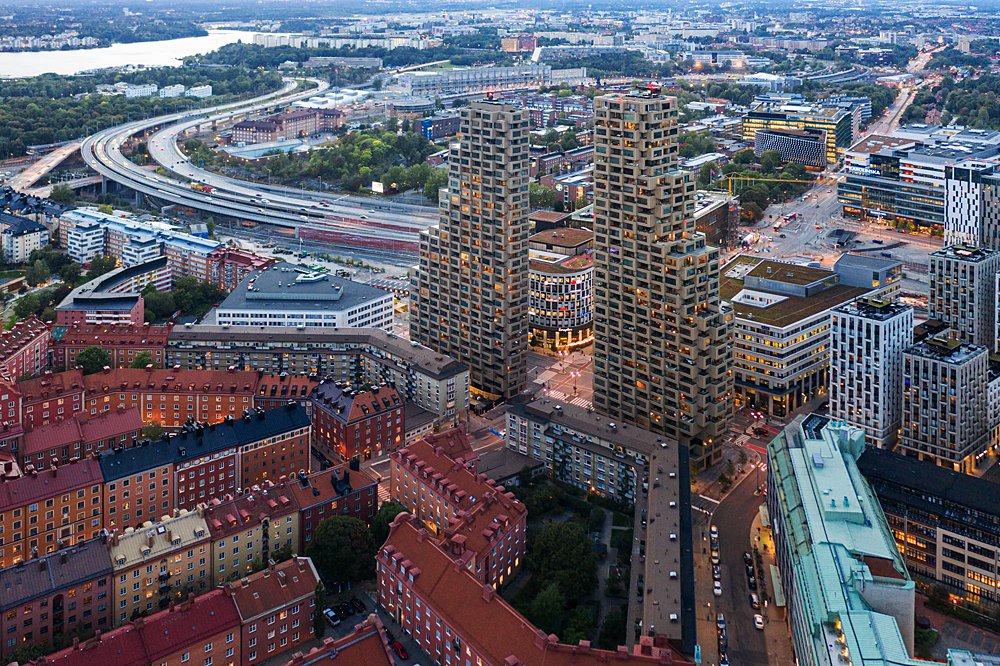
Небоскребы Norra Tornen. Стокгольм, 2013–2020.Фото: Laurian Ghinitoiu/OMA
В Швеции, в Стокгольме колоссальная вертикаль нагроможденных друг на друга кубов — Norra Tornen («Северные башни») — в 2020 году была отмечена архитектурной премией The International Highrise Award как «лучший в мире небоскреб». Впервые в истории эту престижную международную награду присудили скандинавской стране.
В Финляндии вопросом строительства целого комплекса небоскребов администрация Хельсинки заинтересовалась еще в 2010–2011 годах. В объявленном конкурсе победило архитектурное бюро LMA Architects, предложившее новаторский проект Trigoni. Его автор, знаменитый финский архитектор Райнер Махламяки подходит к своей работе как к художественному процессу и считает важнейшим фактором создание комфортной среды в районе высоток. Возведение группы треугольных высотных зданий начнется на окраине Хельсинки, в Пасиле, в конце 2021 года (его ведет компания YIT). Когда они будут закончены, архитектурный профиль столицы изменится навсегда: небоскребы будут видны через Финский залив из Таллина. Сейчас также обсуждается возможность строительства «мини-Манхэттена» в центре Хельсинки, на берегу моря, где собираются создать искусственный, насыпной полуостров.
РАЙНЕР МАХЛАМЯКИ: «С ВЫСОТЫ 200-МЕТРОВОЙ БАШНИ Я ДОЛЖЕН СПУСТИТЬСЯ НА УРОВЕНЬ ОЩУЩЕНИЙ ЧЕЛОВЕКА»
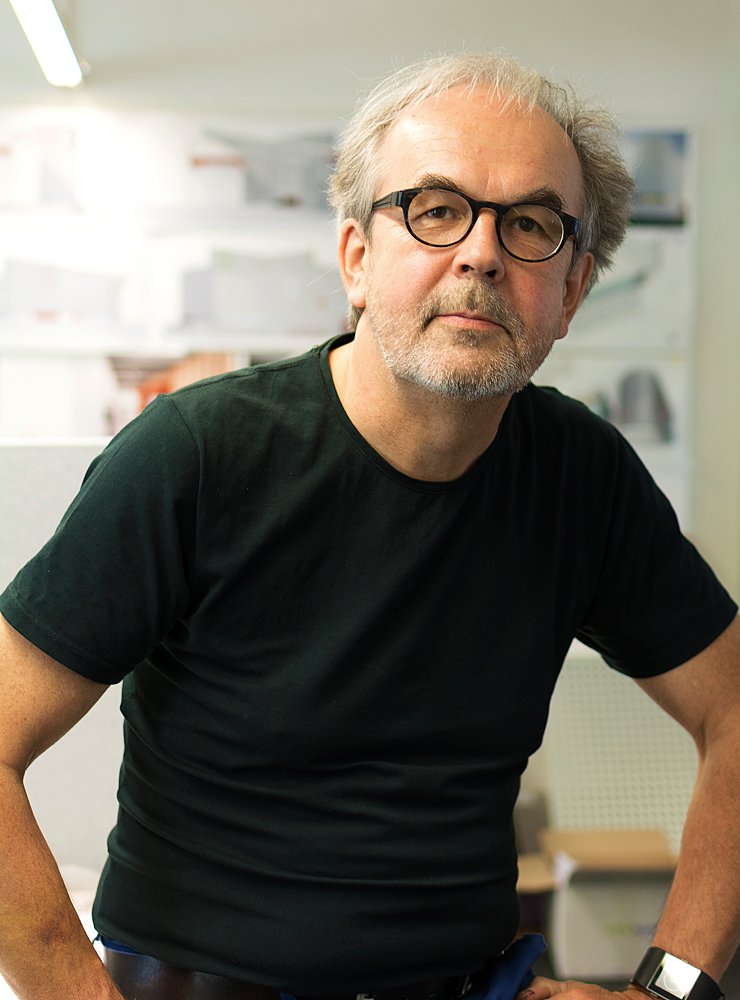
Архитектор, совладелец бюро LMA Architects Райнер Махламяки.Фото: Jukka-Savolaine
Райнер Махламяки — один из самых востребованных финских архитекторов, совладелец бюро LMA Architects. Он автор здания Музея истории польских евреев «Полин» в Варшаве, а также строящегося мемориального комплекса «Потерянный штетл» в Литве (будет открыт в 2023 году). Проект Махламяки «Реквием» для Музея обороны и блокады Ленинграда в Санкт-Петербурге занял третье место в конкурсе в 2018–2019 годах. На счету этого крупного мастера — проекты мемориалов и музеев в Лондоне и Мюнхене, проект музея современного искусства в Риге, осуществленные здания концертных залов и музеев разных направлений в Финляндии, университеты и библиотеки. Архитектор рассказал нам о Trigoni, первом в Финляндии комплексе небоскребов.
В чем новизна вашего отношения к возведению высотных зданий?
Думаю, что в принципиальном подходе. Я размышлял прежде всего об ощущениях человека, который будет находиться не только внутри башни, но и около нее, в пространстве, которое она формирует.
Я много ездил и изучал среду в тех странах, где небоскребы являются неотъемлемой частью пространства города: в Америке, Канаде, Мексике, Австралии. Очень часто среда, созданная небоскребами, остается неуютной, странной и неприветливой.
Если обратить внимание, например, на район высоток, кардинально изменивший облик Лондона, — что мы прежде всего чувствуем? Там неуютно и холодно — в первую очередь в метафорическом смысле, но и в буквальном, кстати, тоже, из-за очень сильных ветров, дующих теперь в этом районе. Всего этого мы стремились избежать в нашем проекте Trigoni. Если вы создаете такое ультрапространство, то прежде всего должны задуматься над тем, как сделать, чтобы в этом районе человеку было тепло, уютно и комфортно.
Предварительный набросок идеи проекта Trigoni.Фото: LMA Architects/YIT
Как же сделать ультраурбанистическое вертикальное пространство уютным?
Избегать прямых линий, давящих прямоугольников, думать о том, как замкнуть пространство между башнями. Как архитектор, я должен размышлять не только над формой, уходящей ввысь от уровня нормального человеческого взгляда, но и над тем, что человек видит и ощущает вокруг себя. С высоты 200-метровой башни я должен спуститься на уровень ощущений человека и создать для него защищенную среду.
Расскажите подробнее о своем подходе к форме.
В архитектуре, как и в искусстве вообще, существуют две школы мышления — декоративный подход и подход чистой формы. В отношении небоскребов декоративный подход характерен для восточной школы, которая нагружает здания дополнительными элементами, делая их, на мой взгляд, тяжелыми, иногда неуклюжими, иногда фантасмагорическими. Подход чистой формы, которого придерживаюсь я, является залогом элегантности, а это для меня главный критерий и в жизни, и в искусстве, и в работе. Чистота формы не есть ее простота. Чистота рождается из понимания искусства и линии, которое было у скульпторов Древней Греции и которое развил Роден. Форма не должна быть обычной, она должна быть интересной. Но при этом чистой, элегантной. В архитектуре работа над формой является определяющей: мы создаем пространство на долгие годы. Самая большая награда для архитектора — осознание, что люди полюбили твое здание, что они ощущают себя хорошо и внутри, и рядом с ним. Поэтому, например, я настоял на том, чтобы в группе небоскребов Trigoni, которые возводятся на очень небольшом участке, все башни были разной высоты, от 100 до 200 м.
Визуализация проекта Trigoni.Фото: LMA Architects/YIT
Ваши небоскребы будут треугольными и из довольно небанальных материалов. Почему?
Идея треугольного плана была навеяна выдающимся мексиканским архитектором Луисом Барраганом (1902–1988). Я пришел в восторг от его цветных треугольных башен в Мехико. Но, конечно, я работал самостоятельно и создал нечто новое, я надеюсь. Используя треугольную форму, я думал о солнце — чтобы люди, находящиеся внутри башен, могли видеть солнце, когда оно к нам возвращается начиная с весны, и воспринимать свет со всех сторон.
Материал — это еще один принципиальный вопрос в работе архитектора, и я отказался от стекла для проекта Trigoni. Мне представляется, что небоскребы, фасады которых сделаны из стекла, холодны. Из-за больших размеров и площадей фасадов стекло создает дополнительное чувство холода. То, что хорошо работает в Австралии, не будет столь же удачным на севере Европы. И потом, это шаблонно. Шаблонно до такой степени, что у многих людей при слове «небоскреб» мгновенно возникает в воображении здание со стеклянным фасадом. Мы хотели показать, что можно создать запоминающееся высотное здание с использованием других материалов для фасада. И достичь художественного эффекта, например, цветом и его вариациями. Я не думаю, что наши башни будут решены в контрастных тонах. Напротив, мы хотим получить гармоничную композицию близких, но разных цветов наших небоскребов, создав мягкое цветовое пятно в архитектурной линии Большого Хельсинки.
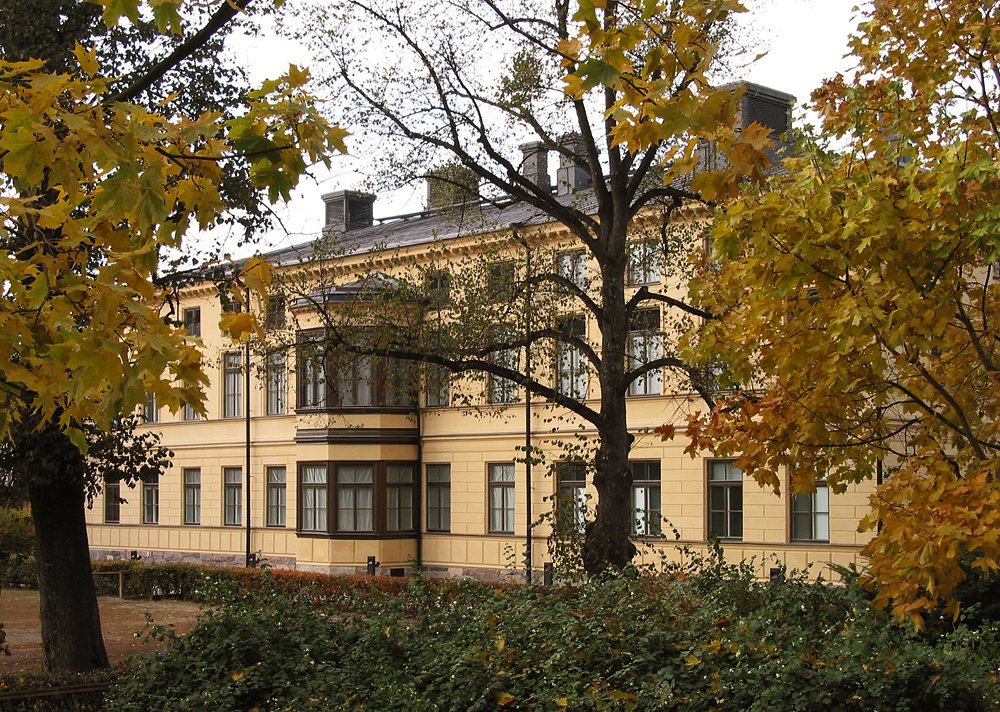
Здание Музея Синебрюхова в Хельсинки.Фото: Arno de la Chapelle
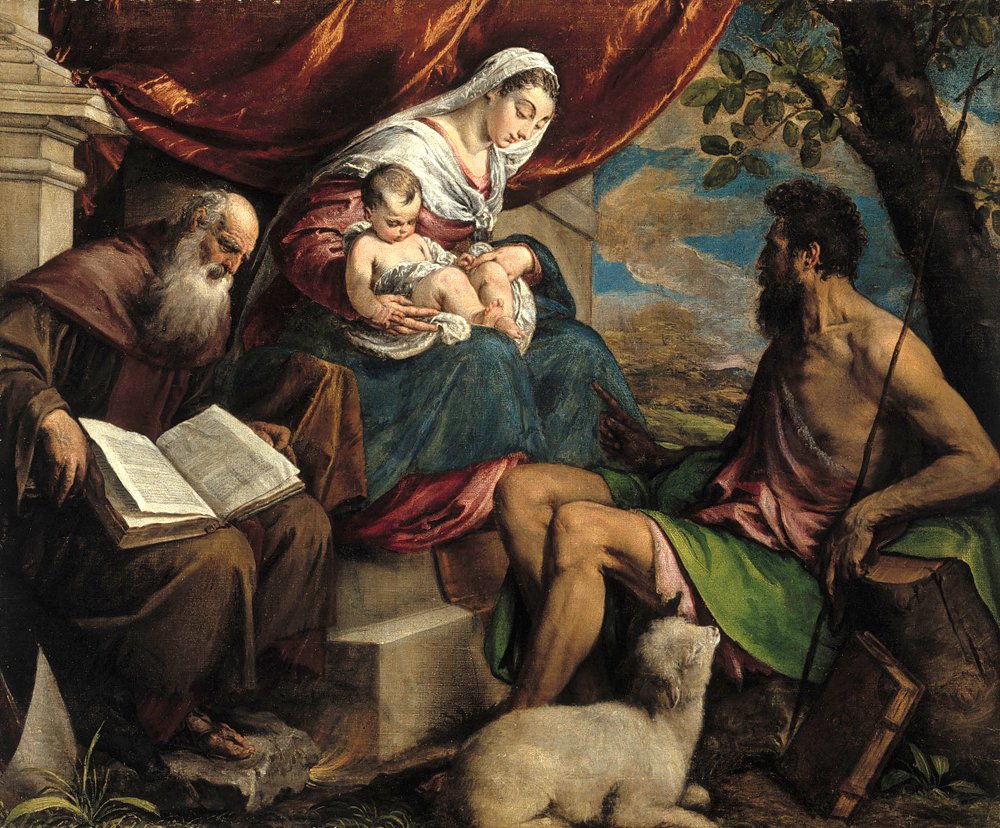
Иногда его называют «мини-Эрмитажем»— и любому жителю Хельсинки понятно, что речь о Музее Синебрюхова. Он расположен в центре города и окружен старинным парком. В красивом, превосходно отреставрированном особняке, построенном в 1842 году для купеческой семьи из России, под одной крышей живут произведения Якопо Бассано, Лукаса Кранаха Старшего, Рембрандта, Якоба ван Рёйсдала, Хусепе де Риберы, Джованни Баттисты Тьеполо. Это собрание и столетие спустя удерживает два давних рекорда: оно до сих пор является крупнейшей частной коллекцией старых мастеров в странах Северной Европы, и, кроме того, дар Синебрюховых остается самым значительным частным пожертвованием искусства за всю историю Финляндии.
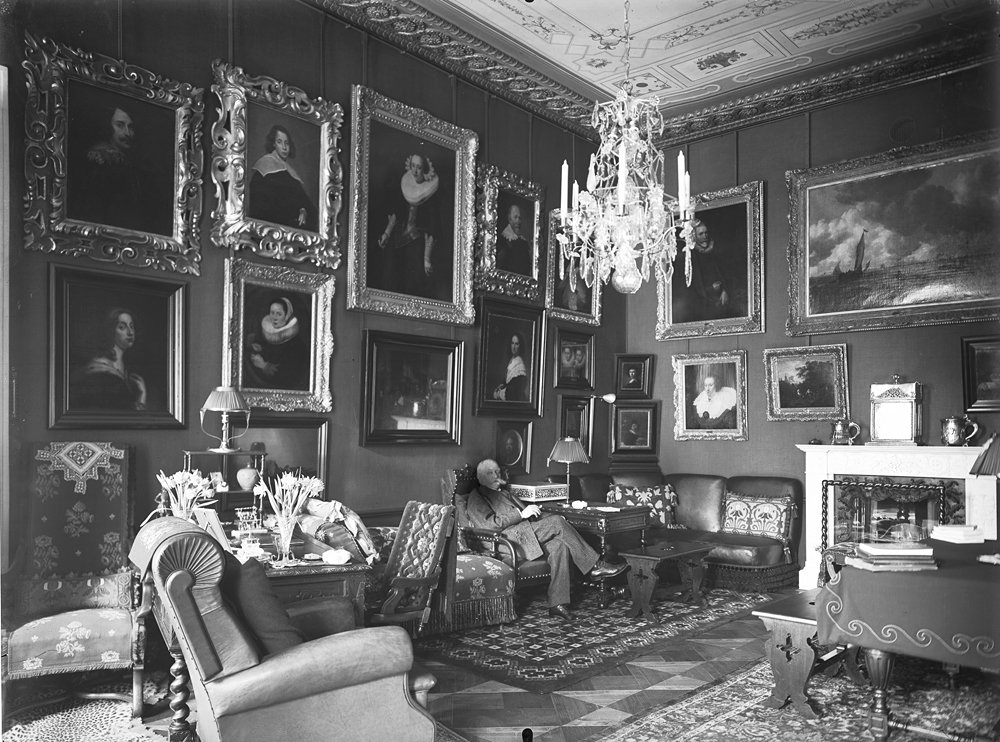
Павел Павлович Синебрюхов в своем кабинете. 1910-е.Фото: Signe Brander/Museovirasto
По завещанию Фанни Синебрюховой, основанном на пожелании ее покойного мужа Павла, главным условием при передаче их коллекции государству было то, чтобы все произведения хранились вместе и были бы доступны для публики. С конца 1921 года музей стал функционировать в качестве домашнего. Он размещался в четырех залах — в той же обстановке, что и при Фанни, пережившей мужа на четыре года. Музей, который первоначально находился на попечении Художественного общества Финляндии, был открыт для посещения в первой половине дня лишь для небольших групп — во избежание порчи ценного паркета и по прочим соображениям сохранности.
В 1939 году уникальную коллекцию едва удалось спасти от бомбежек, экспонаты успели спрятать в хранилище буквально в последний момент. Сам же дом в результате бомбардировки получил существенные повреждения. После войны, с 1945 по 1959 год, он сдавался в аренду химической лаборатории Технологического университета Хельсинки; тогда оттуда исчезли исторические двери и ценный паркет. Члены семьи Синебрюховых проводили первую реконструкцию здания за свой счет. После ее окончания в 1959 году коллекция наконец вернулась домой.
Якопо Бассано. «Дева Мария с Иоанном Крестителем и св. Антонием аббатом». 1560–1565.Фото: Hannu Aaltonen/Finnish National Gallery
В 1975 году государство выкупило у семьи Синебрюховых исторический особняк, а пять лет спустя было решено присоединить собрание европейской живописи, находившееся прежде в музее Атенеум, к коллекции Синебрюховых. Это объединенное собрание, богатое и разнообразное, обосновалось в Музее Синебрюхова (Sinebrychoffin taidemuseo), который тогда же стал составной частью Национальной художественной галереи Финляндии — наряду с Атенеумом, где представлено финское искусство, и «Киасмой», музеем современного искусства. В 2002–2003 годах была проведена исторически точная, детальная реконструкция здания, благодаря которой его экстерьер и все внутренние пространства обрели прежний вид — каким он был в 1910-е годы.
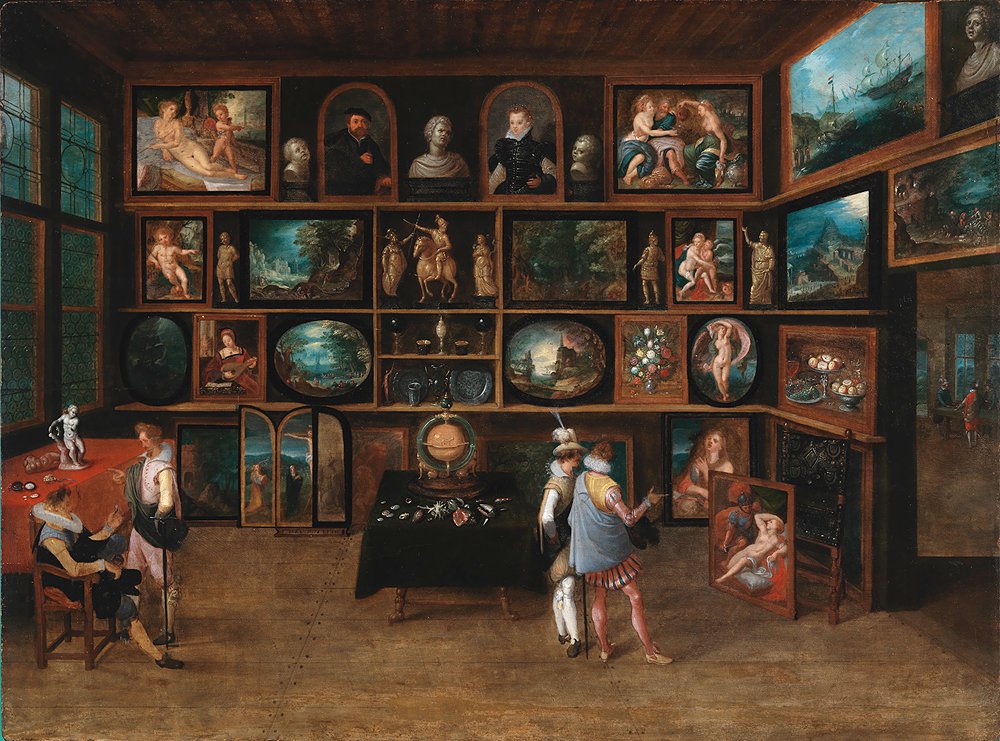
Иероним Франкен II. «Ценители искусства в галерее». Между 1607 и 1623.Фото: Yehia Eweis/Finnish National Gallery
К нынешнему юбилею руководство музея и концерн Oy Sinebrychoff Ab, который продолжает поддерживать тесные связи с этой культурной институцией, подошли со всем тщанием, стремясь отметить знаменательную дату наилучшим образом — вопреки коронавирусным обстоятельствам. Как рассказали нам директор музея Кирси Эскелинен и куратор юбилейной выставки «Путешествия собирателей» Салла Хейно, первоначально планировалось отпраздновать 100-летие передачи коллекции Синебрюховых в дар финскому народу, показав их коллекцию в соседстве с произведениями из зарубежных собраний, однако в условиях пандемии пришлось изменить концепцию, и сейчас публике представлена версия, основанная на собственных фондах музея.
«Сделав коллекцию Синебрюховых ядром выставки, музей привлек и другие собрания, прежде всего те, что принадлежали когда-то коллекционерам одного круга», — уточнила Салла Хейно. А Кирси Эскелинен добавила, что именно на фигуры коллекционеров искусства устроители выставки обращали главное внимание: «Кто были эти люди? Чем они руководствовались? Какие интересные истории с ними происходили? Что они хотели сказать своими коллекциями и что мы видим в них сегодня?»
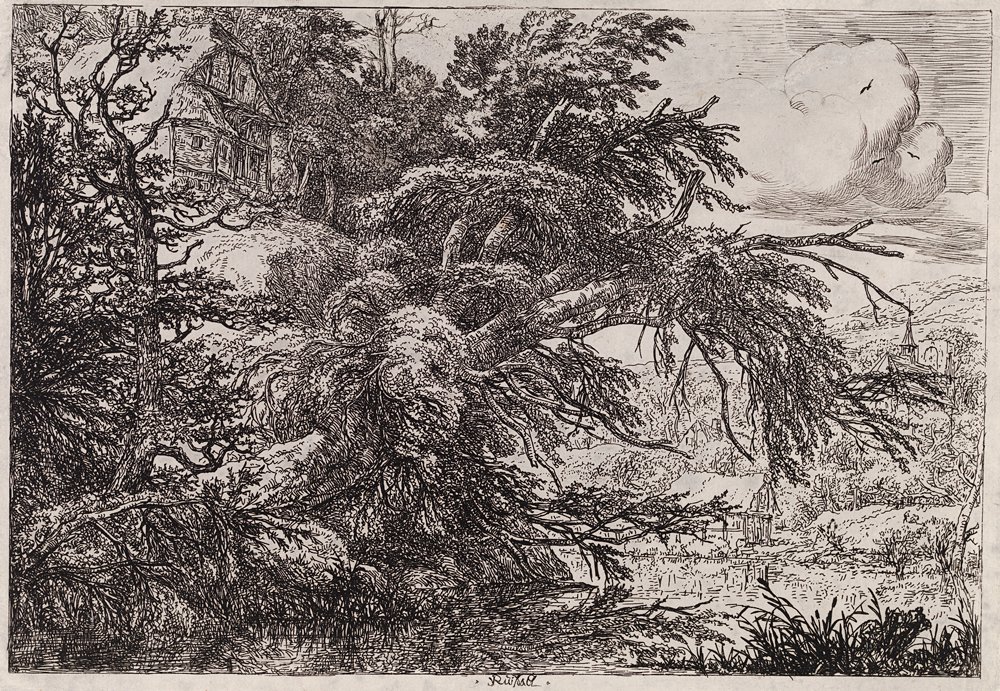
Якоб ван Рёйсдал. «Дом на скале». Между 1628 и 1682.Фото: Hannu Aaltonen/Finnish National Gallery
Выставка будет работать весь юбилейный год — до января 2022-го. В экспозиции представлено 130 работ из коллекций Синебрюховых, Хьялмара Линдера, Яло Сихтолы, Хермана Антелла и других. Прежде всего это живопись — с добавлением выдающейся графики, коллекционного фарфора, редкой мебели, миниатюр. Многие из экспонатов демонстрируются впервые или после долгого пребывания в запаснике. Обращают на себя внимание пейзажи Рёйсдала, не выставлявшийся прежде портрет кисти Элизабетты Сирани «Молодая женщина в тюрбане», графика Арнольда Хаубракена и Рембрандта. Здесь можно встретить превосходные работы Якопо Бассано, Джузеппе Креспи, Шарля-Франсуа Добиньи, ученика Рембрандта Исаака де Йодервиля. Специально к выставке была отреставрирована картина Луки Карлевариса «Средиземноморская гавань».
Зритель словно оказывается в путешествии вместе с теми людьми, ценителями искусства, которые когда-то любили и хорошо знали искусство Европы. А чтобы связать впечатления разных поколений, организаторы дополнили старые собрания двумя современными медиаработами о Риме, которые на свой лад продолжают тему Вечного города.
Коллекция Павла и Фанни Синебрюховых
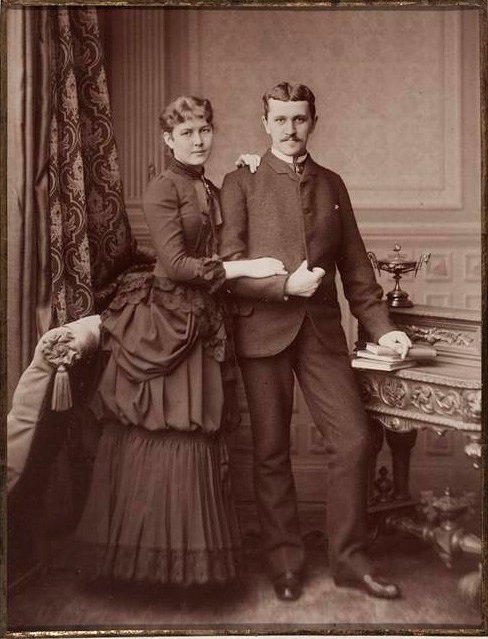
Павел Синебрюхов и Фанни Гран. 1883.Фото: Johannes Jaeger
Получивший известность в Финляндии купец, пивопромышленник и меценат Павел Павлович Синебрюхов (1859–1917) в конце XIX — начале XX века собрал и впоследствии передал в дар стране уникальную художественную коллекцию. Внук торговца из Гавриловой слободы во Владимирской губернии и сын купца, чье дело расцвело в Финляндии, он был первым человеком в этой семье, кто получил университетское образование. И женился он на представительнице совсем другого круга: семья популярной в Хельсинки актрисы Шведского театра Фанни Гран (1862–1924) состояла из архитекторов, педагогов, людей искусства. Художественную коллекцию Павел Синебрюхов начал собирать в 1884 году — в период их свадебного путешествия по Европе — и посвятил своему увлечению 30 лет жизни. Жена разделяла с ним эту страсть.
Павла Павловича особенно интересовали шведские портреты и работы старых голландцев, в то время как Фанни с не меньшим азартом собирала фарфор. Оба любили миниатюры и ценили редкую старинную мебель. Эксперты обращают внимание на то, что для бездетной пары приобретаемые ими произведения искусства словно становились их детьми. И действительно, есть трогательные документальные свидетельства именно такого отношения супругов к ряду картин из их коллекции, например к «Портрету мальчика» работы Франца Лёйкста. По воле Павла Синебрюхова, скончавшегося в ноябре 1917 года, его жена завещала их совместную коллекцию финскому народу. Передача собрания в ведение Художественного общества Финляндии состоялась еще при ее жизни, в начале 1921 года.
Edward and Wallis Simpson meeting Hitler. Germany, 1937.
Missing Part of the Guide for TV Interview Watchers
“Racism drove us out of UK” – a quote from the recently carefully planned and calculated interview by a very fitting each other couple to Oprah. 17 millions Americans watchers, probably more, are in shock and full of sympathy, naturally.
The Labour MPs in Britain have jumped on the horse and have demanded an official probe into the racism at the Palace. Of course. Racism claims are a hot commodity nowadays.
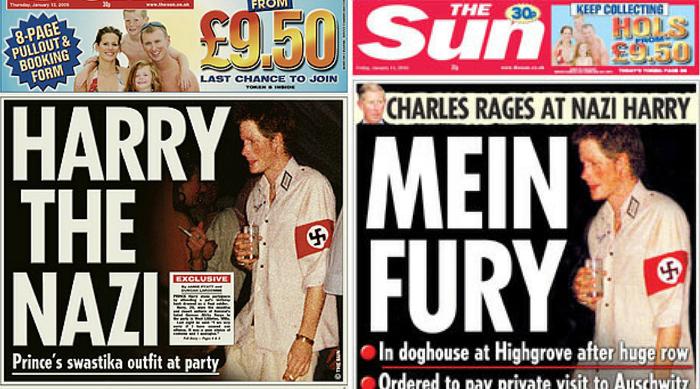
Perhaps, those sympathisers have to be educated a bit who is the person who has stated the line so somber-like and self-convincingly. That still young man is the person who sixteen years ago was featured all over the UK and in some US media as well, on the front pages. He was going to party, with a Nazi bandage on the sleeve of his white shirt. And it was not an isolated case. There were reports on Heil saluting by the same person, too. So he knows something about racism, it seems. British media covers, 2015. (C) Wiki Commons Image Library.American coverage , New York Post, 2015. (C) Wiki Common Images Library.
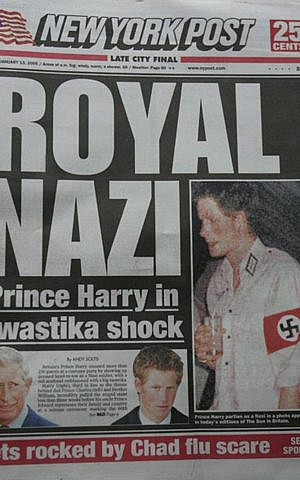
To compare the person’s actions and his words in this case and at this time leads to only reaction: it is simply hilarious. Whoever chooses this kind of outfit for a dressing party is declaring who-he-is. Period. And he is somber-like mentoring his family now choosing to shame them world-wide, for the profit, in that utterly hypocritical exercise for dumb and dumbest.
Next to him is a thriving former barmaid, former B-movies participant ( actress is a profession, so it has to be a distinction) who is having a moment of her life and enjoying every millisecond of it.
The image of the woman on the screen is renewed to the smallest detail: the hair, the dress, every single gesture rehearsed thoroughly. As it happened, it all is a blatant appropriation: the hair, the dress, and gestures too.
Just somebody in a huge Oprah team who was preparing the show, had to read something about the person whose hair, dress and gestures they were appropriated for never-made-it actress on the bench opposite Oprah. Because they have put themselves, their subject, their mighty hostess, and the whole show, actually, in real jeopardy with that choice. Wallis Simpson, 1936. (C) Wiki Common Images Library.
Because – as it was noted in the British press yet before the interview – the copy-catted image was of Wallis Simpson, American socialite who has persuaded Edward VIII to marry her by the price of abdicating. Which was, actually, a blessing for Britain, as it turned out, because having undeterred pro-Nazi sympatizer on the throne at the time of the Second World War would make the job of Winston Churchill much harder. He would prevail anyway, of course.
It would be highly recommended to consult some historian in order not to put the entire operation in such utter embarrassment for those who were responsible in the Oprah team before reviving the Wallis Simpson image 80 years after many of her notorious public and private statements and her multiplied allying with pro-Nazi figures literally everywhere she went. It would be so obvious to read, to learn, to think, to make this probably seen as unnecessary for them exercises of putting one plus one, before copiously cloning and putting in front of multi-million audience today a person who produces all these lines and hints on racism being 100% in the appropriated image of disgusting personage of the modern history known as Wallis Simpson. So much meticulous effort of all sorts to revive the image of whom?
Just for Oprah team – and for those among the huge international audience who have no clue about who Wallis Simpson was: she was the person who has publicly stated that ‘France has lost ( to the Germans) because it has been infested inside”; she was the person who did choose as the host for her scandalous wedding with abdicated Edward the Portuguese banker who was known to the MI-6 as devoted Nazi sympatizer, appropriator of looted by Nazi art, and who was close friend and business partner of dictator Salazar.
She was the person who with her husband ran in 1937 to Germany to meet Herr Adolf and to lick his rare part enthusiastically, forgive me a small slip off the protocol. The Simpson and Edward visit to Germany and their cheerful and cordial meetings with Hitler are very well documented. Just one of many existing photos of the tour voila:
Edward and Wallis Simpson meeting Adolf Hitler in Germany in 1937. (C) Wiki Commons Image Library.
She was the person who has organised the luxury marine tour for her-beloved-self and her husband on a board of an yacht of Alex Wenner-Gren, their good friend and associate and at the same time close personal friend – and business associate of Herr Göring, Hermann Göring. Furious Churchill managed to avert the public disaster with that would be sun-bathing of still Royal couple on the yacht of a pro-Nazi person who was actually banned by the British and American authorities during the WWII for his pro-Nazi activities and dealings with the Third Reich.
Substantial part of these activities were banking manipulations subsidising Nazis via Wallis Simpson’s one of the best and closest friends Wenner-Gren’s bank domesticated where? In the Bahamas, indeed. In the Bahamas where Simpson’s third husband Edward was put by the British Crown to be the Bahamas governor during 1940-1945. One might wonder why on earth did he step down from that so convenient position on March 16, 1945 when the the Nazi Germany’s utter defeat was imminent? One might, but none of the British historians do not.
I am not going further into that man’s personal relations and existed – before masterly retrieved by the able British ( and it happened, Kremlin) agent immediately after the end of WWII – highly incriminating letters between him and Hitler. But it is well-known that they did exist.
My point with regard to that stunningly mean exercise on the TV screen aired with such publicity is that the guide for this show for massive TV audience, especially in the States, clearly misses the part in which the audience would be reminded on the episode of the Nazi entertainment costume happily picked up by member of the Royal family who is now making such blatant statements on racism which in his words ‘drove him and his family out of his country’, and about the record of the openly and proudly pro-Nazi American socialite whose image has been picked up for appropriation by another American who is a parody even of a socialite. The audience has its right to know about these historical facts, to make their conclusions.
But of course, this kind of missing part of a guide for TV audiences does not generate such dizzy profit. As we know from history, including the modern one, decency hardly does. That’s why throughout long historical records it is regarded as a luxury. Royals or not.
First published at Israel National News, February 2021.
Covid pandemic has turned our lives upside down. For observing Jewish families, all spiritual peaks of our traditional year have transformed into something completely new, unexpected, unknown. But it is not only our holidays which we are trying to keep on a surface, with more or less success. In many Jewish lives, such crucial events as bar Mitzvah and bat Mitzvah have been muted into some completely new experience for the second year now.
Each family adopts to it in its own way. Parents, siblings and relatives are trying their utmost in a frantic effort to make this odd substitutional bar and bat Mitzvahs as celebrating as possible.
And the children. In big families in particular, being witnessing their older brothers and sisters’ previous bar and bat Mitzvahs celebrated in the way we knew it, the children whose bar and bat Mitzvah are to be celebrated during the pandemic are in such a daring situation.
All together, it poses a truly tough challenge to every observing Jewish family world-wide. How to handle it? What to do? To create something truly memorable for our children that they would bear it with them all their lives, being proud of it and cherishing it forever.
As it happens in life, toughest drama can also produce the most powerful overcoming. There are so many various ways for that. In the special cases when people in question possess the richness of our tradition and the depth of their own inner content, this overcoming is getting into all different levels altogether.
We closely know the family of Rabbi Shmuel Kaminetski, his wife Channah and their children for many years. We love them dearly, as many people do whose lives were and are shined because of who Rabbi Shmuel and Rebbetzin Channah are and what they project to the outside world.
I once said that Rabbi Shmuel is ‘a diamond of a man’, and the longer I know him, the more I think this way. Being a direct descendant of Rashi on his mother’s side, Rabbi Shmuel projects his genetically rooted intellectual and spiritual brilliance generously, and it is always for sharing. He also can be tougher than tough, if the circumstances require it. As a diamond, indeed. He is witty and deeply cordial. And he shows extraordinary understanding and character amidst the most challenging situations. The best possible Rabbi and an exceptional man.
His wife Channah who comes from the Baumgarten-Lipsker Lubavitch Chabbad family of the people who were devoted close assistants of the Rebbe, is a very special person, indeed: brilliant mind, golden heart, beauty and witt, and that ever present youthfulness which is a special and rare gift to those very few who are truly deserve to be mercifully highlighted in the life this way.
Channah’s grandfather was first ever Chabad Lubavitch shlicha to Argentine, while her grandmother was a close friend from youth with Rabbi Yehuda Krinsky, the closest person to the Rebbe, the man of extraordinary mind and outstanding character. Channah herself in her childhood was lucky to spend many afternoons at the Rebbe’s house with his wife, Rebbetzin Chaya-Mushka, and remembers the Rebbetzin’s many talks with her, then little girl, all her life. Being moulded by such extraordinary people, Channah has told me very recently that ‘as far as I remember myself, I could not understand how to live, under any circumstances, in any place, without giving, whatever I had”. When domineering priority in one’s life is giving, this life is enlighted from within. And it warms up many people around.
Recently, one of Rabbi and Rebbetzin Kaminetski children, Yossi, has had his bar Mitzvah. Celebrating it under the harsh realities in the pandemic restrictions, they have decided with assistance of their friends in the Dnepr Jewish community in Ukraine that Kaminetskis lead for over 30 years being sent to the beloved place of his youth by the Rebbe personally, to make a special video to commemorate the date.
Yossi himself has chosen that so very beautiful Ben Kodesh Lechol song by Shulli Rand and Amir Dadon. There are many Jewish boys today recording musical videos for their altered way of celebrating bar Mitzvah, and the trend will be only growing. But there are videos and videos. The video which has been made for Yossi Kaminetski’s bar Mitzvah with his father Rabbi Shmuel starring with him there, is exceptional.
One can watch it endlessly because of many reasons. The video presents a very good cinematography – for which a well-deserved thank you goes to talented, cordial and understanding Larissa Tremba and her husband Vjacheslav who runs their La Tre studio. It also shows a tasteful symbolism, organically balanced emotions, not too much, and not too little. It brings out surprisingly high quality of singing and musicality by both protagonists, the father and the son – yet more surprising for those who would learn that both are singing publicly for the first time ever. What a fantastic debut.
But most and foremost of all, this three-and-half minute video captures and produces a simply golden outpour of the best in our people: loving kindness, an accord of aspiration and wisdom, best possible family bond. I just do not know a better living sample of what a Jewish family is about among the thousands of videos available on the theme. Additionally to that, there is also an organic, not boasting, spiritual aspect which shows how this enrooted dialogue of a Jewish believing person with the Creator originates the light of its own.
I think I know the secret behind this very special effect of Yossi Kaminetski’s bar-Mitzvah musical video. It is the substance of the characters of father and son there, and their relationships which has come so beautifully out from that wonderful singing duet.
To me and my husband, this video is a gift and a blessing. Every time when we are watching it – which is a lot – the warmth of love and the rare depth of the mighty Jewish character of Rabbi Shmuel outpours from the screen and embraces us in a special enlightening way. I regard this video not as just a good song and nice smiles. There is so much more in it. It is a very valuable spiritual experience which enriches life by its beauty, its substance, its warmth, its depth and its gentleness. It is also the best live – and singing – illustration of the term ‘loving kindness’ I’ve seen for a long time.
And it is a rarity, too – as Rabbi Kaminetski did this incredible recording just for once, for this very occasion of unusual form of the bar-Mitzvah of one of his sons, in a superb way of joining forces with Yossi to celebrate it in a memorable way.
I am very glad to be able to share this special video, this singing love in between our generations, with the wider audience.
Being inspired by the talents of our dear friends, I have created a special series of original artworks Duet of Loving Kindness. Enduring Beauty of Jewish Family which is presented here in the form of a photo-essay, an exclusive art panel to honor the Kaminetski family who live Jewish values as one breathes. This living is truly beautiful, as their singing is.
And even there, Pat’s works which I presented, were perceived by the people who know every detail of what has happened to the inhabitants of Brehow Ghetto, with deep emotions. Because when someone , 70 years later, re-lives a tragedy on the level of a certain child, a certain mother, a certain boy, with such a passion, asking loudly all those questions which had been answered never, it reverberates in people’s hearts powerfully.
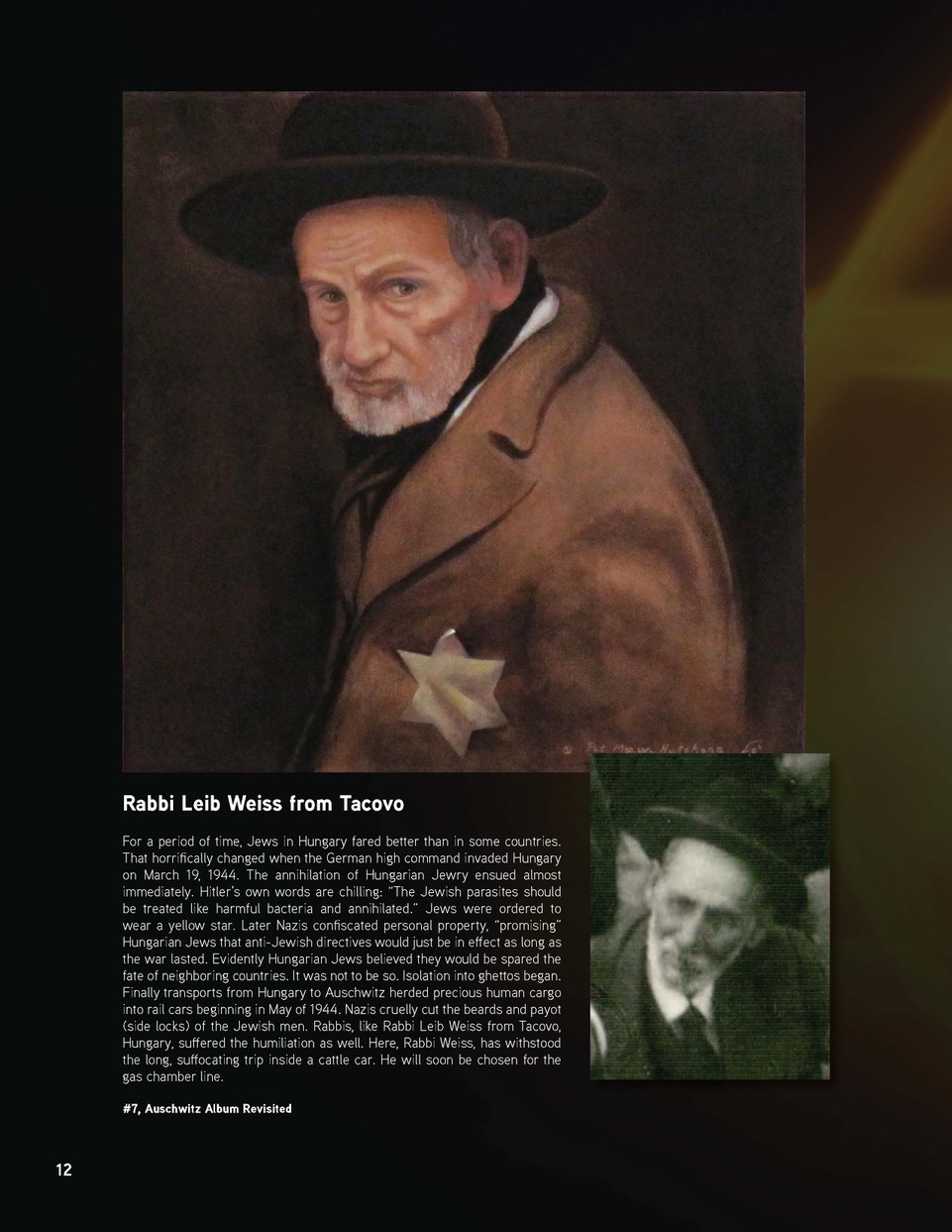
Comparison of Pat’s coloured oil works and prints made in 2011-2014 with black-and-white photos from the original album works in a stricken way. Pat’s art is metaphorical – photos are documental. Pat’s works are picking up some one-two-three people from the photos – photos fixes groups as they were. Pat’s works manifesting hyperbolised details, such as a children doll, a girl bow, oversized yellow star on the Rabbi’s coat – photos are not magnifying anything like that, they show us a cold view of a butcher before his methodically applied butchery would start any minute from the stills taken. The contrast is colossal. It shows the very essence of the Nazi butchery of human beings in uniquely magnifying glass of compassion which becomes conviction.
Our committee has decided to start to work with good colleagues at Yad Vashem and go on for the publication of a special brochure, publishing all forty Pat’s art works next to their prototypes from the original The Auschwitz Album, with her – and ours – commentaries.
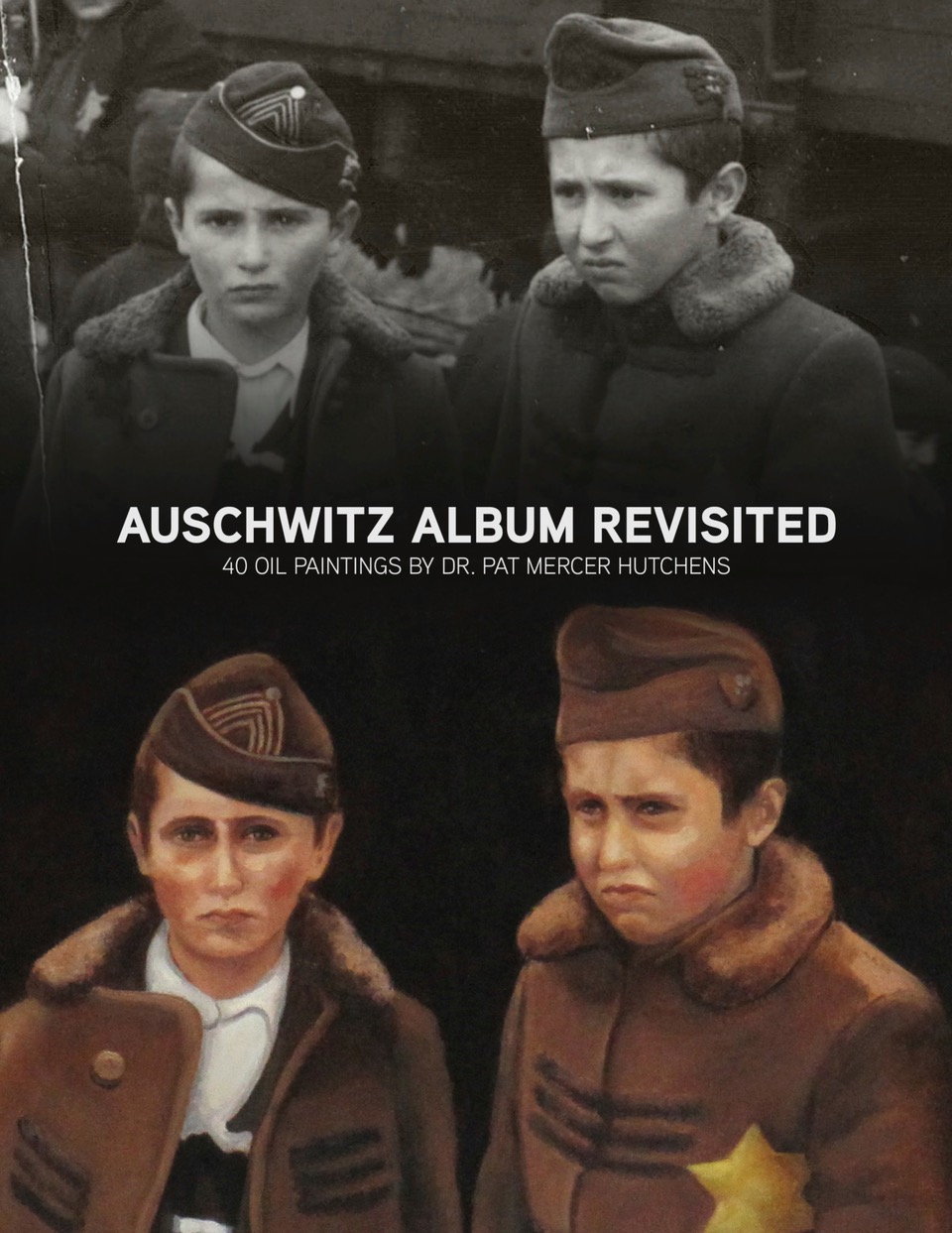
Eight months later, in Nomver 20202, the first brochure in this format has been ready, thanks to focused and devoted work of Dr Shelley R.Neese who took upon herself to implement our ideas, in memory of her great teacher, Pat Mercer Hutchens. In the end of the past, so difficult because of the pandemic year, 2020, 500 catalogues comparing Pat’s artistic interpretation with chilly black-and-white photos from the Auschwitz Album went to the Faculty of Arts at Liberty University for our pilot educational Art & Holocaust course there. We are having plans for expanding the program world-wide. Cover of the Auschwitz Album Re-Visited Catalogue published in November 2020. Credit and permission: Shelley R.Neese, The JerUSAlem Connection.
Forty Personal Stories
I knew Pat well. I felt her as a family member. She was a close friend. She was a fighter, and a straightforward strong American girl from Louisiana, that type of made of steel ( outwardly) Southern American girl with strongest and noble convictions, immense will, and mighty spiritual drive. She was sharp and fair. Inwardly, she was very subtle, finely feeling and subduedly expressing herself as a gentle soul who knew what a nuance was about in an organic way of implementing it.
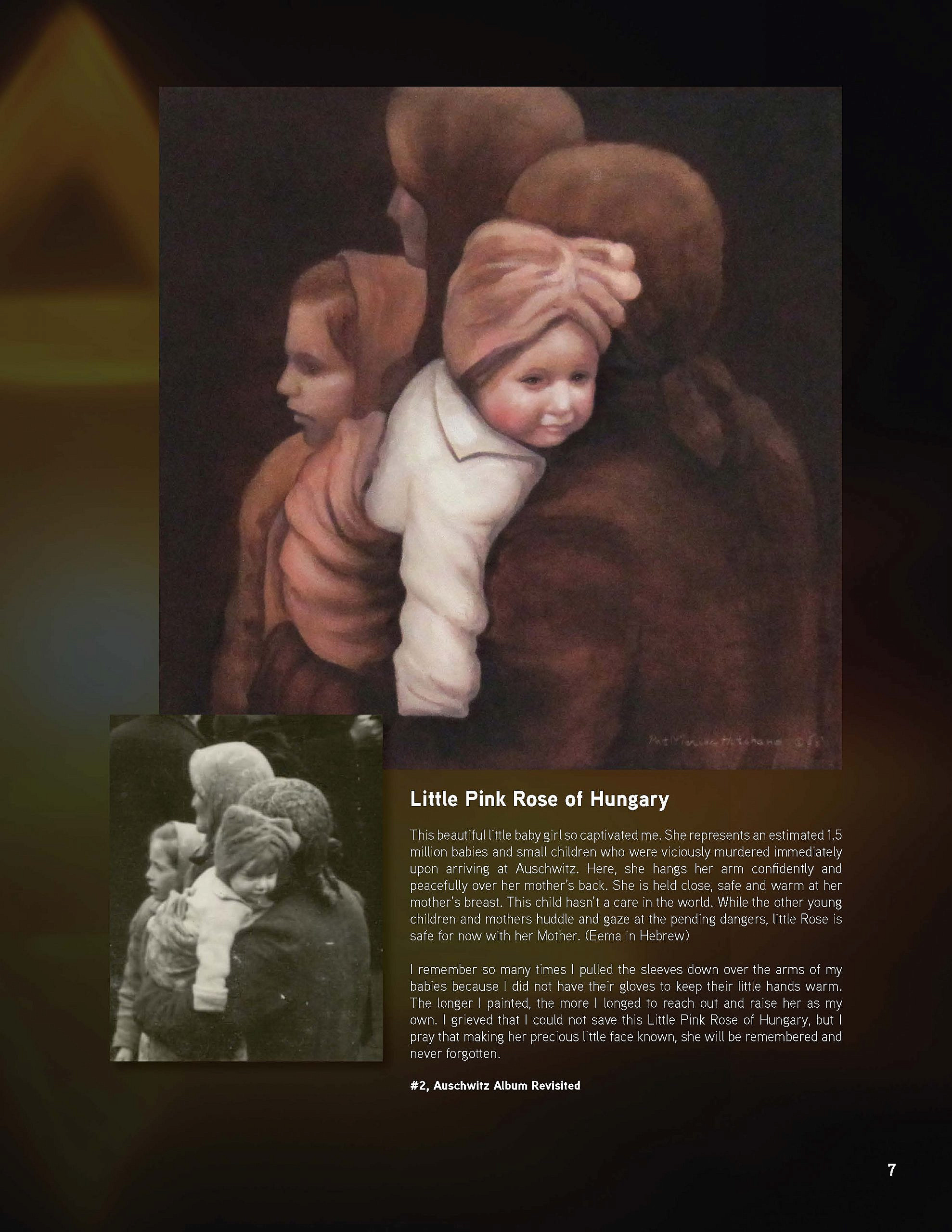
I also knew, being helping her in her last project as its curator, in what hurry she was. The Auschwitz Album has 56 pages with 193 photos on them. Originally there were more, but Lilly Jacobs who found the album in the pocket of the left SS-coat on very chilling day of January 27th, 1945, in one of the Auschwitz barracks, and who kept it in her attic in the US until 1980s , gave some photos to the people who did recognise their family members in that terrifying document of the Shoah. Page from the catalogue with Little Rose of Hungary art work, the artist’s comment, and the corresponding photo from the original Auschwitz Album.
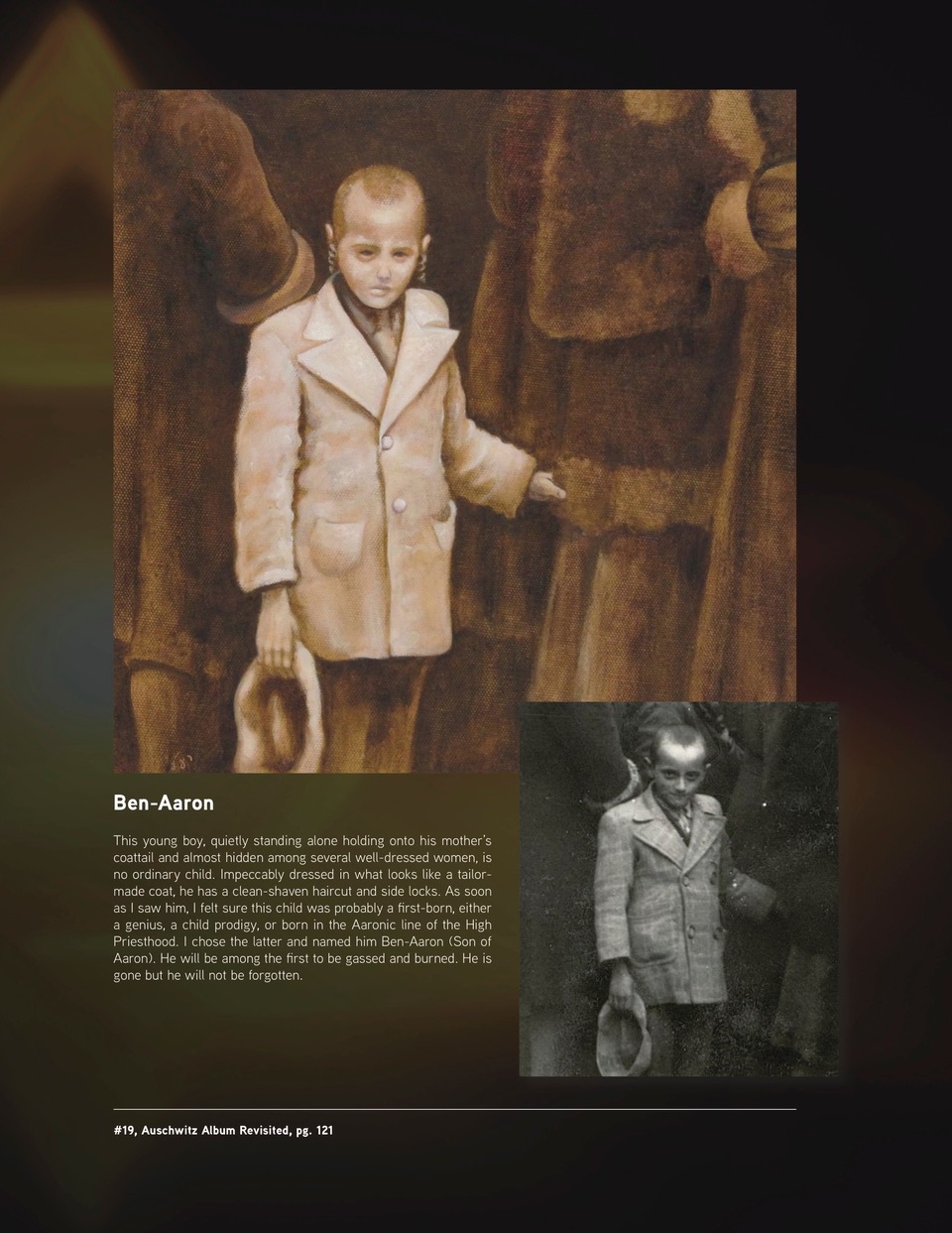
Pat has told me several times how hurried she is. “You see, my dear, there are about 200 photos in the album. I did just a bit of them. I know that I would not be able to do them all, but I am trying to work hard, to do as many as I could”. She was hoping to make seventy of her artistic interpretation out of 193 in the album. She managed to do 40 of them. Catalogue page with Ben-Aron art work, the artist’s comment and prototype photo from the original Auschwitz Album.
In the recently published art brochure, the catalogue of her last art and humanist project, there is a quote from Pat’s thoughts with regard on that ordeal which she willingly adopted as her last mission in life: “Horrifying as they are, these group photos revealing mass tactics of de-humanisation make it harder to see each person as a suffering individual. My purpose is to zoom in, take two, three or four, and search for a more personal story. It is my prayer that observers will think about each man, woman, and child pictured in the album separately. That was my goal in the heart-wrenching process of painting. Often, I dreamt of trying to bring one of the children back to life. My heart tells me that if I had gone through such an appalling, de-humanising experience, it might bring some small shred of hope to know that perhaps someday, somewhere, someone would know—and let the world know what happened. That is the goal of my life work as an artist; to create monuments of remembrance through art. I am grateful to God for giving me the honour, strength and compassion to paint each precious person”.
It was written by a mortally-ill over 70-year old woman artist who knew that her days are numbered and who went through an exhausting chemotherapy process at the same time while working on her last project which has been also emotionally powerfully drenching out. Catalogue page with Rabbi Leib Weiss art work, the artist’s comment and photo from the original Auschwitz Album.
Seven years on Pat’s passing, I am thinking of my elder friend ( Pat and Jim are the generation of my parents), on her selflessness, and her focusing on the tragedy of Jewish children, women, elderly, Rabbis, anyone who has perished in the Shoah. I am thinking of her vision, her approach to see individuals in all those six-plus million victims of the Shoah, with one and a half million children among them. She tried to see and recognise every single person in those 193 photos from the only photographic evidence we have of what was happening inside Auschwitz.
Because only if one would be seeing them individually, they would be recognised and remembered. If we will be looking not on an unidentified child or elderly, but on Little Emma, Ben-Aron, Rabbi Weiss, we would start to comprehend the horror and enormity of that unspeakable crime which has been committed against them and our people. Each of them. Six million and more, individually. With the name. With the place. With the face, if possible. And this is exactly what Pat Mercer Hutchens has done in her last art project which goes far beyond art and gets into the orbit on applied universal humanism, being positioned high there.
It is very encouraging to me, who was named after my young aunt Minna Chigrinsky who was murdered in the Shoah in October 1941 along with her aunt and uncle being just 18, that many kids in schools in several countries and many students in several American and European Universities would be studying and understanding the Shoah as a personal stories having in front of them the catalogue of the Re-Visiting Auschwitz Album by my dear friend Pat Mercer Hutchens and being able to compare it with the original photos from that horrendous document which is kept at Yad Vashem. I know that this way, people’s understanding of the Shoah will get personal. As it should be.
* * * *
The booklet can be ordered here. All funds from it goes to the Holocaust Educational Fund.
January 2021
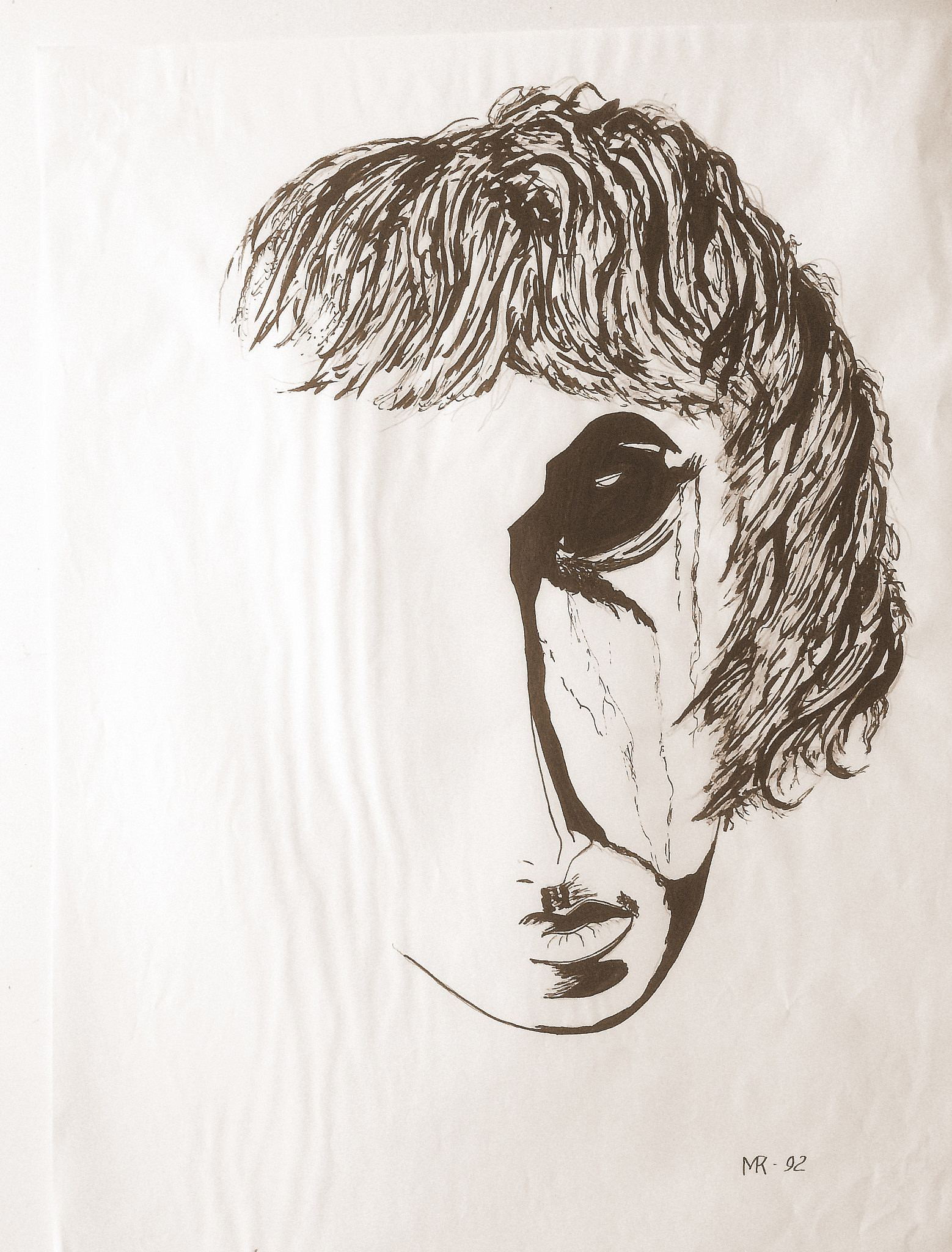
The scale of the Shoah prevents us from perceiving it in a whole. Human psyche’s self-defence mechanism is evoked, often blocking us from absorbing it in its enitre shocking volume. We know its methodic plan and idea. We also know the incomprehensible outcome of it. It comes as facts of history. But what connects us with our brethren perished in that unspeakable crime is the way of personal identification with real people from those six – and in all likeness, more – million murdered Jews. That’s why many of us randomly adopt one Jewish person from the Yad Vashem data-base every January 27th, to identify with that Polish girl, or that Hungarian boy, or that Lithuanian woman. My husband and I are doing it annually, and we treasure that somber but also warm and personal moment when a face and a name appears on our screens and we are able to commemorate the taken lives of more than six million souls while identifying with just two of them, each for one of us. Michael Rogatchi (C). Faces of the Shoah. Indian Ink on cotton paper. 50 x 40 cm. 1992. The Rogatchi Art Collection.

Another day, I saw some photos of a nice American Jewish boy whose family has chosen for his bar-Mitzvah a very moving Yad Vashem program in which Jewish boys can conduct their bar-Mitzvah with adopting a Jewish boy murdered in a Shoah who had no chance for that. There is one thing when a Jewish boy chooses to put his tefilin for the first time in front of the Auschwitz entrance. It is a symbolic and conscious gesture.
It gets disarmingly different when the same boy is doing it in the name of a 2-year old Hungarian Jewish boy with a name and surname, knowing the circumstances of his annihilation. I cannot imagine more formatting experience in upbringing of the kids whose families had the heart and thoughtfulness of choosing this kind of bar-Mitzvah for them.
When the Shoah gets personal, it gets under our skin for good.
Presence of Little Emma
A year ago, on previous annual commemoration of the International Holocaust Day in January 2020, I penned the story about such a personal journey into the depths of the Shoah by several people in different generations. The story can be read here.
I wrote there about dear friend, late American artist Dr Pat Mercer Hutchenswho, after learning on contracting cancer at the age of 74, have decided to dedicate the last three years of her life to scrupulous research and the artistic visualisation of the images on terrible photographs from The Auschwitz Album, well-known document. As a matter of fact, the Album which is preserved at Yad Vashem from 1980 onward, is the only existing photographic evidence from inside the largest Nazi factory of death. Inna Rogatchi (C). That Kind of Forest. Watercolour, wax paster, oil pastel, lapice pastel, encre a l’alcool, perle de jaune on authored original archival print on cotton paper. 30 x 40 cm. 2021. Ghetto Waltz series.
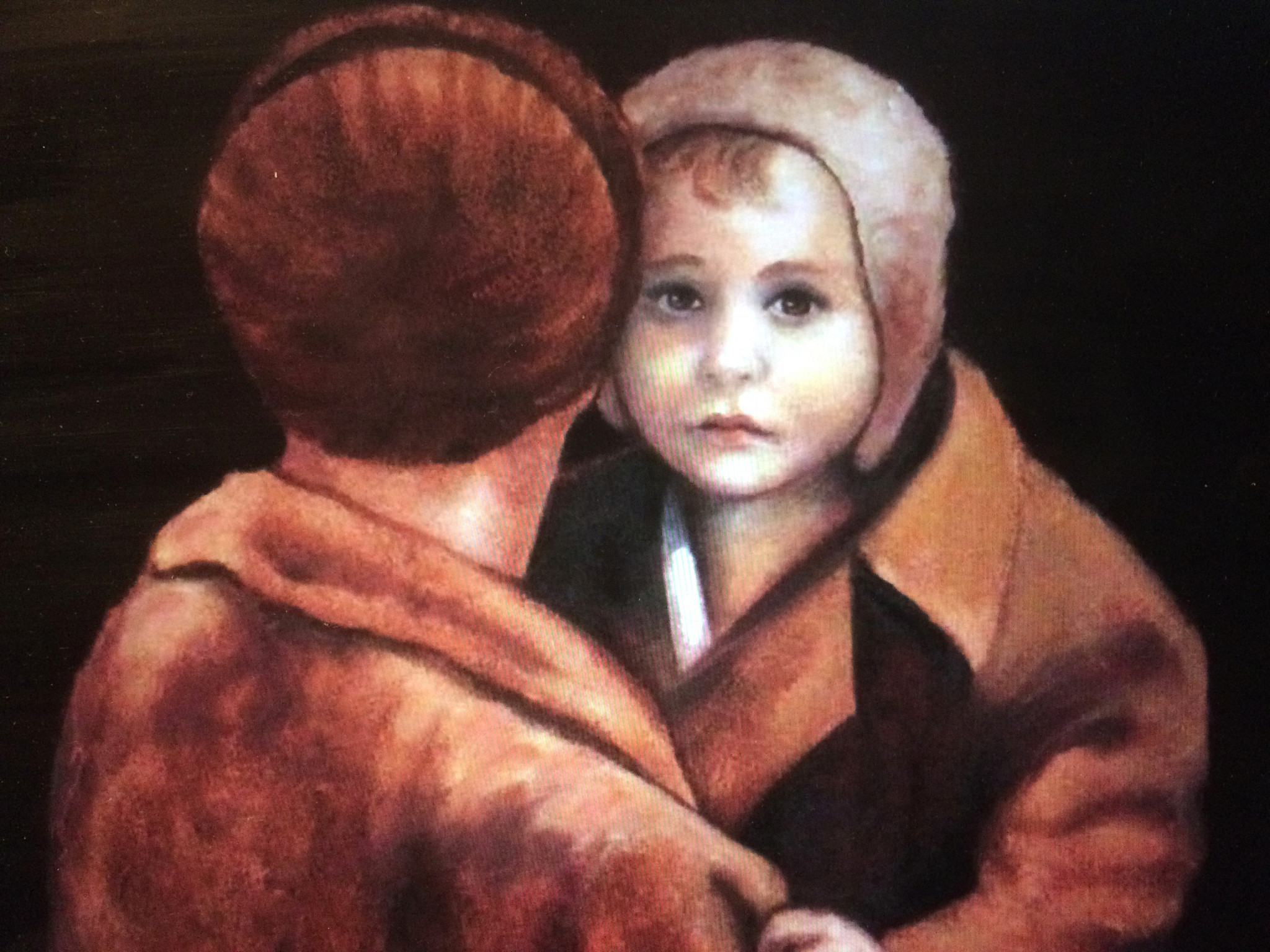
I also wrote in that essay a year ago about several types of interconnections, between the Shoah witnesses and its victims and their families and those passionate souls as Pat’s who were as if translating the emotional trauma of the Shoah for us today; and also about generational interconnections in between the Pat’s students and their children, the way through which the compassion is preserved and alive, thus assuring the memory of the innocent souls murdered, and also strengthening the personal qualities of all, especially young generations, involved.
A month after publishing that essay, in early March 2020, I went to the USA in what happened to be my last trip before the pandemic that has grounded us all. Many things during that memorable visit were connected with Pat’s memory, her legacy and how to transfer it to the next generations. We have had a special ceremony of our The Rogatchi FoundationHumanist of the Year 2019 Awardin memory of Pat Mercer Hutches for her husband, legendary American hero, Brig. General ( Ret) Jim Hutchens, meetings of the educational committee on Pat’s artistic and historical legacy, collegial encounters at the US National Holocaust Museum and Memorial in Washington D.C., among the other things.
I was encouraged to see the eyes of young generation, from 10 to 20 year old ones, during the ceremony near Washington D.C. where they were listening to speeches and our re-collections on how the active, creative, spiritual, passionate memorialising of unknown to her victims of the Shoah has marked the last years of Pat’s life, how she , while battling the cancer, bravery immersed herself into sharing the destinies, actually, the very last hours and minutes of the boys and girls, women and elderly, Rabbis and mothers from the Brehow ghetto in Hungary, which was a collecting point from several towns in the region. How this established American artist, sixty seven years after the collapse of the Hungarian Jewry, decided and carried on re-living the terrible end of their lives with those people.
It was very quiet in the audience during our ceremony at the speeches part of it when we were recollecting what Pat and Jim did and why. And I would remember the eyes of a few youngsters present there with a hopeful feeling of preservation not only of memory, but the interest towards it. All his life, Elie Wieselwas deeply troubled by the indifference he witnessed first-hand before, during and after the Shoah. Many other survivors would share both publicly and privately the same never answered question and piercing pain on that paralysing, incomprehensible indifference surrounded Shoah and emboldened it in the most desperate way.
The eyes of those youngsters at our ceremony near Washington D.C. in early March 2020 when we were discussing, remembering and reflecting on the Hutchens family attitude and their life-long efforts to share the tragedy of Jewish victims of the Holocaust in their post-life, were telling to me that these very people would not be indifferent. I do think that it is a vital outcome of the efforts of the people like General Hutchens and his wife artist Pat Mercer Hutchens, their living and growing up legacy.
Thanks to a generosity and great hearts at the right place of Amy and Bill Zewe who were hosting our ceremony near Washington D.C., it has become a wonderful, warm, meaningful, loving and memorable event.
There was one spot in Amy and Bill’s house which was a kind of a magnet to every single person who entered it prior to the ceremony. When I saw it once and again, I decided to get closer there to find out what makes the place attractive to everyone to stop there, and groups of guests to stay there for a while. When I got close, I was overwhelmed. My favourite artwork of Pat, which is also on our wall as I’ve described it in my previous essay on the topic, Little Emma was there. People were as if being pulled next to that wonderful, and so very special work. Pat Mercer Hutchens (C). Little Emma. Authored original archival print signed by the artist. The Rogatchi Art Collection.
I said: “ It is on mine wall as well”, and was about to continue with “It makes two of us”, meaning Amy and myself, while people staying next to Little Emma started to respond: “ It is on my wall as well” – said Shelley Neese, historian and writer, President of The JerUSAlem Connection, – “ and on the wall of my in-laws, too”. – “It is on my wall, too” , -‘ and mine’ – said both daughters of Pat and Jim Hutchens. – “ It is on my wall, as well”, – said two more guests of the ceremony. ‘So we have a Little Emma club here” – I concluded, being deeply impressed by the choice of all those people, their solidarity, their sentiments which I would never know about unless we all happened to be at the same time at the same place next to that so special for each of us work of our all dear friend.
I still remember that episode as vividly as it happened right now. And I remember the eyes of all those smiling women around Pat’s Little Emma, these eyes transmitting deep, non-declarative compassion that little Emma and all of those little Emmas were devoid of in the awful end of their brutally abrupt lives.
I also thought of what one artistic work made by a wise heart is capable of, in generations.
Blue Hills of Virginia
During my last trip before the pandemic, we were travelling through extraordinarily beautiful blue hills of Virginia, a magic place with special people living there, so rich in history from the beginning of the American story 244 years back till today. We approached a huge campus of Liberty University and were greeted into its giant Faculty of Arts. We have had an important working meeting there, to discuss the further development of the Pat Mercer Hutchens artistic legacy.
After doing a lot of research and thinking, Pat has decided to donate all 40 originals of her oil on canvas works of her Re-Visiting The Auschwitz Album collection to the Faculty of Arts of Liberty University. She has told me shortly before her passing that it was not her immediate and first decision, neither was it spontaneous one. She realised that those 40 originals are a central part of her legacy, and she wanted to make sure that it will go to the right address, she said.
With over 70 thousands students attending Liberty University, and many of them taking also different art courses there, with their facilities, and the attention of the Art Faculty’s head, known sculptor, professor Todd Smith, Pat’s decision seemed to be the right one.
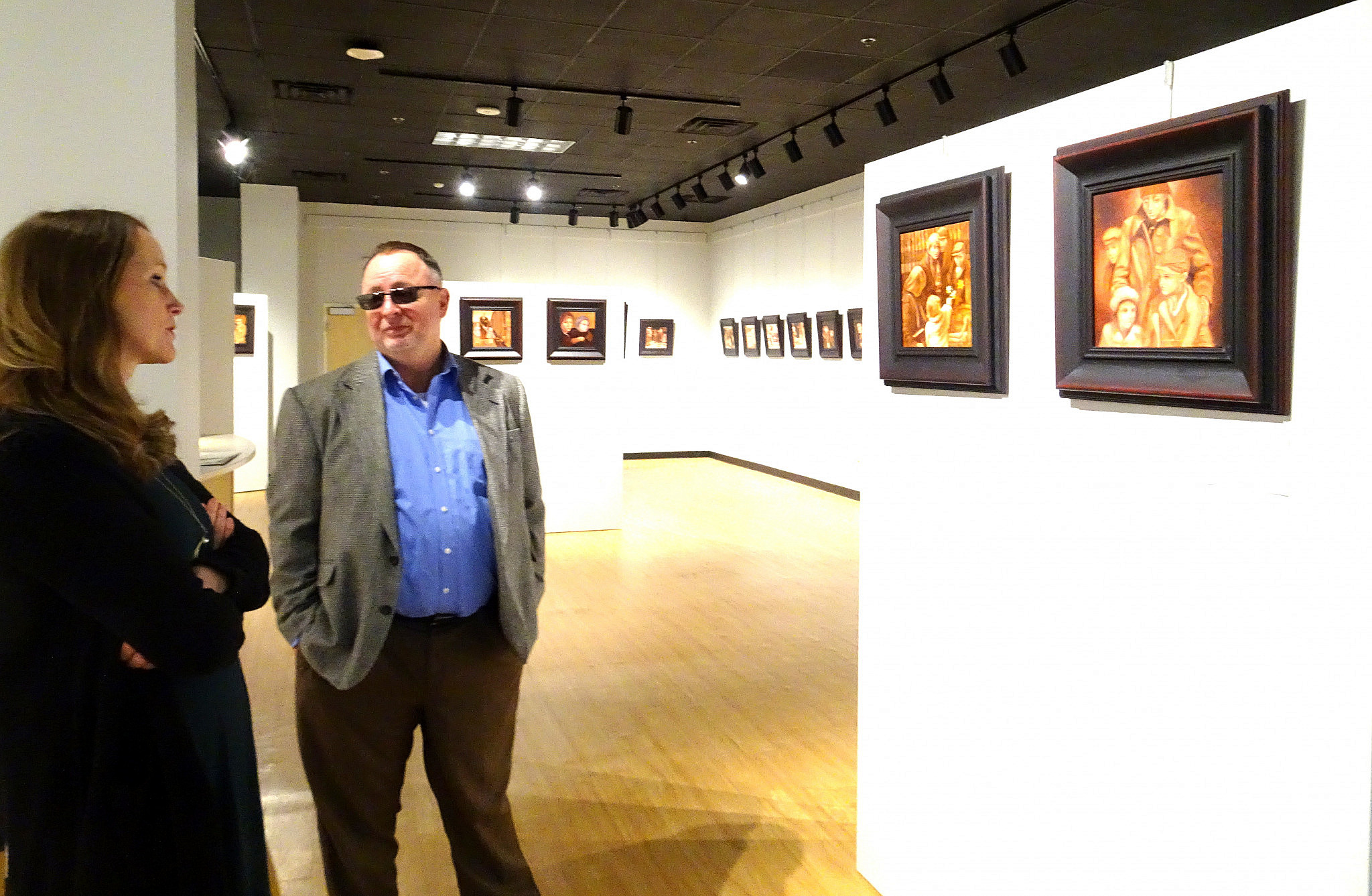
Pat’s works were presented at the special exhibition at the University Gallery, all forty of them, in a spacious, professionally lit inviting space. While we were there, students and visitors were coming in constantly, chatting and smiling when entering and being completely silent and crying, staying for a long time next to every single of those 40 tragedies on canvas. Pat’s canvases from this collection are not too big, but they are extremely intense, and one needs an extra strength to meet with them, with all those children and women, and elderly, for the first time. Also, there is one thing to see separate prints, and it is totally different to have that mass of human suffering reflected in deep oil, alive, all around you. Such immersion results in a long-lasting impression, staying with the artist’s message in her dramatic, even desperate canvases, with you for a long time. And yes, nothing can replace a physical seeing the art works, all other experiences are different stories, providing different impressions. Dr Shelley R Neese and prof. Todd Smith at the Auschwitz Re-Visited exhibition of the works by Pat Mercer Hutchens. March 2020. the Art Gallery of Liberty University, Virginia. Photo (C) Inna Rogatchi. The Rogatchi Archive.
During our many-hours meeting at and around Pat’s exhibition, the first one after her passing away in 2014, six years on, we were discussing with Shelley R. Neese and professor Todd Smith how to develop her artistic and historical legacy, how to make it ‘work’ in different ways and forms.
Since the first moment when I saw the Pat’s works from that heart-rendering collection for the first time back a decade ago, in 2011, I was of an opinion that this kind of art , with the artist’s personal comments, is the one of the best possible ways to teach Holocaust in schools, to bring that element of colours, the accents on humanistic details as adequate and natural for children’s attention. I saw that collection-in-making as the right way to start a conversation on the Shoah with children between 10 and 15, to introduce it to them in the terms of simple, organic compassion, to make the beginning of the explanation of inexplicable. I did what I could in that direction, with our Foundation working on several programs and projects of Pat’s The Auschwitz Album Re-Visited in several European countries.
Now, when our Educational Committee was working on further tasks regarding Pat’s legacy, we thought on the most appropriate way of presenting her works and thoughts to the next level, the university students. I remembered that in many of my lectures on Pat and her re-reading of the Shoah in pictures, I combined her works with corresponding black-and-white originals from the album at Yad Vashem. It always worked, at any audience. I did it in Finland, the UK, Poland, Lithuania, Latvia, Estonia, Ukraine. Especially poignant was my experience in Budapest, at my presentation at the Holocaust Remembrance Centre, during the international conference on Raoul Wallenberg. There, a big gallery is dedicated to the tragedy of the Brehow Ghetto, with all material from The Auschwitz Album and more available is presented in graphic and extremely saddening detail. The light in that gallery only makes it harder to see all those faces, their homes, their streets, that open wound stilled in time.
January 15th, 2020 has marked one of the most special commemoration dates in this year’s cultural calendar, the 130th birth anniversary of Osip Mandelstam, Russian poet of Jewish origin, vulnerable and hunted man who has created a cosmic, unparalleled quality of poetry that has become a distinctive mark of literature of the XX century in general.
This anniversary could well be his 300th or 30th one. He is from the category of eternal lights, and there are so very few of them.Michael Rogatchi (C). OSIP. Portrait of Osip Mandelstam. Oil on canvas. 70 x 50 cm. 1993. The Rogatchi Art collection.
Mandelstam is one of the most brilliant and ever-lasting ‘contributions’ of Russia in world culture. In my lectures, I often call him ‘Mozart of Russian poetry’, to give my students a glimpse of understanding of whom I am talking about. Because to translate his poetry is just impossible, as it is impossible to translate any really good poetry. Even when another genius poet Paul Celan who loved Mandelstam tried to do it, the result was not close to the original. If Celan could not do it, nobody else could.
There are people who are as if present in our life effortlessly, by definition. Osip, who was actually Joseph, definitely is one of them. It is just impossible to use ‘was’ with regard to Mandelstam because he is always there. His unique talent has formed so many people in a huge country, and many of the others world-wide, bringing us to incredible heights which we would never imagine existing, without being immersed into his smashing, ultimate, dizzy talent. With years passing on, one can only be amazed at how really few of such people exist in world culture – and how much did they give to enrich it.
Mandelstam was like a golden equivalent to the foremost of the Russian poets who lived and created after him, from his close friend and contemporary Anna Akhmatova to his partial ‘re-incarnation’ Nobel laureate Joseph Brodsky who was known in their close circle around Akhmatova as ‘Osja ( shortened from Osip) Jr’.
I wish Mandelstam would know a bit, smallest bit of his posthumous fame and his meaning for Russian literature, Russian culture and so many people before he met his awful death that occurred in the nasty corner of Gulag in December 1938 when the pride of Russian literature died of typhus and cold and hunger, as so many other prisoners of Gulag, being just 47. Till this day, the place of his burial is unidentified and would not be identified. We only know about a huge ravine in which his body along with thousands of decayed corpses was thrown down seven months after his death. The climate conditions in that part of the Gulag were such, you see, that it was impossible to dig before short summer when earth would give up a bit of its closeness to the eternal freeze. Many decades later, a bit of the soil from that ravine was brought to be entered next to the grave of his heroic wife and widow Nadezhda Mandelstam who died in Moscow in the end of 1980. Michael Rogatchi (C). Kolyma. Indian ink and oil on paper on board. 30 x 20 cm. 1993. The Rogatchi Art Collection. Published for the first time.
NADJA
And Nadja, Osip’s heroic wife. Without her, we would not know his eternal poetry and prose. We simply would not. That’s why Akhmatova, Brodsky and many other giants of spirit never separated them. In our common perception, Osip means “known because of Nadja”. And Nadja means Osip, for all of us, in generations. Our debt to Nadezhda Mandelshtam has not even started to be appreciated any close to what it should be, really.Nadezhda Mandelstam. Ca 1920s. Courtesy: Maija Mailis – Inna Rogatchi archive (C).
That vivid Jewish girl whose family lived in Kiev in the beginning of the XX century and who studied art at the Alexandra Ekster studio, bumped into an already well-known poet, eight years her senior, at one of the popular and crowded cafes when she was 20, in 1919. It was the love from the first sight. But it was more: what happened to Nadja Khazin and Osip Mandelstam, two extraordinary Jewish people, was what is known in the Talmud as ‘the rule of three minutes’: when Jewish man and Jewish woman are destined to each other, they feel love towards each other within first three minutes of their first encounter.
From a Kabbalist perspective, according to Rabbi Luriah, it can be pondered that in the Jewish world, the souls of its men and women are destined each to another, and often those souls are, in fact, halves of one common soul. When those halves are finding each other, we, mortals, having a sensation of love, that mightiest in the world magnet which we are unable to explain often. It is exactly what happened to Nadja Khazin and Osip Mandelstam in the evening in that cafe in Kiev back in 1919. Their souls found each other, understood each other and were amalgamated into each other to a rare degree.
Nadja Mandelstam has proven it during her long life which was lived for only purpose: to make Osip’s legacy remembered and lived on. She over-lived her murdered husband for 42 years, with only the last fifteen years of which she had a home of her own, a tiny apartment far off Moscow down-town. Before that, after her trials with Osip to their common first exile in 1934, after his arrest and perishing in 1937-1938, throughout the Second World War and years after that, that small woman was a wanderer, literally. Nadia was moving from city to city – mid-Russia – Uzbekistan – Ural region – mid-Russia, very often, avoiding authorities, trying to survive, having no possessions of her own ever, and – memorising the poetry and prose of Osip daily and nightly. Waiting for the time and opportunity to put it on paper and to publish it, somehow, somewhere, anyhow, anywhere. A person has to be made of steel to lead such a life for so many years and decades. But she did it.
During the political ‘thaw’ in the mid-1960s, friends helped her to return to Moscow, to get that small apartment, and to send the Osip priceless archive to Princeton, for free, obviously. She also wrote her legendary memoir which was published in the USA in Russian in the 1970s, with two followed volumed later on. This memoir is one of the most important books on the history of the USSR in a period between the 1930s and 1960s.
Nadja was not an angel, far from it – and who would be under the circumstances of her life? Just one detail: her only dream – people with a disciplined brain were not much of dreamers in that country – was ‘to die in my own bed’. Which she did, with my friend Vera Lashkova being next to her. Vera is a well-known Soviet dissident, very special and devoted person who did help the others completely selflessly all her life. She was very close with Nadja, and spent days and nights next to her during the last period of her life. Not only Nadja slept away in her own bed, she was taken loving care of, and was looked after by a real friend. Luxury, in her understanding.
I always felt a special attachment to that tragic and unique couple of two Jewish people, two halves of evidently one Jewish soul who has become the pride and the heroes of Russian literature and culture. What was and still be amazing about them is that both Osip and Nadja Mandelstam, despite all the persecutions, hunting and crushing of them, were always strong and free. This message of their extraordinary characters and lives is not less important than Osip’s genius poetry and Nadja’s great prose. Not for a bit.
One Teacher, One Book
These days, I am commemorating my own Mandelstam connected anniversary, as well. It is half of a century this year while I am living with his presence in my life. Some things in one’s life are remembered surprisingly graphically, and this one, with Mandelstam entering my life, is one of them.
I was a 13-year old bookish Jewish girl who loved literature and poetry greatly being raised this way by my mom who was a legendary teacher of it, and who treated great writers and poets with trepidation. My appetite for reading was both selective and insatiable. I was not interested in reading ‘all of it’, but only the best of it, and all of the best, naturally. After I completed reading through our big home library, my mom realised that I needed to extend beyond it. Public libraries were not an option for me at the time. I was not the type. My mom was also a brave person who could allow herself a bold move every now and then. Especially in the name of culture, the sacred name for her.
The one of such moves was to send me on my own, as an under-aged cultural apprentice, so to say, to one of her close friends, also famous teacher of literature Maija Mailis, a legend in our large enough Soviet Ukrainian intelligenzia circles. Maija was a legend because she was a very brave political dissident who was a close associate of the widow of famous Russian poet Maximilian Voloshin Maria and belonged to the inner Voloshin circle of Russian intelligentsia – this meaning families of the most important writers and poets, including Tsvetajev sisters, and many others, all with utterly tragic destinies.
Maija gave me a quick look during my first visit to her small apartment which was all in books, magazines and manuscripts from ceiling to floor, on tables, chairs, floor, anywhere, and immediately started to teach me the real history, culture, literature and poetry, most of which had been forbidden in the USSR. I was a very grateful sponge, and visited Maija several times a week. Very soon, I have become her willing and enthusiastic assistant who was helping her to produce those small and priceless home-made samizdat books of genius poetry which I was only over-happy to print on my mom’s type-writer at home, bringing all five exemplars of tiny paper to Maija, who would show me how to produce ‘almost a real book’ from my sheets. All that was done at her kitchen during the long hours every day. She always knew whom she would give those precious gifts of real, beautiful, great – and heavily forbidden – poetry, from hand to hand. Precious as they were, the only window to the world of real culture and literature for us, they posed the certain danger, too, to everybody participating, but most of all, to the initiator and informal head of the circle of people who dared to read what they would like to, not what has been prescribed.
Remarkably, not anyone from hundreds of people, her pupils and their friends whom she gifted with those pearls of the best of Russian literature, ever gave her in to the KGB authorities. She was regularly summoned to ‘the conversations’ there after her returns from Voloshin house where she would be going as often as she could, several times a year, but as she claimed her absolute innocence and total immersion in literature matters only, and there was no hard evidence on political activities against her, she managed to teach for years.
There were several searches in her small apartments in my memory, with tens of newly produced small volumes of poetry confiscated. As there were no political manifestos, but literature creations, she was allowed to continue to work for a while, after which she was sacked, eventually. My family and some of her friends were supporting her to the end, with my mom employing Maija on her first opportunity to do it, during the rest of Maija’s life. Those people never went to retirement, all of them, they regarded it as a drama, failure, and pitifulness, to put it mildly. They all did strive to work to the end. Such was their understanding of usefulness of life.
Maija was my teacher not only in literature and poetry, but in freedom of thinking and dictated by that attitude to life, from quite an early age. She provided me with knowledge and books from which I learned not to follow the mass. She widened my horizon of knowledge from its outset, for which I am still grateful to that extremely knowledgeable and freely spirited Jewish teacher all my life.
Maija noticed very early that of many Russian poets about whom she did teach me, Osip Mandelstam was my favourite, indisputably. It was a love from a first glance, indeed. That’s why I was given a special task to type, namely Mandelstam’s poetry on my mom’s personal type-writer that I did so diligently and so happily for a few years.
One day, Maija showed me a huge foliant. She took it from her shelf, not from its front row, but from some hiding place behind it, and put it on the table in front of me ceremonially, with a special expression on her face.
–What’s that? – I asked. I was spoiled by Maija by the endless gems of her treasury by now. Maja was smiling as if expecting something really delicious to share. – Well, this is such a kind of book that you have never seen before – she said, at last. – What do you mean, dear Maija? But you are providing me with so many wonderful books – which was true, every time I visited my teacher, I left with several volumes to read at home. – No, my dear girl, I can guarantee you that this kind of book you never hold in your hands – Maija was smiling wider and wider.
The exceedingly heavy foliant of 740 pages was the Anthology of the Russian poetry of XX century published in Moscow in 1925, with all important poets of the first quarter of that tumultuous century presented by their best poems, their biographies, bibliography of their published works, everything. Cover of the rare Anthology of Russian Poetry of the XX century. Moscow, 1925. Inna Rogatchi archive.
The book was a huge liability. From the early 1930s until mid-1980s, it was listed among the books which had to be hidden in what was known in the Soviet reality as spetzhran, heavily controlled books and other printed materials and manuscripts depositories sealing those materials off Soviet public. The book was also the only Anthology of the Russian poetry of the XX century ever published in the USSR until the end of it. Today, the original edition of it has become a gem at the rare books auctions.
Forty eight year ago, I brought it home being absolutely happy. I can physically remember that happiness still now. That blossom of poetry has become my favourite book ever. I knew that I should return it to Maija who did treasure it extremely highly, as I was doing with all the books and magazine borrowed from her, and as it my habit ever. There are people who return books and there are those who don’t. I belong to the first category emphatically.
But that book was an exception, the only one in my life, as it happened. Every now and then, I would ask her:
-Maja dear, can I please still have Anthology for a while? She always smiled and always said: – Yes, my dear, you can.
That dialogue was going for years. I felt guilty, but I just could not depart with that very book. I finished school, started to study at the university, and it was still the same. When I was going away from home for a substantial period of time, to the student camp, and alike, and was unable to take such a heavy volume with me, I was missing it distinctly.
Then I got married to a young man whom I knew – without any other elaboration , but with that firm inner knowledge – that I would marry very soon after we met.
Maija decided that as a part of her present to me for my wedding, I should not return Anthology to her. I was absolutely happy and so very grateful. That heavy volume travelled with us to St Petersburg where we moved soon, but because of its rarity, it was impossible to take it with us across the border in our further journeys. We left my treasure with good friends. At least I know that it is at the family-like home. I still miss it, tell you the truth.
Portraying Memory
The young man who has got that rare wedding present from Maija together with me, has become a very able artist. At the beginning of his artistic journey, Michael was deeply connected to the literature with which we grew up and to his preceding work at theatre. He was very sensitive to the historical storms which have formed us, our families, the writers whom we read and the poets whom we loved. Michael also knew that I am missing that Anthology volume which always crowned my working table at our previous homes.
Without discussion or hinting on what he was working, he created a very special artwork, his early portrait of Osip Mandelstam, as the present for my birthday. Almost thirty years have passed since that moment of that total and overwhelming surprise to me, but I can tell that this is one of the most dear to me presents, and one of the most dear and special of my possessions. For many years, ‘my Osip’ painted by my Michael was hanging on the wall in all my studies being a reflection and source of empathy to me.
Later on, I have created a few works to commemorate Mandelstam’s huge talent and his absolutely tragic destiny in my projects on Jewish heritage and our living memory which is not only paying a bit of our debts to the people who has formed us by their talent, but also continuation of some of their ideas, having them as ‘a golden equivalent’ of the level and the quality of what we do while we creating ourselves.
It is also about keeping their spirit alive. The most important – and actually, the only thing – that we could do for them, for their memory. The one of the musical video-essay presenting such project, Horizon Beyond Horizon:Celebration of Jewish Talent , can be watched here. Inna Rogatchi (C). Osip Winds. Homage to Osip Mandelstam. Horizon Beyond Horizon project. Authored original print of pearl paper. 50 x 70 cm. 2011-2012.
Osip Mandelstam has become much better known and much more justly appreciated in his country after his death than during his short life. It happened so very often in the XX century, due to the demons which were unleashed from the beginning of it and through three quarters of it.
In commemoration of his 130th birth anniversary, a truly special memorial plaque was unveiled in Ekaterinburg, Russia’s main city in the Urals. On the plaque created by Russian artist Nikolay Peredein, and crowd-funded by people from all over Russia, Osip and Nadja are depicted together, as two birds, hunted but strong and determined, living by the huge resources of their both’ extraordinary souls.Nikolay Peredein. Memorial plaque to Osip and Nadezhda Mandelshtam. Ekaterinburg, Russia. Unveiled on January 14, 2021, in commemoration of Osip Mandelstam 130th birthday. Credits: Roman Liberov, with kind permission.
Or that one soul which I believe was in the case of Mandelstams, Osip and Nadja, Jewish heroes of Russian culture.
“Jewish tradition commands us to tell the truth to the power” – Elie Wiesel to President Reagan at the public ceremony in the White House, April 19, 1985.
A Nazi for the Office. Or rather not
Just over a decade ago, which is not that long a time by the standards of political development, I was very busy. In my capacity of a senior foreign affairs adviser for the members of the European Parliament, including the EU-the UK- the US- and Israel public diplomacy, I did initiate the process examining the possibility of expelling from the EP the one of its new members, British open Nazi who, among his other public racist activities, was bragging openly of having two Rottweiler dogs, ‘one named Anne and the other Frank’. During the several months’ process, I was often wondering: why on earth nobody else bothered to try to block that bastard’s membership at the European Parliament? Why on earth it was considered as acceptable to have an open and active Nazi as the member of the highest political pan-European body? Democracy had nothing to do with it. Ineptness had.
We did everything possible under the legal realities of the European Parliament at the time, including issuing a special inner-EP memorandum protesting the situation and signed by a number of MEPs. That document which although had no decisive legislative power to expel the Nazi from the European Parliament in the XXI century, did raise the question of moral unacceptability of the openly pro-Nazi personalities as the members of the European Parliament as such, with all legally possible points following our claim, including appeal against the owner of two Rottweilers’ membership in any EP committee.
As we found out, at the time, during the seventh term of the European Parliament (2009-2014), the EP lacked necessary legal instruments to unseat a member selected by a member-country although everyone at all the levels of the giant pan-European institution had completely agreed with us and with the justification of our demand. As a result, the humanoid in question was not made a member of any important committee, and contrary to all his steroid-energetic efforts, was listed as a member of just one the EU delegation to the non-EU member country of the least importance.
Because of our articulated stand, the open Nazi was effectively muted since the day one of his term at the EP for all five years there. After his hanging around in Brussels, he was expelled even from his own racist party back home in the dispute of financial matters.
During my involvement in that important process, I was threatened seriously and multiple times. Those people breeding the Rottweilers with such names, are real bandits and are connected with professionals in the field. My husband was also contacted, repeatedly, with strong recommendations to convince his wife ‘to retreat from her annoying activities, or else’. ‘What is she gaining personally in this campaign?’ – was one of the arguments of the people who pressured us persistently. I gather that their question might be even genuine. How could they understand, really?
At a certain stage, a close friend, one of the Queen barristers, got so worried for my safety, based on his own information, that he demanded that the corresponding security authorities would be briefed on the escalating situation. The situation was taken under scrutiny and tight control. And I was wondering again: how on earth it was I who needed protection from the Nazi and his trained dogs, metaphorically too, almost 65 years after the ultimate defeat of Nazi Germany worldwide? I still wonder.
Praising Hitler next to the Capitol
I remembered that decade-back episode vividly now, watching the painful unfolding of that unbelievable-but-true last turn of events preceding the change of the US Administration in Washington D.C.
Just next to the Capitol where I am visiting regularly and so very often during last three decades, a newly elected Congresswoman from Illinois with no trace of intelligence on her face whatsoever was screaming in that typical abrasive provinciality manner addressing the huge crowd that we saw a bit later in their incredibly stupid and clearly criminal action, indoctrinating them that ‘Hitler was right…’. As it is known and recorded, her full phrase was ‘Hitler was right on one thing: who has the youth, has the future’. But I am not interested in anything that this moronic creature pronounced after the beginning of her phrase in her capacity of an elected Member of the US Congress, “Hitler was right…” in front of the US Capitol. Neither do I interested in her apology, as stupid and as provincial as her speech at the rally on December 6th, 2021 was. I am convinced that a creature like that shall be dismissed from the Congress, and that there is existing legislation that allows it. Plus there has to be bipartisan demand of her to resign. Now.
This was an unpardonable precedent which has to be addressed further than it has been done by now, with all the just storm risen in the media and by many Jewish organisations, both Americans and international ones. That Congresswoman’s escapade has nothing to do with the First Amendment, or democracy , or anything else from the category of applied American domestic policies. It has everything to do with sheer racism and unwarranted Nazi glorification and thus has to be cut off instantly. That message, its phrasing, and more importantly what is behind it, is a menace. There are consequences of such statements, always.
And – in the first place, really – the outgoing US President, or anyone else, for that matter, from any side of the US political spectrum – should not have this kind of humanoids as their supporters, not to speak as the representative of their party at the highest US legislation body. It is always screamingly counter-productive, to say the very least.
Many of us know from history about both awful and shameful pro-Nazi rally in February 1939 in New York when 20 000 people gathered at the Madison Square in support of the Nazis – this is after the Kristallnacht, mind you. It is also sobering to remember how The New York Times covered the Holocaust, with its unimaginable 6 mentioning of Jews as the primary victims of the Shoah in just 24 front-page articles dedicated to the theme during all six years of the Second World War, from September 1, 1939 until September 2, 1945. It stands in history as the one of the most shameful phenomenon of the public response to the ultimate global tragedy and the crime of unheard scale by the leading American media.
One could expect that with having all terrible Holocaust-related data available in so many ways and forms nowadays, those who are seeking to become a statesman or stateswoman, would know what is permissible to state publicly and what is not. But as we are seeing it, they do not care. What is also important and worrisome, they are not dismissed or rebuked by the leaders at whose rallies they are rallying. Rallying for what? – we all have the right to ask. For applying some of Hitler lessons? Seriously?
I firmly disagree with followed regular laments that the Hitler-praising Congresswoman ‘needs more and better Holocaust education’, and alike. Give me a break. This kind of creatures are immune to any education on Holocaust, and the other topics of humanity. It is simply naive to lull oneself with this kind of suggestion. This kind of person should never be accepted to run a party ticket to any office. And the core of the problem is in the fact that she and alike were accepted and then promoted at the huge rallies. There are highly problematic representatives of the Democratic party as well, as we all know and fighting against it for years by now. But this ‘Hitler was right…’ bomb-shell was dropped by the fresh Republican representative.
That Hitler admirer farmer-turned-Congresswoman was not rebuked by none of the top bosses of the Republican party. More, the Republican Jewish Coalition leadership ‘ thanked her for her ( apologising) statement’, with not an inch of anything beyond it. Great. And telling.
Out of my long personal active experience in international public diplomacy, I have to say that such a muted reaction would be absolutely impossible under any previous US Administration from the end of WWII onward. And this fact alone is disturbing, to say the least.
Leaders and their Legacies
The breeder of the Rottweiler dogs that he called Anne and Frank, was from the country which was the earliest, selflessly brave and decisively anti-Nazi fighter during the six devastating years of the Second World War. Prior to the war, from the end of the 1920s and until mid-1930s, in that country, the United Kingdom, there were also quite strong pro-German sentiments among the certain part of the British establishment, and enough pro-fascists movements and small parties, none of which came to power, however.
That country – and the entire world, as it happened – was extremely lucky with having a leader at the most daring hour of the XX century history whose brilliant mind was combined with ultimately and unwavering strong will, and who did bring the honour to that country and relief to mankind, becoming the first and the principal opposer, global-wise, to the evil of Nazism. If not for Sir Winston Churchill, the entire course and the ultimate result of the Second World War could be tragically different. One should always remember that.
Sir Churchill hated Nazism unequivocally. He did it being not only an extremely well-educated person with genuine strategic thinking and broad vision, but also because he had a highly developed sense of decency as a prerequisite for anything else in the vast array of his activities. Decency is not only one of life-saving vitamins. It is a vital component of the preserving legacy, especially if it is a legacy of a politician or public figure.
In the wake of the recent outrage at the US Capitol conducted by a delirious rabble of jerks, there are some important aspects, out of many, that I think is necessary to emphasise. It is astonishing to unparalleled degree that a statesman, not to say the president of a country, can allow himself to exercise such utter irresponsibility as to call people ‘to walk down to the Capitol’, not to mention him saying to the multi-thousand rally that “I will be going with you’ having a zero intention to do so. For the record: political affiliation has nothing to do with this. Personal qualities and choice of behaviour do.
It is pathetic – although expected – that the president of the leading country in the world does not bother to get the basic legal proceedings of his country, to allow to himself to pressurise and bully, all publicly, his own Vice President and senior figures of his party whom he repeatedly and publicly calls ‘weak ones’, instigating the chain of escalating public bullying them, already after the amok at the Capitol Hill, by the same rabble of the same delirious jerks, with ‘Hang Mike Pence’ hashtags that Twitter allows, incomprehensibly, and with mass threatening senior politicians in public places days on after the assault of the Capitol.
As if directly from a third-rate movie, the Vice-President of the USA with his family had had to hide in a protected bunker while hearing the mad crowd screaming ‘Hang Mike Pence!’, in that idiotic inciting hateful ‘lock-em’up’ motion, with Number One not bothering to check on how safe is his Vice-President. To revoke personally the access to the White House to the Vice-President Chief of the Cabinet? What scheme is this? Where this came from? From a fourth-rate movie? The world being totally dumbfounded is watching how that wilder-than-wild scenario unfolds. And there is seemingly no limit to this show of disgraceful incompetence.
In a sharp contrast, it was Vice-President Pence who did demonstrate to his country and the world that there are leaders in the USA today who know what decency is and who live by that. I have a honour to know Mike Pence for over 20 years, and can attest to his honourable and very able conduct, on any of many of his governing positions and in various situations always. To attack this man and to instigate the marginalised mob to do it in their wild way is indecent.
But most disturbingly, to me, is the utterly disappointing fact of harbouring all those lowlives whom we all saw on our TV and other screens on December 6th, 2021 at the Capitol vulgar, stupid, and cheap assault, and incorporating them verbally, in a repeated motion, into the range of ‘great American patriots’.
Is that scumbag in Camp Auschwitz hoodie ‘a great American patriot’? So many people are indignant about that hoodie, but for some reason, not many have mentioned that the black hoodie has its back, and that there is one more sign on that back, namely ‘Staff’. Nazi supporter during the assault of the US Capitol, Washington D.C., January 6, 2021. Open Internet Library.
Does it differ from an owner of Anne and Frank Rottweiler dogs? Not, it does not. Does it differ from ‘Hitler was right..’ screams earlier the same day at the nearby place? No, it does not. Is it acceptable? Absolutely not. Should it be overseen, let it go, written it off for ‘wing-off’ ones? Those who are accepting such positions in their understanding of loyalty are self-deluding themselves badly. They are shielding themselves from common sense and from both intellectual honesty and human integrity.
The same as it is absolutely unacceptable to incorporate into the rank of supporters all those whom the world had a shock to see in that show of imbeciles ramming the Capitol: the Nazis, the QAnon, Proud Boys, all those wacky ultras of various breeds. How on earth these kinds of creatures have become acceptable by the president of the United States and those of his advisers who gave their go-ahead of usage of these kinds of organisations and creatures who are its members?
Telling the Truth to the Power
When watching that third-rate real-life movie from the US Capitol during its assault on January 6th, 2021, I was thinking about our dear friend and teacher Elie Wiesel. I know that his son Elisha and his entire family which is very small, because of the Shoah, were in-tuned, as well, in an emotional way. I was thinking that thanks to Heaven that Elie does not see Camp Auschwitz moron and other alike roaming the US Capitol. I simply cannot imagine what Elie Wiesel would feel at such a moment.
And I also remembered how in the spring 1985, Elie, without thinking on political surviving code and maneuvering, has decided to come to to see and to speak directly with President Reagan to discuss with him face to face the very troubling decision of Reagan who gave into the pressure of German Chancellor Kohl to visit the military Bitsburg cemetery of German soldiers, including some Waffen-SS members, during his official visit to Germany to commemorate the 40th anniversary of the end of the Second World War in May 1985. The truth is that the Reagan Administration was not told by the German side initially that there were members of Waffen-SS buried at the Bitsburg cemetery. Reagan agreed to visit. Then the truth unfolded, to the horror of many. But there was the only one who did confront the president of the USA directly and openly about it, Elie Wiesel.
Only Wiesel’s family and close friends know quite turbulent events around that his meeting with President Reagan. We know that Elie was seriously thinking about ignoring, rejecting the ceremony at the White House honouring him with the Golden Medal of the US Congress in the protest against a planned Reagan visit to Germany with that outrageous symbolic visit to the German military cemetery ahead. I also remember how Elie did recall in our conversations that in the end, he decided to go to the ceremony at the White House – primarily for the opportunity for him to speak with President Reagan face to face before accepting the medal. It was not an easy decision for him, I know that first-hand.
I also heard the insights on that episode from inside the Reagan team, among whom I have many good friends and colleagues. The Reagan Administration, as any US Presidential Administration, was divided on many things, including the inflammatory episode with the visit to Germany in May 1985 and with regard to Elie Wiesel’s lonely, I emphasise, and brave stand on that. Some of the Reagan White House team petty apparatchiks were trying to cut planned Elie’s speech to an insulting mini-version of it. They were overcome with normal people in a higher positions within the Administration. Then the ceremony was moved from the planned big hall with capacity of accommodating 300 people to the smallest possible room in the White House with capacity of accommodating 40 people maximum, in a pitiful understanding of ‘a possible damage-control’ preventive measures.
Elie did not care how many people would attend the ceremony honouring him at the White House. As I know it from him personally, all he cared about was an opportunity to speak with President Reagan one to one, to see him in the eye, as Elie has put it.
Their meeting lasted about a half an hour which is a lot by the White House protocol and which was three times longer than planned.
Elie Wiesel was unable to change the very wrong visit of President Reagan’s visit to the German military cemetery in Bitsburg. But he succeeded in amending the President’s agenda for his commemorative visit to Germany with Reagan visiting the site of Bergen-Belsen first, prior to his visit to the cemetery that Chancellor Kohl was so extraordinary pushy about visiting it along with the US President. That Reagan’s unplanned – for some reason, let me put it this way – visit to Bergen-Belsen prior to the German military cemetery has put a proper balance in place, at least.
I know that Elie wanted very much and tried very hard to convince President Reagan to visit the Bergen-Belsen site only. Reagan excused himself for his inability to do so after he gave his personal word to Chancellor Kohl. Elie Wiesel speaking at the White House ceremony in presence of President Ronald Reagan and Vice-President George Bush Sr. April 19, 1985. Credits: White House Television Office. The Reagan Library. The Rogatchi Archive.
Importantly, Elie Wiesel did see President Reagan in the eye. And yet more importantly, President Ronald Reagan saw in the eye of Elie Wiesel too – which I do think, and always was thinking this way since the time I heard about it from Elie just five years after the event – was a very healthy thing to do.
During that eye to eye conversation, Elie Wiesel was simple in his phraseology, as he always was. I remember some of it: “ Mr President, the issue here is not politics, but good and evil. And we must never confuse them. For I have seen the SS at work. And I have seen their victims. They were my friends. They were my family.”
And during his short speech during the public ceremony in overcrowded very small room, Elie Wiesel did remind to President Reagan, Vice-President Bush Sr and everybody else present that ‘Jewish tradition commands us to tell truth to the power’. Exactly so.
It was an unforgettable lesson of humanity to politics. I know that Ronald Reagan did remember it until the end of his life. And so shall anyone else who would like to leave the legacy of decency.
This is another important point, the legacy. While watching that impotent cheap show at the Capitol, I was thinking that with these vulgar scenes of trashed chaos, the legacy of the 45th President of the USA will be sealed for good. And there is nothing that can be done about it. Surely enough, the following issue of The Economistappeared in a day or two exactly with this verdict on its cover. The cover of The Economist magazine. January 9-15, 2021
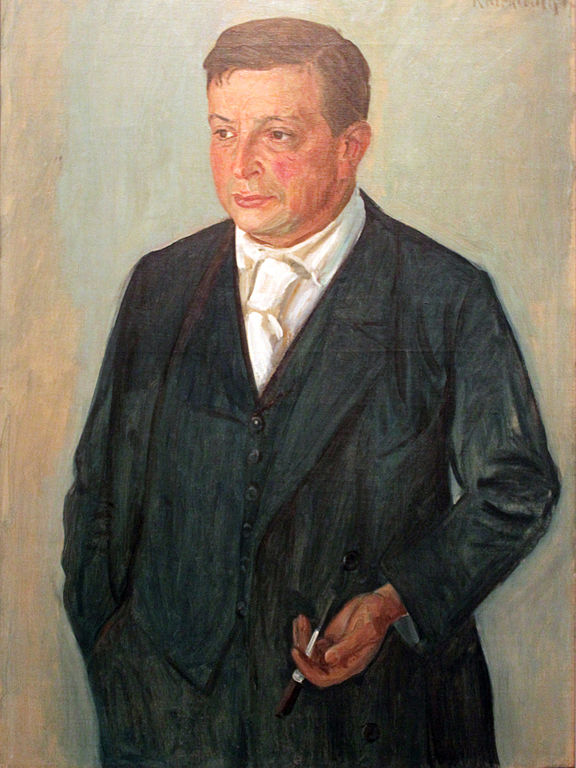
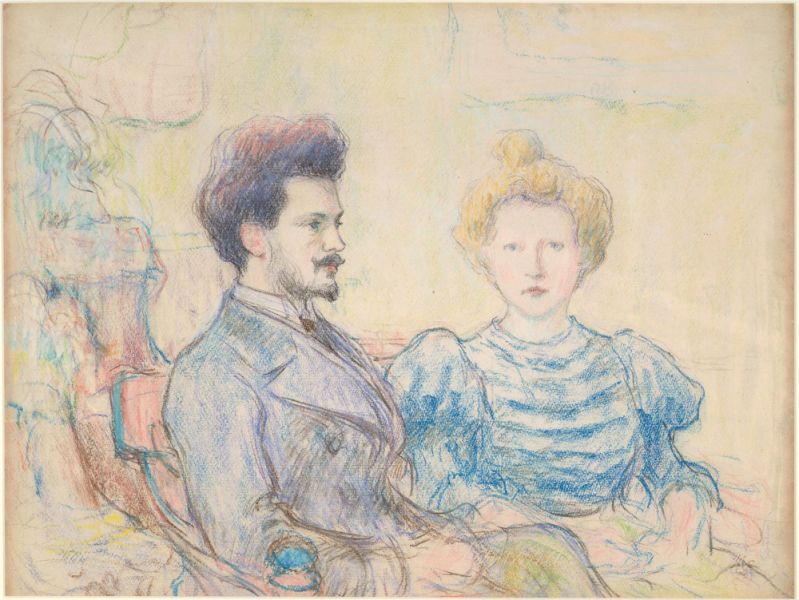
As far as I can see it, the President and those who had assisted him in such an ill way, has caused irreparable damage by overseeing the inclusion of these surreal elements into the rank of his supporters. Irreparable damage that has crossed, to the large extent, some of his serious achievements both domestically and internationally.
One does not deal with Nazis. One does not rely on the support of a Staffer at Camp Auschwitz. One does not support scums praising Hitler. How grotesque it is to be in necessity to state the obvious. At this level, in this context. How terrible it all is for all decent conservatives who are terrified on what unfolds in front of our eyes.
In the Talmud, there are two leaders of the Jewish nations regarded as the most important and the best ones, Moses and David. Why? Because both of them, according to the great Baal Haturim, ‘were faithful shepherds who put the fate of the people before their own, and therefore the people had faith in them” (Baal Haturim Chumash, Shemot, The ArtScroll Series, 2000 ).
Leadership is not about personal success. It is about one’s country, one’s people. It is the social mutual pact with society conducted with mutual respect. Leadership is not about slogans. It is about the ability to convince – not to push, to convince the majority or necessary qualified number of people in the society to follow your agenda wilfully and consciously. To be able to convince a qualifying amount of society, one has to be able to respect. It is about sharing, not imposing. It is not an intuition for a deal. It is very difficult, and often quite ungratifying work. It is not about ‘I’, it is about ‘you’. Some people might be surprised, and some maybe even laughing, but it is also about modesty. And decency. And dignity. What a fantasy list.
The only glimpse of some hope in the outcome of the disgrace at the Capitol lays in a prospect that after that shocking show, some leaders world-wide would think more carefully on what their legacy would become like.
Escalating Damage
The damage that has been done by the real-life drama on the top of the US power at the moment of the transition of power in the beginning of 2021 will be the long-lasting one, sadly. This damage is multilateral, dangerously. The Republican party is damaged very seriously, with the prospect of debilitating schism inside the party being quite real. The conservatism movement in general in the world that traditionally relied on the might of the US Republican party is damaged powerfully, as well. Conservatism as a world-view is undermined, even if briefly so, having a blow of stupidity and irresponsibility into its face, with people with conservative views being marred by association, so to say, both consciously and gaining on purpose by the opposers, or even subconsciously, or automatically, as a way of associative thinking.
The status of the American state, the leading country in the world, is changed now, being diminished seriously, with years in need for recovering it.
The ugly demonstration of jerks storming the seat of power has become a precedent instantly – thus, the damage has a potency to become an international one.
Incomprehensible, but true. Depressing, but real. Unacceptable, but done. This is what happens when kitsch gets dangerous.
Part of VINCENT: Etudes on Van Gogh special project, Outreach to Humanity series of projects.
Shortened version of the essay is published in The Jerusalem Report magazine, Iss. 1, January 11, 2021. It can be read here.
Fanny and That Painting
On March 8, 1903, Fanny Flodin heard the news that her long effort to sell that painting to the museum had been approved, finally. Fanny sighed with relief. It was quite an effort for her to sell that painting which she brought with her to Helsinki from Paris when she returned to her family after the death of her husband.
Everything in this passage hints to things special and unique in history of art and civilisation: Fanny Flodin, notable pianist whose teacher was the last pupil of Franz Liszt, was the daughter of an important Finnish statesman of Swedish origin and sister of sculptor Hilda Flodin who worked with Auguste Rodin. Fanny’s husband, recently deceased in Paris, was no one else, but Julien Leclercq, well-known in France as a poet, art critic and cultural figure. The museum in question was Ateneum, the National Art Gallery of Finland, the country’s principal art museum. That painting was Van Gogh’s.
Leclercq who was a close friend of Van Gogh, have had several of his works by the artist that he bought from Theo Van Gogh’s widow, and which he also obtained in the process of that vivid non-stopping exchanges of ‘trophies’ within the artist circle in France.
Emile Schuffenecker (C). Portrait of Fanny and Lucien Leclercq. Pastel on paper. 47 x 61 cm. ca 1898. The Johnson Museum of Art. Cornell University, the USA. Gift of Mrs Carol Meyer in memory of Seymour Meyer. 1936.
In 1901, just Lecreque got ill suddenly and died very quickly from tuberculosis to complete shock of his wife and everyone else. He was just 35. Fanny inherited 5 or 6 of Van Gogh’s paintings from her husband. She sold all but one of them in Paris before her return to Finland. But that one painting she just could not sell. So she brought it with her when she did return to Helsinki to live there with her young daughter after her recent trauma caused by the sudden death of her husband.
The family has put quite an effort to convince the board of Ateneum Museum to acquire Van Gogh’s work. They used their powerful connections to influence the decision, including securing the learned opinion of leading Finnish Swedish artist Albert Edelfelt who was the member of the board of Ateneum and who lived and worked in Paris and understood the quality and meaning of Van Gogh art far better than many others in the artistic world which largely regarded Van Gogh as ‘an obscure mad Dutchman’. According to the Ateneum documentation and thorough historical study work by prominent Finnish journalist Antti Virolanen, apart from Edelfelt, no one among the members of the Board of Ateneum have not heard Van Gogh’s name, which was completely normal in 1903. It looks like it was Edelfelt insisting and his repeated opinion that have decided the matter positively for Fanny Flodin.
Even after the positive final decision of the Ateneum Board to acquire that painting of Van Gogh, they were bargaining with Fanny about the price back and force. Finally, the sides agreed on the sum of 2 500 marks. The equivalent of it today is Eur 11.300 . Such was the price that Ateneum Museum has paid for great Van Gogh’s Street in Auvers-sur-Oise work ( 1890) which was initially known as Rue de Village. This very work is especially valued for two reasons: it was the one of the last works that Van Gogh painted in Auvers-sur-Oise just two months before his death; and this work has its distinct mark: the part of sky there seems to be unfinished. For a long time, art critics were discussing: was the spot with unfinished sky left by Van Gogh intentionally, or he simply did not finish the painting? This discussion is still ongoing.
Vincent Van Gogh (C). Street in Auvers-sur-Oise. Oil on canvas. 1890. Ateneum, the National Art Gallery of Finland, the Antell Collection.
Street in Auvers-sur-Oise has become the only Van Gogh work existing in Finland. For Ateneum it is simply priceless, and it is regarded as a special treasure among their very solid collection of 650 works by many great artists.
Ateneum was very kind to loan this bright, wonderful work to the ongoing Becoming Van Gogh exhibition ( 5.09.2020 – 31.10.2021) which has been organised, despite all covid pandemic obstacles, at The Didrichsen Art Museum in Helsinki to celebrate the 55th anniversary of this special art institution.
The Didrichsen Art Museum is based on the unique collection of modern art assembled by legendary patrons of art Gunnar and Marie-Louise Didrichsens. Their son Peter led the museum for many years. Currently his wife Maria is leading it. The Didrichsen family is also known as dedicated supporters of the State of Israel, and they contributed into the worthy humanitarian causes in and for Israel for many years.
The Long Road Towards the Appreciation
Why was it so difficult to convince the members of the Board of Ateneum to acquire a big and expressive canvas by Van Gogh? Because at the time, just 13 years after Van Gogh’s death at the age of 37, his name was not that well known beyond France and partially Belgium, and he certainly was not understood as an artist at all even there.
The situation was not helped much by the fact that Theo Van Gogh who was supporting and promoting his genius brother died just six months after Vincent being shocked beyond anything by his beloved brother’s death. 23 years later his burial, and at the same time of publishing substantial selection of Vincent’s famous letters, in 1914 devoted Theo’s widow Johanna Van Gogh-Bonger, to whom we owe the preservation of Van Gogh’s works and legacy, re-buried her husband next to his brother at truly beautiful spot on the cemetery in Auvers-sur-Oise which is covered all over by ivy, the brothers’ favourite plant.
Burial site of Vincent and Theo van Goghs. Cemetery at Auvers-sur-Oise. Open Internet Archive.
The first ever positive – and quite providential – critic opinion on his art Van Gogh received from a colleague and acquaintance, the Dutch artist of Jewish origin Joseph Jacob Isaacson ( 1859 -1942) nine months prior to his death. Visiting Paris, Isaacson got to know Theo, and via Theo, he befriended Vincent. Isaacson, who was a deep and well educated person who specialised in Jewish mysticism, realised the merits of Vincent’s art and wrote about it in “The Portfolio” art magazine. “Who is there that conveys, in form and colour, the magnificent, dynamic energy the 19th century is against becoming aware of? I know one man, a lone pioneer, struggling on his own in the depths of darkest night. His name, Vincent, will go down to posterity. There will be more to be said about this heroic Dutchman in the future” – Jewish artist have written. It is the very first positive art critical mentioning of van Gogh’s art, and a very rare one made during his life-time.
Joseph Isaacson over-lived once briefly be-friended Vincent for over a half of a century, during which he changed his opinion on Van Gogh’s works, at least publicly so. After Van Gogh’s large exhibition 16 years after his death, and 17 years after his first first so positive and providential critique, Isaacson was not that impressed any longer. Or so he said in his 60-pages “A new point of view on art’ critic work in which he concludes that although Vincent’s work ‘is impressive, it does not move’ him any longer. It is quite possible that posthumous exploding fame of Van Gogh was somewhat irritating for Isaacson who was the first one to see that Vincent belongs to posterity.
Joseph Isaacson’s own destiny was as terrible as the destiny of all Jews of Europe who were unfortunate to live to see humanity’s surrender to Nazism. Old artist and his not that old wife were murdered in Auschiwtz in 1942, upon their arrival. Joseph Isaacson was 82 years old at the moment.
* * *
Coming back to Fanny Flodin and her husband Juliene Lecrercq whose first name was Joseph, he did for Van Gogh more than any other person except Theo and Johanna Van Goghs.
Van Gogh’s obituary is the one written by Joseph Juliene Leclercq.
With the help of his wife Fanny and her family’s connections in Scandinavia, Lecrercq organised an important travelling exhibition of Post-Impressionists to Scandinavia, bringing their works, including Van Gogh ones, to Helsinki, Stockholm, Copenhagen and Oslo as early as in 1898. A rare and charming portrait of the couple done by Emile Schuffenecker which now is at the collection of The Johnson Museum of Art at the Cornwell University, was done by the artist in appreciation of Fanny and Julien’s efforts to bring his and his fellow artists work to Scandinavia. Schffenecker who was a close friend of Gaugin, knew Van Gogh well.
Leclecrq was the person who organised Van Gogh’s first important exhibition ever, the artist’s first retrospective in Paris which consisted of 65 of Van Gogh’s oil paintings and six of his drawings. It was one of the fundamentally important exhibitions in the history of modern art, not only because it brought a sizeable collection of Van Gogh works to wide public for the first time, but also because solely due to that exhibition, several important groups of French artists that developed into the main-stream art of the XX century, such as Fauvists who did include the most important artists of the XX century such as Matisse, Derain, Braque and many others, were inspired by Van Gogh deeply right there and then.
It was Van Gogh who, eleven years after his death, did influence and actually defined the development of the important and rich direction of modern art, and that’s why he is known as the father of modernism. That crucial development was originated thanks to the exhibition organised by Julien Lecrecq at the Bernheim-Jeune galleries.
Juliene Lecrecrq died within a half of a year after that legendary exhibition. But before that, he has bought several Van Gogh’s works from Johanna Van Gogh-Bonger, among those was the work which was acquired by Ateneum two years later. Very importantly, it was the very first acquisition of Van Gogh for public collection world-wide. It has to be stated clearly, to clarify the established fact of the first ever display of Van Gogh’s work which had happened in 1908 for Städel Museum in Frankfurt.
But display and acquisition are two quite different things. The first ever museum acquisition of Van Gogh in the world had happened for the Finnish Ateneum in March 1903. Ironically enough, in the Ateneum documentation there is a note regarding new acquisitions in which Van Gogh’s work is mentioned as ‘that peculiar Dutch impressionist Van Gogh’ ‘Village Street’ work”.
Van Gogh’s German Jewish Connection
It was at that very exhibition in Paris in March 1901, without which the world simply would not know any Vincent Van Gogh, that a wealthy German Jewish art dealer walked in the Bernheim-Jeune Galleries. The Bernheim-Jeune family was of Jewish origin, their input into the development of modern art is quite substantial, and the history of the family and its business under the Nazi occupation during the WWII is painful and tragic. Their role in laying ground for initial understanding and appreciation of Van Gogh as the major artistic genius is crucial.
The man who was coming from Berlin in 1901 to see that largely unknown artist with a strangely sounding name at the Bernheim-Jeune Galleries in Paris was Paul Cassirer, the person who basically has made Van Gogh famous and desirable artist first in Europe and then in the USA. Cassirer would be never able to do it unless two factors: the article that he read about Van Gogh and which was the sole reason for him to travel to Paris to seeing that exhibition, and the exhibition itself where Cassirer was smitten by Van Gogh to the depth of his innermost.
Leopold von Kalckreuth . Portrait of Paul Cassier. 1912. Markisches Museum, Berlin.
The article that has prompted Paul Cassirer’s initial interest in Van Gogh was published in 1900, shortly before the exhibition in Paris although independently from it. It was written by Julius Meier-Graefe, great German Jewish art historian who lived most of the time in Paris. Meier-Graefe has noted and understood Van Gogh as no one else has done before him, and it is largely thanks to him that reading public in Germany received his deep and brilliant appreciation that has really made Van Gogh known in Europe.
Lovis Corinth. Portrait of Julius Meyer-Graefe. Musee d’Orsay, Paris.
After publishing his first large essay on why Van Gogh is a great artist, the one which has been read by Paul Cassirer, Meier-Graefe expanded it first into a tiny book, then worked on it more and more, until his books on Van Gogh published in between 1910 and 1929 became the world’s classic.
It is worth noting that Meier-Graefe who lived until 1935 and who escaped Germany in time, was instrumental with his wife in establishing the art community of German Jewish refugees there and providing hospitality to many of them.
Paul Cassirer did not live to see the Nazis seizing power in Germany. He died a decade earlier than Meier-Graefe, in 1926, and his death, in a weird way, was quite similar to that of his beloved artist, Van Gogh. Paul Cassirer took his own life , on the emotional grounds, as the result of tormented relations with his wife, and quite like Van Gogh, did not die immediately, but was suffering for two days, just like Van Gogh, before succumbing to his wound. There was quite a parallel in Cassirer’s ending of his own life – in the way Van Gogh did. If to believe that Van Gogh committed suicide, the fact which has quite substantial reasons to be questioned.
Paul Cassirer was under a total spell of Van Gogh from the moment he stepped into the Bernheim-Jeune Galleries in Paris in March 1901 at the first retrospective of the artist organised by Josef Julien Lecrercq. His first purchase of five Van Goghs were actually borrowings. These were the first Van Gogh paintings brought by Cassirer to Germany soon after the exhibition he saw in Paris. Very soon after, towards the end of 1901, Paul Cassirer pursued, thanks to his good relations with Johanna Van Vogh-Bonger, about twenty first Van-Gogh paintings from many he would acquire during his 25 years of very energetic efforts of building Van Gogh’s appreciation and fame. Until the moment when WWI had started, Cassier was organising annual Van Gogh exhibitions in his gallery in Berlin, coming to 14 of them. Thanks to his leading and some other people’s efforts, it was Germany, where Van Gogh’s fame had actually evolved, first in Europe and then world-wide. By the start of WWI, German collectors, largely, and some museums, as well, owned as many as 120 oil paintings and 36 drawings of Van Gogh, the master about whom nobody heard a bit over decade back. It was an extraordinary boom which has no precedent in the history of art.
One has to remember that it all had happened against the background in which the criteria of ‘a good art’ were traditional and imperial ones. The Van Gogh boom in conservative Germany in the first and second decade of the XX century was a truly revolutionary change of a public taste not just in art, but also in further and wider aesthetic context.
Another twist of irony is not that widely known fact that in the early period of Nazism, from 1933 to 1937, some modernist German artists and the functioners of arts and propaganda at the period who were trying hard to adjust to the Nazi regime in hope to be able to continue their career in Judenfrei Germany, and who identified with anti-Semitic nature of the regime, tried to hijack van Gogh for a short period of time. There were some articles in the pro-modernist art and propaganda publications still allowed by the Hitler regime until 1937, in which their authors were writing that ‘misunderstood and unappreciated by decadent impressionists and post-impressionists in France, van Gogh with his Dutch, and close to German one, upbringing and background, belongs to us, he is German’ ( Kunst der Nation publication, March 1934, cited in Artists Under Hitler by Jonathan Petropoulos, 2014).
Soon after, of course, that inclination was shut down by two factors: in the eyes of pro-Nazi German art circles, French impressionists and post-impressionists were awful and unacceptable due to the fact that they all were dealt and appreciated by the Jews, Jewish art dealers, Jewish art critics, Jewish writers, and Jewish connoisseurs of arts. The second fact of life in Nazi Germany was that from 1937 onward, all pro-modernist tendencies in art, culture and propaganda were shut down completely. It did not prevent a big art consumer, or rather shark Göring to grab the one of the best van Gogh’s works, the one of the two portraits of Dr Gachet, from the piles of the Nazi-stolen art. That particular work has a very dramatic history and is believed to be the one of the five van Gogh’s major works to be destroyed or disappeared during and in connection with the Second World War.
The combination of brilliant writings by Julius Meier-Graefe which were captivating mind of German public widely, with actual top-class elegant and assured, understanding and energetic art dealership by Paul Cassirer has prompted the name of Van Gogh to become famous and his works to be sought after by growing number of art collectors.
Vincent Van Gogh. Self-Portrait. 1887. Collection Kroller-Muller Museum, Otterlo, the Netherlands.
The one of such prominent collectors was Helene Muller, who started to collect Van Gogh being introduced to the artist by Paul Cassirer as early as in 1907. Helene Muller was married to prominent Dutch industrialist Anton Kroller, and was guided in further amassing her collection by well-known Dutch art historian and artist Henk Bremmer whom she authorised to buy for her collection practically without restrictions. Bremmer admired Van Gogh, so Muller was lucky to have, as the result, the second largest Van Gogh collection in the world. This outstanding collection known nowadays as Kroller-Muller Museum in Otterlo, the Netherlands, has 91 Van Gogh’s oil paintings and 180 of his drawings.
Another Circle in Never Ending Spiral
In a remarkable meeting of echoes of historical events and deeds of people who lived somewhat a hundred and more years ago, some of the heroes of our story have met again recently, in Helsinki, at the Becoming Van Gogh exhibition at The Didrichsen Art Museum. The only Van Gogh’s painting in Finland has met at this exhibition with 40 works from the Kroller-Muller Museum in a celebration of the 55th anniversary of the special Finnish art institution. What is more, this exhibition has created the possibility for many people visiting the exhibition during the five months of its display, to resist and to beat the growing pressure of corona realities in our all’ life.
Art always matters. But in the time of tough pressure and its growing effect, it is art that enlightens our life. Not to speak of such a catalyst of emotions as the art of Van Gogh.
The only Van Gogh in Finland has landed there thanks to the widow of the man who first did realise who Van Gogh was in art. The Didrichsen Museum partner in this important exhibition is the museum that has a stunning collection of Van Gogh that had originated and was prompted as the results of the Berlin Jewish art-dealer’s visit to Paris in March 1901 to see the exhibition which had been organised by the same man whose widow had returned to Finland after his death a half of year after the exhibition in Paris.
Maria Didrichsen (C). Becoming Van Gogh exhibition at The Didrichsen Museum of Art. September 2020. Helsinki, Finland.
71 years after the death of Van Gogh, in 1961, a rather special statue of his was unveiled in Auvers-des-Oise, the first one of several memorials to Van Gogh in France. It was also special because of its author, famous Jewish sculptor Ossip Zadkine ( 1988-1967) who, being born in Vitebsk, lived and worked in Paris most of his life, from 1910 onward.
Ossip Zadkine. Vincent Van Gogh. 1961. The first Van Gogh memorial in France. Auvers-sur-Oise.
Zadkine was fascinated by Van Gogh a big deal. He created at least five Van Gogh’s sculptures, including the one dramatic sculptural double-monument to both Van Gogh brothers in the Dutch town of Zundert, next to the small church which had been memorable and quite important for both brothers, next to the place where they both were born. That special monument was unveiled in May 1964 by the Queen of the Netherlands Juliana.
Ossip Zadkine. Monument to Vincent and Theo Van Gogh. Zundert, the Netherlands, 1964.
Zadkine dedicated a decade of his life to Van Goghs, from 1955 through 1964. The sculptor has produced so much various creative material during that decade that he was preoccupied with Van Gogh brothers that at the large Zadkine retrospective in early 2010s, the one room was specifically dedicated to display it.
Ossip Zadkine with a model of his first statue of Van Gogh.
During the years and decades, there were some more Jewish people who did contribute to Van Gogh’s world-wide fame: some collectors, writers, film-makers, art historians. Among them, were notably, writer Irwing Stone ( Tannebaum) who authored ever popular Lust for Life novel in mid-1930s, followed by yet more popular film biopic with the same name produced in Hollywood twenty years later, by semi-Jewish great producer John Houseman, and Izzy Danilovich from Belarus shtetl who world knows as Kirk Douglas playing Vincent.
Very important contribution in what we nowadays know and how we are perceiving Van Gogh was made by great American Jewish art historian Meyer Shapiro from Columbia University who from the 1950s onward was the first one to introduce into the art history the method that is known nowadays as interdisciplinary studies. That pioneering approach that was practised by Shapiro widely has started and had Van Gogh as the main subject of this multifaceted studies. It was also the first time when psychology has become a valid part of art history and art studies. Today, we cannot imagine any qualified art study without this vital component. Meyer Shapiro’s thinking and understanding of Van Gogh has brought it to modern culture in the first place.
Of course, there are many more people, most of them not Jewish, from different walks of life and occupations who with their fundamentally important contributions have built the understanding of Van Gogh as the established phenomenon of culture. Actually, understanding is a wrong word. One cannot really understand Van Gogh. Van Gogh is a kind of artist who could be loved, unconditionally and overwhelmingly, or the opposite.
Theo and Johanna Van Goghs did preserve Vincent’s art and his letters, in their fundamental service to humanity in the XX century.
But the initial, principal boost that led to Van Gogh’s professional and public appreciation followed by his unparalleled world’s fame, had been created due to the efforts of three Jewish men: Jewish gallerist ( Alexandre Bernheim-Neuve) , Jewish art historian ( Julius Meier-Graefe) , and Jewish art dealer ( Paul Cassirer).
All of them were not just liking, or appreciating Van Gogh among the other artists, but loving him deeply in a unique, all-consuming way, the only way to love Van Gogh, thus being motivated and energized by their encompassing love to work for his sake with all their devotion and success, establishing his world-wide fame and appreciation.
Why did that happen? What is the answer behind this distinct and not cracked yet phenomenon? Yes, all three of them were extremely well educated, and mastered the heights of their professions, with Julius Meier-Greafe being the grandson of Germany’s principal expert on Latin and Greek literature and history, the man who basically laid ground for famed German education in these fields. Broad education and erudition can help to place Van Gogh in the context of culture, but it would not do a trick of understanding him as an artist. Besides, there is no context for Van Gogh in the history of art. I think that Van Gogh could appear at any time and be exactly his own self at any period of art.
I think it is the paradoxicality of these great Jewish men’s brilliant minds that allowed them to grasp the genius of Van Gogh. They were so right. There was not and will be no the same artist as Vincent Van Gogh. And our deep Thank You should go to all three of them and to Josef Julien Leclercq who did see and realise the magnetism of the unsolved Van Gogh’s mysteries so early for the sake of us all.
October – December 2020
(C) Inna Rogatchi. VINCENT: Etudes on Van Gogh special project, Outreach to Humanity series of projects.
On Marchesvan 28th 5871, which is Sunday November 15th 2020 in the secular calendar, Rabbi Yitzchak Ginsburgh will turn 76. We are lucky to live at the time when such a luminary shines on so many of us. Rabbi Yitzchak’s super-modesty in projecting his immense knowledge upon us cannot overcome the fact that, in my deep conviction, he is an unparalleled figure in the modern Jewish world in his massive knowledge, his profound understanding, and his extraordinary talent for elegant clarity in presenting his knowledge and vision.
Rabbi Yitzhak GinsburghGal Einai Institute.
My husband Michael and I were very privileged to meet with Rav Yitzhak in his house in Kfar Chabad, and I am often in touch with him over many questions of Judaism that appear in my ongoing work and projects.
Rav Yitzhak is the one of the most elegant men I have ever met. It is not easy to bear the knowledge he is blessed to have, but he does so effortlessly. The inner light of the Torah shines out of him in an emphatically quiet, but stunningly beautiful way. In additional to being the supreme authority on Kabbalah and Jewish mysticism, Rav Yitzhak is a soulful composer and sublime musician who loves to perform his own melodies and he does it in the way that it stays with you forever once you’ve heard it.
He paints, a fact which is not widely known. He is open to Jewish people of various levels of faith, he has special programs for women, he extends his hand to non-Jewish people who are interested in our faith, tradition and heritage. He has many brilliant students who are authorities in many fields of Jewish knowledge in their own right. He is a wonderful husband and devoted father to his many children and grandchildren. His house shines in that unique quiet glow of modesty, dignity, elegance and loving kindness which is the golden heart of Jewishness and Judaism.
Special Connection
Never in my life had I felt the return to the house of my great-grandfather Meer Chigrinsky and his wife Dinah Paley until we stepped into the house of Rav Yitzhak in Kfar Chabad. The last time I had the very same sensations it was there, in the room left for them to live in after the Bolshevik seizure of power, over half a century ago. It is the light which defines any home, not the number of rooms. The light which defines the house of Rav Ginsburgh in Israel is of the same nature which was the light in the apartment of my great-grandparents in Ukraine.
Thatis not that surprising, actually. Dinah Paley’s brother Sergey Shraga Paley was the person who ensured the work position for Rav Levi Schneerson, the father of the Lubavitcher Rebbe, in Ekaterinoslav in the beginning of the XX century. Shraga’s daughter, my great-aunt Esther married Menachem Ussishkin, and the couple lived in the Shraga’s house for their first ten years of marriage before they emigrated to Palestine. My great grandfather Meer, the nephew of Abram Chigrinsky, the treasurer of the giant Ekaterinoslav Jewish community, together with Rebbe’s father Rabbi Levi, saved that entire community from famine in a specially elaborated scheme.
Rabbi Ginsburgh, in his turn, is the one of the most brilliant students of the Rebbe, who had encouraged him to publish his teaching lessons in the form of the book back in 1980 when Rav Yitzhak was 35 years old. The Rebbe was known to be extremely foresighted. He saw the rare qualities of Rav Yitzchak quite early. With his encouragement and his blessing, during the following forty years until this day, Rabbi Ginsburgh has authored a stunning number of over 100 books in Hebrew, English, French, Spanish and Russian. His books explore the fields of knowledge which span science, physics and math in particular, in addition to psychology, health, Jewish mysticism and Kabbalah, marital relations and family, and on to politics and leadership. Rabbi Ginsburgh never repeats himself which is a quality of a super-brain. But this super-brain alone would never go into the innermost hearts of his readers, as it always does, without the fine and delicate, but very strong soul which speaks out in the voice and thoughts of Rav Yitzchak to all of us.
The Inner Dimension
Rabbi Ginsburgh’s newest book is The Inner Dimension, Insights into the weekly Torah Portion. Rav Yitzchak’s commentaries on the weekly parashot, his essays, are based on many of his public teachings on the corresponding portions of the Torah at Kfar Chabad, Jerusalem, Safed, Ramat Aviv, Beitar, Elon Moreh, Afulah, Upper Nazareth, Arad, Karnei Shomron, and Tel Aviv during the previous 13 years, and partially on several of his previous books in Hebrew with some of the articles featured on Arutz Sheva. It tells us, knowing the steady massive productivity of Rav Yitzchak, that he and his colleagues who worked on this book for a long time, have chosen the choicest parts of his wisdom. The book is exceptionally edited in masterly fashion by Rachel Gordon.Cover The Inner DimensionDr. Rogatchi
In the sense of the character of the knowledge brought out in these 54 chapters on 54 parashot, the book is very balanced . The narrative is neither too dry or too light, not too scientific and not too story-telling. In a very harmonious way, it provides the reader with an explanation of the essence of the phenomena occurring in every Parasha. Rabbi Ginsburgh has decided to focus not on the plots or character traits, but on the phenomena appearing and defining every parasha, thus enlightening us with a deeper understanding of what the Torah means to tell us while telling of certain characters and episodes. This is insight into insight.
In its overall tone, the book reminds me of a very important conversation with an esteemed Rabbi who is organically kind and is so wise in his heart that he does not project himself, but sees with the eyes of those to whom he is talking.
The tone of this book is perfect, when you read it, you are as if accompanied with a special quiet light.
Like many of us, I have read numerous commentaries to the Torah, many of them with brilliant thoughts, interesting insights, new parables. You can be knocked down by the mighty knowledge of the great Ari in what his brilliant and devoted pupil Rabbi Chaim Vital wrote down. You can be enlightened by the brilliance of the Maharal and be engaged by his demanding mind. You can be completely gripped by a colossal work and its great result in the Baal HaTurim’s unique commentary.
But I never manage to read the commentaries to the Torah each week except for Rashi, which provides you with this shimmering light that stays with you, importantly, from the moment you close the book, to the next moment when you open it again.
In his book, Rav Yitzchak brings parallels to the current life in Israel in his insights on the Torah weekly portions, and in it, this commentary brings Jewish Law into the midst of our day. Many of those who read it, would think again, and again, and will see the events of the present day, its tendencies, its genesis, in the context, as a moral constant for mindful believing conscientious Jew – and this is exactly why the Rebbe instructed young Rabbi Yitzhak to publish his classes in the form of books. Rebbe knew precisely whom he was tasking, why, and what for.
Watch: as Rabbi Ginsburgh sings the Alter Rebbe’s E-li Atah melody at the special event in Shilo on the Sukkoth 5780 (October 2019):
There are two schools of thinking on the matter of the way of commemoration of our tragic Jewish past in the parts of the world where Jewish life has been eradicated during Holocaust so efficiently. According to one school, everything ruined should be restored, for the sake of historical fairness if not for any other sake. The representatives of the other school are more pragmatic and they are asking: who will be praying in those restored giant synagogues? Is it good and proper if they will be staying empty?
I can see the points in both opinions, actually. Normal human logic prescribes to restore the objects which were destroyed. But normal human logic also wonders on who will be going there. The fact is that that unspeakable sadness which has become the overwhelming, ever-lasting constant after the Shoah is still in effect, 75 years on, three generations after the end of the Second World War. Will it ever go away? No, it will not. Such is the character of the crime committed against the Jews in Europe. Michael Rogatchi (C). Shtetl Memories IV. Homage to Devilspiel novel by Grigory Kanovich. Mixed technique. 50 x 40 cm. 2020.
In those places which were not made if not entirely Judenfrei, but quite close to that, the vicious goal has been almost achieved to the chilling effect, with the consequences palpable to this day. Eradication of Judaism in the vast part of Europe has been successful to a stunning proportion.
This change is qualitative. It has to be admitted and understood as it is. Without these irrelevant ‘never again’ chants. Never again what? It is never again already: never again Volozhin, Mir and all this myriad of great yeshivas will be teaching Jewish boys in Lithuania, Ukraine, Poland, and all the places where they were flourishing. Never again there won’t be charming self-sufficient life streams in all thousands of shtetls all Eastern and Central Europe however modernised it all could be with time. Never again hundreds of Jewish professors will be teaching thousands of students all over in Poland, Germany, France and any other places. Never again Jewish musicians will bring that brilliance to their home countries all over Europe. Never again millions of Jewish people, substantially more than six million, will be living all over the places they lived during centuries enormously and indisputably enriching European economy, trade, science, industry, culture, everything. It. Will. Never. Happen. Again. Period.
So, how to commemorate the life and the people which had been destroyed in all this unspeakable cruelty with all this barbarian enthusiasm?
Der Vaser-Treger on the Vilna street
On Monday, October 19th, 2020, a new sculpture was unveiled right on the street of Vilnius. The place is the corner of Lidos and Kedainiu streets, the one of the entrances into the Vilnius Jewish ghetto. Some people with whom I am speaking today, are calling it, fully organically for themselves, ‘former Jewish ghetto’. I understand what they mean. For me, the Vilna Jewish ghetto, as any other our ghetto anywhere in the world, is always in present tense. I just feel like that. But there are some ghettos in which the air is an open wound. Vilna ghetto is just like that, for me, my husband and some of our friends. Romualdas Kvintas (C). The Water-Carrier. Bronze. 2010. Unveiled in Vilnius on October 19, 2020. Courtesy: Egle Kvintiene. With kind permission of Egle Kvintiene.
So, the street has its new street-walker, the one casted in bronze, of a human figure size. His face is beautiful. He looks up. Many of us do. And did, always. Such a habit. The shape of his figure brings us a hundred years back, at very least. There is a well-known photograph of a similar figure, alive man, from a Vilna street taken in 1922. The minister of Foreign Affairs of Lithuania, a known friend of Israel, Linas Linkevičius, has referred to that picture in his tweet about the recent event. There is another similar picture from Vilna taken five years earlier in 1917, which exists on the archival postcard in the collection at Beit Hatfutsot, The Museum of Jewish People in Tel-Aviv. Archive photo of water-carrier from Vilnius. 1922. Courtesy: The Library of Congress, the USA. No reproduction restrictions.
In a nice ceremony organised by the City of Vilnius and Vilnius Mayor Remigijus Šimašius, and supported by the Embassies of the Netherlands and Germany, gathered 30 people, the maximum permitted by the corona restrictions. The ceremony commemorated the second anniversary of the death of the author of that soulful sculpture, The Water Carrier, Der Vaser-Treger in Yiddish, Romas Kvintas, the outstanding Lithuanian sculptor who passed away so tragically and so early in October 2018. I have written about Romas and his input into the our commemoration process before, just after his death, in connection with his sculpture of Leonard Cohen which is also on the street of Vilnius.
Romualdas Kvintas and his Way of Memory
In a paradoxical phenomenon, due to the number of reasons, the outside world beyond culturally sophisticated and advanced, but laconic behaviourally countries, such as Lithuania or Czech Republic, do not necessarily know enough about big artists and cultural figures there, as it ought to. Romualdas Kvintas, or Romas as he was known to his family and friends, is one of those artists. He is widely known and appreciated in Lithuania, but not that much outside it as he should have been.
There are millions of tourists who are coming to Vilnius annually, all of them are seeing Romas’ sculptures in bronze all over the city, and the same is the case outside Vilnius, all over Lithuania. Kvintas was a Master: top professional who worked very fast, but always in a great fashion, a deep person, soulful thinker, he produced his sculptures with love and understanding. Rare love and rare understanding. His works are the rare case when a bronze and stone figures communicates with a viewer in a special way and conveys palpable emotions. Sculptor Romualdas Kvintas ( 953- 2018). Courtesy: (C) Egle Kvintiene. With kind permission of Egle Kvintiene.
Kvintas knew precisely not only what and whom he was sculpting , but also why. His tributes to the leading Jewish figures of Lithuania, which are – importantly – are also the leading figures in the entire Jewish heritage, are works of love, and for that, our appreciation of Romas Kvintas’ contribution in the process of living memory will last forever.
In the case of The Water Carrier, Der Vaser-Treger, the story which was told to me by Romas’ widow Egle Kvintiene tells that Kvintas was working on a big project which included possible numerous sculptures, bas-relieves, and other possible sculpting creations which would be placed all over the territory of the former Jewish ghetto of Vilnius, as a sign of commemoration to the people and culture which had been whipped off from the Jerusalem of the North for good.
‘Romas has finished the 3D model of this Water Carrier ten years ago, in 2010, and then, sadly, there was not enough interest to place the sculpture. There were various ideas regarding the suitable place, but it ended nowhere at the time. But now, fortunately, it is not just placed in the ( Vilnius) down-town,it stands at the place which was the one of the entrances of the ( Jewish ) ghetto. You cannot make it more symbolic”, – Egle has told me. Indeed.
Lasting Gift of Friendship
It was largely thanks to two notable personalities in Lithuanian culture, both close friends of Romualdas Kvintas that his charming, warm, evocative Der Vasser-Treger had been erected on the Vilnius street now, ten years after its creation and two years after its creator’s death. Romas’ widow Egle has told me with warm gratitude that former long-term principal of the Vilnius Academy of Arts Audrius Klimas and well-known Lithuanian architect AlvidasSonglaila had put forceful effort in order to make the Water-Carrier standing in the street of the former Ghetto in Vilnius.
The one of the leading Lithuanian designers, professor Audris Klimas himself has navigated me through the details of the story behind the erection of this new sculpture in Vilnius: it has to be finished, casted in bronze ( a very good work has been done by Martynas Gaubas and Rimantas Keturka), and importantly, a prominent and suitable place has to be found, with getting all the necessary permissions and funding. “ Fortunately, we in Vilnius, as in many European capitals, do have a special ongoing program for public art, and this is within this program that the City of Vilnius decided in support of our application of The Water Carrier project” – professor Klimas has told me. Good for the City of Vilnius and for its Mayor Remigijus Simasius who decided this way and who is consistent in his policy in this regard. Ceremony of unveiling The Water Carrier sculpture in Vilnius. 19 October 2022. Photo : (C) Saulius Ziura. With kind permission of The Water Carrier project, Lithuania.
I personally would like to see more decisions like that in so many European cities which do have this program, and which do have so many reasons for statues like that, from Barcelona to Prague and from Paris to Krakow, but so far, we haven’t to see this kind of sculptures on the streets of those and so many other cities. So many others.
Unveiled on the sad second anniversary of Romas Kvintas’ passing, his Water-Carrier stands now just next to a new stylish building resolved in the style of the historical epoch of the architecture of Vilnius downtown. The building is authored by another close friend of Kvintas, known Lithuanian architect Alvidas Songaila. I was told that Romas used to work with his architect friend closely in anything regarding many architectural decisions for his sculptures, during many years.
I am thinking of that so special gift of friendship. What would we all do without it, without our friends? In the case of truly important for Vilnius work of Lithuania’s best sculptor, it is solely thanks to the love, memory and devotion of his friends that his memory has been honoured in the way which has become a cultural and historical lasting commemoration.
Inspiration In Parallel Worlds – and Time
Kvintas’s widow and his friends did share with me the background and source of inspiration for Romas while he was working on his Vaser-Treger. “ Romas got the inspiration for his sculpture from that famous Moyshe Kulbak’s poem, Vilno”, – tells Egle. “ Yes, it was exactly from that canonic Kulbak’s poem that the personage for this sculpture came to Romas’ mind’ , – mentioned also prof. Klimas.
More precisely, Kulbak’s image comes from these lines that back in 1926 he dedicated to the city he loved:
You are a dark amulet set in Lithuania
Old grey writing – mossy, peeling.
Each stone a book; parchment every wall.
Pages turn, secretly open in the night,
As, on the old synagogue, a frozen water carrier,
Small beard tilted, stands counting the stars.
At the earlier stage of this special project, it was discussed a possibility to engrave the quote from Kulbak’s poem on the sculpture’s initially planned base under the figure in eight languages. Now, the Water-Carrier ‘walks’ straight on the street, so there is no basement, but anyone can read the whole story about the sculpture, its author, Kulbak and his poem in an efficient way of sharing QR-code on a smartphone from a wall nearby the sculpture.
Moyshe Kulbak is the one of the leading names in the group of superbly talented Litvak poets, writers, artists and musicians from the first third of the XX century. He was the star even in such a star-made group, and his Vilno poem, the source of Romas Kvintas idea and inspiration for his Der Vasser-Treger, has become a canonic one, far beyond the circles of Yiddish and Jewish cultures. Poet Moyshe Kulbak ( 1896 – 1937). Open Sources Archive, The Water-Carrier Project.
After torturous interrogations, along with more than 20 other Jewish writers Moyshe Kulbak was murdered by the NKVD in Minsk on 29th October 1937. Almost all his family perished tragically in the Minsk ghetto a few years later. His wife was a prisoner of Gulag for over 10 years, and his youngest daughter Raya who was found by Kulbak’s survived brother after the Second World War in one of the orphanages in Soviet Union, is living with her family in Israel nowadays.
There has been the most interesting twist of synchronised inspiration that has occurred with regard to this symbolic Der Vaser-Treger figure almost a century ago. Looking into some historical material, I found the poster of the performance played at the Yiddish Art Theatre in New York 86 years ago, in December 1936. Poster for Der Vaser-Treger play performance at the Yiddish Art Theatre in New York, December 1936. Courtesy (C) American Jewish Historical Society. Permitted for reproductions in cultural and educational publications.
The play which is Der Vasser Trager, had the Water Carrier as its central personage, and there were even Lithuanian personages in it, like Jewish merchant from Lithuania and some others. The author of the play was Jacob Prager who lived before the Second World War in Warsaw, in close proximity to Vilnius. According to my research supported by some YIVO documentation, Prager was known for creating some of characters in his plays from the poems popular at the time.
As Moyshe Kulbak wrote his Vilno poem ten years before the Prager’s play was performed in New York, and as he was a cult figure among Yiddish intelligentsia both in Lithuania and Poland, Prager definitely knew that poem well. My guess is that his Der Vaser-Tregger theatrical hit in the mid-1930s in New York with the main character of Simcha Vaser-Treger was quite likely inspired by Kulbak’s poem, as well, the same as Romas Kvintas sculpture 80 years later. And what a painful irony turned it out to be the Water-Carrier’s name in the play. Simcha means joy in Hebrew, and it was very popular given name among our people always, before the Shoah yet more so.
One of my great uncles, a renowned doctor, was Simcha too. He survived by hiding in France, but his son, also a doctor, as his father, did not. Simcha’s son Alexander who escaped just after the occupation from France to Switzerland in an extremely daring escape and who tirelessly treated his brethren in the DPC in northern Italy, was infected by typhus and died aged 29.
The resemblance of the Water-Carrier on the Yiddish Art Theatre poster of 1936 and the bronze sculpture on the street in Vilnius today is remarkable. Yet, Romas Kvintas never saw it. We all, Kvintas’ widow and his friends, and I and my husband just love the fact of this incredible spiral of creative inspiration and humanity that whirled around the globe and time in this special Water-Carrier small figure.
Enlightening Memory and the Drama of an Orphaned Street
The first reaction that I have heard to the appearance of a bronze Jewish Der Vaser-Treger on the Vilna street from the residents of the city was from a 40-something IT-manager, who is not Jewish. He lives in the house on the street with a sculpture. This modern Lithuanian man has said: “ I am glad that every day I will be going to work and to return home walking next to this figure of that water-carrier. I am glad because the figure and everything that is behind it does remind us about the Vilnius where we all have come from. And this is enlightening memory”. I was glad to see such a normal human reaction.
Of course, I am fully aware of the situation regarding the ongoing struggle around recognition of guilt with regard to the local collaborators of the Nazis in Lithuania. I know about the continuing efforts of those who strive to revise the factual history of the Shoah in Lithuania – and many other European countries – to insist that some of the collaborators should be regarded as national heroes by Lithuania.
I know about smashed memorials to the victims of the Holocaust and about flowers and candles next to the outrageous memorial desks to the people who would be justly treated as military criminals in Germany and many other countries. I am in Lithuania often and am following the situation there closely. My and my husband’s families are Litvaks. We do care.
Very much as in the case with the sculpture in the Vilna street, my thought was that there are so many European countries that had had all the reasons in the world to name the one of years to honour their noble Jewish sons and daughters, and to mint some memorable collectible coins as so well deserved by never delivered tribute to their memories , from to , and from to.
The erection of the Jewish symbolic figure in the centre of Vilnius has revived the conversation about the topic which is still hot in Lithuania today. Some people, again, not Jewish ones, have observed with this regard: “ Despite all those memorial plaques, at the Holocaust spots including ( like in Paneriai forest) , we still cannot admit our guilt. We just need conscience and courage to do that, but we still lack it”.
What is important here is that those are reactions and thoughts of ordinary people, not politicians, not public figures. It is the reactions of these people which always tells about the real ‘temperature’ and conditions of a given society.
There are also those from Lithuanian public today who have mentioned with regard to the Water-Carrier: “It is the message for those who want and who can understand”. Exactly so. At the unveiling ceremony of Romualdas Kvintas’ The Water Carrier sculpture. Photo: (C) Saulius Ziura. With kind permission of The Water-Carrier Project.
From that perspective, the words of Bonnie Horbach , the Ambassador of the Netherlands in Lithuania who was actively and kindly supporting the Water-Carrier project, the words that she said at the opening ceremony in Vilnius are the words of so natural human attitude:
“We all share the history of what happened here in the Second World War, and we all have a responsibility to investigate that history, even when it’s uncomfortable. Because it’s only then that we can understand what happened at that time. The statue of the Water Carrier is a constant reminder of the promise we made to acknowledge the inconvenient truth to ensure such a history will not repeat itself” ( Ambassador Bonnie Horbach, Opening remark at the Water-Carrier sculpture unveiling ceremony, Vilnius, Lithuania, October 19, 2020).
Elie Wiesel’s one of the most often used phrases in his both speeches and writings was ‘and yet, and yet’. This phrase said in Elie’s voice so many times still sounds in my head. When the subjects were those which dear Elie had to cover for over 70 years – just imagine – there always were ‘and yet, and yet’, and more of ‘and yets’.
Remembering our dearest friend, and especially at the times when I deal with this ever present in our conscience – and sub-conscience – theme of my annihilated people, I am saying Elie’s ‘and yet’ again when thinking on Vilna Street and its new inhabitant, the Water-Carrier, Der Vaser-Treger, Jewish man named Simcha, with all that piercing irony in that naming just before the WII that one just cannot invent.
And yet, a few days after unveiling the sculpture, I received another photo of it from my Lithuanian friends. Arunas Kuliskausjas (C). Yesterday in Vilnius. 2020. With kind permission of the author.
One of international Litvaks, dear friend, reacted in the way that resonates with every single Litvak world-wide, I am positive on that: “ Where are you, Jews? I brought some water for Shabbes dinner…”.
The original capture of the work by its author, known Lithuanian photographer Arunas Kulikauskas, says it all, to me. It is simple: “Yesterday in Vilnius”.
All the years after the extermination of the Lithuanian Jewry, the streets of Vilna were depressingly, very sadly blank-empty, despite any number of people walking there, for the Jews who remained. It was always the case, all the years from 1945 onward. There is such sadness from a dust of memories on the walls, in the air, under your feet, such a tangible heart-ache when you are walking there and looking into the inner court-yards, such helplessness, such never going away pain. This is the Jewish Vilna legacy after the Shoah, permanently so.
This sepia photo portrays it exactly. Before, until October 19th, 2020, these streets with its street lights were completely orphaned for us, Jews. They were orphaned for 75 years. From now on, at least our Simcha , Der Vaser-Treger is there, standing for all of us. More far more importantly, for all of them.
Aciu, dearest Romas for thinking of us and making your Water Carrier as real, as one can make real a soul in bronze. Aciu, dear Audrius, Alvidas, Remigijus and all those who did help Romas’ Water Carrier to stand up there now, to make this street of Vilna a bit less orphaned. Just a bit.