Nuremberg, Oscars and Search for Humanity

Review-Essay of the film of 2025 and historical events of 1945-46

by Inna Rogatchi (C)

Disclaimer:  I do believe that the newly released epic Nuremberg drama ( 2025) was well intended. We do need the films on the theme today and tomorrow more than even. Thus I am grateful to the team who had conceived and produced the film and I am greeting its release. There are reasons for criticising some of the film’s features and  creative decisions, but overall, the more films on the theme will appear, the better. And this is what really matters nowadays. 

Commendable Interest

The new Nuremberg film premiered at the Toronto Film festival in early November 2025, and it was released first in the US cinemas a month later, with soon coming international release. The timing of the release was both historically reasoned and professionally calculated. It came to the screens at the time of commemoration of the 80th anniversary of the beginning of the first, International Nuremberg Tribunal, and professionally-wise, quite conveniently for the Oscar 2026 run. The intent for Oscars is palpable in the large, over two hours, aiming for epic historical film which can not be attested as a drama because it does not produce the one.

Genre-wise, it is a rather featured historical chronicle which in a too-typical Hollywood manner re-tells a very important moment in the modern history, the setting, beginning and the outcome of the first international Nuremberg tribunal back in 1945-1946. The date which actually was not properly commemorated , or maybe not yet. We generally have had  a problem with commemoration of all those WWII and Holocaust connected dates throughout 2025 due to the drastically changed atmosphere in the world which now prefers to ignore the facts of the Holocaust and its lessons. It is not ‘fashionable’ any longer. Not prestigious. Simply said, it is not required any longer in the way it was so for the decades. 

The global moral doctrine that was developed and was unanimously accepted from 1945 onward,  after the world saw the crimes of the Shoah, black on white, for the first time, in the organised public way, at the Nuremberg Tribunal, has become irrelevant today. That unthinkable shift in a public domain has become possible, following an absurd irony, being pushed off-stage of public concern by the crimes committed on October 7th and after it by the terrorist animalistic force. It is like the worst being added to terrible has produced something totally different and unthinkable in human perception, namely acceptance of the crimes, both by Hamas and the Nazis, in one bottle, so to say. 

Scene from the Nuremberg film ( 2025). Russel Crowe as Hermann Göring. Official photo (C) Sony Picture Classic. 2025.

Prior to  the October 7th 2023, many, if not all  of my senior international colleagues in the field of commemorative education were planning massive events of all sorts for 2025, as it was coming ‘the year of so many commemorations of the history of WWII’, as they have mentioned. We know the rest after the massacre in Israel. The attitude towards it is and will certainly stay as one of the most shameful pages in the history of human society of the XXI century. 

That’s why the idea, work and producing such films as Nuremberg by the US-British-German-Polish-Hungarian team to be released at the end of 2025 is a merit of its own, Oscars or not. 

How Final was the Final Solution? 

What are we aiming at by addressing and re-addressing Holocaust in the cinema? It is a grim – thus unpopular –  subject, and, at the same time, the subject which has been explored to a serious degree ( also the magnitude of the Shoah makes any exploration insufficient). 

There is a known opinion of Elie Wiesel about the incompatibility of the Shoah and cinema. Elie  was a softly speaking and mildly mannered man, but on the subject of an impossibility in his view to film the Holocaust apart from existing documentary evidence he was emphatic and passionate. 

When I was younger, I was surprised at his categorical refusal to see a possibility for cinema to feature the Shoah. The older I get, the more I understand what our wise and deep friend did mean. The naked horror of the Shoah in a multitude of its expressions which Elie and his contemporaries saw in real life was of such magnitude and impact , just because it was real, that no performing of it in his and many of the Holocaust survivors eyes was remotely close to the truth, and thus was perceived by many of them ( apart from Elie, I personally met and spoke with several of the survivors with similar views in the UK, US and Australia) like bordering with a travesty. Maybe, their all perception and understanding of cinema was of the kind that set the genre in the category of pure entertainment, with all its limitations. It is also possible. 

The answer is simple: as long as there is a human story, cinema will always be there to cover it. A human story is the mightiest magnet and impulse for film-makers to act and create. When these stories are wrapped in a certain historic period or events, it appeals to those creators who are interested in the period. 

That’s why one of the especially poignant moments of the Nuremberg film was the one in which the sides of the tribunal on the crimes against humanity, the first ever trial that has introduced the legal status of the crimes without the statute of limitation in history, got involved on the initiative of the line of defence ( which defence, actually, could be applied to the Nazis? , I always wonder on this aspect of the Nuremberg tribunal ) on , literally, how final meant to be the final solution.

The answer, instead of justly baffled prosecution, was provided by the presented at the tribunal – and in the new film – documented evidence from the death camps just after their liberation. The footage of the bulldozers throwing the mass of human corpses in the Belsen camp is one of the most compelling evidence of the finality of the final solution. And it has to be watched by any following generation, if we intend to keep humans.

In this respect, the new film does a good thing in educating new generations on the crucial historic facts of the recent past. In some moments of the film, otherwise keeping authentic to the period in the appearance of the actors  and their costumes, it gets ambiguous , on purpose, and presenting some of them, both in appearance and acting,  as the dialogue in a good scene between the main hero of the film, the US Army psychiatrist and his contemporary, the US Army translator who happen to be a German Jew, both in their late 20s – early 30s,  as close to our times, as possible, without crossing the line and making a caricature of it.

I found this move to be a worthy one. It might be not scrupulously correct historically, but it is quite appealing psychologically, and in such moments, it is as if the film and its creators and actors are speaking directly to their modern-day’ audience, especially those of the age of the two protagonists on the screen. Such open dialogue is, actually, what films are made for.  

Scene from the Nuremberg film ( 2025). Rami Malek as Douglas Kelly and Leo Woodall as Sgt. Howie Triest. Official picture. (C) Sony Classic Pictures. 2025

Plus, the real story of the US Army’s young translator sergeant Howie Triest ,who was assigned to the commander of the prison for the top Nazi command, Colonel Burton C. Andrus  ( who is played quite authentically by John Slattery )  is performed in the film by the British actor Leo Woodall  with heartfelt effort and devotion. 

Scene from the Nuremberg film ( 2025). John Slattery as Colonel Burton C. Andrus. Official photo.(C) Sony Pictures Classics. 2025

In the telling historical fact, Colonel Andrus after his incredible experience as the commander of the prison in which all defendants of the International Nuremberg Tribunal were kept before and during the trial, has become the first American military attache to the State of Israel for years 1948-1949. It does make a lot of sense to me.

There is also one reason, perhaps even a core reason, of why the world of cinema is repeatedly returned to a very difficult and emotionally distressing theme of the Holocaust all this time from the 1960s ( when the first feature Shoah films appeared) onward. The reason is a steady incomprehensibility of the abyss of the Holocaust horrors by normal human beings. Thus, the core question: how on earth could that have happened? – still acts as a trigger for every new generation of directors, script-writers and actors. It is in human nature to strive to find the answer to powerful questions. But this one has been proven to be  as unanswerable one. 

With regard to the Nuremberg Tribunal back in 1945-1946, there are a couple of historic reminiscences telling authentically about a period attitude among the people towards ani-humanity. It has to do with the American public and some of the US authorities at the trial. Firstly, the US public genuinely had not a full picture of what was going on in Europe until the beginning of 1945, due to the way of the coverage of WWII and its atrocities has been done in the American media. It is only from the beginning of 1945 the US public started to learn about the real situation and the previous hideous crimes committed in Europe more or less adequately. 

Secondly, psychologically, the level of the Nazi atrocities was too shocking for the American public to comprehend it, both in general when the US public just instinctively refused, or rather was incapable to believe that people can be murdered en masse. It went further on, affecting some of the US key-officials at the Nuremberg Tribunal,  such as the US second prosecutor there, judge John F. Parker, who initially refused to believe , while working at the trial, in the fact of murders of children by the Nazis. He just cannot bring himself to such comprehension. In a well known among the historians episode of the trial,  judge Parker was so deeply affected by the documentary footage that shown merciless mass murders of children during WWII  that he was unable to get up from his bed in Nuremberg for three days. 

Judge Parker and this telling episode are not part of the Nuremberg film made in 2025. The new film focuses on this aspect at the main American prosecutor at the trial, well-known judge Robert H. Jackson who indeed has played a very important role in the very fact that the Nuremberg International Tribunal will happen, thus setting up a vitally important and necessary precedent in the international law system as the response of the international human society to the conscious hatred, instrumentalised prejudice and the crimes against humanity, the deeds of anti-humanity.  Before the Nuremberg Tribunal nothing of it existed, and from that perspective, the significance of the tribunal in 1945-1946 just cannot be overestimated. American actor Michael Shannon performs in his role of judge Jackson professionally and convincingly, even if sometimes over-pedalling. 

Scene from the Nuremberg film ( 2025). Michael Shannon as Judge Robert H. Jackson and Giuseppe Cederna as Pope Pius XX. Official picture. (C) Sony Pictures Classics. 2025.

One of the best episodes of the film is a fictional one, ironically. It is a never-occurred meeting between judge Jackson and the pope Pius XII, signore Pacelli ( played in the film very precisely and professionally  by the Italian actor Giuseppe Cederna ). Educationally-wise, the short scene in which the American judge is snapping to the master of Vatican on their institution and his personal shameful role during WWII and with regard to the Holocaust, is truly important. These kinds of gems in a featured film are quite capable to generate a real interest among many people in the audience, who would like to know more about it and will start to check and read about it after seeing it in the movie. And this is a very positive outcome of the film’s researching the core of anti-humanity. 

The Oscar for Intentions

Additionally to mentioned above successful roles in the Nuremberg film, two German actors playing two notorious Nazis, publisher of Der Strummer  Julius Streicher  ( played by Dieter Riesle ) and Rudolf Hess ( played by Andreas Pietschmann ) have created an adequate, not shallow or placard ones, but  memorable portraits of those moral cripples and sheer criminals. It was done by both actors masterfully and with authentic understanding of what they are doing.  In my opinion, the role of Streicher played by  Dieter Riesle does deserve a special note. 

Sadly, the main roles in the Nuremberg film have not been that successful. The choice of a very character actor Rami Malek for the US Army psychiatrist Douglas Kelly, a real person with a sad life and its tragic ending, was a very strange one. Maybe, Malek understood quite well everything about his role and the real-life person behind it. But his way of acting is anything close to the authenticity of that period and these events. It’s just another planet. 

With regard to Russel Crowe who was invited to play Hermann Göring, and who is praised for the role widely, he is obviously trying his best ( as he always does), but he is simply not Göring. What we see on the screen in the new rendition of the Nazi evil is a cunning top manager who believes that he is running any shop he happens to be at. But Hermann Göring was probably the most complicated figure to crack  among the bastardy hierarchy of the Third Reich. He was deeply devil-like, but far from an obvious way, according to the massive amount of existing literature on the matter. Russel Crowe is a master, and still in every of his roles, there is always Russel Crowe. It happens with many famous actors, whose level of personality is always present in every role. In this case, in my view, this towering factor did  not turn out to be compatible with the most complex figure among the Nazi ruling elite. 

In any historic film, the cinematography is half of its success, or the opposite. Twice so for the Holocaust movies , just because it has to be as authentic as possible but also not repeating known ways of Schindler’s List and the other modern classics on the subject. From that point of view, inviting a well-known Polish cinematographer Dariusz Wolsky was a good idea. He did his job at the high professional level and in the top way in which the Polish and Central European masters of cinematography are known for in general and in particular on the themes of WWII. 

Sadly, all the high-quality cinematography undertaken by Dariusz Wolsky went under the editing and the way of presentation in a too-typical and too-expected Hollywood way, thus making the overall impression for the visual stream of the movie to correspond to that approach. No surprises, no intimacy, no revelations, no moments, except a couple of scenes, that would stay in one’s memory for a long time. 

Still, despite all the new Nuremberg film’s shortcomings and all that Hollywood typicality in it, the film’s creators  and team’s interest for the theme and their effort to bring it to a big screen today, their understanding of the importance of our still ongoing for eighty years search for humanity should be the prevailing criterium for considering their production. From that point of view, which actually, has no statute of limitation as we did find out recently and so painfully, if there would be the Oscar for intentions, my nominee for that category would be the Nuremberg ( 2025), certainly. 

January 2026

THE HONESTY OF HEART

Shemot – Names 

Exodus 1:1 – 6:1

Essay from The GLIMPSES of the TORAH

Analysis of Psychological Causes of Human Behaviour in the Torah

 © INNA ROGATCHI

With ART by MICHAEL ROGATCHI ©  

2020, 2022 – 2026  

The Rogatchi Foundation

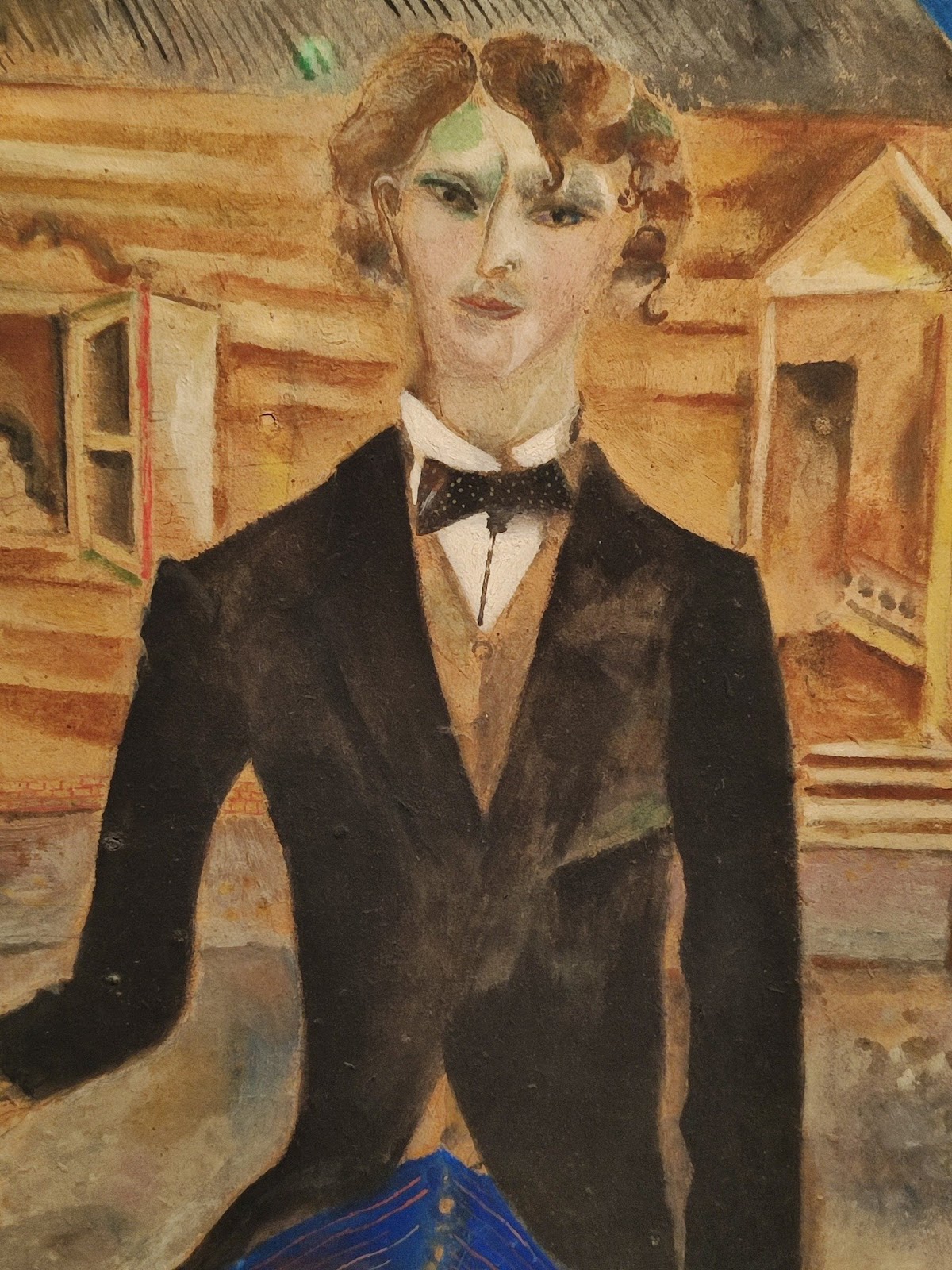
Michael Rogatchi (C). Motherhood. The Next Year in Jerusalem. Forefathers. Oil on canvas. 1995.

Parsha Shemot opens the second book of the Torah with the chapter under the same title, the Names. The Torah tradition provides a special, elevated meaning for naming. When it is done ( apart from those representing evil ) it means more than a usual mentioning. It means an emphasis, double-weight and verification. It adds a special merit. In this motion, the names of all the Tribes have been provided in the Shemot, most likely, as the respectful  commemoration of them at the moment of the sons of Jacob generation’s leaving the stage of life. 

At the same time, very much in the mode of the Torah narrative, here also the end of something means or leads to beginning of something else, in a reflection of the Judaism philosophy and perception of life. It is in this way that after mentioning of the Tribes families names, the parsha Shemot brings to us some of the names of the Moses family, with all the family appearing in the Torah together for the first time – opening the new chapter not only in the second book of the Torah, but in the life and history of Jewish people. 

Here appears Moses’ parents, Amram and Yochebed, and his siblings, sister Miriam and brother Aaron. The marriage of Moses’ parents was the marriage between a nephew and his aunt in the period when such marriages were not forbidden by the rules of Judaism yet. It also means that Moses , Aaron and Miriam all had the genetically enforced super-line, all coming from Levi, as both their mother Yochebed who was Levi’s daughter, and their father Amram who was the son of Levi’s son Kehot, were direct and closest relatives of Levi, thus making Moses and his siblings twice grandsons of Levi, so to say. This is an extremely strong and highly mattering genetic potential. 

With developing the Moses’s story, his miraculous saving from the Nile river, and his high-end upbringing at the Pharaoh court, the parallel between him and Joseph appears very graphic, with only difference that Joseph appeared at his time Pharaoh court when he was 17, while Moses grew up as the adopted son of the Pharaoh daughter Bithiah since he was a baby. But the principle of their development is strikingly close: both Jewish boys were thriving as the Egyptian royalties, with no impact of anything Egyptian or royal on their both personalities of organic strong Jewish men whatsoever. This is highly unusual, if not to say unique.  But this, so similar parallel in both Joseph and Moses life-lines in its beginning, their both strong and devoted withstanding of their Jewish personality amidst total and quite strong Egyptian environment around them in their formative years does explain, from yet another perspective, that deeply touching devotion that Moses had for Joseph. 

After all, he was the only one amongst thousands of people whom he was preparing to lead out of Egypt , who was interested to find and to take with him Joseph’s remnants, not merely remembering Joseph’s will, plea and hope, but also being absolutely committed to fulfil it. The only one – as it is emphasised in the Talmud and other primary Jewish sources. Just to think about it.   

Reading, analysing and studying this parsha, we normally concentrate on Moses’ family and the dramatic twists of their lives, with a good reason. Miriam’s character of a strong and extremely smart and decisive Jewish woman is shown here in her life-saving actions, with a rare vision, even pre-vision, understanding and knowledge of what to do, and with a phenomenal sense of timing.  Moses’s mother Yochebed is set in this parsha as a model of the forthcoming in a vast number and at the different periods of history a special character of Jewish mother, with our moms’ absolute devotion, bottomless love, their unique hearts, their incredible selflessness, their warmth, gentleness, protection. Their beauty, their smartness, their stunning resourcefulness. In short, the best of what life can actually provide to a human being. All this had been set  for our extremely lucky in this respect people initially by Sarah and all following matriarchs, and further on by Yochebed, that special loving and brave mother of Moses.  

Michael’s Motherhood ( Next Year in Jerusalem) painting tells about it in the best possible way, with our never ending dramas, our moms’ main priority in life for their children, our strength and ability for overcoming against all odds and through any storms that are pushing non-stop our way. The work is both elegant and dynamic, which is a rare and worthy combination in visual art. It is created in a very coherent palette, thus making its strong , almost passionate message, tangible but  intentionally constrained, in a noble, not over-reacting  way.  And finally, it brings out the ongoing drama of Jewish life and history, the drama which very often falls on the protective shoulders of Jewish mothers, from Sarah and Rebeccah to Yocheved and so many others all the way through the history. In a paradoxical way, this work , while portraying an open, ongoing drama, strengthens a viewer instead of making him depressed and weaker. When art  that speaks about suffering strengthens, it is both the most unusual and most healthy outcome. It is a deed by an artist. 

 * * *

In my understanding, there are two unsung heroes in Parsha Shemot, additionally to its main protagonists, a man and a woman. Yethro, who will become Moses’ father-in-law, and whose role in Jewish way of life and history will be quite meaningful, due to his personal qualities and his ability to think and to see the core of matters, was known to Moses many years prior to becoming his father-in-law. It was Yethro, the one of the most notable wise men in the Pharaoh court, who saved the boy Moses from an evil-inclined powerful people in the household who with a power instilled into them by the evil forces, if not fully realised but still sensed the threat to the Egyptians en masse that will come from Moses, eventually. In both Midrash and Talmud, the story about Yetro saving the life of the adopted son of Bithiah is told in detail. 

We also know, from the same primary sources, that soon after saving Moses, Yethro did become disillusioned with the pagan practices and preaching, and left the Pharaoh household making a pretty clear moral choice. Due to that fact and his principal disagreement to preach the paganism, Yethro, previously very popular and influential on the top of the Egyptian hierarchy, following , naturally for this kind of regime, with wide subduedness by  the middle and lower lawyers of the Egyptian society , has become a pariah in the eyes of them all overnight, which forced him to retreat to his own place of living and to work for providing his family by himself with his seven daughters. Still , Yethro did not mind, was not depressed, and lived as he believed was right, which was and still is a privilege of strong and independent minds. 

That man saw and understood many things and phenomena that most of the ordinary and non-ordinary people of his time and environment had no clue about. One of such provident samples has to do with Moses’s stuff. As we learn from the Talmudic sources, the miraculous stuff that has been created  on the Sixth Day of the Creation, went from Adam to Abraham and further on the line of the patriarchs , reaching Joseph from Jacob. After Joseph’s death, his household was looted by an Egyptian mob, with the stuff ended at the Pharaoh household. The stuff had such a self-protecting power that nobody who would approach it , trying to grab it, could not do it. Except Yethro. 

Leaving the Pharaoh court for good, Yethro took the stuff with him, being the only person who could physically – and metaphysically – do it. Secluded with his family at his home far from the Pharaoh court ‘s glitter and menace, Yethro was wise to place the stuff in the middle of his garden. And again, nobody was able to reach the stuff, and the stuff was a blessing and the most powerful protection for Yethro’s household and the family. Leaving the court and stating publicly his disillusionment  with pagan practices and belief, Yethro had all the reasons to be in need of protection, indeed. When Moses entered the Yethro’s home after meeting him and his daughters , including his future wife Zipporah , at the well, the first thing that grabbed Moses’ attention on the spot, was the stuff that stood proudly in the centre of the Yethro’s garden. Coming closer, Moses saw the signs on the stuff and was able to read and understand that. It is then, according to the Talmudic sources, when Yethro realised fully who was the man whose life he saved in the boy’s childhood at the Pharaoh’s court, and at that moment Yethro decided to give his daughter Zipporah as the wife to Moses. And we know how Yethro was supporting and helping Moses ever since. 

An unsung female hero of the Parsha Shemot is Serah. The text of the Shemot parsha does not mention Serah explicitly, but according to the Midrash and other Jewish sources, the events described in this part, has her role as a key-one. And at least in one more substantial episode from the Torah narrative, Serah has played a special and important role , as we learn from the Talmudic sources.   According to the rabbinical tradition, she was daughter of Asher, possibly adopted one, and if that was the case, she is mentioned as the granddaughter of Eber.  In the highly dramatic and full of possible  emotional implications episode of Joseph returning home with his brothers in the parsha Vaygash , the Tribes were seriously worried of what might happen to Jacob if he would be told straightforwardly and on the spot that his beloved Joseph is alive and is about to meet him soon. Jacob’s heart might not sustain such a shocking, even if positively so, news without necessary psychological preparedness. To make it happen, the Tribes tasked Serah, an exceptionally beautiful ( as all Asher’s daughters)  their niece, to sit near Jacob, with lute in her hands, and to play and sing gently, including into her solo from time to time a small phrases like “Joseph is alive”, “Joseph is about to come’, “Joseph will see his father soon”, the things like that. Serah’s solo set up Jacob’s sub-consciousness in the proper mode, so when he was informed sometime after that Joseph is alive and coming indeed, it did not come as a high emotional risk for him. It was probably the earliest psychological training in the history of humankind. At least, the earliest among the registered ones. 

 In the parsha Shemot, Serah plays a pivotal role twice, first time acting as a fact-checking authority, and second time as a historian or archivist with a decisive knowledge. When Moses appeared to his people, they were not convinced at all. Not to mention that some of them, like those two who reported him to the Egyptian authorities years before in the episode that had prompted his escape for his life, did not like him from the beginning. Interestingly enough , that vicious couple of low  informers is believed by the Torah commentators to be the same Abiram and Dathan who would later on bring another serious mess among the Jews igniting, on purpose, the mean conflict with Moses and Aaron. 

When Moses, fulfilling the Creator’s will, appeared to Jews and started to speak with them, most of them had their doubts in the beginning. Some of them ran to the wise woman who was the only one surviving of the generation of the Tribes ( as Serah was blessed with an exceptionally long life), to check what she was thinking about this newcomer. Listening to what the doubters had to say about what Moses said and how he did it , wise and knowledgeable Serah was not impressed either, saying that that man was a commoner without a mission. The people speaking with Serah then said that Moses did pronounced the phrase which they did not quite understand, ‘ I will indeed remembered”/or visited, ‘pakod pakadeti’, and Serah immediately recognised the code phrase ( known as ‘pakad-pakad’) that was known in her generation ( and previously, from Abraham onward) as a special message and the sign from the Creator indicating His chosen ones for the mission. It is hard to imagine what might happen  – or might not happen – with enslaved Jewish society in Egypt without Serah and her recognition of who Moses was that she explained to the people who were doubting him. 

Later on, the same woman, Serah, would be the one who only knew and remembered what had happened with the remnants of Joseph when Moses ran to her to inquire about her possible knowledge after frantically searching for Joseph’s bones prior to leaving Egypt. Among all the people who were preparing to leave ( those 20% brave and convinced ones), Moses was the only one who was occupied with the matter. After his search proved fruitless , he turned to Serah, who did remember what had happened with Joseph’s coffin, or rather the lead box with his remnants,  and where the Egyptians had put it. They had placed it in the Nile, to bless the river that was in their culture much more than a river . It was the element that commanded their way of life, a cosmos of Egypt. Moses ,who went to the Nile’s bank and started to pray fervently, did succeed in finding the resurfaced lead box with Joseph’s bones in it. But he would not know where to search unless wise and special Serah would not tell him. Given the importance and not obvious underlining of all remarkable episodes ( there are many more)  in which she was playing a decisive role throughout her remarkably long life, it is logical to conclude that Serah is one of the most interesting and meaningful personages of the Jewish tradition. 

And there is one more exceptional woman portrayed in the parsha, Bithiah. Her, the Pharaoh’s daughter’s history in the context of the Jewish – and the world civilisation’s – history is crucial.  An Egyptian royalty takes pity on a Jewish male baby, in the midst of the draconian measures against precisely these acts, imposed all over Egypt by the  young woman’s father, mighty sovereign of Egypt.  Something has driven her from inside, perhaps something that she was not able to comprehend fully at the time. That mighty impulse has prompted Bithiah to save that little boy who was inside that basket floating slowly through the Nile. But Pharaoh’s daughter not  only saved the boy. She loved him. Only a loving person would allow the saved boy’s real mother , Yochebed, to nurse him for two years. Only  a loving person would bring the boy out with utmost care and love, subduing and avoiding the rigid rules of a cold power to produce an empathy towards a lonely boy from entirely different people , and to make his life as warm and privileged as possible. 

I tend to think that Bithiah was given knowledge , probably from the very beginning, even if she did not realise it in full measure at the time. I think that Bithiah might have been infused by the High Force with a subconscious sense of duty, which she might not fully comprehend in the beginning of that moral imperative . It is for that devotion, I believe, that Pharaoh daughter Bithiah , who was subsequently converted, was rewarded by marrying Caleb, according to the Talmudic sources. Caleb, of all Jewish men, the best of them at the time, the most devoted one both to Moses and to the Jewish cause,  the most decisive and resilient, the eternal  pride of ours. Bithiah’s life and evolution in her unique mission is a very important part of Jewish history, one of its lines that has determined our all’ future.   

In this remarkable parsha, there are so many episodes which one can identify as key-ones for the entire destiny of Jewish nation, they are coming in the Shemot one after another.  But the most enigmatic one, and one of the most decisive for entire Jewish history is the episode of the Burning Bush.  There are some intriguing questions in the phenomenon that still has its grip not only on the Jewish observant people and scholars, but also on many of those of the Christian faith who find the episode as one of the strongest in the Old Testament. In my artwork Burning Bush II from my Songs of Our Souls collection, I have been trying to address the ongoing importance of the Burning Bush from which the Creator did speak to Moses, for every next generation of Jewish people. 

Inna Rogatchi (C). The Burning Bush II. Mixed technique. 2022 – 2024.

Why was the Bush burning, without being consumed by the fire for as long as seven days? Not one, not two, not even three, but that many. As it comes from the logic of human behaviour, it happened because Moses himself could not believe in the sufficiency of his leadership abilities, most of all due to his exceptional humility. We know that Moses was the epitome of humility in the very best sense of it.  But the Creator knew the main quality of that stuttering ( because of an incident in his childhood) man, a crystal honesty of his heart. This quality has become the main source of Moses’ leadership that sustained so many daring tests, and which designed the character of the man who led our people out of slavery, not only literally, but metaphorically too, which is of principal importance. 

Undoubtedly, in the case of Moses, there was a fantastic genetic lineage. He was the grandson of Levi on both his mother and his father’s sides, the great-grandson of Jacob, and the direct successor of Isaac and Abraham in the third and fourth generations. But there was also the conscious choice of his heart which led him through life, and which was the decisive factor and the main criteria for the Creator’s choice, I dare to believe. 

There is no coincidence in the way of the Creator’s choice among the Jewish forefathers to become our patriarchs and the key leaders. Both Abraham and Moses were chosen directly by the Creator for their personal abilities and the honesty of their hearts. It was a foundation stone of their both personalities. This honesty of the heart formed the way of their both faith. It has kept their will to believe unshaken. It has made their beliefs uncompromising, with a special strength. It also contributed largely to their both ability to lead – because due to their crystal honesty, they had nothing to be afraid of, they were both completely uncompromised people in any way, thus having a lasting moral authority under any circumstances.

These kinds of people appear in every generation, as we know. Otherwise, humankind would not sustain. My great-grandfather and my grandfather were men of this kind.  I was very lucky to know what the crystal honesty of a strong, convinced in the best morality Jewish person is since I was born. The only thing is that such people are so rare. But it tells about the quality of us, and our preparedness and ability to overcome challenges and give  – or not – the way for compromises. Moses did not. And that’s why Bush was in the fire, unconsumed, for seven days, to set up a strong  symbol of the strength of the honest heart that gives us, everyone who is open to honest dialogue with itself and the Creator,  to live decently.

Origination of the Shema, the Impulse for the Tribes, and the Circle of a Jewish Destiny

Vayechi   – And he lived

Genesis 47:28-50:26

Essay from The Glimpses from the Torah. Analysis of Psychological Causes of the Human Behaviour in the Torah.

Inna Rogatchi (C) 2023 – 2026

With Art by Michael Rogatchi (C)

Michael Rogatchi (C). Shema, Israel. Oil on canvas. 80 x 70 cm. 2023. Forefathers.

Parsha Vayehi, And he lived, which ends the Bereishit, the first Book of the Torah, is one of the most concentrated chapters of the Torah. It is  filled with so many essential topics for Judaism and Jewish outlook towards the world that even one of them would be sufficient for a very substantial part of a Jewish fundamental document to discuss and learn. But perhaps the fact that this parsha concludes the first book of the Torah demands an extra weight in it.

In this part, we are told about the passing of both Jacob and Joseph, the third Jewish patriarch and his beloved son, it narrates a rather dramatic and essentially meaningful process of Jacob’s blessing the Tribes, his sons, and in the case of Joseph, his grandsons. That destiny-prescribed blessing  gave to the Tribes the impetus for their development from the new plato, with new knowledge and understanding, all of it being articulated by their father at the highly special moment before his departure from this World . 

The parsha also tells about the one of the most enigmatic episodes in the entire Torah when Jacob who was about to tell the Tribes , and thus, to the entire Jewish people, the time of the end of the world ( meaning the coming of the Messiah in the Jewish tradition) , was prevented from doing it by the Divine intervention. The reason for that is still discussed by the Jewish scholars till today.  

Vayechi tells us about the return of Jacob’s body to the Land of Israel and the unusual circumstances of his burial there ( with Talmud bringing more dramatic detail on that important episode). It also tells about the death of Joseph, but yet before that , it brings to us another eternal thriller of the Tribes’ behaviour towards Joseph after passing of their all father, in a very human whirl of emotions, fears and nervousness. 

And – it produces Shema, its beginning, the first of its three verses, in the scene of the beginning of Jacob’s blessing of the Tribes. The appearance of the quiet-essential of Jewish prayer is a very decisive mark of the chapter which tells about Jewish people entering a principally new, post-Patriarchal stage of our history. With the passing of Jacob, the last of the patriarchs, the Jewish people were about to enter the next period of their life. The life in which the responsibility for self-sustainability had been growing for every Jewish person individually further more. They had to be morally prepared for this new way of their spiritual and moral life. They had to have their constant personal check-in, which the Shema is effectively about. 

It is in this connection that Jacob decided to double-check, in the emphatic manner, the Tribes’ devotion to the Jewish faith. Prior to his departure from this World, Jacob knew that he needs to make the Tribes, his sons and two of his grandsons, to look into themselves at the pivotal moment and to make them to be decisively re-assured in their devotion to the Creator, an absolute basic of Jewish faith.  

Jacob’s sudden, sharp, dramatic  question to his sons which was perceived as an unexpected alarm by them ( and that reaction was exactly what Jacob was aiming to),  in fact , was his ever-wise signal to the Tribes to remember who they are, what was their purpose in life, and what this purpose shall be based upon. 

The Tribes’ emotional reply is the first  phrase from our three-phrased essential Shema prayer: “Shema Israel, Adonai Elohaynu, Adonay Ehad” ( Hear, O Israel: the Lord is our G-d, the Lord is One). Before the Shema will be formed as we know it in the last, the fifth book of the Torah, in Deuteronomy, its first phrase, according to the Talmudic authorities was actually the Tribes’ answer to their father Israel ( as Jacob was re-named by the Creator, and as his name is written in the Torah since then, including the entire Vayechi chapter) – “Hear , O Israel… “ was their re-assurance, literally so, to their dying father of their strong, deep, unshakable devotion to the very core of the Jewish belief. 

In Michael’s very special – and unique in his oeuvre – visual interpretation of the Shema, there is a ground for many reflections on the matter, from clear differentiation between good and evil to virtual details of the essential for Jewish people prayer. The shield of our belief and the way of an Jewish individual in his very personal daily addressing the Creator and plea to Him are expressed in this amazing artwork at the high level of intellect and laconism. Every time this work has been exhibited, we observed many people spending a lot of time in front of it, not surprisingly. 

Michael Rogatchi (C). Shema, Israel!… Oil on canvas. 80 x 70 cm. 2003. Forefathers.

Further on in the parsha Vayechi, patriarch Jacob not only blesses his sons and two of his grandsons, Joseph’s children, before his passing, but his vital blessings is also a deep destiny-visioning analysis, which only wise heart of a unique leader of a courageous nation can provide. The leader whose own life was a concentration of an incredible amount of trials. It is not coincidental that many commentators have pointed out that the last seventeen years of Jacob’s life, his time in Egypt after his re-uniting with Joseph, were not only the happiest days of his life, but it was the only happy period of it. This is less than the eighth’s part, something like 11%  of his 147 years of life. And he lived – emphasises the title of the parsha. 

In the crucially important for all the further development of the Jewish history Jacob’s blessing of the Tribes, the leaders of the Jewish people received the impetus for their personal and, very importantly, their families, the tribes of Israel, further development. They’ve got the direction from Jacob, putting it in the modern way of expression. And they lived by it. Our people lived by it, having the Tribes characterised by Jacob before his passing, in the most authentic way. 

That’s why Michael’s Strength of Love depicting the Lion of Judah in his work of 2016 ( he has more than one work on the theme) is so powerful. It conveys Jacob’s blessing to Judah as it is breathed through and from the canvas.  At the same time, the work also reflects Judah’s and his descendants’, including King David, Michael’s favourite personality in the Jewish history, devotion to his father’s crucial blessing, and brings it tangible to anyone who sees it. The loyalty of Judah – and his tribe – to his father, and to Jacob’s vision and principles of life , his and his descendants’ resilience to defend our soil, spirit, lives and values, has become one of the noblest features in the Jewish character and Jewish history.  And it continues to be like that. 

Michael Rogatchi (C). The Strength of Love. Zion Waltz. Oil on canvas. 120 x 100 cm. 2016.

The Torah’s commentators in every generation were acutely interested in the fact that Jacob, very decisively,  has blessed two of Joseph’s sons, Ephraim and Manasseh, thus elevating them to the level of his sons, the Tribes. In the blessing that has doubled Joseph’s portion, according to Jacob’s intention, Jacob foresaw two other crucial developments in Jewish history, with our heroes and formative figures Gideon and Joshua coming as descendants of Manasseh and Ephraim respectively. Nothing, just nothing, not a single detail in this amazing parsha Vayeish appears as occasional, sidelined or casual. And he lived. 

Coming to its end, parsha Vayeish tells us about Joseph’s passing. But yet before that, the Torah narrative gets us to Shechem, twice. Firstly, in the beginning of his meeting with Joseph during which Jacob made his beloved son to give him the oath ( an exclusive deed in Jewish life), he grants Shechem as the portion in the Land of Israel to Joseph and his descendants, in a very meaningful reminder of the role of the place in their both destiny. Shechem was the place where his brothers carried out the plot against Joseph. By granting Shechem to Joseph as his portion of the Land of Israel, Jacob recuperated the devastating damage that the brothers, his sons, inflicted upon Joseph. It was an absolutely important and very meaningful implementation of fairness which, as a concept of life, is a backbone of Jewish moral heritage and tradition. 

The next time Shechem appears in the same parsha after Jacob’s death, when the burial procession of his family accompanying Jacob’s coffin enters the Land of Israel and moves towards Machpelah Cave in order to bury the third patriarch there.  At the Machpelah, as the  Talmud provides in a dramatic and rather detailed account, there was also a dramatic confrontation between the Tribes and their descendants and Esau who decided to appear and prevent a possibility for Jacob to be buried at the last available place in the Cave, which Esau has planned for himself. The confrontation led to the ultimate end of Esau in swift and rather brutal way when one of the grandsons of Levi, in indignation of Esau’s plotting against Jacob, took his sword and the Esau’s decapitated head rolled over on all the way to the Machpellah, stopping precisely at the feet of his father Isaac where it is believed to be still there from then on, as it is stated by the Torah authorities. 

But Shechem which is 200 km from the Machpelah, was the place where Joseph went alone after entering the Land of Israel after all those 37 years that he spent in Egypt after being set up by his brother in Shechem. It was essential for Joseph to return there, at the place from which his life has had such an ultimate and dramatic turn. 

In Joseph’s decisive return to Shechem and his quiet  intense prayer there, on his own, a special important feature of Jewish existence has transpired. In Shechem, returning immediately after entering the Land of Israel after 37 years of absence, a third part of his life that continued for 110 years, a mighty viceroy of Egypt, a de-facto ruler of a huge and important country, has profusely become the person who he really and always was: a Jewish man, the son of Jacob and Rachel, supremely talented and intelligent, solely devoted,  introvertive Messenger of G-d, to cite the vision of Elie Wiesel, who had a lot of similar characteristic with Joseph himself and who understood and loved him deeply. 

First and foremost, that sole prayer of the Egyptian viceroy at the pit in Shechem that has changed both his destiny, the destiny of his family, and consequently, the destiny of Jewish people, was absolutely important for Joseph who was there Alone But Not Lonely. That return and that prayer in Shechem was not just a closure for Joseph, but, from the point of view of Jewish perception of the world, it was a closing of the circle, which is an essential philosophical concept in Judaism. In the case of Joseph, it was a circle of a Jewish destiny which in the form of a circle is always purported to the perfection, and the logic in which the end also means the new beginning. This is actually the foundation of Jewish stern optimism that moves us on through the centuries of unimaginable trials against all odds. 
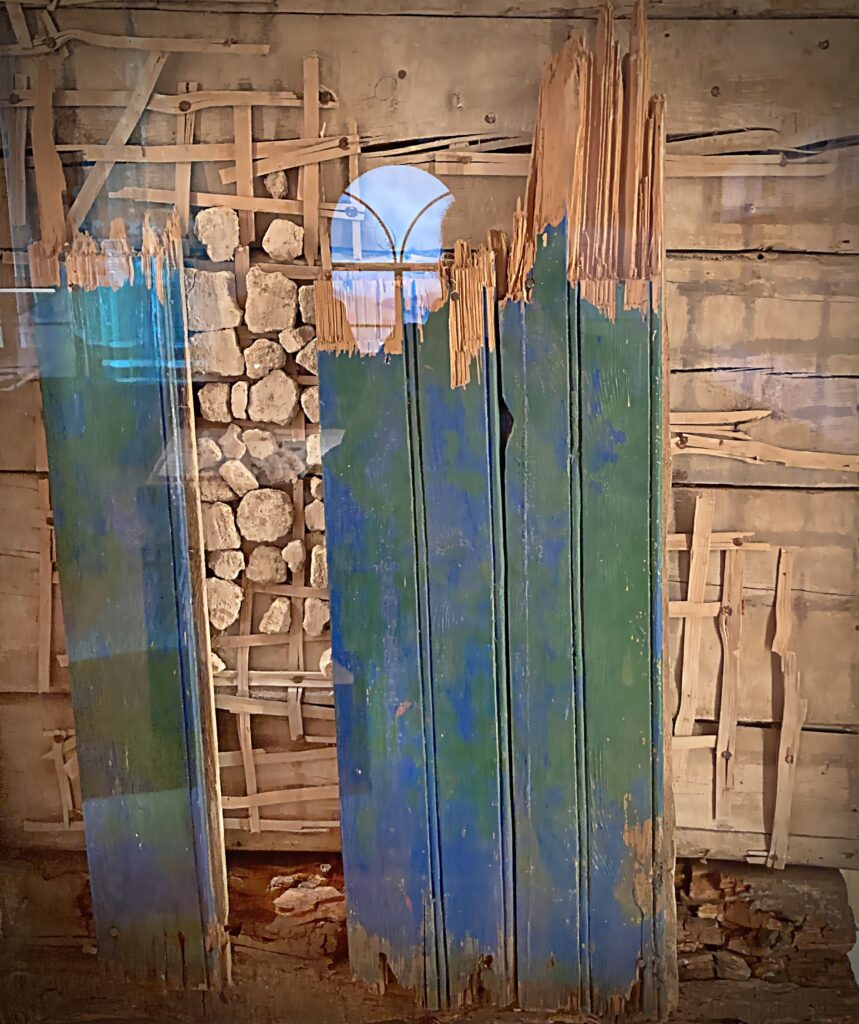
Both, his father Jacob’s and his own deaths featured in the parsha Vayeshi, have not only ended their both noble and extremely difficult lives which did not poison their both hearts, but it prompted the springing of Jewish life further on, led by their both’ sons, the Tribes and Manasseh and Efraim whom both Jacob has elevated to the level of the Tribes so prophetically.

The Honesty of Love

Vayigash   –  And He Approached

Genesis 44:18-47:27

Essay from The Glipmses of the Torah. Analysis of Psychological Causes of Human Behaviour in the Torah.

Inna Rogatchi (C)

2023 – 2026

With Art by Michael Rogatchi (C)

Michael Rogatchi (C). Light Flight I. 2025.

Throughout parsha Vayigash , translated as And He Approached, the high degree of the dizzy thriller’s plot unfolding during Joseph’s and narrated  in previous parshat ( chapters of the Torah) , has got to its highest degree. The parsha tells about Judah’s confrontation with Josef over the latter’s intention to keep Benjamin next to himself.  The extraordinary confrontation initiated by an unknown man in position who initially came to ask for a life-saving favour, and the viceroy of Egypt,  demonstrated an extraordinary character  and resilience of Judah. We are not that surprised about it as we know that from that unique man as Judah was,  will originate the line of people leading to King David . But in general, that unheard of confirmation has become one of the most commented episodes in the entire Torah throughout the centuries. 

In my reading , from a complex background of the feelings and considerations that overwhelmed Judah at that moment, the driving force for his extraordinary standing off to the viceroy ( he had no clue at the moment who that viceroy really was) was  Judah’s deep love for his father Jacob. That mighty love of a mighty man with its honesty has driven Judah to the situation in which a compromise was excluded. 

 This ability of Judah to see the things as they were had been undoubtedly affected by his auto-remourse for his inability to save Joseph – and to prevent his beloved father from an immense suffering – all previous twenty years from the moment of brothers’ plotting against teenager Joseph and them coming to Egypt in a desperate hope to obtain some provision from that legendary viceroy who ruled Egypt.  

Being deeply remorseful about the catastrophe they the brothers did cause to Joseph and thus to their all father Jacob, seeing – and understanding – his father’s suffering during all those twenty years, Judah just cannot allow the next tragedy in their family to happen by leaving Benjamin to the demanding viceroy. He simply could not let his father down. Does not matter what. Every real leadership comes from a personal preparedness to defend the most vulnerable ones.  

That amazing Judah’s persistence in the front of the viceroy, and yet more amazing his preparedness to stay his ground has affected Joseph’s heart directly and powerfully.  He also heard Judah’s rightful words about Rachel who was ‘the most beloved wife of our father’.  

 One has to possess a seriously above-average courage to confront the viceroy of Egypt in the way Judah the Lion did. One also has to have the most serious reasons for that – and the clarity of mind to acknowledge it , first of all, for  oneself. Those things are not as easy as they seem. People are usually moving to self-defence, self-comfort and absolution far more easier and quicker than they are able and willing to act as Judah did, starting the count from oneself. 

Importantly, the origin  of that unusual courage of Judah was love. The honest, deep, manly love to his father. Being prompted by this  powerful and deeply human love, Judah was not afraid for a bit of whatever might happen to him while confronting the viceroy. The only thing he was thinking about was his father.  

The argument between Judah and Joseph was conveyed at several levels: rational, spiritual, emotional and human.  As Joseph saw and recognised the essence of Judah’s ability and willingness to confront him, which was an indisputable love for their both father, his own extremely elaborated self-defense in dealing with his brothers twenty years after they have plotted to get rid of him has been breached. By the honesty of love. 

What started as an escalating confrontation turned into an unexpected – and that’s why so highly emotional – dialogue of the souls of two sons of Jacob. The brothers. The selfless sincerity of Judah towards his father has compelled Joseph to open to his stunned brothers. 

Looking back from the perspective of time, that healing of the broken ties inside the Patriarch Jacob’s family has paved the way for the entire Jewish people’s history to move forward and to go to its next milestone, coming to Egypt. 

On his way, Jacob had all justified doubts and fears with regard to the immediate and more distant future of his family and his people there. But he was calmed down and assured on his way to Egypt by the Creator himself, commanding him not to fear ( which is a quite-essential motto for any Jewish character at any moment of history ), as He will be with Jacob, his family, and our people. This presence is seen in Michael’s Light Flight  ( 2025) artwork from his Alone But Not Lonely collection. Amongst the darkness and challenges, amidst the winds, many of them hostile, there is always the Presence of caring High Force, which often is depicted in the Jewish tradition as a bird, which protects, supports, and helps us. This Presence is the best and most important gift that we do have in our lives in this world. This Presence is actually the only thing on which we can rely on. And we do. 

With the coming of the Jacob’s family to Egypt, not only the essentially important next chapter in the Jewish history started to unfold, but a principally important period of the world’s civilisation had begun.  

The importance of the 70 souls coming, or descending as it is stated in the Torah and Judaism religious literature, is hard to over-estimate. The whole new stage of the development of the civilisation has started from there, from agriculture to craft, from geopolitics to arts and culture, eventually. The number of 70 Jewish souls who moved with Jacob in order not to perish in the famine, but to survive, blossom and develop, is also principally important for Judaism, Jewish history and history in general.  Seven is understood as the figure of perfection, and its multiplication in ten times refers to many highly important symbolically patterns of Jewish life and knowledge. 

We know, directly from the detailed list in this very parsha Vaiygash, that with Jacob there went 66 souls of his family, who were united in Egypt with Joseph and his two sons. But who was the last, the 70th soul that entered Egypt? 

There are a couple of opinions with this regard. I support the one that lists as the 70th soul Yochebed, a baby girl, the child which was born just on the border with Egypt, already in the Egyptian territory, but still between the walls of it, as it is stated in the Jewish sources. 

The baby girl was the daughter of Levi. She would become the mother of Moses, who has played a pivotal role in the Jewish and humankind’s history.  

This also explains, to me,  Moses’ unique feelings towards Joseph , who was the one who has made the entering of the Jacob’s family, including his just born   mother , possible, thus simply saving their all lives.  It also explains Moses’ very touching love and  his unique personal connection  to Joseph, coming from a conventional wisdom of the simple fact: without Joseph and his will and ability to bring the entire Jacob’s family, predecessors of us all, effectively, to Egypt, his, Moses’s mon Yochebed simply might be not born, due to the severe famine , and thus, Moses himself could never be born, G-d forbid.  

I know, first-hand,  several cases of the people’s feelings similar like that, in the families of the Holocaust survivors. It concerns the families in which children from the Jewish families were saved, and later on, they became parents for the next generation. The feelings of the second generation children born to the saved parents towards their parents’ saviours  are probably the strongest ones one can encounter in life. 

In this logic, the 70th soul of our people who entered Egypt thanks to Joseph’s vision and will, was the soul of the woman who will give birth to Moses, thus prompting the history in the direction we know it.  

And the focused  caring glance of the High Spirit was at that pivotal moment on a small baby girl who would be named Yochebed ( translated as Glory of God, so justly)  and who was born on the way to Egypt – just as the loving, caring, thoughtful and  concentrated  glance of the High Spirit bird that Michael’s artwork expresses . 

VISIONS OF RE-CREATED SHTETL: IMAGES & DESTINIES

 SPACE, IMAGES, PEOPLE

Essays series about  new historical museum in Lithuania

Part 1 analysing the architectural aspects of the museum can be read here – https://www.innarogatchi.com/?p=824

Part 2. IMAGES & DESTINIES

 INTERIOR DESIGN AND ITS IMAGINARY 

None from many international visitors to the Lost Shtetl Museum in Seduva, Lithuania special commemorative event for the victims of the 1941 massacre in August 2025, almost a month prior to the museum’s official opening, was prepared for the level of sophistication of its interior design and permanent exhibition that we saw.

Top-notch quality of presentation, advanced modern interior design produced by the leading in the world the US RAA,  Ralph Appelbaum Associates managed to encapsulate the story of the Shoah in the concrete shtetl in Seduva, one of over 200 shtetls that had been all around Lithuania before WWII, into a wide context of the Shoah as such. The number of the shtetls in Lithuania varies according to different experts and institutions, between 200 as it is indicated in the museum’s core exhibition, 270 according to the Yad Vashem Black List of the Depopulated Jewish Villages in the WWII,  and about 400 as it is cited at the Litvak Heritage site. 

Core exhibition at the Lost Shtetl Museum. (C) Inna Rogatchi. 2025.

 Nothing has been missed in the narrative of the core exhibition of the museum. In an extrapolated way, the presentation of the ultimate tragedy of Jews from a small place in northern Lithuania tells about so many of them in a heart-warming detail, tactfully and simply, with  love which is palpable in the entire story. One can say that the Lost Shtetl museum in its many parts, aspects and details projects two significant lines: attention to detail and love to the people. And one does not see a lot of it in historical museums, especially newly opened ones. 

In this way, the story of Jews of Lithuania gets on the universal orbit of the Shoah in general and of the intentional and methodical murder and annihilation of Jews of Europe. This essentially important line comes from the permanent exhibition in the new Lost Shtetl Museum in Lithuania clearly and strongly, but not too pressurising. It comes in a technically elaborative and truly very well done way, placing the narrative of the events almost a century old ( as there are plenty of pre-war stories, very justly) in a superbly modern way. And it does the trick of grabbing a visitor’s attention and keeping it. 

I was especially touched by the animation on the floor of the main gallery of the museum. The children’s drawings that the curatorial group of the museum produced as a result of their educational program, are bringing an absolutely right and very fine accent into the whole presentation, which is  filled with photos of all sizes , all kinds of high-tech installations, all of them at the place and tasteful, and authentic artefacts, including , admirably, many donations by the descendants of the Seduva and other Lithuanian Jews from all around the world , which all treated with respect and love, as it should be.

But those appearing – disappearing – re-appearing different charming kids’ drawings that have their own  non-stop dance on the floor  of the main gallery , brings so much of life and gentleness into the heavy pile of difficult, sad and tragic facts told and shown in the main gallery hall, the centre of the core exhibition. This gentle dance of unpretentious children’s visions which is an integral part of life in general, perceived from that floor like a soundless melody, a thin and delicate, as an enlightening thread of life that re-appearing once and again after its total disappearance. Very thoughtful and gently beautiful, to me.

The museum contains nine galleries, and many people were deeply impressed by truly haunting The Last Journey which has been truly masterly designed. 

The Last Journey gallery. (C) Liana Jagniatinsky. 2025.

To counter-balance that inevitably haunting emotions at the museum that tells about the life interrupted and annihilated, there is a very welcoming design of the foyer where all known shtetls of Lithuania are presented in a beautiful way. There was not a single person in a jam-packed museum’s premises at the pre-opening event in August 2025 who was not touched by this steady light coming from the wall of Jewish communities. 

Hall of Jewish Communities of Lithuania. (C) Laura Refelt Sobel. 2025.

In general, the way and level of the interior design and its production at the  Lost Shtetl Museum, as well as the presentation of its permanent exhibition affects the visitors to its best. ” It is just great, very informative and so modern” – said to me a dear friend and colleague, MEP Petras Austrevicius who did travel to the event specifically, and who was grasped by everything he saw, as we all were.

The interior design and the core exhibition for this new museum envisioned and produced by Rick Sobel and his RAA, Ralph Appelbaum Associates, team, is simply superb.

Rick Sobel, who led his RAA, Ralph Appelbaum Associates team in their work on the Lost Shtetl Museum interior design and core exhibition, at the special pre-opening event at the museum. August 2025. (C) Laura Refelt Sobel.

The Beauty of Remembrance: Exclusive Exhibits

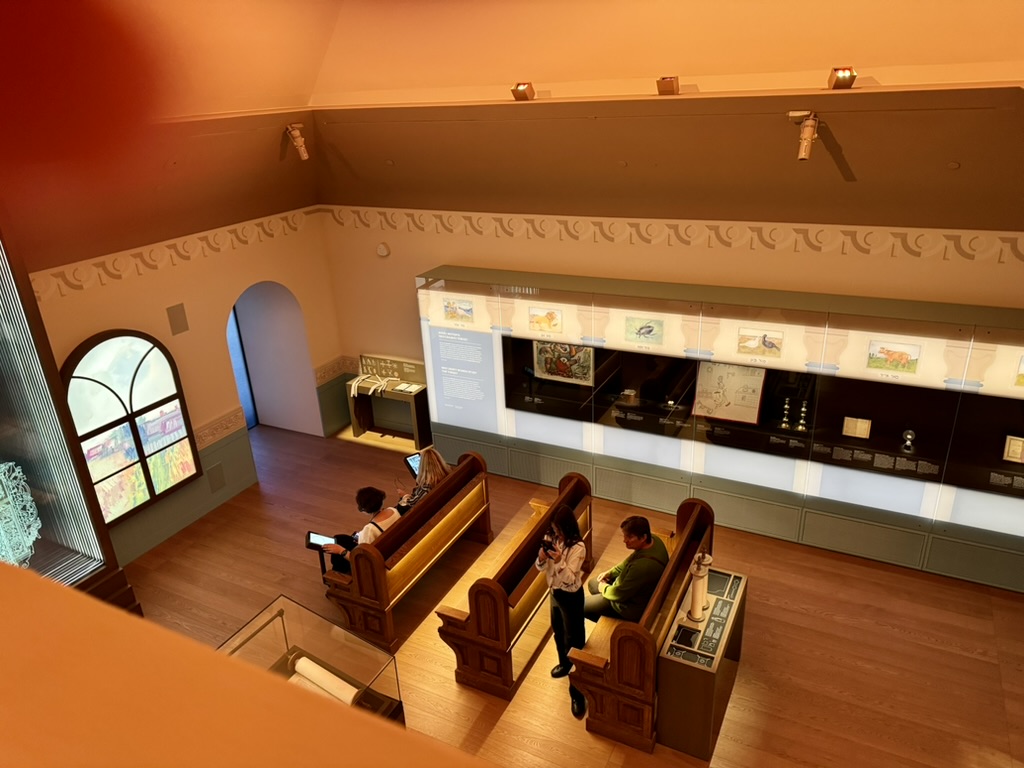
 Inside many galleries of the new Lost Shtetl Museum which opens in September 2025, there are a couple of places which are tactfully located a bit off the mainstream route of the core exhibition. The place that refers to a synagogue is quite special to me.

Its design is suggestive, simple but not simplistic. It features some elements of a Judaic religious rite and some symbols, all explained. It is equipped very well with all high-end technical tools belonging to the modern museums.

Synagogue Hall. (C) Inna Rogatchi. 2025.

Such a quiet place for meditation and a thought-corner, often in the form of a synagogue-prototype can be found in many Jewish and Holocaust themes museums world-wide, such as Jewish Centre in Oswieciem ( the town itself, not the camp), or the big and justly famous recreated synagogue in the  POLIN Museum and many others.

But one magnificent exhibit in the Synagogue Hall of the Lost Shtetl Museum made it exceptional. In the centre of an intimate synagogue hall, there is a purposefully extra-large superb box of pure beauty.

Aron Kodesh, Torah Ark, an exclusive exhibit at the Lost Shtetl Museum in Seduva. (C) Inna Rogatchi. 2025.

It is a modern-day crystal-engraved replica of a very special  Jewish art and ritual object, wooden Torah Ark, Aron Kodesh, which was made in the early 19th century for the synagogue in Valkininkai, 50 km from Vilnius. 

As it happened, luckily, at some stage that magnificent  Ark which was the subject of general and registered admiration,  was photographed, with few very old photos surviving, incredibly.  That has permitted the museum’s team and commissioned artists to reconstruct, or actually re-create it in the new material, with new  light effect, and, above all, with added metaphorical deep meaning that came with time perspective.

There is no synagogue today, not in Valkininkai, nor in Seduva, where there also were two large synagogues, or, for that matter, nowhere in over  200 shtetls all over Lithuania which all had been whipped out completely and cruelly in 1941 and thereafter.

There are also a very few Jewish people left in Lithuania, with many of us visiting the places of our families regularly, but still, there is a huge void in the sense of life and spirituality which is simply insuperable, and this is the fact of life and history.

Detail of an engraved and enlightened modern Aron Kodesh, Torah Ark, at the Lost Shtetl Museum. Seduva. (C) Barbara Kirshenblatt- Gimblett. 2025.

The beautiful, fine and enlightened crystal-engraved replica of Aron Kodesh in the museum’s Synagogue hall projects engaging echo of the core of Jewishness reflected in the authentic for Lithuanian Jewish cultural and artistic tradition ( in the same way of authentic finery and beauty as it is very successfully done in the POLIN with regard to the parts of the museum telling on artistic tradition and its characteristics in the Polish Jewish religious rites and customs).

This very special piece of art attracts attention and keeps it. The technique itself is very demanding. I have followed it for years, among the other subjects of applied Jewish art. The crystal engraving is traced to the Venice school of engraving since the 13th century  ( after it first appeared in  Europe in France a bit earlier). Continuing the non-interrupted tradition in Venice ever since, there is also a special Jewish branch of it, some great masters who are producing beautiful artistic Jewish-themes engravings still today.

To make it in the size  and in the detail in which it is done for the exhibit in the  Lost Shtetl Museum is a colossally demanding job, and it is a great craft, even if it is done with the help of machinery, not entirely by hand. This job was done extremely well.

The lighting for the Torah Ark t is also done both professionally and thoughtfully , as it does create, additionally to general lighting, a volume- and 3D-effects , which are bearing an extra-message in such subject as Aron Kodesh, adding there an extra-dimension of the layers of enlightened time and memory of the life and people destroyed.

This special and beautiful modern art subject re-creating the disappeared wooden Torah Ark of destroyed synagogue of eliminated shtetl in Lithuania truly enlightens our and future generations memory in a fine and beautiful way.

As my dear friend and good colleague, director general of the Lithuanian National Museum of Art Dr Arunas Gelunas mentioned after observing the  museum, “ it is a great gift to Lithuania, in many senses”.  And this beautiful modern Aron Kodesh evokes the same response.

Quiet Whispers of the Heart:  the Soul-talk of the Original Art

The visual narrative of modern museums is getting increasingly challenging: where is the right balance between a top-notch end of the constantly developing hi-tech solutions and steady unique images of traditional art? Success of a visual narrative of any new museum depends on a right balance of this tricky objective to a serious degree.

In the Lost Shtetl Museum that opens towards the end of September 2025, in their very nice prototype of a synagogue, there are three pieces of original art, two originals and one digital reconstruction of a rare and special piece that has been found in the Jewish abandoned house in 1944 and which original is preserved at the Yad Vashem. 

Synagogue Hall at the Lost Shtetl Museum. (C) Barbara Kirshenblatt-Gimblett. 2025.

Among the two original artworks, the work of Rafael Chwoles, a very good and soulful Jewish artist, is gentle, talented and warm. It is a Cheder scene.

Rafael Chwoles. Cheder. Lost Shtetl Museum art collection. Photo (C) Inna Rogatchi. 2025.

The other work here is the replica of that embroidered work that was found back in 1944  in an abandoned Jewish home in Lithuania by a Jewish soldier, and which original is preserved in Yad Vashem.

Unfinished embroidery found by a Jewish soldier in an abandoned Jewish house in Lithuania in 1944. Digital replica of the original which is preserved at the Yad Vashem. Photo (C) Inna Rogatchi. 2025.

In my view, as stunning as they can be, smashing hi-tech visuals that do perform their function of education really in a superb way, just cannot beat these quiet whispers of the heart , as they possess the bits of souls of the people who created it.

Both pieces of soulful art are situated at the calm and thoughtful synagogue hall of the museum.

The Real Thing: Magnets for Remembrance 

As we were visiting and observing the new Lost Shtetl Museum in Seduva, we saw a couple of authentic elements from the annihilated life that have a magnetic effect.

The tragedy of several European countries of which the Jewish population was annihilated entirely and with an extraordinary zealotry, such as Lithuania, Latvia, Estonia, Poland, Ukraine, is that together with people, their material culture was destroyed and whipped away, too. Also, to make the horror doubled, after WWII, anything still standing around has been literally whipped away by the Soviet authorities, with shocking enthusiasm.

Those who are working in the field of culture and museums, are well aware of the very serious difficulties to find authentic pieces of once superbly thriving Jewish culture in the Baltic states. That’s why those very few existing pieces are also very sad ones. It is such a hopeless reminder of the world lost.

In the Lost Shtetl Museum’s thoughtful and calm synagogue hall, there are two of those authentic fragments of the past, both wooden pieces. One is part of the synagogue in Seda, some 35 km from Seduva town, and another part of the Seduva synagogue.

Original piece of Seda synagogue in the Lost Shtetl museum. Photo (C) Inna Rogatchi. 2025.
Archival photo of the Seda synagogue, at display in the Lost Shtetl museum. Photo (C) Inna Rogatchi. 2025.

Both of those pieces are presented very well, masterly. And it is a tremendous luck for the museum that at least some of the authentic pieces of both synagogues in Seduva have been found. The real materials always bear its authenticity, its in-born feeling of time, the physicality of senses, in this case, the sense of memory. In my view, nothing, just nothing can replace material culture which is instrumental for our authentic perception, understanding, feeling and remembering the time and life past. Without it, not a bit of compassion would never become possible, due to the threats of human psychology. 

Original piece of a dove-tailed synagogue building in Seduva. Photo (C) Inna Rogatchi. 2025.

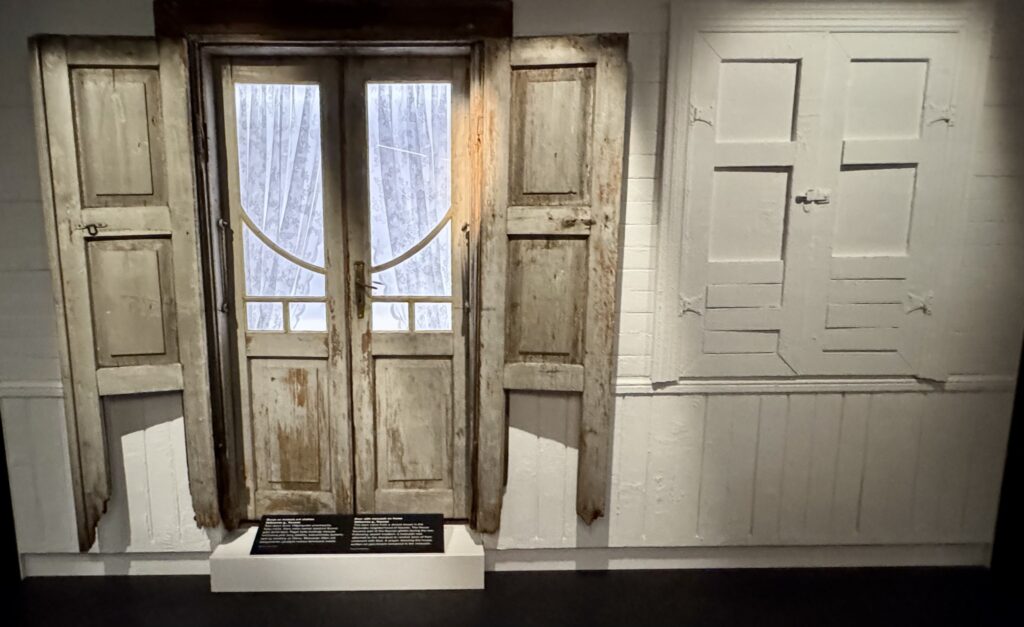
There is also one more real artifact displayed in the museum which evokes a feeling of inevitable sadness over the world and lives lost in it, and also a warm gratitude for its existence and presence in our life today. Those doors from a Jewish house in Kaunas with the place for mezuzah on it are both sad and moving, And they are very much in place in this core exhibition. It is like a silent song of remembrance. 

Fragment of the door of a Jewish house in Kaunas, with a place for mezuzah. Lost Shtetl museum. Photo (C) Barbara Kirshenblatt-Gimblett. 2025.

All other means can and are very helpful in adding the knowledge, they work at the different faculties of the human brain.

The real things are giving you a sense which nothing can replace. And that’s why material culture is such an essential part of civility.

But how sad those fragments of two synagogues in Seduva are. Just a few wooden planks of the buildings which housed so much life in all its facets for so long.

The real things, magnets for remembrance.

 CUSHIONS OF NATURE AS A PART OF MEMORIAL LANDSCAPE  .

LANDSCAPE & EMOTIONS

Memorial Garden at the Lost Shtetl Museum. (C) Lost Shtetl Museum.

A site always matters for created and re-created places of memory, whatever aspect of memory people address in their effort to commemorate it. There are arguably more demanding sites than the ones connected to the Holocaust and the emptied places of previously intense and thriving Jewish life that has been eradicated.

Seduva in Lithuania is one of such quite demanding places. From one side, there is wide and open serene and very large natural landscape in and around the place of one of so many non-exiting anymore shtetls. From another side, everyone who steps in at this place today knows that mass murder had a place just very near from this quiet place.

When our talented and sensitive leading Finnish architect Rainer Mahlamäki first came to see the site of his future Lost Shtetl Museum, back in May 2016, which, interestingly, was his very first visit to Lithuania,  the vision of his unique complex of buildings which opens in Seduva in September 2025,  was to large extent dictated by the landscape of this part of Lithuania and the nature surrounding the place. 

Renowned Finnish architect professor Rainer Mahlamäki during one of many of his visits to Seduva while working on his unique Lost Shtetl Museum. (C) Inna Rogatchi.

With regard to the core exhibition inside the building for which the leading RAA, Ralph Appelbaum Associates US company was responsible, it is ultra-modern, done with talent, taste and measure,  and  is very impressive and intense.

In a contrast to that serious and harrowing , in certain parts, impressiveness of the museum narrative which tells as of people’s stories, as of horror beyond horror in The Last Journey part of the core exhibition displaying a sheer fraught in an elaborative haunting galleries which are designed to project a personal sensation that refers directly and powerfully to the horrific last journey of about 700 Jewish children, women, elderly and men who were brought to their awful death by the local Nazi enthusiasts supervised by two German soldiers. As it was in the Babyn Yar, the same model and the system of organising and command of the mass murders of the civil Jewish population in those countries.

To balance emotionally after such an uneasy experience for visitors  it was decided to set a memorial garden around the building and stretch it to some substantial distance at the museum territory. That task was entrusted to a well-known ENEA Italian-Swiss company specialising in landscape architecture. The museum’s site provides a very good introduction to their memorial garden.

Memorial Garden at the Lost Shtetl Museum. (C) Lost Shtetl Museum.

Being there in person, I can mention that it is designed to be a soothing place and it relies on the local type of plants, trees and flowers. Many people who visited the place liked it a lot.

Memorial Gardent of the Lost Shtetl Museum. Photo (C) Liana Jagniatinsky. 2025.

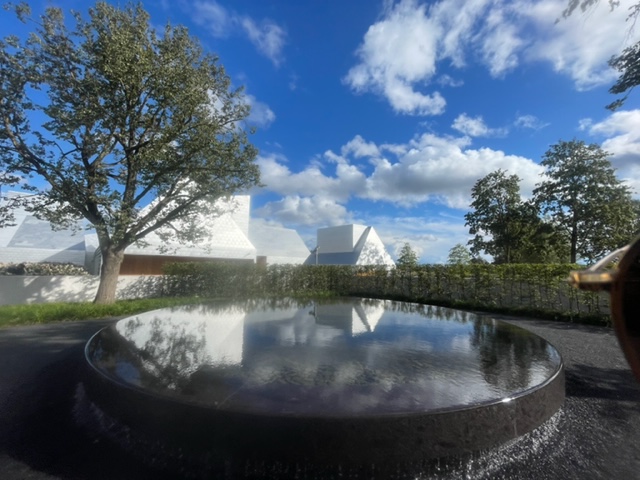
A distinguished part of the museum’s exterior landscape is a beautiful, well set, dignified and meaningful fountain on the way to the main entrance. It projects an essential in Judaism symbolism of a circle, combining it with another equally important symbol and meaning of water. That part and that piece of landscape art has been designed and made exceptionally well.

Water sculpture and mediative fountain in the Memorial Garden of the Lost Shtetl Museum. Photo (C) Michael Leiserowitz. 2025.

Put together in a simple but  elegant way, those two core symbols of Judaism create the picture of continuity, the continuity of life, thoughts and reflections, and  memory. It sets up the tune for visitors both before they are entering the museum and after they are living it, in the right tonality of dignity and reflections on the unique value of human life. It is a worthy and important element of the memorial complex around the special new history museum in Seduva. 

So much needed today at both societal and individual level. Needed for seeing the critically unfair world today through the lenses of humanity. 

 August – September 2025. 

Seduva – Vilnius – Finland

Visions of Re-Created Shtetl: Architectural Aspects of New Museum in Lithuania

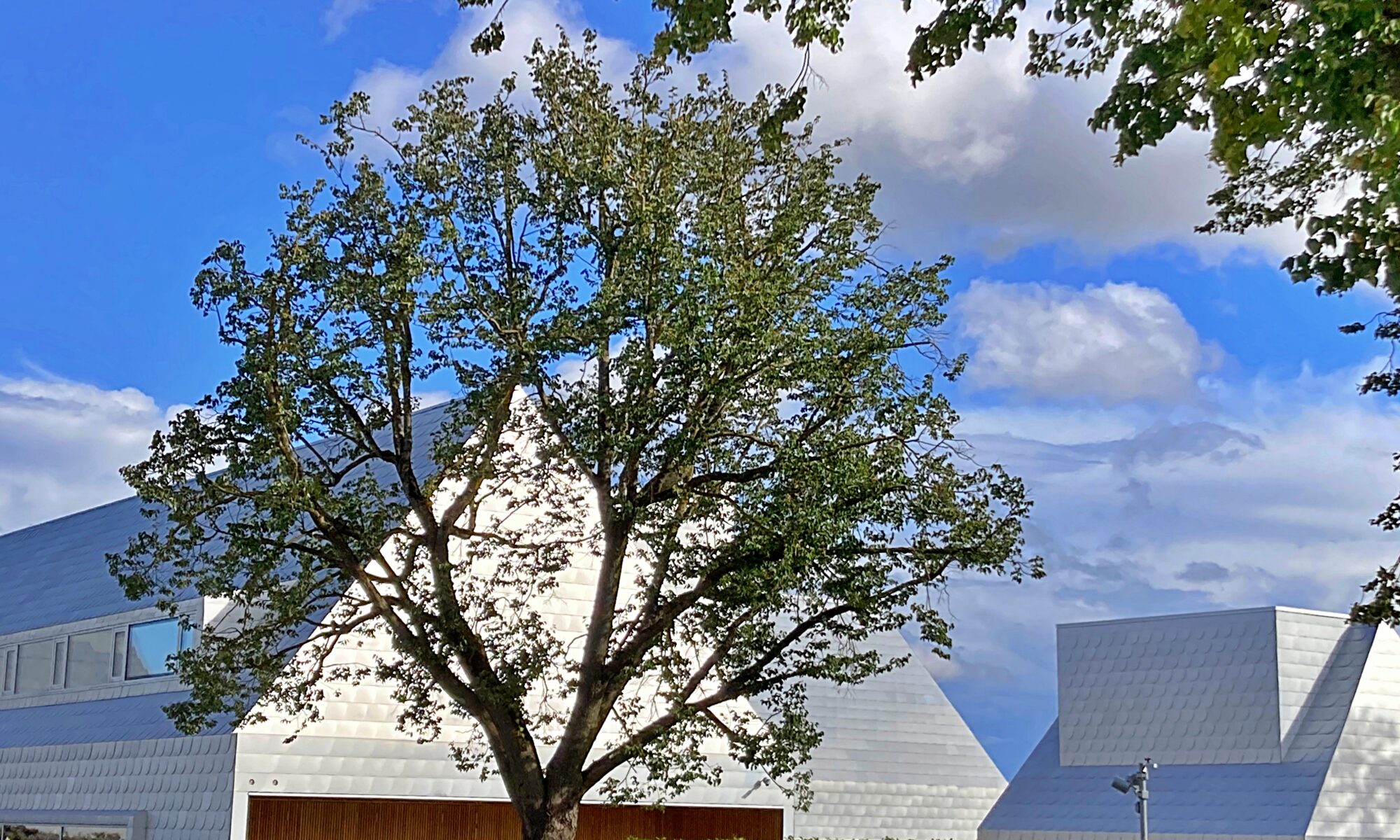
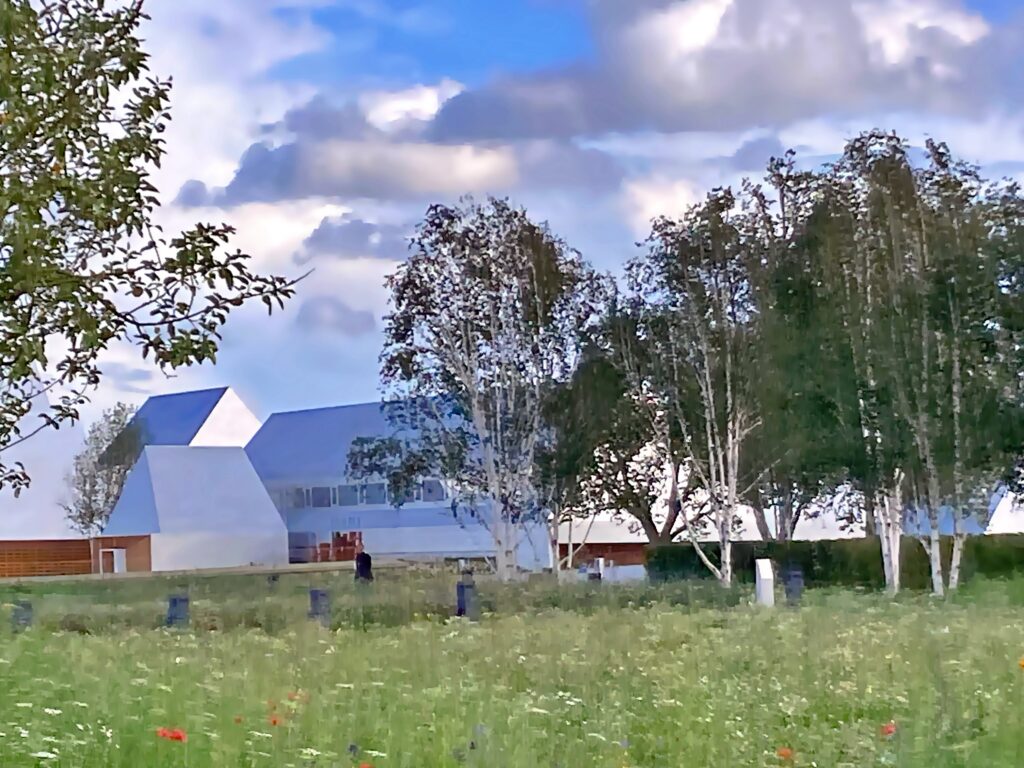
Inna Rogatchi (C). Lost Shtetl Museum. Seduva, Lithuania. Architect: prof. Rainer Mahlamäki. 2025.

By Inna Rogatchi 

August 2025

 Respectful Memory & Decency of Civility: Commemoration in Seduva 

On 25th August 1941 the Jewish life of one of so many shtetl places in Lithuania, in Seduva, was annihilated. About 700 children, women, elderly and men were cruelly and energetically murdered in the nearby forest.

Eighty four years later, to the date, the time of three and half generations, many people from all around the world whose roots are from Lithuania, and even precisely from Seduva, gathered in the place which is more than two hours drive from Vilnius, to commemorate the solemn date, and to see in advance the new memorial museum which will open in September 2025. 

It is a very special project, Lost Shtetl Museum and Memorial complex that includes a lovingly restored cemetery and meditative comforting park around the truly remarkable complex of buildings, with smashing in many senses interior design and permanent exhibition.

When visiting Lithuania among three Baltic states with an official visit in the beginning of August 2025, the President of Israel Isaac Herzog, whose grandmother is from the place, have  spent several hours with his wife Michal at the special mezuzah fixing ceremony of the door of the Lost Shtetl Museum.

The President of Israel Isaac Herzog visiting The Lost Shtetl Museum before its opening. August 2025. (C) The Lost Shtetl Museum. With kind permission.

After a detailed two-hour tour through its premises and the core exhibition, President Herzog called the museum ‘outstanding’. He had a good reason for this praise. 

* * * 

My husband artist Michael Rogatchi  and I were glad to be able to participate in that cordial, touching, warm and dignified commemoration that gathered so many so different people, including the descendants of the Lithuanian Jews from Toronto to New Mexico and from Cape Town to London, Lithuanian top politicians, Members of the European Parliament, Ambassadors and distinguished diplomats, important representatives of the leading international Holocaust and Jewish institutions, such as Yad Vashem and POLIN, historians , leaders of the cultural life in Lithuania, international stars of music in its different genres.

Inna Rogatchi (C). The Lost Shtetl museum. Seduva, Lithuania. Architect: prof. Rainer Mahlamäki. 2025.

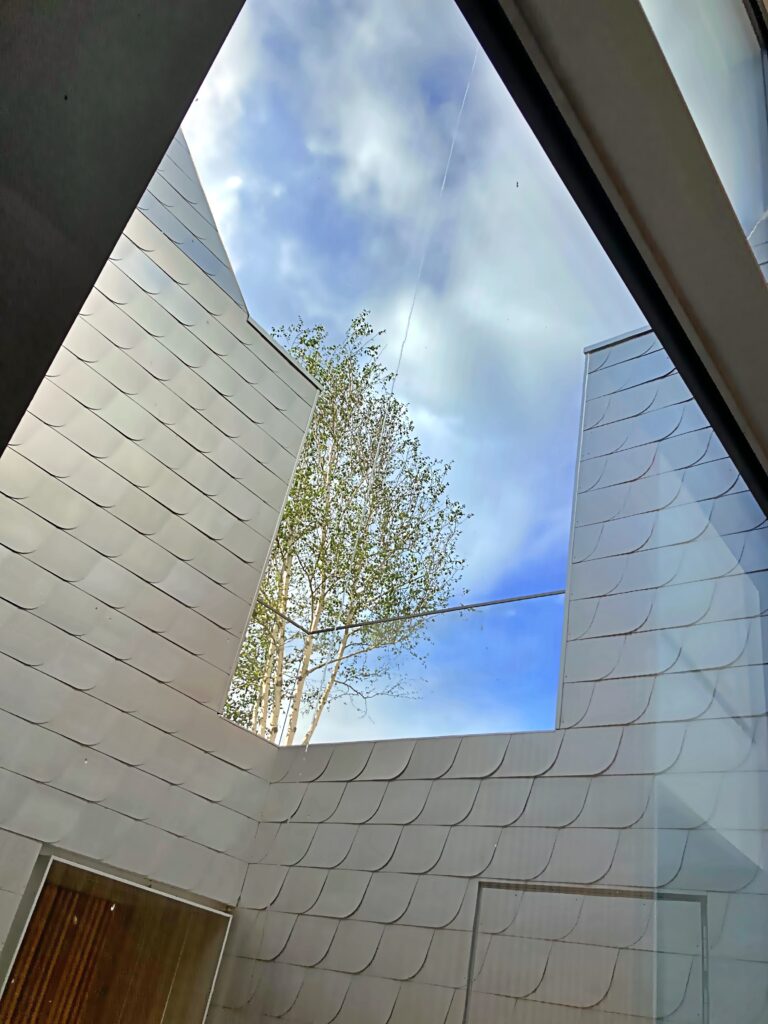
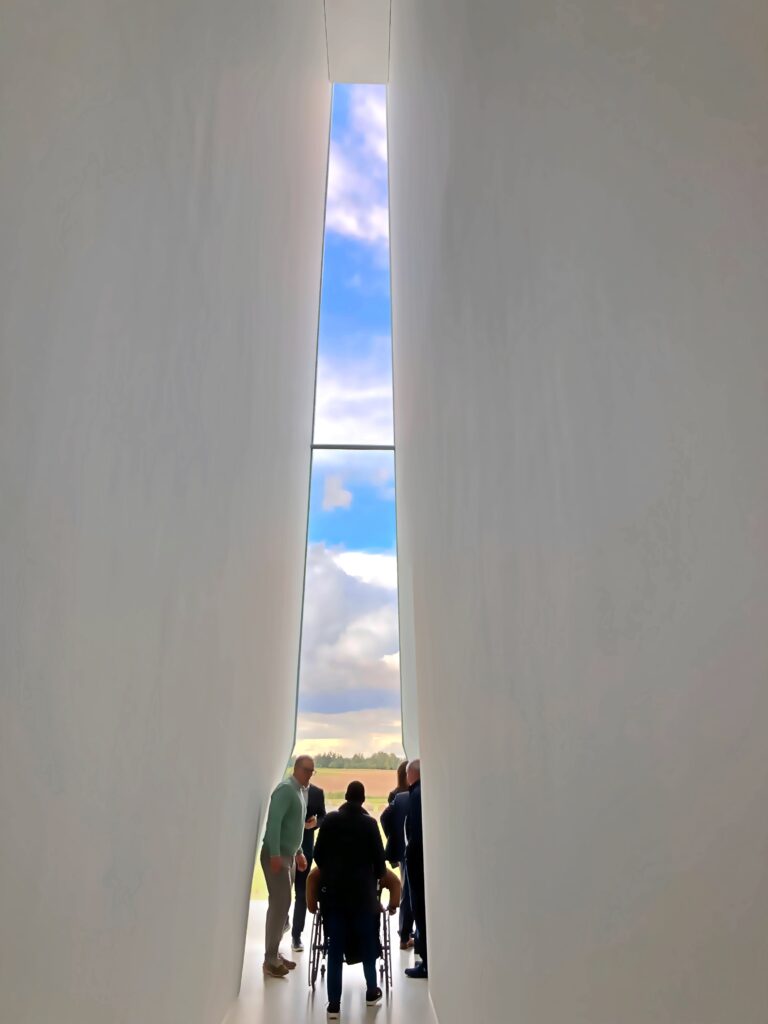
The one thing that has united all those different people from all around the world was interest, with a capital I. Their all and each of them genuine interest towards what we all were seeing around and in front of us: the complex of buildings which makes a special, distinctive statement in its modernity and elegance, the trademarks of our great Finnish architect professor Rainer Mahlamäki who authored the project, cutting-edge interior and permanent exhibition design by world-famous RAA, Ralph Appelbaum Associates company, soothing park around the building produced by also quite well-known in its field ENEA, that truly special completely restored, to be ready in 2013 after a three-years work, Jewish cemetery nearby. All together it works and impresses very different people, and not necessarily with a Jewish background, in a deeply humane way.

In all this, a huge service to the Jewish memory and civilised history has been done, and hopefully, the museum will continue to produce that special atmosphere of quiet compassion and respectful, caring remembrance which actually builds our own, each one’s individually, status of civility and decency.

* * * 

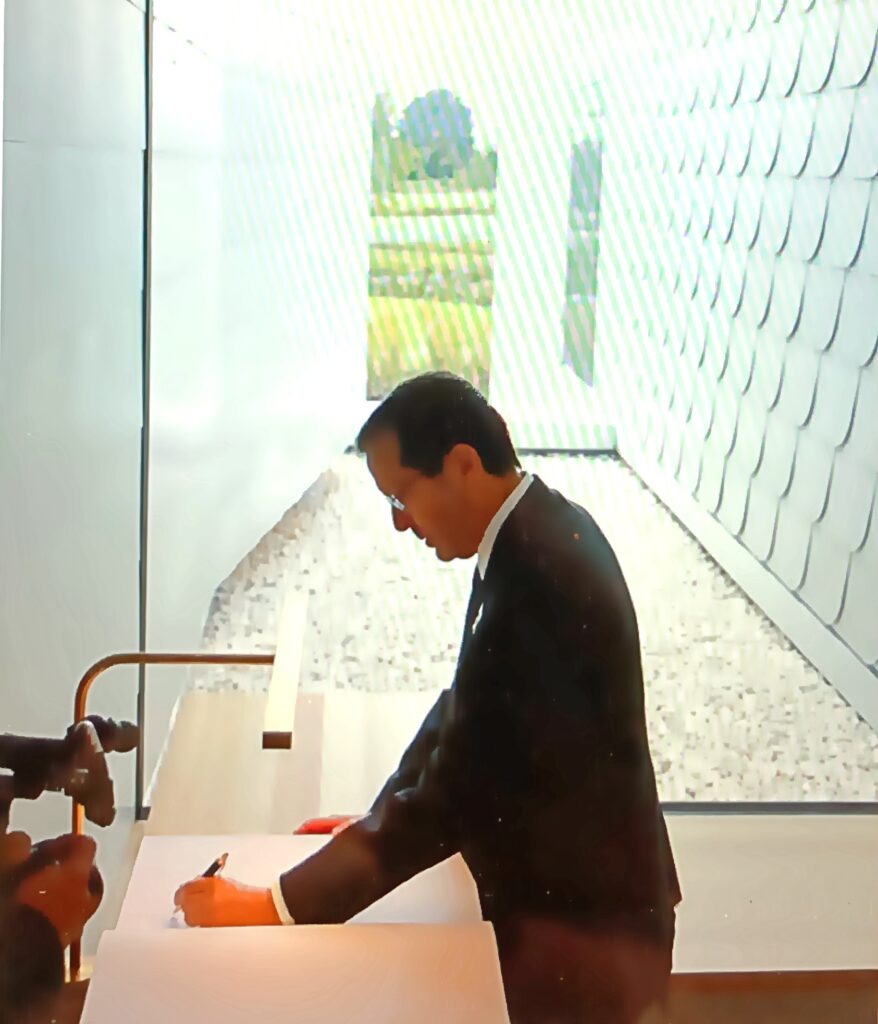
We came to see the fruit of almost 10-years hard work of our dear colleague professor Rainer Mahlamäki and his dedicated, talented and reliable team, our friends and colleagues from very able Lahdelma & Mahlamäki Architects Finland, and their Lithuanian colleagues, and to be with Rainer and his wife Maria at that special commemorative event and on that day.

We both were very glad to see the people’s unanimous fantastic reaction to the complex of buildings, its harmonious architectural decision, its modernity, its articulated messages, its metaphors, and its light which is the main proponent in everything what Rainer creates, even – and even more so – when he deals with the darkest and most difficult historical themes.

 Symbols of the Heart: Modern Architecture of Memory 

There are very rare architects who are able to create a harmonious co-existence of distinctively different domains, such as modernity and sharpness of contemporary architecture from one side, and living nature from the other.

Professor Rainer Mahlamäki is one of those rare architects whose vision have created both beautiful and humane new reality that can be seen in both of his important buildings appeared in a decade between them, POLIN Museum in Warsaw opened its doors in 2014, and recently we all celebrated its 10th anniversary, and new Lost Shtetl Museum in Seduva, Lithuania, will be opened in September this year.

These two photographs of mine, also taken in a decade between them, captured that vision of the architect. The vision that actually creates a new reality, which is and will be imprinted in the perception and  will stay in memory of so many.

Inna Rogatchi (C). Facade of the Lost Shtetl Museum. Seduva, Lithuania. Architect: prof. Rainer Mahlamäki. 2025.
Inna Rogatchi (C). Facade of the POLIN Museum of the History of Polish Jews. Warsaw, Poland. Architect: prof. Rainer Mahlamäki. 2014.

This new reality, which is a harmonious creation, importantly, yet is more and specifically meaningful in the cases of the buildings that houses both incredibly rich but also bottomlessly tragic history, as it is the cases of both POLIN and Lost Shtetl museums.

These beautiful and emblematic trees in the front of the POLIN and Lost Shtetl museum facades indicate life, and strive for life, ongoing living memory, continuity, and the thread of humanity.

 It has created a special, authored by Rainer Mahlamäki spatial reality. It has also created a new space in both places. The space which speaks to one directly. The space of humanity.

Canyon of Hope & Message of Light: Essential Features of the new museum in Lithuania

The Lost Shtetl Museum and Memorial Complex in Seduva  is a purposefully accommodative building, architecturally. It was done by its author, well-known Finnish architect professor Rainer Mahlamäki, with an attentive care, to create, or as Rainer emphasises, “to re-create the life that has been annihilated”.

Coming close to the building which is situated in an open airy place in the Lithuanian country-side, one feels very comfortable, immediately. This is also one of the trade-marks of Rainer Mahlamäki’s architecture, his wish and ability to create not just a place, but the place of comfort, psychologically as well. And one can feel it in practically all Rainer’s buildings. This is a special focus and a special talent, undoubtedly.

But this architect, who is a deep and strong intellectual, is not satisfied with one dimension in his architecture, far from it. Entering the building of the Lost Shtetl Museum, one is getting surprised almost instantly, and then non-stop. 

The main element of this surprise is the building’s openings. Visitors of the museum are facing them in several places, and every time, the effect of opening works with no mistake. 

Inna Rogatchi (C). Opening at the Lost Shtetl Museum building. Seduva, Lithuania. Architect: prof. Rainer Mahlamäki. 2025.

An opening effect in architecture is a tricky thing. If an architect fails in it, it will be counter-productive, and it would be felt as unnecessary, something like a seasonal decoration that has been forgotten to be taken away in time.

But if the opening, especially inside the modern building, is done with vision and masterly, it adds to the building , and to a visitor’s impression of the building in a big way, with a long-lasting reflection. The Lost Shtetl Museum building in this respect is very successful and very special indeed.

There are several openings in the Lost Shtetl museum, not too little and not too much. They are all different. Being an organically talented person, Rainer Mahlamäki possesses a special quality of not repeating himself and the elements of his design. In some of the openings, we are seeing all elements of living nature: skies, trees, plain calm landscape in some instances.

Inna Rogatchi (C). Opening and the terrace at the Lost Shtetl Museum. Seduva, Lithuania. Architect: prof. Rainer Mahlamäki. 2025.

This creates the dialogue between a visitor and the building momentarily, and this instant interconnection sets up a dialogue for a visitor during his elaborate and rather uneasy travelling through quite intense permanent exhibition of the museum that tells about the life which is not ‘simply’ not anymore, but which has been interrupted and destroyed brutally and with unlimited cruelty.

Rainer’s Canyon of Hope in this museum in my opinion should bring him a very substantial international architectural prize, indeed.

I have been following this project since the beginning, for almost a decade by now, and I knew about this unique element of the building design all these years on. But nothing, just nothing can prepare one for experiencing this sensation in reality.

Not only does the Canyon of Hope lead people to the skies after a rather uneasy walk through the museum’s galleries.  It hovers over the meticulously restored Jewish cemetery which is located just nearby the museum’s building. This Canyon of Hope is a grandiose success of Rainer Mahlamäki’s building of the Lost Shtetl Museum, and I am sure that it will become its re-sounding symbol.

Inna Rogatchi (C). Canyon of Hope. Lost Shtetl Museum. Seduva, Lithuania. Architect: prof. Rainer Mahlamäki. 2025.

As if this high-class architectural philosophy created by professor Mahlamäki and implemented so well by his Lahdelma & Mahlamäki Architects Finland and their Lithuanian colleagues would not be enough, the master architect provides a very smart architectural dialogue in the museum’s Canyon space. The opposite of the great Canyon of Hope, there is another canyon and another opening.  I call it Canyon-2.

It is very high and it is designed in the same coloristic key, thus making the dialogue of two canyons organic and natural. But the window of the canyon-2 is a fraction of the size of the Canyon of Hope’s opening, and it is placed incredibly high, in the way that one needs a push of extra attention to notice it. The message that the dialogue between the two canyons creates is gentle and meditative, also due to the spatial but also metaphorical and psychological completeness of the space. 

Inna Rogatchi (C). Canyon -2. Lost Shtetl Museum. Seduva, Lithuania. Architect: prof. Rainer Mahlamäki. 2025.

The space created by those two canyons opposing each other is like a special stratum, the special place to think. And think again. The canyon-2 idea has a connotation with the opening in the powerful Daniel Liebeskind’s Jewish Museum in Berlin. But it is quite different.

In Berlin, the place of the opening is the place of barely controllable horror in a stylised prison cell. One is so impressed there that many people instinctively inclined to forget it, to take it away from their consciousness, because it is objectively very difficult to bear. Not many succeed though, because Liebeskind’s decisions in the Jewish Museum in Berlin are very powerful indeed. 

In the Lost Shtetl Museum, the window opening of the canyon-2 opposing the long vertical opening of the Canyon of Hope, is placed  much higher, curved not directly, but with Mahlamäki’s trade-marked beautiful curves, as he applied in the POLIN building,  thus  making the space immediately comforting, and  inviting mediation.

The space of two canyons in the Lost Shtetl is as if it embraces you, it supports you. This is a rare sensation in modern architecture, doubly so when the subject is the Holocaust.

And there was not a single person among those who visited the museum on the special commemorative event honouring the memory of the victims of Jews of Seduva murdered in August 1941, who would not spend a substantial time in the Canyon of Hope. 

That space works miraculously. It is not about Hope Against Hope. It is about Hope as an element. And this is what life is about.

Inna Rogatchi (C). The Quiet Wind of Memory. Seduva Diary. Watercolour, wax pastel, oil pastel, lapice pastel, pigments, Luminance Caran d’Ache on original authored print on cotton paper. 50 x 40 cm. 2025. The Rogatchi Foundation Appreciation Award to prof. Rainer Mahlamäki and the Lahdelma & Mahlamäki Architects team on the completion of the Lost Shtetl Museum project. 2025.

With cordial Thank You to all and everyone who has made this special and important project of respectful and loving memory, in its almost decade-long journey of creation, happened. It is a meaningful contribution to humanity, and it is highly appreciated.

August 2025

Seduva – Vilnius – Helsinki

Inna Rogatchi Essay on Art and Memory is Commended by the President of Israel

Publication by the Tribune Juive, Paris

Highly popular, widely read and consistently influential Tribune Juive media portal has published the news regarding President of Israel Isaac Herzog’s commendation of Inna Rogatchi’s essay JUNE BIRTHDAYS: Reflections on Love and Humanity.

M.C. Esher is his study.

The full text of the Tribune Juive article can be read here:

https://www.tribunejuive.info/2025/07/31/inna-rogatchis-june-birthdays-reflections-on-love-and-humanity-essay-commended-by-the-president-of-israel/

The photograph of Anne Frank at the M.C. Escher’s study. (C) Inna Rogatchi

The full text of Inna Rogatchi’s June Birthdays essay can be read here:

https://blogs.timesofisrael.com/june-birthdays-reflections-on-love-and-humanity/

Re-Creating the Path of Remembrance

The first exhibition in Lithuania and the world to mark the 100th anniversary of  the legendary institution

The Path of Remembrance is a 6-part series of a reviewing essay of a special commemorative exhibition, and is part of Inna Rogatchi project from her Art & Memory series of international projects.

By Inna Rogatchi ©

Part I. 

The first exhibition to mark the 100th anniversary of YIVO

In the beginning of March 2025, an unusual, special and warm exhibition opened in the heart of Vilnius, at the Vilnius Picture Gallery, part of the Lithuanian National Museum of Art. Titled as You Shall Not Make an Image. Commandments, Daily Life and Change, and occupying two floors of a very well maintained popular museum in the downtown of the Lithuanian capital, the exhibition is significant in several respects. 

By referring  in a multi-sided way  to the story of the legendary historical institution of YIVO, it is the first exhibition in Lithuania and the world to celebrate the 100th anniversary of the institution. With several more exhibitions to commemorate the important date on the way , later this year, in various Jewish cultural institutions of Lithuania, this exhibition is the first one, it is organised by a national cultural institution and is funded by the Lithuanian Ministry for Culture. It would be notable and commendable in any case, but today, in the atmosphere of either negligence or distancing from anything Jewish anywhere world-wide, this gesture is significantly meaningful. 

At the exhibition opening. March 2025. (C) Gintare Grigenaite. LNDM

I first heard about the plans for the YIVO commemorative exhibition two years ago, when discussing a series of block-busting Chagall exhibitions with the Director General of the Lithuanian National Museum of Art Dr Arunas Gelunas. “ And of course, in 2025, we would have the 100th anniversary of YIVO” – Dr Gelunas has mentioned – “ which we would celebrate in the best way possible”. – “ Of course”, I did agree knowing the academic background of the man who leads the Lithuanian National Museum of Art for the second term now, who previously was the Minister of Culture in his country and who represented it as Lithuania’s Ambassador in UNESCO. It was half a year before October 7th. Many things have changed, sometimes drastically, in the activities of so many cultural institutions world-wide. But the commitment of one of the leading cultural institutions of Lithuania and its leaders stayed. 

Now, prior to the exhibition’s opening, Dr Gelunas remembers with a palpable pleasure on how this special project has began: “ Our common friend Jonathan ( Brent, the director of YIVO) during one of his visits here raised the topic of the forthcoming 100th anniversary of our beloved institution, and of course, my initial reaction was “Absolutely. We will do it”.  

Lithuanian art historians are at the exhibition opening. March 2025. (C)Gintare Grigenaite. LDNM

The idea of Dr Gelunas was to create a special exhibition dedicated to YIVO and its story in the year of the institution’s 100th anniversary, and to do it pointedly in the heart of Vilnius, in the beautiful, carefully restored and meticulously maintained central museum of the Vilnius Picture Gallery, which occupies one of the wings of famous 18th century Chodkevicius Palace. To have the exhibition there had the purpose to make it visible, known and visited by as many people as possible, both those who live in Lithuania and  those many who are coming to visit. The centrality of the place and a Jewish-themed exhibition in a non-Jewish cultural institution, well-known and of a national representation, were well-thought  lines of the director Gelunas’ thinking and planning. But not only. 

For years, I dreamed of organising a Jewish-themed exhibition in one, or several of our ( The Lithuanian National Museum of Art) museums. I really did –  Arunas was sharing with me his reflections during our tour of just finishing exposition. – Lithuania of many and many countries does have its richest Jewish history, it has accumulated so much knowledge, culture, heritage and legacy of Jewish life, its art, its science, its literature. It all was developing here in the thriving and versified way for centuries. We are proud of it and are grateful for that. Jewish cultural heritage is an organic part of the Lithuanian national heritage, absolutely so, this is the fact of life, science and history. And it is the richness of our cultural heritage. So to celebrate it, in the year of the 100th anniversary of such a unique institution as YIVO, it has to be in Lithuania, it has to be in Vilnius, and it has to be in the national museum, right in the heart of Vilnius. There is a real pleasure for me and our team to do it, and it was a pleasure to work on it” – said the director of the Lithuanian National Museum of Art Dr Arunas Gelunas. 

Dr Arunas Gelunas, Director-General of the Lithuanian National Museum of Art with Gabija Kasparaviciute-Kaminskiene, curator of the exhibition. March 2025. (C) Inna Rogatchi.

As soon as a curatorial team was formed to start to work on this special project, the destination of them was New York, where YIVO institute works for 85 years by now, in one of the most dramatic stories of culture and memory of our times. 

Re-Creating with Love: Curatorial Approach

For two of three curators of the exhibition, the Vilnius Picture Gallery director Aiste Bimbiryte and  curator Gabija Kasparaviciute-Kaminskiene, it was the first professional encounter with the theme of Jewish heritage. The third curator, to whom they referred as ‘the box of knowledge’ is a well-known in Lithuania expert in the field , professor of the University of Vilnius Jurgite Verbikiene. 

When I learned that two of three curators of the exhibition presenting the Jewish heritage in Lithuania via the lens of the history of YIVO Institute had no previous experience with the theme, I asked both Aiste and Gabija what were their starting point for this demanding, multi-directional serious project that took a year of intense work.

 When I started to think about this exhibition, initially I had an impression that there are many taboos in Jewish culture. The taboos which could institute a sort of a barrier which for people who are not experts in arts and culture would be difficult to overcome. But I was wrong. When I started to examine, to research and to learn, and to work with specialists, I realised that this is not the case altogether, and never was. As soon as that first and only hurdle for me personally was overcomed, the work on this international exhibition was a sheer pleasure, and the source of a massive learning, for which I am very grateful” – said director of the Vilnius Picture Gallery Aiste Bimbiryte, herself is an University teacher who specialises on the history of fashion. 

Director of the Vilnius Picture Gallery Aiste Bimbiryte and curator Gabija Kasparaviciute-Kaminskiene at the exhibition opening. March 2025. (C) Gintare Grigenaite. LDNM

For me, it was the pleasure of discovery – said Gabija Kasparaviciute-Kaminskiene, who is studying for her BA, specialising on a women artists of the 18th and 19th century , – and  as for an art historian, it was very interesting for me to look into the roots of the Jewish art, in many of its original sources, including books and manuscripts.  It also was important to work on a public project. Our exhibition presents things which are known to the specialists in Jewish heritage, of course, but we were trying to find special and importantly, authentic objects which would be attractive for the general public. Another curatorially interesting aspect during the last year of the work was discovery and presentation of those Jewish symbols which have different meaning from what is generally believed about it, which was a very happy, meaningful and engaging re-discovery”. 

Both Aiste and Gabija spent a week in New York in 2024, working intensely with their colleagues at YIVO going through the institute’s incredible archive, its collections and materials in order to distill the choice of the documents, original artworks and artefacts to be present at the exhibition in Vilnius. Importantly, most of the forty objects from YIVO presented in Vilnius are originals, with several copies among them. The materials from New York are quite substantial, it is over 20% of the entire large exhibition with its over 180 very different objects to be seen, from the rare books and manuscripts to Chagall’s hand-written  correspondence, and from a very rare and simply brilliant wooden carved sculpture of the 18th century to vivid and special original of Emanuel Mane-Katz painting of a happy Rabbi in a yellow robe. 

Thoughtful cooperation

The large exhibition is the fruit of an elaborate and thoughtful cooperation of not less than 20 major  cultural institutions, including YIVO in New York and the Chagall Committee in France, with which the Lithuanian National Museum of Art has forged of an extremely productive cooperation materialised in two major and unique exhibitions in 2023 and 2024, and who did contribute in providing the possibility to exhibit some parts of Chagall’s correspondence with YIVO, with some had-written letters and cards, which is a special magnet, to me. 

Marc Chagall correspondence with YIVO exhibited in Vilnius. (C) Gintare Grigenaite. LDNM

Among the other partners are National Library of Lithuania with its incredible Department of Judaica and generally, one of the richest European cultural institutions, Lithuanian State National Archive, fine National MK Ciurlionis Art Museum, Lithuanian National Museum, important Library of the University of Vilnius, Vilna Gaon Museum, and several regional museums, many of which have truly special objects. Among those museums Pakruojis, Ziezmariai, Birzai, Alkam, Samogitian and Trakai museums, as well as Panevezys Diocese and Church Heritage museum of Lithuania.  Two leading private art collections in Lithuania, TARTLE Art Foundation and the Dr Jaunius Gumbis Collection of Lithuanian Art contributed very good original artworks for the exhibition, too. As everyone in the artfield of knows, to coordinate the effort between just a few institutions is a serious undertaking that requires a lot of time and effort. To run the exhibition with twenty partners, some of them major international cultural institutions, is truly a very demanding effort which in this case went on  smoothly and productively, for which the organisers are truly grateful. And so do we, all those who are coming to this unusual exhibition to find so many gems in a wide variety of genres,  and from a hugely expanded period, starting from the 15th century onward. 

Implementation: Loving Care

For those visitors who are familiar with many exhibitions of the various institutions of the Lithuanian National Museum of Art, with its eleven museums under the roof of the national cultural institution, the quality of presentation during the last several years is taken for granted. Having a privilege to be able to compare the way of exhibiting taken as a standard in the museums of the Lithuanian National Museum of Art with many other museums, both inside and outside Lithuania, I can happily mention that the level of presentation there is of a top world class. This is absolutely important, demonstrating not only the level of professionalism but also the level of respect towards museum visitors. It has always been like that, starting from the Louvre. 

The location and history of a museum as such do not necessarily guarantee the quality of presentation in a museum, as we all know well. The outrageous history of a virtual hijacking of the unique Vasari Corridor in Florence after the Uffici had become a target of a brutal mob terror attack in 1994, which had continued until very recently, is probably the most dramatic but just one of many sadly existing samples of neglecting the fundamental rules of exhibiting in too many museums world-wide today, due to a various reasons, from poorly educated staff to wrongly understood concepts. Or just simply due to not caring much. 

This is fortunately not the case for any exhibition organised in any museum of the Lithuanian National Museum of Art, where the level and detail of presentation is classically high. Dr Arunas Gelunas, the Director General of the museum, did set it as a standard, with the team, of which  many people were  hired anew, after Dr Gelunas started to lead the national museum of art back in 2019. 

“ When we started ( back in 2019), I was especially concerned by the technical conditions and presentation practices in our museums, but  in this one, in the Vilnius Picture Gallery, the old and famous palace which is located in the heart of the capital, I knew that before anything else, and in parallel with hiring the new team to run the museum, we needed to re-equip it. We did it by changing practically everything, from exhibition boxes, stands and vitrines to the top-end professional museum light system, which is a half of the success in every museum today. It was elaborate, time and resources consuming effort, but  we knew that before any new program should start, the museum should be re-made to be at the top international presentation level.  In parallel, we were hiring a new team, and when these both must-stages of our renewed Vilnius Picture Gallery museum were accomplished, we were able to take a deep breath of satisfaction, and to start to build on and develop our programs and exhibitions there, in this great premises in a star location in Vilnius. So, we are doubly glad to host our exhibition which tells about the unique history and way of YIVO from Vilnius a hundred years ago to New York eighty years ago , with happiness of rediscovery of many incredible things 35 years ago and joint work on it, with return to Vilnius from New York for this exhibition, first to mark the noble 100th anniversary of YIVO, these days. It has been quite a journey” – summarised Dr Gelunas.   And it was, indeed. 

Vilnius Picture Gallery, part of the Lithuanian National Museum of Art. (C) Gintare Grigenaite. LDNM

Both, the architect of the YIVO commemorating exhibition Auste Kuliesiute-Semete and the exhibition’s designer Migle Datkunaite were also supposedly thinking of incorporating this idea of a way, the route of memory, the path of remembrance into their very thorough and masterly concept of the exhibition. In the case of this show, it was both the abundance of the material and artifacts from one side, and the objective to produce a laconic in outline and modern in style exhibition, from another.  Those factors posed a certain challenge for the  architect and designer. Both Auste Kuliesiute-Semete and Migle Datkunaite are recognised professionals in their field, and both are working with the Lithuanian National Museum of Art of many if its dizzying number of exhibitions, from 50 to 70 annually. 

Architectural concept of this exhibition indeed resembles a path. In a visually organic way, it is lays down  a zigzag of the YIVO story and the Jewish life in Lithuania and its forced relocation beyond the ocean, escaping the war and the Holocaust. The design of the exhibition is both somber and sophisticated, with much attention paid by the designer Migle Datkunaite to every detail, from the colours and its shades in every of many rooms on two floors of the museum, to the charming and pointed details, such as six dots on every annotation card throughout the exhibition, both large and smaller ones. 

Those dots in the Migle Datkunaite personal design symbolises the six days of creation in the basic concept of Judaism. And it also, very personally and charmingly, refers to a milestone book by the founder of YIVO, great Yiddish linguist Max Weinreich, Di shvartse pintelekh, The Little Black Dots ( 1939), that has set the standard for written Yiddish for the masses, and has become the first YIVO published book in the institute’s Popular series. 

The tragedy speaks volumes here, as very soon, in two years, there will be no masses to learn classical Yiddish, in Lithuania for sure, and then, the YIVO so well-meant Popular series would stop for a very long and completely tragic time, as the date of the publication of their first book in it coincided with the beginning of the Second World War. 

So there were no takers any longer for the YIVO Popular series, for the reason of genocide unleashed all over Europe against the Jews. And the YIVO itself as an educational centre and institution had to move the far, the better running for its life. The destination was New York. 

About the gems and highlights of the first in Lithuania and the world the YIVO 100th anniversary commemorative exhibition in Vilnius is told in the Part II of the essay. 

March 2025, Vilnius

IR ©. 

You Shall Not Make an Image. Commandments, Daily Life and Change exhibition at the Vilnius Picture Gallery, Vilnius, Lithuania. March 5 – September 14, 2025.

The Lock of Love: From Chagall to Rembrandt and Back

Rembrandt Influence in Chagall Art

Essay 

Inna Rogatchi (C). The Lock of Love collage. Chagall Heritage Today project 2025.

Inna Rogatchi (C). The Lock of Love. Chagall Heritage Today project. (C). 2024-2025.

There is an interesting and telling gesture and declaration of love and admiration, and the conscious sign of choosing his artistic path being led by the highest possible professional standard, the one by Rembrandt, by 27-year Marc Chagall in one of his most vivid portraits created in 1914.

1914 is one of the most decisive years for Chagall, reflecting the world which never was the same after the Great War started in that year. By then, Chagall had been in Paris for three years already. And being in Paris for young enough Chagall, who was 24 on his arrival there, meant to be in Louvre where his soul was developing and blossoming, absorbing the wealth of the world and civilization art in a dizzy indulgence.

Rembrandt was the world, the cosmos and everything for Chagall from the moment he saw the works of that titan, the titan of art of all times. Rembrandt has become a starting point, metaphorically, for Marc Chagall in his vision of art, and having such a solid ground in very visioning of art in general, the level of Chagall’s own art always was steady, and it was always high. The top. Never faltering, under any circumstances, till the very end of his very long, almost a century-long life. This is not the case for many other artists.

With all his ostensibly easiness of subject-matters and related images, which led to some existing , grossly wrong attributions of the Chagall’s art to the school of naive art, he is a superb master of a highest order and craft who was always led , consciously and by his own choice of a top demand and strive, by the utmost best ones, Rembrandt in the visual art, and Mozart and Bach in music.

When you see the world and your profession through the prism of a highest demand, your own effort brings the corresponding result. That young Chagall realized early on. Three years in Paris , this was largely in Louvre, in his mid-20s, amid fierce work brought the result, with his first gallery contract in Paris, and yet more importantly, especially for him feeling lonely and under-appreciated, with his first solo exhibition in Berlin. Chagall was ecstatic about that first personal exhibition and not anywhere but Berlin, thriving, magnetic and bubbling with a non-stop public appetite for art.

Rembrandt’s effect on Marc Chagall was giant, and because of its depth and continuation, Chagall evolved into painting a huge number of self-portraits, following the pattern set by Rembrandt, the most prolific author of his time. The number of confirmed self-portraits by Rembrandt in all techniques, oil, drawing and etching comes to one hundred. The number of Chagall’s self-portraits is several time more, but the pattern of a perpetual artistic self- search and self-expression via the most familiar to an artist subject, himself, was set for Marc Chagall by his deep admiration, and more, his detailed understanding of Rembrandt, and his certain partial self-identification with the great master, his principal teacher, as goes.

In 1914, 27-year Chagall paints his charming, vivid, expressive and quite masterly Self-Portrait in Front of the House in unusual for his self-portraits official attire, but with a joking and pointing color of the artist’s trousers, that bright and outpouring blue which he adopted as his color for life. His jacket is rich brown, with enlightened spots so familiar to many of us from another master, the one of the 17th century, whose brown has imprinted in our collective retina the same deep, as Chagall’s blue did.

Rembrandt van Rijn (C). Self-Portrait with a Gorget. Oil on oak panel. 38,2 x 31 cm. 1629. Germanisches Nationalmuseum. Nuremberg. Germany. Rembrandt Project – with kind permission.

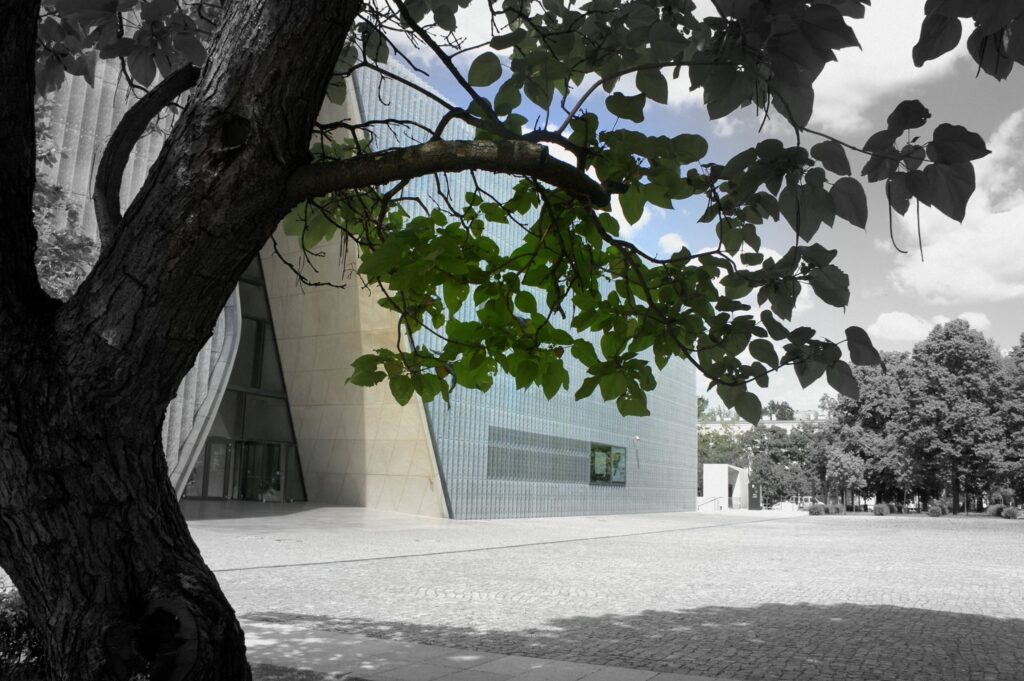
It is not without reason that Chagall believed that ‘blue for me is the same that brown for Rembrandt’, and in the making his jacket not just brown, but decisively and declaratively Rembrandt-like brown, Chagall who, with his first gallery contract signed in Paris and his first big and serious solo exhibition in Berlin, had been just accepted in the club of artist-masters, as he understood it, with a proper reasoning, was referring in his charming and special self-portrait to his teachers of teachers, who lived and worked three hundreds years before him. And not only the jacket.

Marc Chagall (C). Self-Portrait in Front of the House. Oil on cardboard mounted on canvas. 50,7×38 cm. 1914. Private collection (C) ADAGP, Paris. With kind permission.

In the Chagall’s self-portrait in question, we see his left-side lock as a longer one. What does it tell us? It does tell those who know Rembrandt well enough, to remember about his asymmetrical left lock in his second oil-painted self-portrait of 1629 known as Self-Portrait with Gorget, or Self-Portrait With Breastplate.

Lovelock as that asymmetrical lock of hair was known from the 16th century, came from France, and was highly popular there. Not so was the case in the Netherlands of the 17th century, it was a sign of teasing and demonstration of emphasized, publicly demonstrated independence by some young men there. A bit of an intentional over-doing. And young Rembrandt who was 23 at the time of painting his second oil self-portrait, took care to show his lovelock the same expressively as his famous breastplate, the gorget. Or actually he made it famous by portraying it on a small oak panel.

Two hundred and eighty five years later, 27-young Marc Chagall in the year of his first serious exhibition in one of the thriving world’s capital, painted on cardboard his homage to his guiding star , of a size which is a bit larger than the Rembrandt’s self-portrait painted by him at 23 almost three hundred years earlier.

It is quite an artistic dialogue, to me. Powerful, engaged, masterly, and , most importantly, full of subdued love, as it is prescribed by good manners and right tone. Twenty-three years old Rembrandt’s self-portraying on the oak panel is fully self-reflective , as are all his self-portraits. Twenty-seven years old Chagall’s self-portrait is joyful and joyfully ceremonial. In 1629, in Leiden, young Rembrandt was discovered by his most important patron Huygens, and started to get commissions from the Dutch state and the country’s ruler. In 1914, young Chagall got his first gallery contract and his first important exhibition. He saw many reasons to create this rembrandt-ish brown with a bit of chagall-ish blue self-portrait, finishing it with that left-side asymmetrical lovelock. In his case, and now in the history of art, it was his lovelock for Rembrandt which accompanied Marc Chagall all his extremely fruitful and productive artistic life”.

Inna Rogatchi (C). Chagall Heritage Today series of essays. (C). 2024-2025.Publication: The Times of Israel -January 2025 https://blogs.timesofisrael.com/the-lock-of-love-from-chagall-to-rembrandt-and-back/

Dear World: I don’t care – 2.11.2023

By Avi Lewis (C)

Avi Lewis. (C) Avi Lewis, with kind permission.

The War & Humanity project Introduction:

This is what we would call ‘a writing on the wall’. On our Jewish wall world-wide. Avi Lewis, software engineer working for Meta and well-known videographer from Israel, succeeded in a perfect formulating what all of us, Diaspora Jewry, is feeling today. Slightly ironically, it comes from the person who lives with his family in Israel and who is currently on his IDF reserve duty. Avi’s monologue has become an instant classic because of a simple reason: it tells in a clear way what we all are feeling today.

Avi was born and raised up in Australia and his family is friendly with members of our family in Melbourne. Avi made aliyah, carried on his service at the IDF, worked as a news writer for The Times of Israel, and now works for Meta.

Avi has told us that he is currently on duty at the IDF reserve – and his observations from there is also one of the most inspired one can read these days.

Avi and his wife have three children and they are living in Modin.

We are proud to present Avi’s manifesto on behalf of million of Jewish people worldwide in our War & Humanity project, and thank him lovingly for his vision and clarity.

DEAR WORLD: I DON’T CARE

By Avi Lewis (C)

I don’t care that you sympathize with Hamas

I know you wouldn’t tolerate any of the things they did to us if they would’ve done it to you

I don’t care that you’re outraged by Israel’s response to the massacre more than the massacre itself

I know you would do everything to eliminate such pure evil if you experienced it yourself

I don’t care that this doesn’t fit neatly into your carefully constructed narrative of ‘Israel as aggressor’ and ‘Palestinian as victim’

The truth hurts sometimes, but hey, don’t let facts get in the way of your feelings

I don’t care if you think we are at fault, that we had it coming, that Hamas’ actions’ didn’t occur in a vacuum (or to deny they ever happened)

If you feel that the poster of a kidnapped child hurts your cause, maybe yours is a lost cause

I don’t care about your calls for a premature ceasefire, about your demand that we provide them with electricity, that we stop fighting for ‘humanitarian reasons’

What of a humanitarian gesture to release our 230+ hostages – elderly, children, babies – snatched from their cribs?

I don’t care that you’ve rallied for Palestine as part of your march for LGBTQ rights, trans rights, workers rights, socialism, climate change, intersectionality, Black Lives Matter, fighting Islamaphobia and ‘all forms of racism’

Your gullibility would be laughable if it wasn’t so hypocritical. None of those things exist under Hamas

I don’t care that you ‘love Jewish people – just hate Israel’, that you have some friends that are Jewish, that maybe you’re ethnically Jewish yourself – and therefore you’re entitled to levy every libel in the playbook against us

Words matter. They lead to actions. When a lie is repeated often enough it’s accepted as truth. You are laying the groundwork for more attacks against us

I don’t care that you wave the flag of ‘human rights’, that you’ve become overnight experts in international law, that you shout fancy slogans you don’t understand such as proportionality, occupation and apartheid

Your humanity is selective. In your mind, human rights don’t apply to us because we are undeserving. You didn’t speak up when our women and children were horribly assaulted

I don’t care if you think we are colonialists, imperialists and settlers and that we should just go back to where we came from

We are back to where we came from

I don’t care if you believe in a one state solution, a two state solution, a federation, an internationalized Jerusalem or any other theory drawn up in your ivory tower

We won’t readily hold out our necks and endanger our lives in order to satisfy your thought experiments and placate your conscience from afar

I don’t care if you consider yourself anti-Zionist but not antisemitic

We’ve seen enough Jews around the world attacked over the last 3 weeks under the guise of ‘anti-Zionism’

I don’t care that you think we are too powerful, too technologically advanced, too sophisticated

If we didn’t build ourselves up to this point we’d get eaten alive by Hezbollah, Islamic Jihad, Iran and Palestinian terrorism

I don’t care that you blame us for 1948 refugees, for the fact that they have no state, for the keys that they wave in their fantasy of ‘right of return’

Three weeks ago we got a glimpse of what that ‘return’ looks like and what it means for our children

I don’t care if you think we aren’t real Jews, that Zionism has nothing to do with Judaism, that Jews are a religion and not a nationality and so we deserve no state

Your denials have zero impact on the strength of our ideals and the self-affirmation of our identity

I don’t care that you accuse us of flaunting the myriad of UN resolutions, inquiries and statements

They reflect more on the institutional decay of the UN than on us

I don’t care about your media coverage, the lies, the equivocation, the acceptance of Hamas talking points and statistics

You echo chamber is just a another weapon in their strategic arsenal

I don’t care that you accused us of bombing the Al Ahli hospital

It was only a matter of time before you found a symbol for Israel’s wickedness. The subsequent retractions were a fig leaf once the truth emerged that Islamic Jihad was responsible and that the hospital is still standing

I don’t care that you see us as a criminal state, a terror state, usurpers, baby killers, Christ killers, Khaybar Jews or any other depravity that exists in your mind

Your libels lay the groundwork for our dehumanization. Rings a bell. We will fight it

I don’t care that you’ve inverted the truth by accusing us of genocide

If positions were reversed and Hamas held the power we do now, you’d see what a genocide looks like

I don’t care that you’re angry, boiling and outraged

I don’t care that you’re glued to your TV screens and Telegram channels

I don’t care that you’re mad

I don’t care if you’re out on the street, waving your flag and chanting your slogans

We won’t die silently the way you want us to

For the first time in 2,000 years we are organized, we are motivated and we will defend ourselves

We fight for light over darkness

Morality over evil

Not that it matters to you – but we will stick to the rules and hold the high moral ground not because you expect it from us, but because they are a value for us

We will do so ethically and thoughtfully, for we are the People of the Book

Our power and strength are our necessity, because the alternative for us is:

Be’eri, Kfar Aza, Pittsburgh, Toulouse, Farhud, Hebron, Birkenau, Belzec, Babi Yar, Kristalnacht, Kielce and Kishinev

Do you think for a moment that we would return to that reality just to make you feel a little better?

You are deeply mistaken…

World,

For so, so long, I really, deeply cared

I cared about fitting in

I cared about what you think

I cared about being a model citizen

I cared about setting a personal example of how a tiny people in a tough neighborhood could still be a Light unto the Nations

How the world’s oldest minority – now a majority here – could treat its own internal minorities par excellence amidst the complicated and messy reality of ethnic conflict

How we could painfully dismember parts of our homeland and offer them on the platter of peace to Palestinians that want neither peace nor some parts (they want all of it)

How we could dazzle you with USB sticks, drip irrigation, operating system kernels, Nobel Prize winners, swallowable medical cameras, deep tech, quantum mechanics, generative AI and cures for disease

But now I’m finally accepting that you don’t care

You never did

You don’t see and you don’t hear

And because I cared about what you think so much, that so deeply hurts

But you don’t have my best interests at heart

You take issue with my base identity, with what I represent

Don’t expect me to wait for your approval this time

It doesn’t matter what I do, you’re not going to change

It doesn’t matter how I act, because your issue is with who I am

Now I’m going to block out your noise, and do what it takes to win this war

Today
Finally
I no longer care

Published for the first time at the Times of Israel on October 30, 2023.